
A government does not need to know the temperature in 2100 before deciding whether people should lose their wages when it becomes unsafe to work. It does need evidence about the conditions of work, the cost of protection and who can enforce the rules. Confusing those two requirements allows uncertainty about the distant future to postpone decisions whose consequences are already close at hand.
Research published this week brings that distinction into focus. Ghana’s projected loss of working time makes heat a question of employment and income. Interviews in Brazil’s irrigated grape-growing region show how successful protection against drought can change which weather producers fear. Two climate-model studies, meanwhile, find different kinds of long-term behaviour: additional warming after emissions cease at higher temperatures, and atmospheric processes that restrain parts of Antarctic ice loss. These findings complicate simple accounts of what follows from a warmer world. They do not make every practical response equally uncertain.
Financial institutions face the same difficulty. A new commentary challenges assessments that give prominence to a central estimate while leaving disruptive possibilities at the margins. A forecast can become a reason to delay investment when its users demand a precision the evidence cannot provide. The better question is which decisions can be revised, and which make later correction prohibitively expensive.
Heat, health and livelihoods
A lost working hour is also a lost income
Ghana
International Labour Organization · Country study
29 October 2026
The International Labour Organization released its Ghana heat-stress study on 29 October. Under its low-emissions scenario, lost working time in 2040 amounts to approximately 550,000 full-time-equivalent jobs. This is a conversion of hours into an annual employment equivalent, not a forecast that 550,000 people will be dismissed. The analysis combines climate projections and a heat-related work-loss function; its reference period is 1985–2014. Agriculture accounts for the largest projected loss. [1]
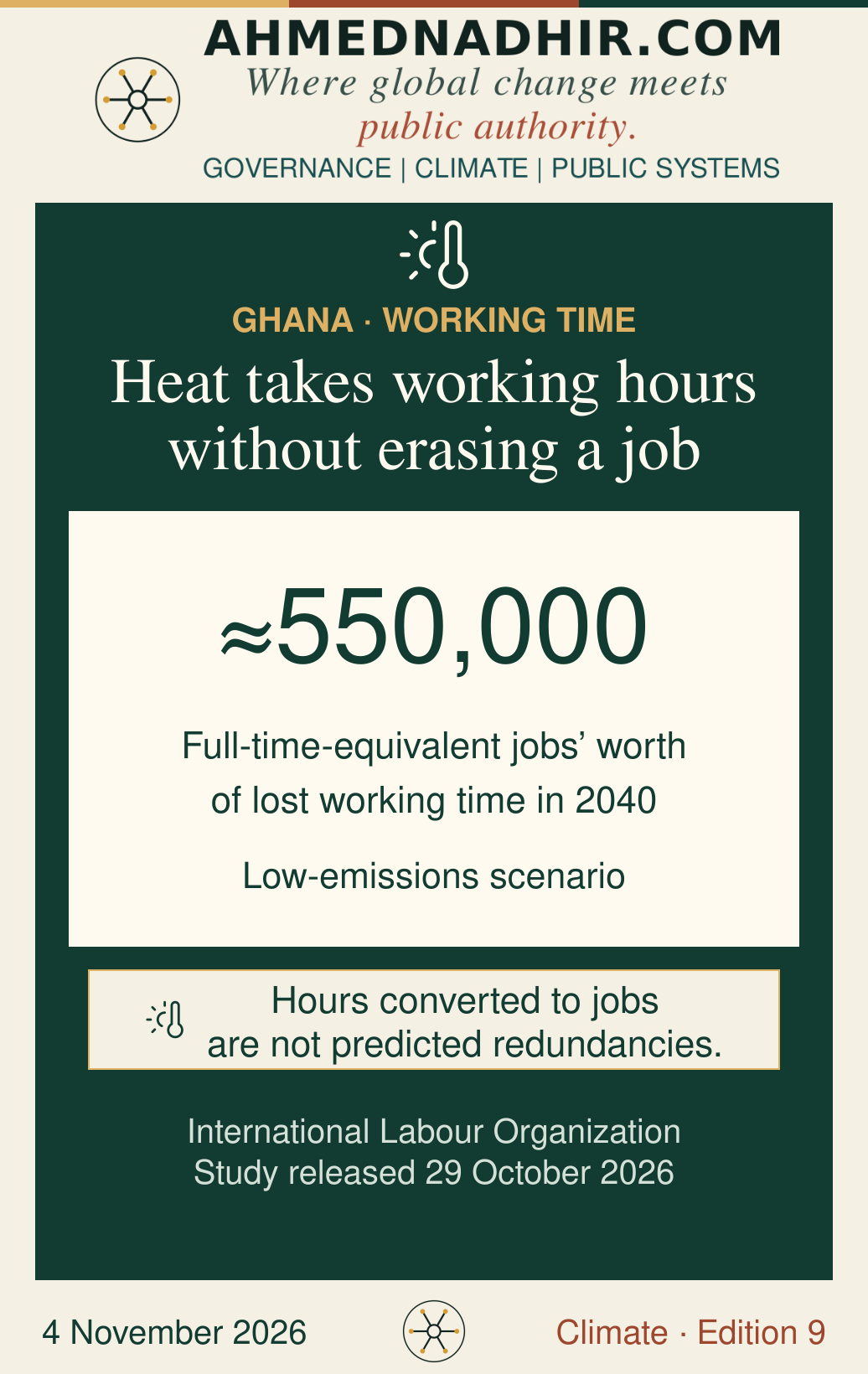
That distinction changes the response under discussion. A reduction in hours can be spread across many people who remain employed. It may appear as fewer tasks completed, lower output or earnings forgone. A policy concerned only with the unemployment count could therefore miss a substantial deterioration in livelihoods. Heat also changes the terms on which work is done: the same physical task can require longer recovery and become harder to complete safely within the available day.
Employers have reasons to improve shade, water access and work schedules, particularly where fatigue disrupts output. Those incentives need examination alongside payment arrangements. For someone paid by the task, resting can mean earning less. A formal permission to stop work offers limited protection if the worker must choose between using it and buying food. Buyers further along a supply chain also influence the available room for change through delivery deadlines and prices. Responsibility extends beyond the immediate workplace.
The study does not calculate how much one particular domestic adaptation programme would save. It uses one climate model, aggregated exposure and assumptions about work that cannot describe every locality. Adaptation is not modelled. Its scenario comparisons should consequently not be sold as a demonstrated return on a specific cooling investment. Those limitations leave a useful decision: testing protection against measured workplace conditions and actual earnings, rather than treating a national projection as a precise instruction for every employer.
Public spending also has more than one claim upon it. Retrofitting a large workplace may protect many employees; reaching dispersed farms and informal enterprises can require a different delivery arrangement. Labour institutions, employers and workers would have to negotiate that choice. The Ghanaian estimate supplies no Kenyan employment forecast. Its wider relevance is the distinction between preserving a job on paper and preserving the safe, paid working time through which that job supports a household.
Water, agriculture and production
The vineyard that fears the rain
São Francisco River Valley, Brazil
Lovato and colleagues · Climatic Change
30 October 2026
A study published on 30 October examines grape growers in Brazil’s São Francisco River Valley. Using participatory appraisal and in-depth interviews, contextualised with precipitation and river-flow information, Luiz Gustavo Lovato and colleagues investigate how producers understand extreme weather. Growers within public irrigation projects identified intense rainfall during expected wet periods as more damaging to production than extreme dryness. Reservoir releases and irrigation arrangements had buffered their local water supply during regional drought. These are situated accounts of experience, rather than a representative estimate of every farmer’s risk. [2]
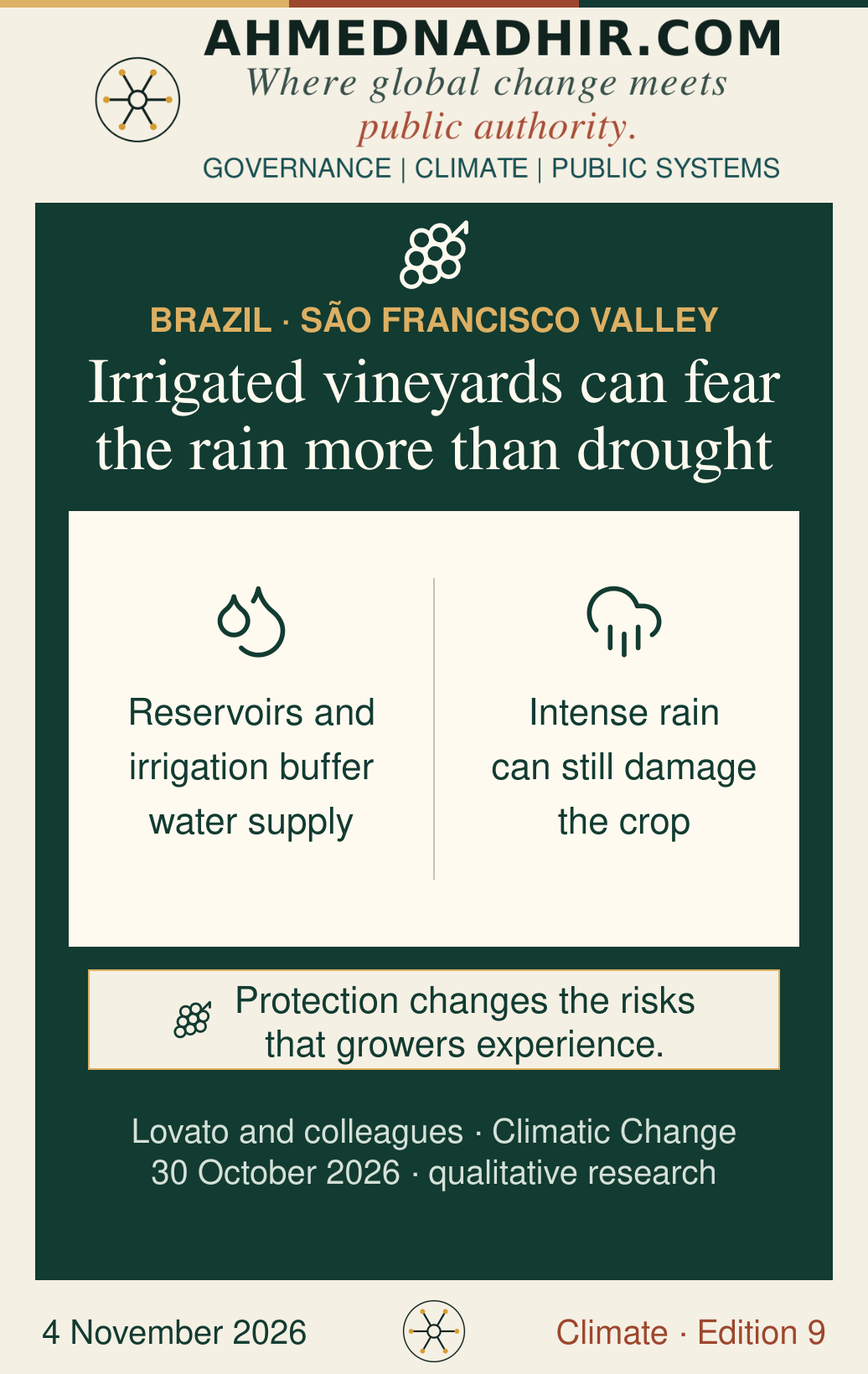
For an outside observer, the setting invites an obvious description: semi-arid agriculture threatened by drought. For a producer with dependable irrigation, the immediate concern can be different. Infrastructure and the institutions operating it change the relationship between weather and loss. Rainfall alone cannot explain the crop’s exposure without an account of access to stored water. Local knowledge is important here because it reveals the protection that a regional hazard map may leave invisible.
Success introduces a further obligation. As investment gathers around a dependable water supply, more production comes to rely on its continuation. Maintenance, allocation and reservoir operation become part of the agricultural economy’s foundations. Confidence can be justified by a service that works; it can also make an interruption harder to absorb. The study does not prove that growers have become complacent, nor does it establish that irrigation has failed. It shows why protection against one hazard cannot settle the whole investment question.
Private producers and public water institutions consequently need a shared account of the service upon which expansion depends. A farmer can change some practices within a vineyard. The farmer cannot individually determine reservoir releases or the competing claims on a river. Equally, a water operator cannot prevent every loss from heavy rain. The important task is to distinguish those responsibilities without pretending that one agency controls the entire climate experienced by a crop.
For irrigation schemes elsewhere in the Global South, the comparison begins with service reliability and farmers’ accounts of loss. It does not begin by transferring Brazilian rainfall or crop responses to another basin. African producers’ experience could similarly improve an assessment that starts from remote observations alone. Treating that experience as evidence requires listening for differences within a scheme, including people whose access is less secure than the accounts of successful growers suggest.
Finance and climate risk
A reassuring average can conceal an unaffordable loss
International financial-risk assessment
Gambhir and colleagues · Communications Earth & Environment · Comment
29 October 2026
Ajay Gambhir and colleagues argue in a 29 October commentary that financial climate-risk assessments should examine plausible disruptive futures beyond central estimates calibrated on recent experience. They recommend broader scenarios and reverse stress testing, which starts with a severe loss and asks what combination of events could produce it. This is a methodological and institutional argument, not a new estimate of the probability of economic collapse. Its authors acknowledge the difficulty of judging the credibility and likelihood of such outcomes. [3]
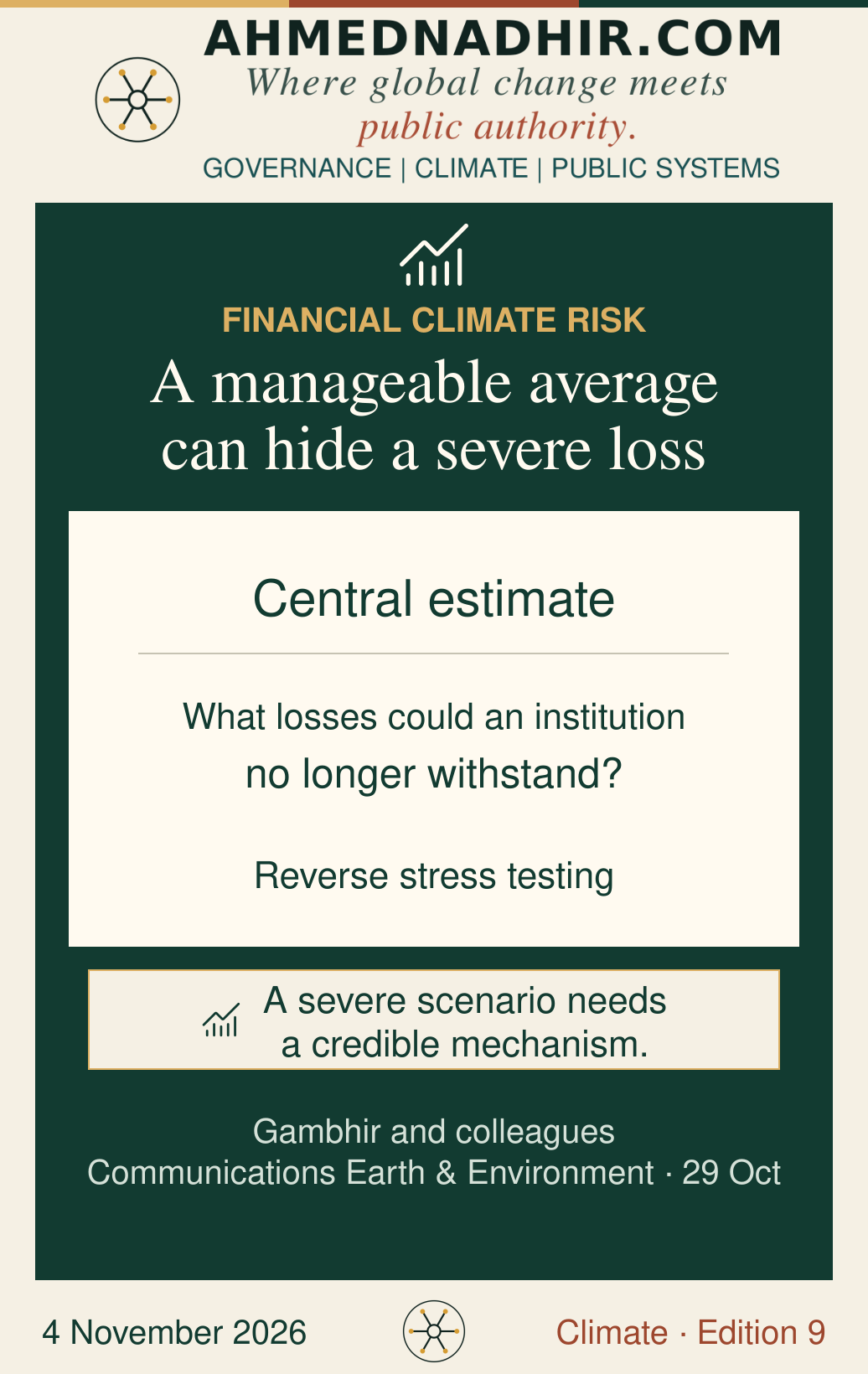
A central estimate answers one question. The survival of a bank, an insurer or a public service can depend on another: how much loss it can withstand before its obligations become impossible to meet. An average that looks manageable across a portfolio may conceal concentrated exposure among particular borrowers, places or occupations. The Ghana study illustrates the distinction without measuring a financial-sector effect. Lost time and earnings matter differently to a household with no savings and a lender with many customers.
There is a danger on the other side as well. Describing a severe scenario does not establish that it is likely. A regulator that treats every imaginable disruption as equally credible can raise costs, discourage useful lending and obscure priorities. Sound scrutiny requires the assumptions behind a scenario, an explanation of its physical and economic mechanisms, and a clear account of what would weaken the argument. An alarming narrative deserves the same discipline as a reassuring model.
The public interest is therefore not served by choosing between numbers and judgement. Financial institutions can retain quantified estimates while examining what the estimates leave out. Supervisors can ask how an institution would respond if several exposures worsened together, and whether its proposed response depends on assistance that others have also assumed they will receive. Such enquiry exposes dependencies without inventing a probability for them. It also makes the institution’s tolerance for loss more visible to those relying on it.
This matters for development finance as well as commercial balance sheets. Excessive confidence can encourage an exposed investment; indiscriminate caution can deprive a country of affordable capital. The better comparison includes ways to reduce exposure, preserve flexibility and maintain essential services. Climate analysis should help distinguish those alternatives. A higher risk rating, standing alone, says little about whether the financed project would make people safer or leave them with fewer options.
Climate science and long-lived investment
The temperature at net zero matters
Global climate-model experiments
Gibbs and colleagues · Nature Climate Change
3 November 2026
Laura Gibbs and colleagues, writing in Nature Climate Change on 3 November, use the UK Earth System Model to explore what happens after human carbon dioxide emissions cease at different warming levels. In their experiments, the subsequent temperature change stays close to zero up to about 2°C of warming. At higher starting temperatures, further warming develops, reaching approximately 0.4–0.6°C after around 150 years. The balance between ocean heat uptake, radiative effects and carbon uptake changes as the system warms. [4]
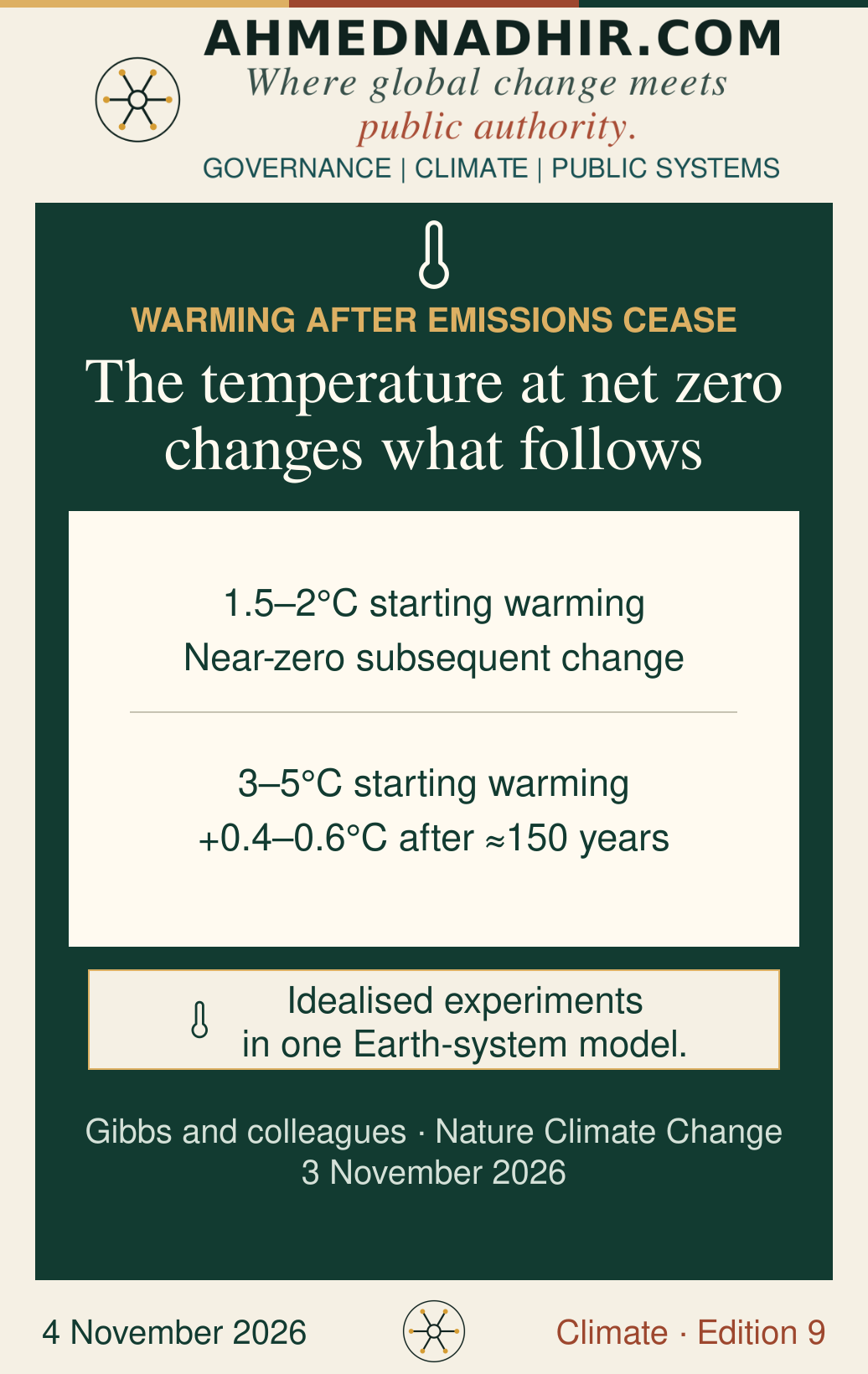
These are idealised experiments in one model, not a new consensus forecast or evidence that reaching net zero at Paris-level warming is futile. They nevertheless challenge an assumption that can make delay appear easier to repair: that arriving later at the same emissions endpoint necessarily brings the same physical outcome. In these simulations, the warming already reached affects what happens next. That makes the route to an endpoint part of the decision, rather than background history that can be disregarded.
The institutional consequence concerns long-lived choices. A firm or government may retain the ability to change an annual purchase, while a power system, transport investment or pattern of land use can shape emissions for much longer. Delaying a decision about one of those assets can narrow the range of later options even before all model uncertainties are resolved. This is an argument about the cost of losing flexibility; the paper does not calculate that cost for a particular country or project.
It also alters how promises of later carbon removal deserve to be read. A commitment to repair emissions in future relies on technical capability, available resources and physical reversibility. These are separate propositions. None can be established by writing a future balancing entry into an investment plan. The new modelling gives a reason to scrutinise the reversibility assumption more closely, while preserving the central value of reducing emissions promptly.
Climate science and coastal investment
One ice sheet is not all of Antarctica
East and West Antarctica · Long-run modelling
Yun and Timmermann · Nature Climate Change
30 October 2026
A 30 October paper by Kyung-Sook Yun and Axel Timmermann offers a counterweight to the idea that every new physical result points towards greater instability. Their coupled climate and ice-sheet simulations find substantial atmospheric restraint on East Antarctic ice loss: increased snowfall and cloud-related changes help counter warming effects. West Antarctica behaves differently and can disintegrate on millennial timescales in the experiments. The work explores very long adjustment under constant carbon dioxide conditions, using simulations extending to 100,000 years. It is not a forecast of coastal conditions in 2050. [5]
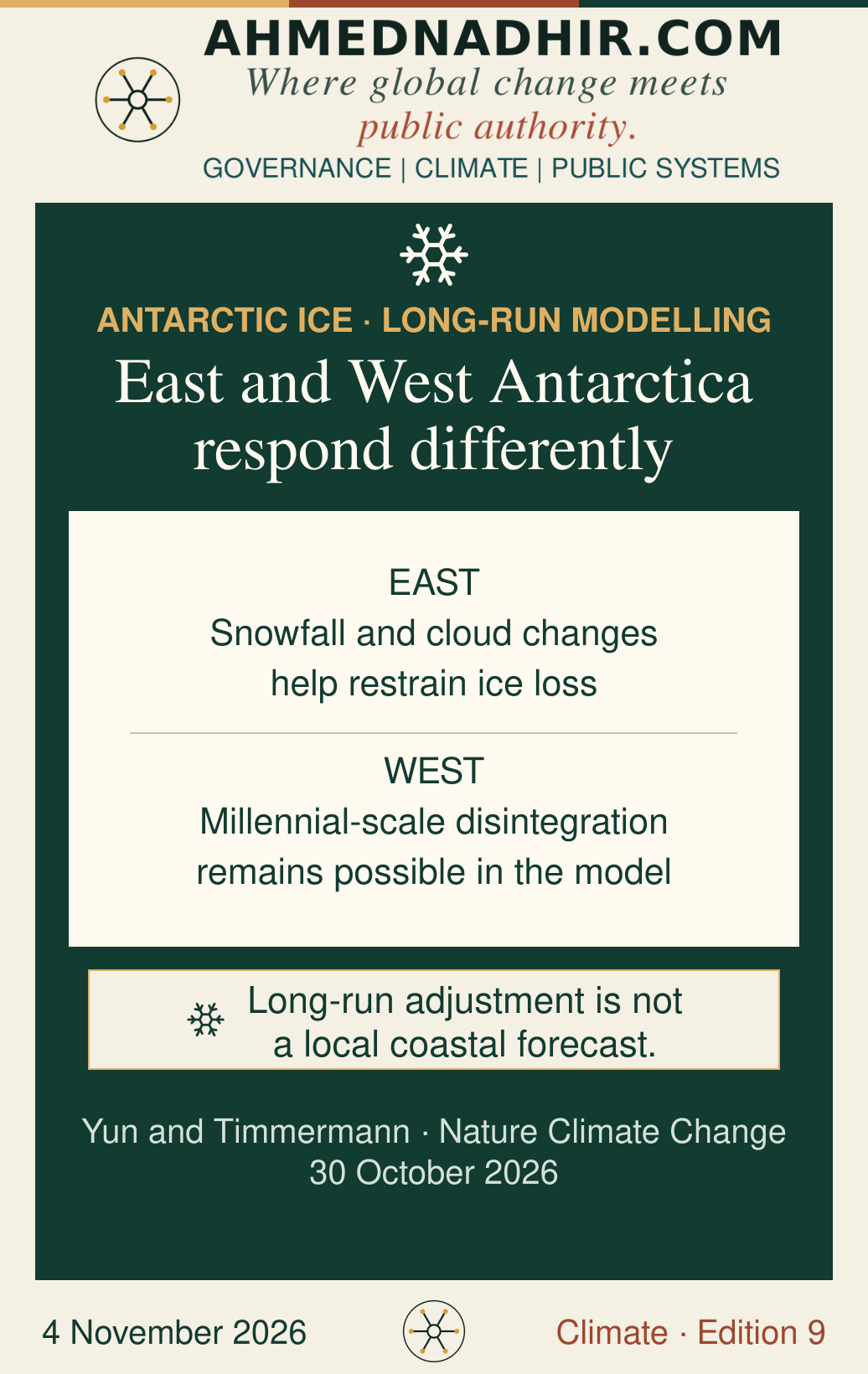
The result is important precisely because it resists a single reassuring or catastrophic headline. Different parts of a large physical system can respond in different directions. The same word, Antarctica, can hide mechanisms that matter to the outcome. Coupling the atmosphere to the ice changes the simulated balance; limitations in model resolution and representation still constrain what can be inferred about regional retreat and timing.
For public investment, the immediate lesson is restraint in translating an aggregate finding into a local assurance. An official assessing coastal infrastructure needs evidence appropriate to its location and lifetime. A long-run result about East Antarctic stability cannot establish that a particular coast is safe. Nor should a severe long-run scenario be presented as an imminent local event. Matching the evidence to the decision is a substantive part of analysis, rather than a caution appended after the headline.
Taken with the emissions-cessation study, this creates a more demanding view of uncertainty. Some feedbacks can restrain change, others can amplify it, and their importance depends on the conditions being examined. Responsible decisions do not require all these findings to point in the same direction. They require an explanation of which uncertainty could change a choice, which does not, and which choices would be difficult to reverse if the evidence later shifted.
Keeping the next decision open
The practical distinction running through these readings is between waiting to learn and waiting while exposure grows. Measuring workplace heat before setting a locally appropriate arrangement can improve protection. Postponing all protection until a national employment projection is exact would ask the wrong thing of the model. Studying an irrigation scheme’s performance can reveal why producers are resilient. Assuming that its past success guarantees every future expansion would ask too little of the institutions maintaining it.
For a ministry, lender or employer, a credible next step would be a limited trial within work it already undertakes. A heat-protection trial could compare schedules and paid recovery arrangements while recording conditions, earnings and disruption. Employers and worker representatives would help define what counts as success; a public purchaser could incorporate the resulting requirements into a suitable contract. The proposition is conditional on lawful local powers and resources. It is neither an announced programme nor a quantified promise of savings.
The expense deserves an honest account. Paid rest, shade and changes in schedules have costs. Small enterprises may need support that larger employers can absorb themselves. A trial would be useful if it identifies which arrangement protects health without transferring an unaffordable income loss to workers, and what recurrent spending it requires. A three-month observation period could test implementation and payment effects; it could not prove long-run climatic benefits or settle differences among global models.
Kenya can examine that practical question without borrowing Ghana’s projected job equivalent or Brazil’s experience of reservoir protection. The same applies across African and other jurisdictions with different working conditions and institutional powers. The missing evidence is specific: exposure during real tasks, how income changes when work stops, and which protective measures remain usable over time. Evidence of poor uptake, displaced costs or negligible protection would require the design to change.
Longer-term research remains indispensable. It can reveal that an apparently recoverable delay leaves a lasting physical consequence, or that a widely used model omits a stabilising process. Neither possibility excuses careless spending. Both make flexibility, transparent assumptions and continuing observation more valuable. The purpose of climate analysis is to improve the decisions available to people now, while leaving future decision-makers fewer preventable losses and a wider choice of remedies.
Sources and notes
The five publications appeared between 28 October and 3 November 2026. Their observations, reference periods and simulations cover different timescales, as explained in the readings. The Ghana report and financial-risk commentary were available in full. Discussion of the Brazilian research and the two physical-climate studies is limited to the findings and methods available in their publishers’ abstracts and article extracts when this edition was prepared. No representative interview result or local climate forecast is inferred from that material. The connections between the readings and the proposed workplace trial are this edition’s own analysis.
- International Labour Organization. Impacts of heat stress on jobs and productivity in Ghana. 29 October 2026. Complete report
- Lovato and colleagues. ‘That’s why the crops are here’: perceptions on extreme weather events and grape growing in Brazil’s semi-arid region. Climatic Change. 30 October 2026.
- Gambhir and colleagues. The finance sector should capture the full range of climate change risks. Communications Earth & Environment. Comment. 29 October 2026.
- Gibbs and colleagues. Zero emissions commitment depends on warming level. Nature Climate Change. 3 November 2026.
- Yun and Timmermann. Atmospheric stabilization of the East Antarctic ice sheet under warming. Nature Climate Change. 30 October 2026.
Ahmed Nadhir Omar (2026), ‘Heat, work and the price of delay’, Climate Across Systems, No. 9, 4 November 2026. Reporting: 28 October–3 November 2026. https://ahmednadhir.com/climate/no-9.
Low-data text edition · Publication materials
This edition distinguishes the sources’ findings from its own comparisons and proposed workplace trial. Author and disclosures.
RSS delivers editions to a feed reader without an email subscription. Follow Climate Across Systems by RSS.