
African economies and public finance
Global markets · Kenya and other import-dependent economies
Food and energy forecasts raise the cost of maintaining services
Outlook released in Washington: 28 October 2026. Forecasts: calendar-year averages for 2026 and 2027.
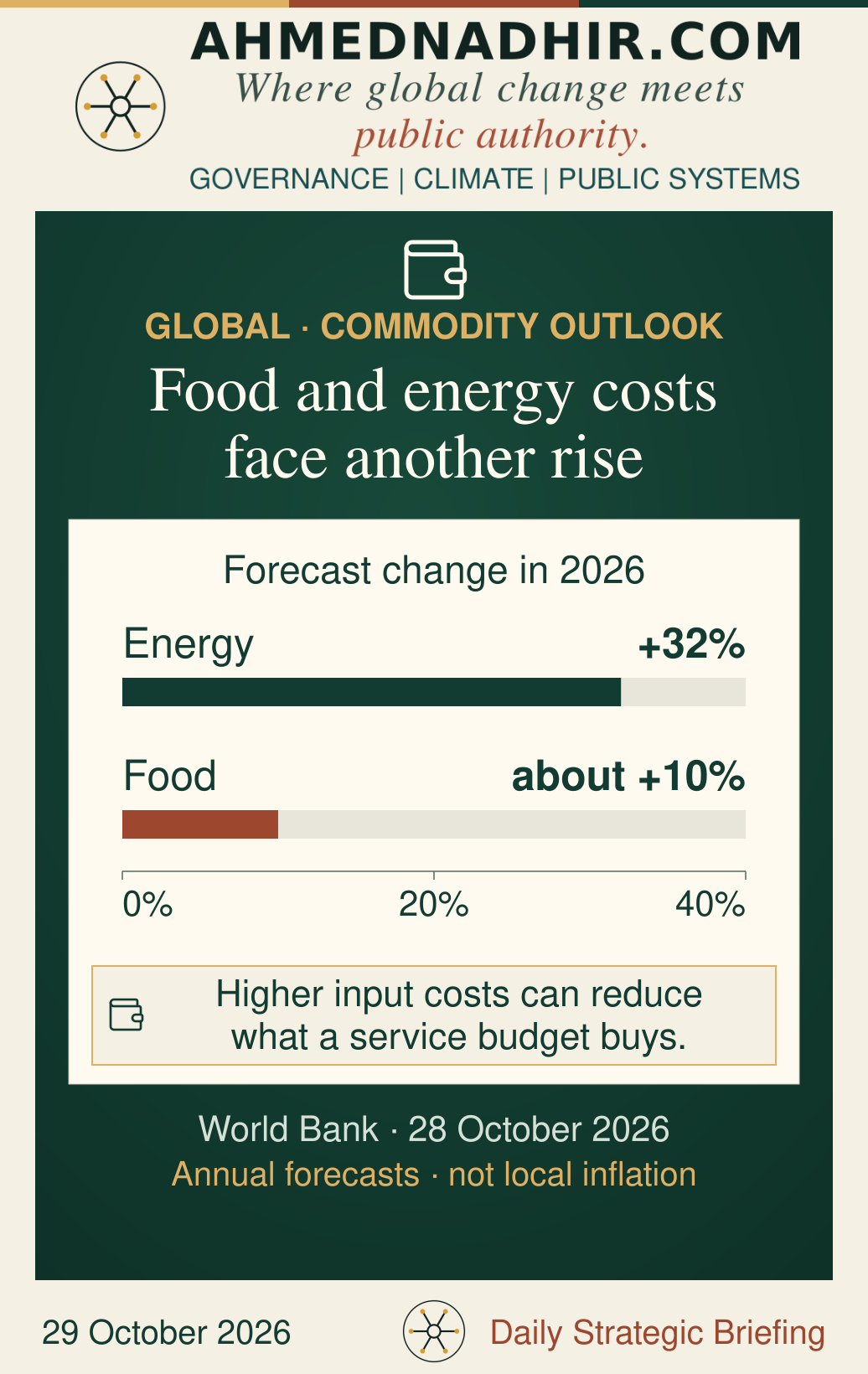
The World Bank’s new Commodity Markets Outlook forecasts a 23% rise in overall commodity prices in 2026. Energy prices are projected to increase by 32%, while food commodity prices rise by about 10%. The Bank expects a further food-price increase of about 7% in 2027, taking the cumulative rise over the two years to approximately 18%. Disrupted supplies, higher agricultural input costs and El Niño-related harvest risks underpin the outlook.
These are international commodity forecasts, rather than predictions of household inflation or a uniform increase in government purchasing costs. The baseline assumes no major intensification of conflicts affecting supplies. Exchange rates, taxes, freight and purchasing arrangements influence how international prices reach local buyers.
Kenya’s exposure has an immediate market reference: the Central Bank’s bulletin of 23 October recorded Murban crude at US$108.23 a barrel on 22 October, up from US$102.39 a week earlier. This observation concerns a different oil benchmark and time period from the World Bank’s annual forecasts.
Climate and health systems
Global findings · African livelihoods and health protection
New Lancet Countdown estimates put heat’s health burden in sharper view
Report released: 28 October 2026. Mortality estimate: 2023. Potential-income estimates: 2025.
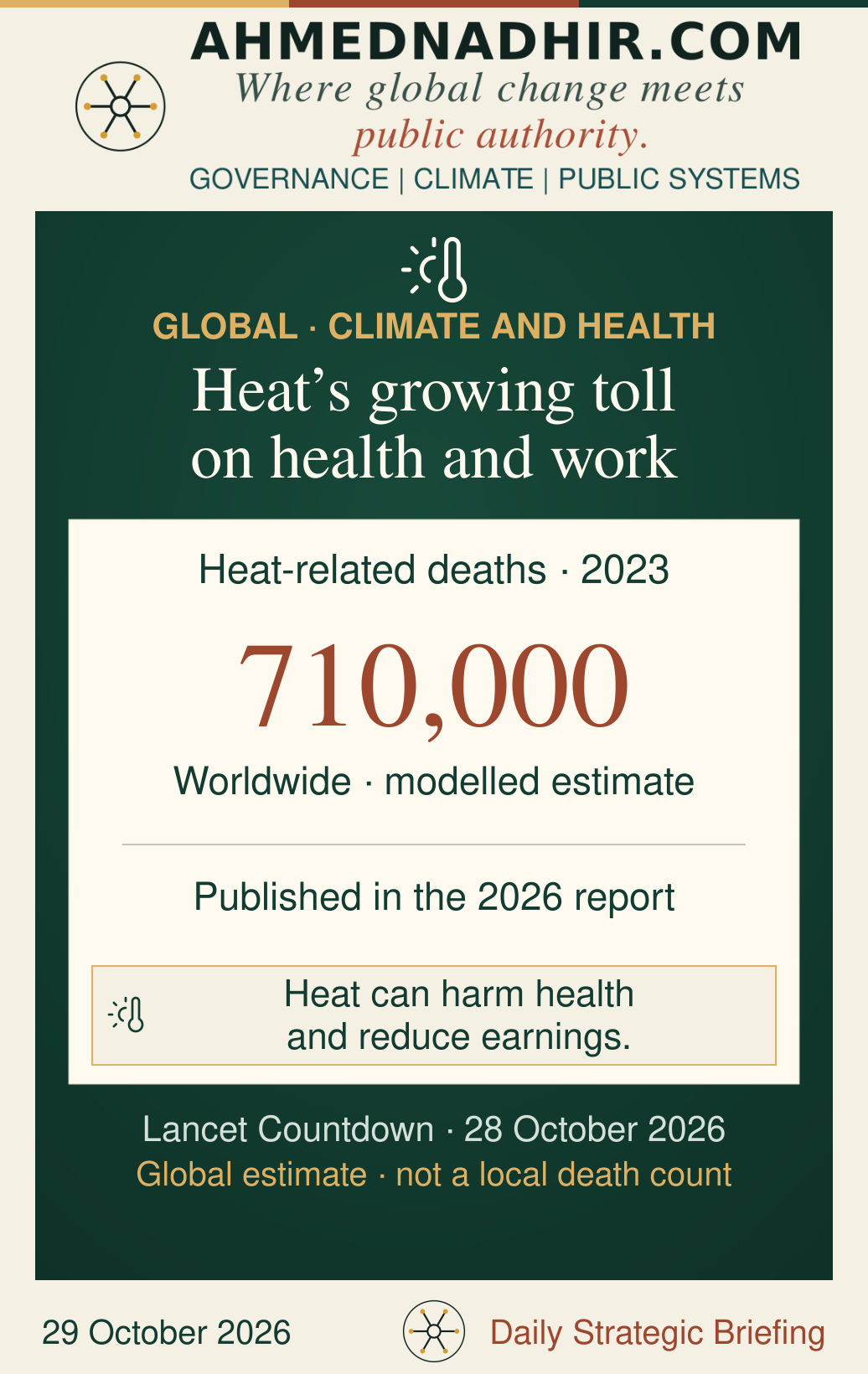
The 2026 Lancet Countdown estimates that heat was associated with 710,000 deaths worldwide in 2023, with more than 70% attributable to human-caused climate change. Released on 28 October, the report tracks 54 indicators of climate and health. Its authors call for climate change to be recognised as a global health emergency. That call does not itself constitute a formal emergency declaration by the World Health Organization (WHO).
The economic burden is also uneven. Report contributor the Potsdam Institute for Climate Impact Research says heat-related losses of potential income in Africa were equivalent to 3.2% of the region’s gross domestic product in 2025. Agriculture accounted for 71% of Africa’s estimated losses. These are modelled losses of potential income, rather than a measured contraction of that size in reported GDP.
The mortality indicator combines temperature and mortality information in a model, rather than counting deaths certified as heat-related. Its assumption that the relationship between heat exposure and mortality remains constant over time limits its ability to capture changing adaptation or vulnerability. The global total cannot establish a local death toll.
Artificial intelligence and digital government
OECD evidence · Implications for public digital suppliers
Large firms lead in using artificial intelligence for cybersecurity
OECD statistical release: 26 October 2026. Enterprise-use figures: 2025.
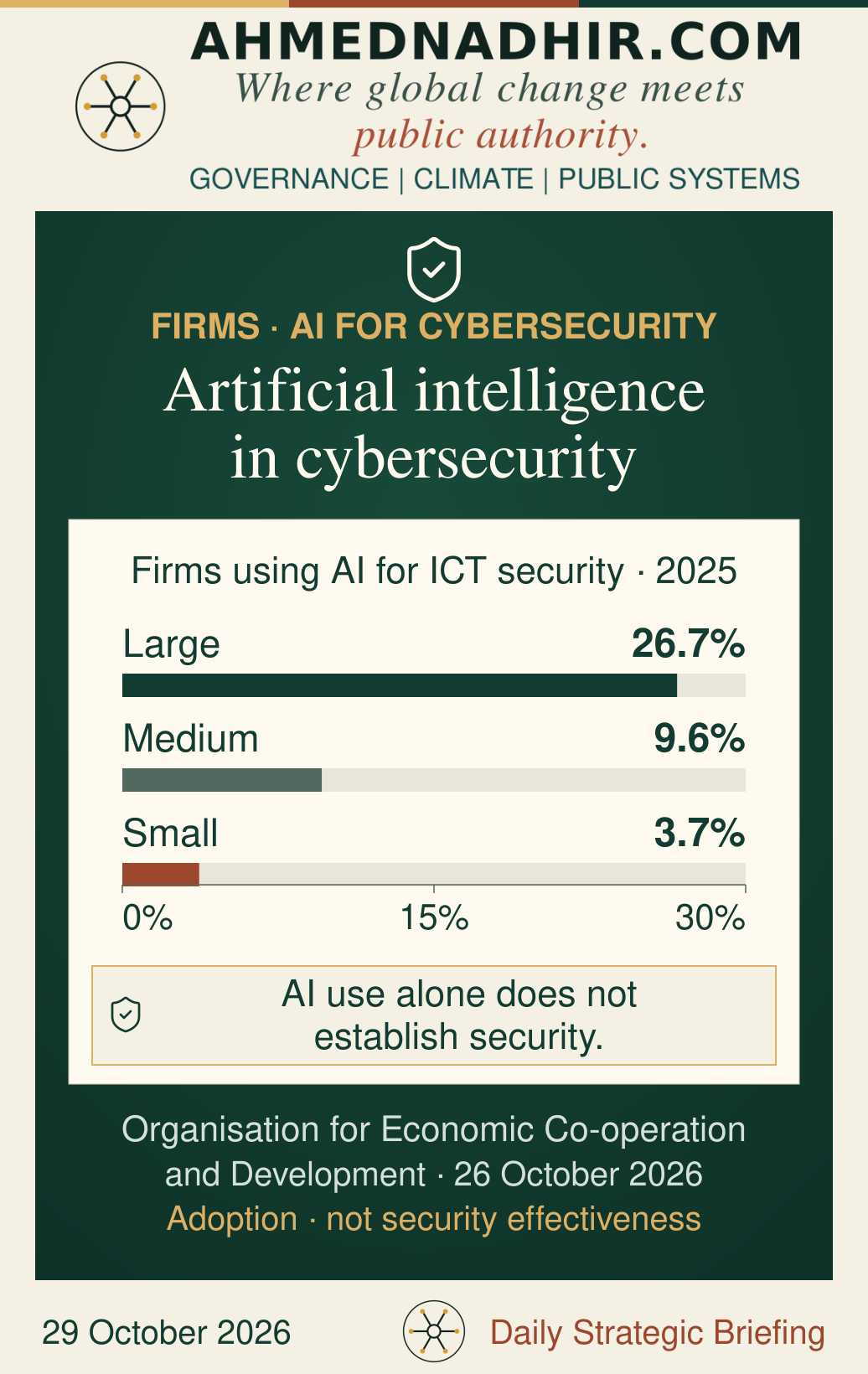
New figures from the Organisation for Economic Co-operation and Development (OECD) show that 26.7% of large enterprises used artificial intelligence (AI) for information and communication technology security in 2025, compared with 9.6% of medium-sized firms and 3.7% of small firms. Uses include detecting attacks and authenticating users.
The figures describe adoption, rather than the effectiveness of a firm’s defences. A business without AI may have strong security controls; one using it can remain vulnerable. The release provides comparative OECD evidence, not an estimate for African enterprises or public administrations.