
Health and access to care
Barbados · Comparative health-system experience
Barbados achieves milestone in preventing infant HIV
Certification announced: 30 October 2026. Reported infant outcomes: 2022–2024.
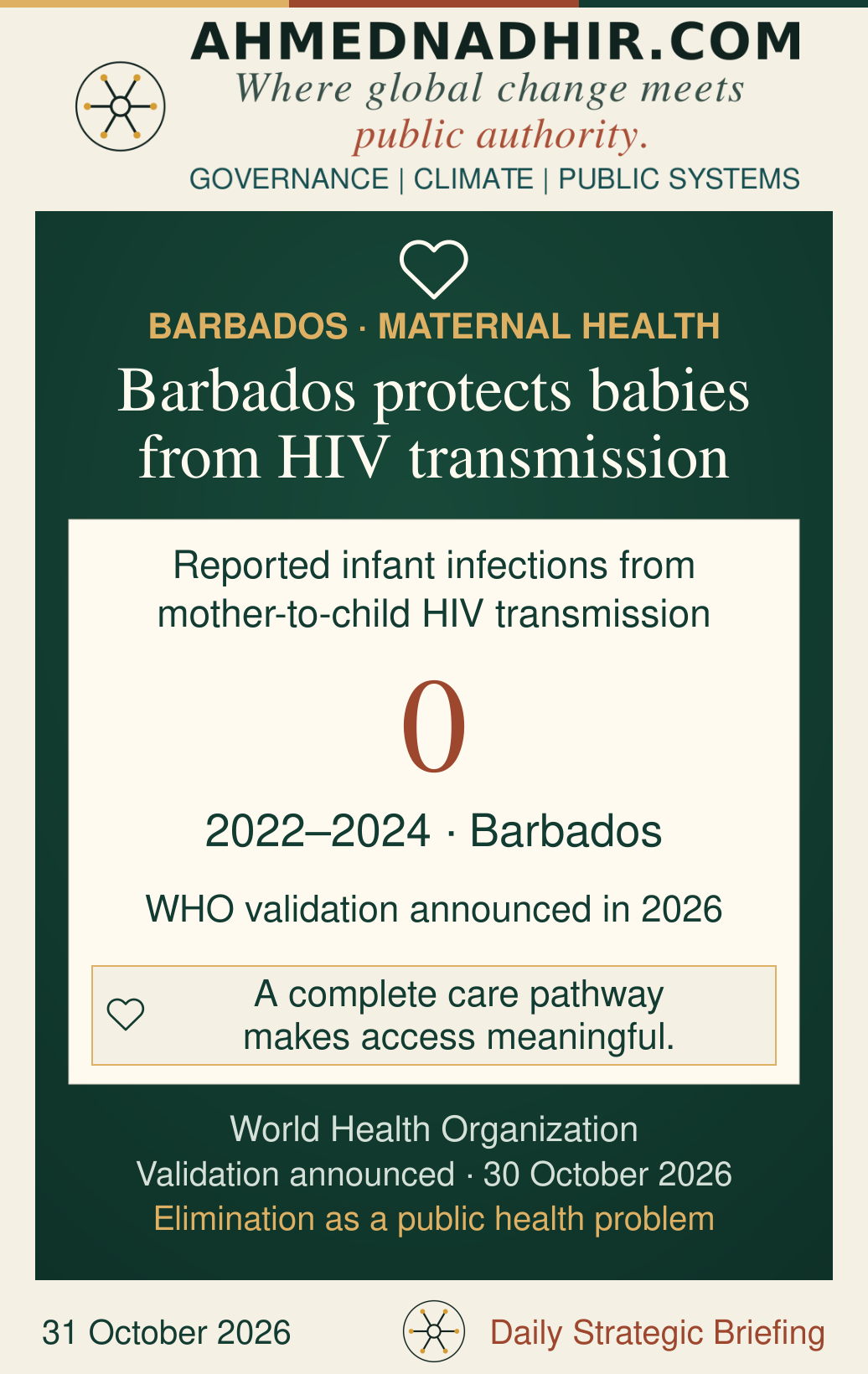
The World Health Organization (WHO) announced on 30 October that Barbados had eliminated mother-to-child transmission of human immunodeficiency virus (HIV) as a public health problem, following independent assessment. No new infant infections attributed to this route were reported during 2022–2024. This is a defined public-health achievement, rather than eradication of HIV or a guarantee that transmission can never recur.
The assessment found 98% coverage for antenatal care, HIV testing in pregnancy and treatment among pregnant women living with HIV. Those percentages concern different eligible groups. Testing and treatment are free for pregnant women regardless of nationality, with voluntary, confidential testing and follow-up for exposed babies.
Climate resilience and urban government
Kisumu · River Auji, with international city comparisons
Kisumu prioritises 100 hectares along the River Auji for restoration
United Nations Environment Programme account: 30 October 2026. Programme experience covers three years; no completion date is established for Kisumu’s priority area.
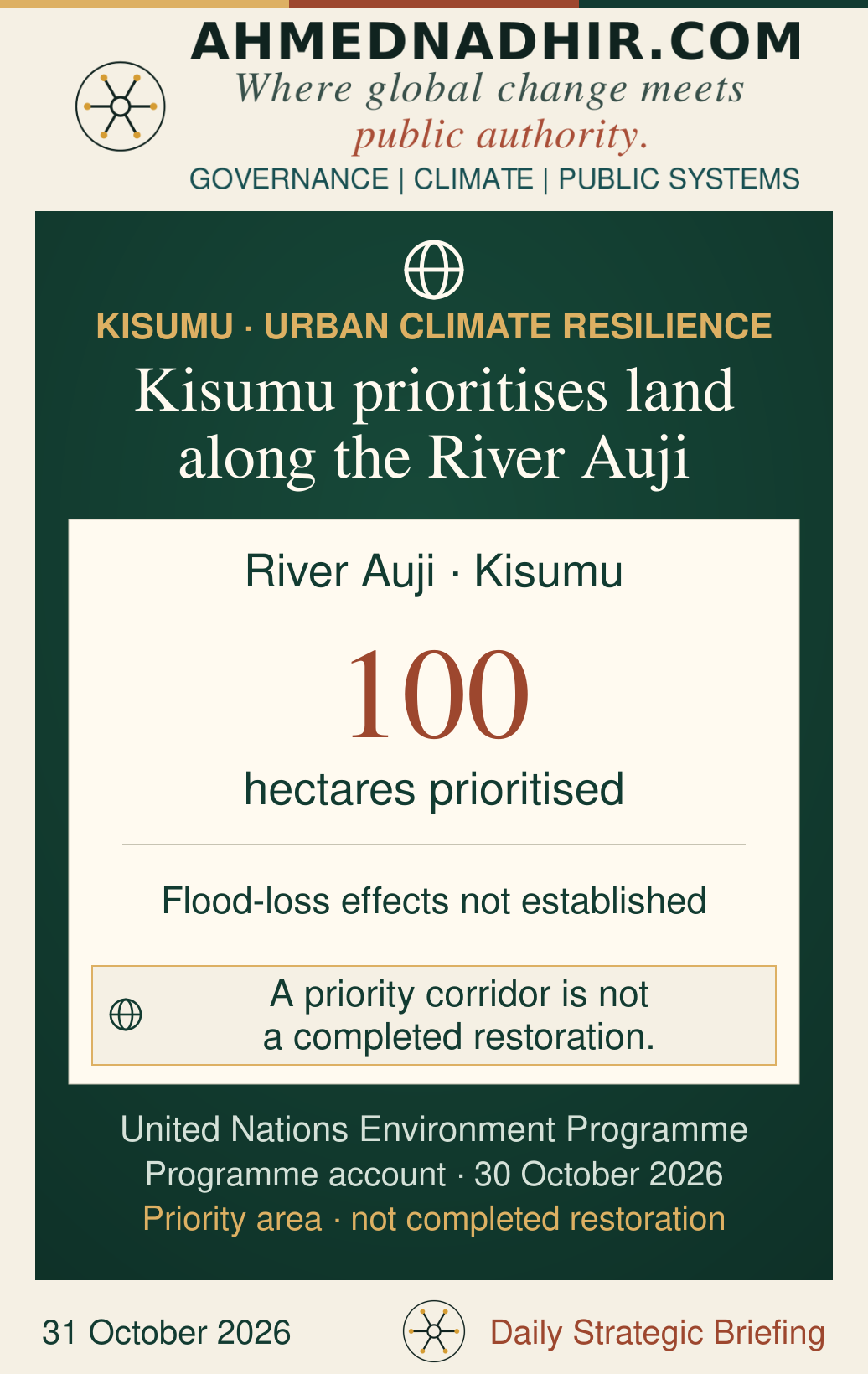
A new account from the United Nations Environment Programme (UNEP) identifies 100 hectares along Kisumu’s River Auji as a restoration priority. The corridor matters for flood control, water purification and biodiversity in the Lake Victoria Basin. The area is prioritised for work; the account does not establish that all 100 hectares have been restored or quantify a reduction in flood losses.
The wider Generation Restoration Cities initiative has worked with 24 cities in 19 countries. Its contribution includes integrating nature into 31 policies, plans and ordinances. These are planning outputs, rather than equivalent measures of protection delivered. The Kisumu finding gives a specific urban application to a subject covered in yesterday’s global restoration stocktake.
Public finance and international administration
Paris · Cross-border work and the digital economy
International tax forum advances work on mobile workers
Meeting: 28–30 October 2026, Paris. Outcome announcement: 30 October 2026.
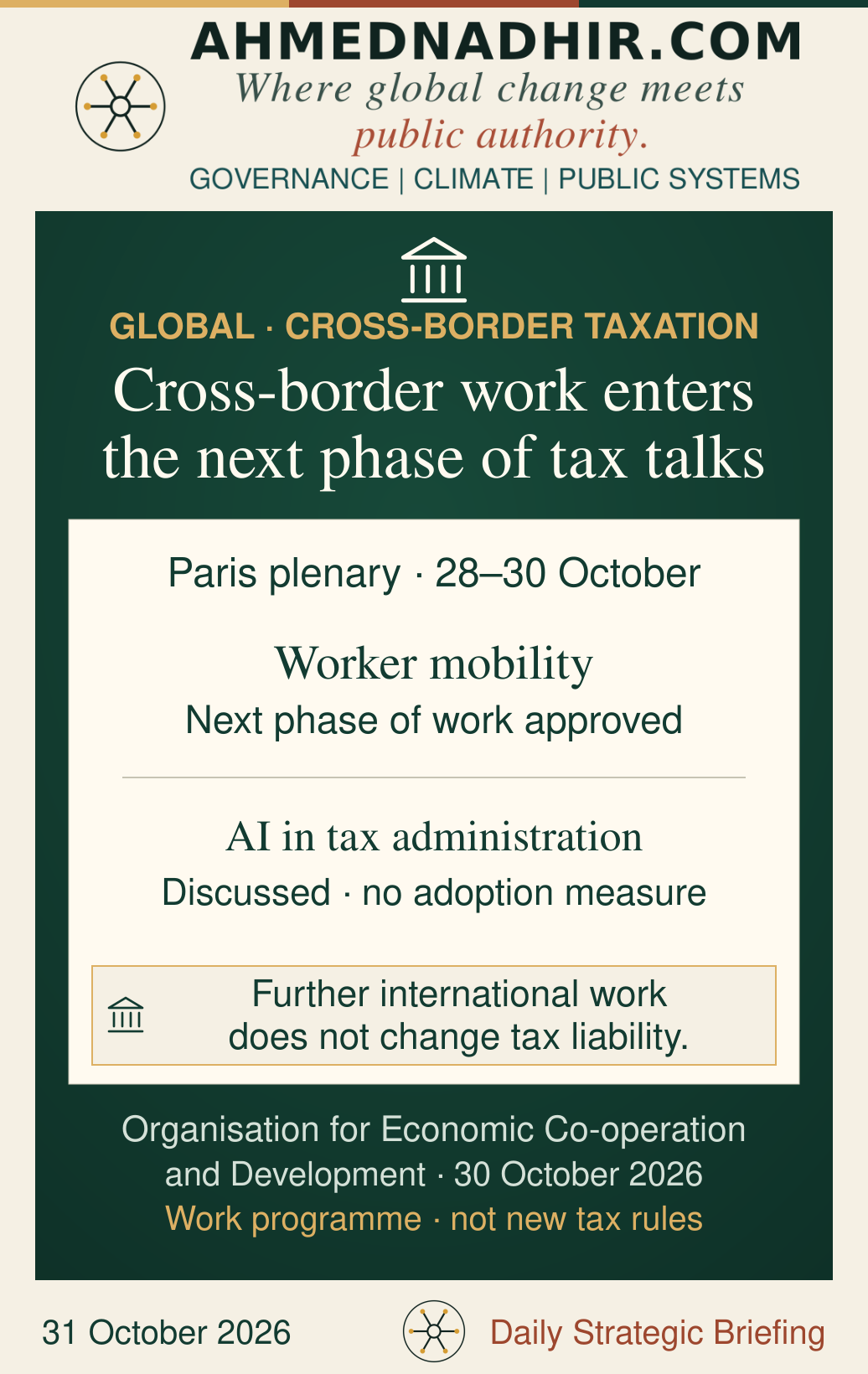
Members of the Inclusive Framework on Base Erosion and Profit Shifting approved the next phase of work on the global mobility of workers at their Paris plenary, according to the Organisation for Economic Co-operation and Development (OECD). The meeting also agreed to advance a common understanding of digital-economy tax challenges and their relationship with existing international rules.
Artificial intelligence (AI) in tax administration was discussed alongside domestic revenue and demographic change. The announcement confirms a programme of work and discussion. It does not announce a new tax on remote workers, a changed national liability or a demonstrated improvement from using AI.