
Poverty, livelihoods and public spending
International evidence · Implications for economic inclusion
Combined livelihood support raises incomes in new poverty review
World Bank working paper disclosed: 30 October 2026. Centre for Economic Policy Research discussion paper: 28 October 2026. Findings synthesise earlier evaluations.
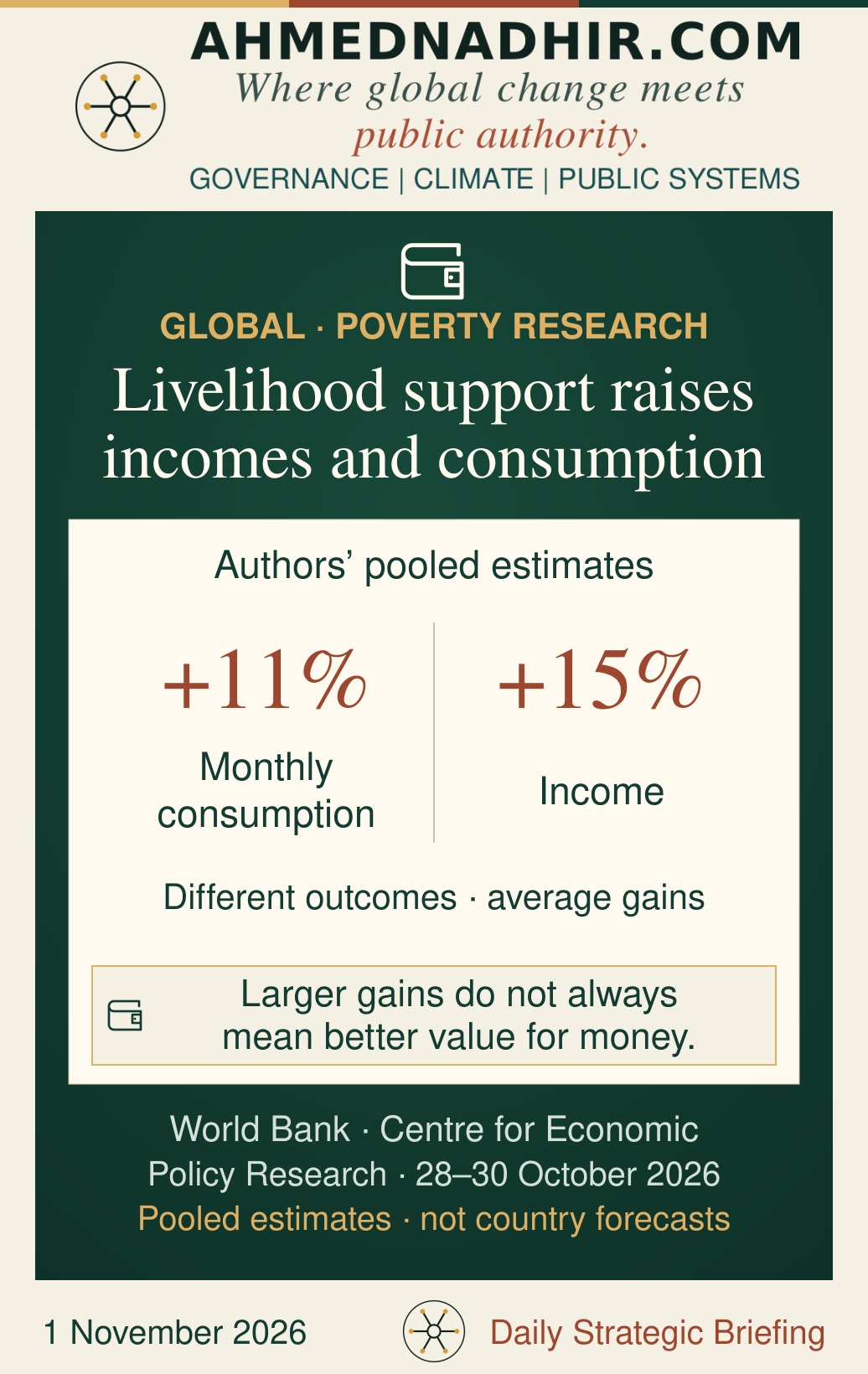
A working paper released by the World Bank on 30 October reports gains from poverty programmes that combine several forms of livelihood support. The authors’ published abstracts estimate average increases of 11% in monthly consumption and 15% in income. These are pooled research estimates, rather than a forecast for a particular country or a promised return to each household.
The programmes, known as Graduation programmes, include at least three of five elements: support for current consumption, help with saving, skills training, coaching and a lump-sum transfer. The analysis also finds that more expensive programmes produce larger effects, but the gains do not rise in proportion to costs. Larger transfers are associated with larger benefits without necessarily offering better value for money.
The paper is by Samantha Carter, Edward Jee, Dean Karlan and Patrick Premand. Its earlier Centre for Economic Policy Research version appeared on 28 October. The findings support a more discriminating discussion of economic inclusion: neither a list of programme components nor the size of a transfer establishes what a public budget will achieve in a new setting.
Housing, health and urban government
Global · World Cities Day, 31 October
World Health Organization puts housing at the centre of urban health
World Health Organization commentary: 31 October 2026. Fuzhou’s programme lists thematic forums on 1 November. Supporting housing guidelines were published in 2018.
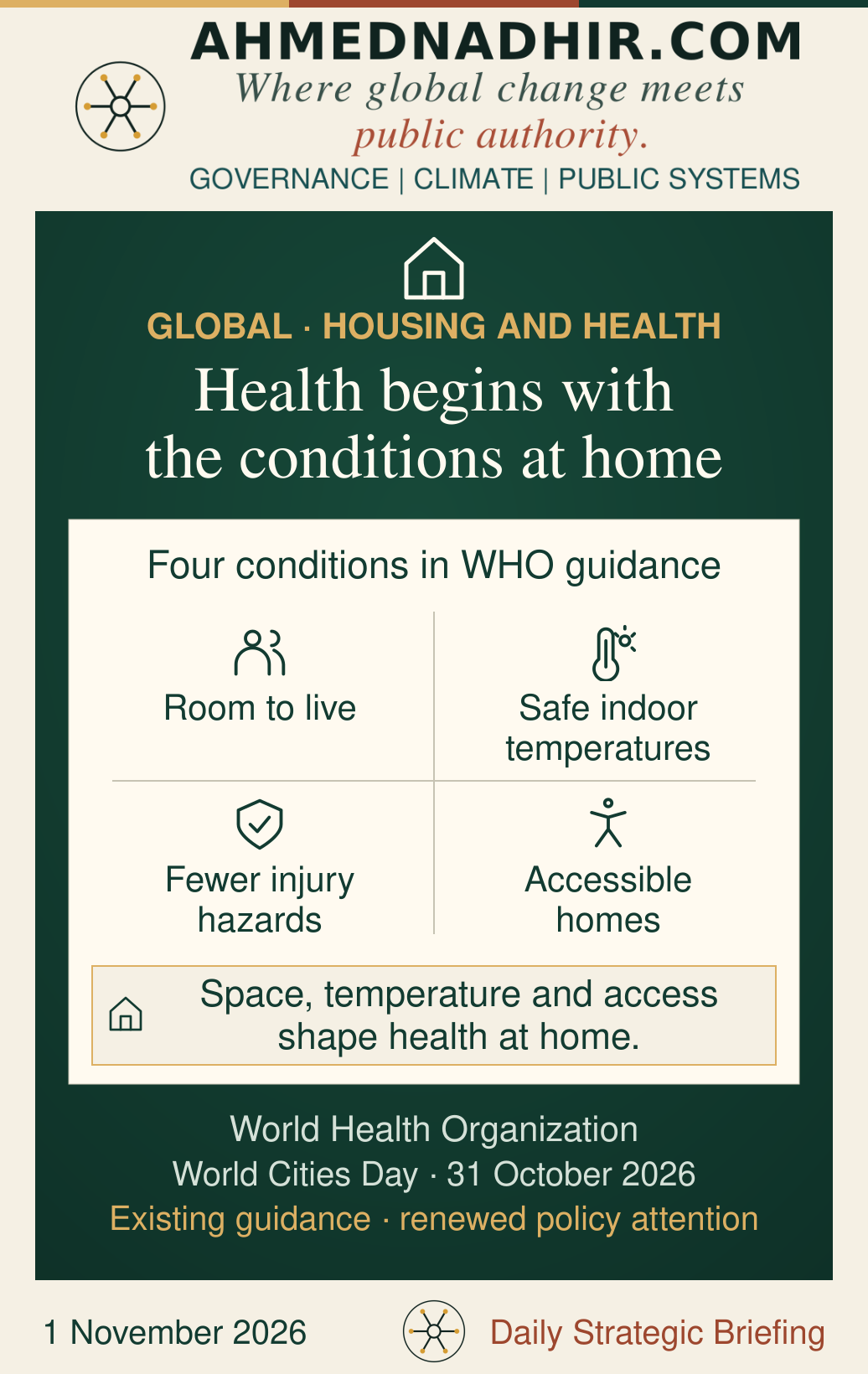
The World Health Organization (WHO) used World Cities Day on 31 October to call for health to carry greater weight in housing and urban development. Its commentary identifies overcrowding, unsafe indoor temperatures, injury hazards and inaccessible homes as health risks. The intervention renews attention to existing evidence and guidance; it does not announce a new building standard or a measured improvement in residents’ health.
The global observance in Fuzhou, China, focuses on adequate housing through urban regeneration. UN-Habitat’s programme stresses community participation and safeguards against displacement. WHO’s housing guidelines, published in 2018, provide the underlying recommendations on space, temperature, safety and accessibility. The current significance is the connection between those established health concerns and decisions about how neighbourhoods are rebuilt.
Climate science, technology and coastal economies
Global ocean · Including observation gaps in the Indian Ocean
United Nations ocean report makes observation a climate investment priority
Climate Technology Progress Report 2026 released: 28 October 2026, Copenhagen. A scientific and technology assessment, rather than a new project evaluation.
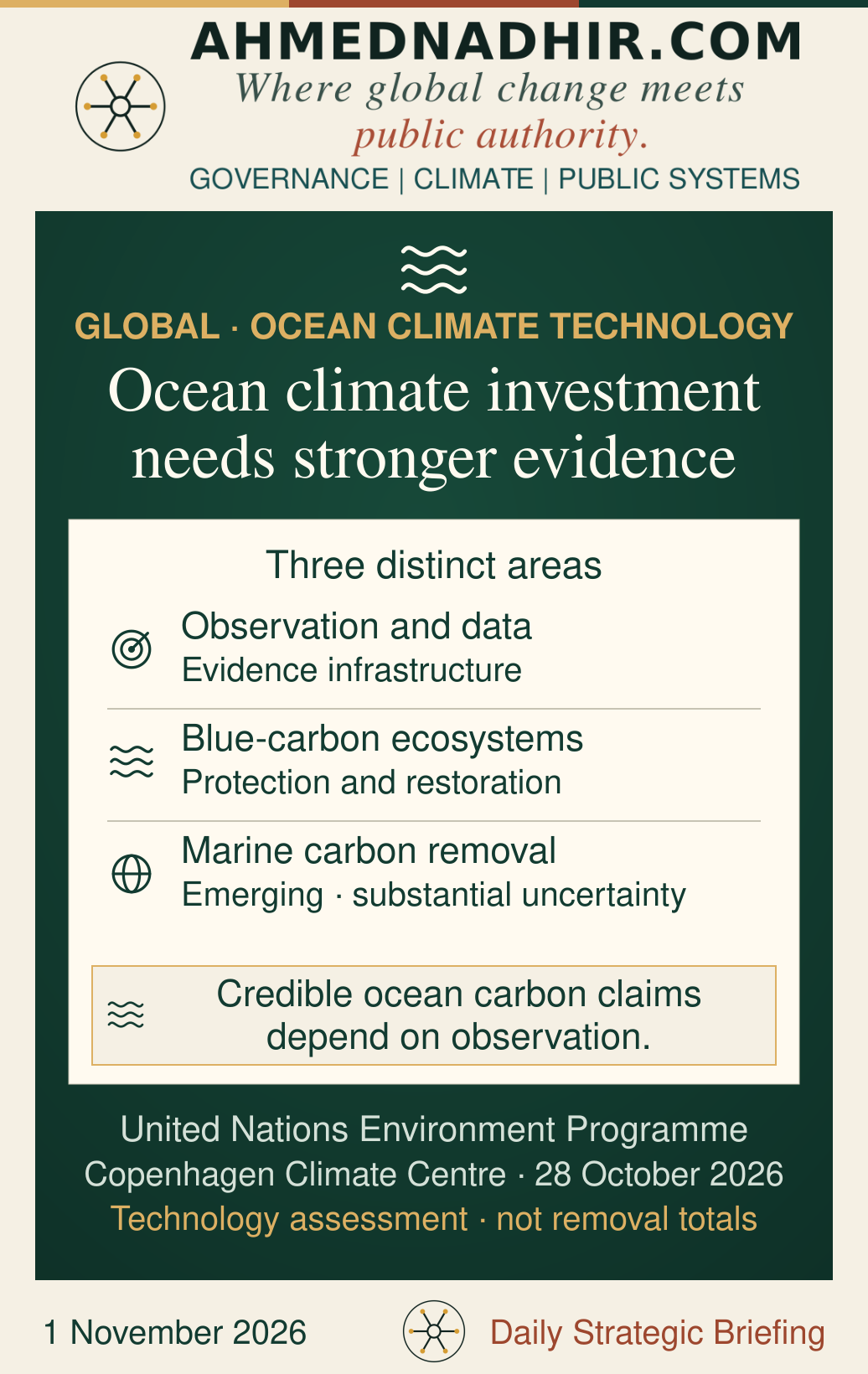
A United Nations report released in Copenhagen on 28 October calls for stronger observation, data systems and modelling to underpin ocean-based climate decisions. The Climate Technology Progress Report 2026 describes Ocean Carbon Intelligence as a way to connect those capabilities. It identifies gaps in the Indian Ocean, the Southern Ocean, the Arctic and many coastal regions, limiting the assessment of change and the ability to separate an intervention’s effects from natural variation.
The report distinguishes protection and restoration of blue-carbon ecosystems, such as mangroves and seagrass, from emerging marine carbon dioxide removal. The latter approaches remain at lower levels of technological readiness and carry substantial scientific, environmental and governance uncertainties. Both require credible assessment. Ocean-based approaches complement emissions reductions; the report does not establish a new quantity of carbon removed or approve a particular technology for deployment.