
African economies and urban development
Sub-Saharan Africa · Cities, expanding peripheries and smaller towns
World Bank projects 748 million additional urban residents by 2050
Report release: 29 October 2026. Population projection: additional urban residents between 2025 and 2050.
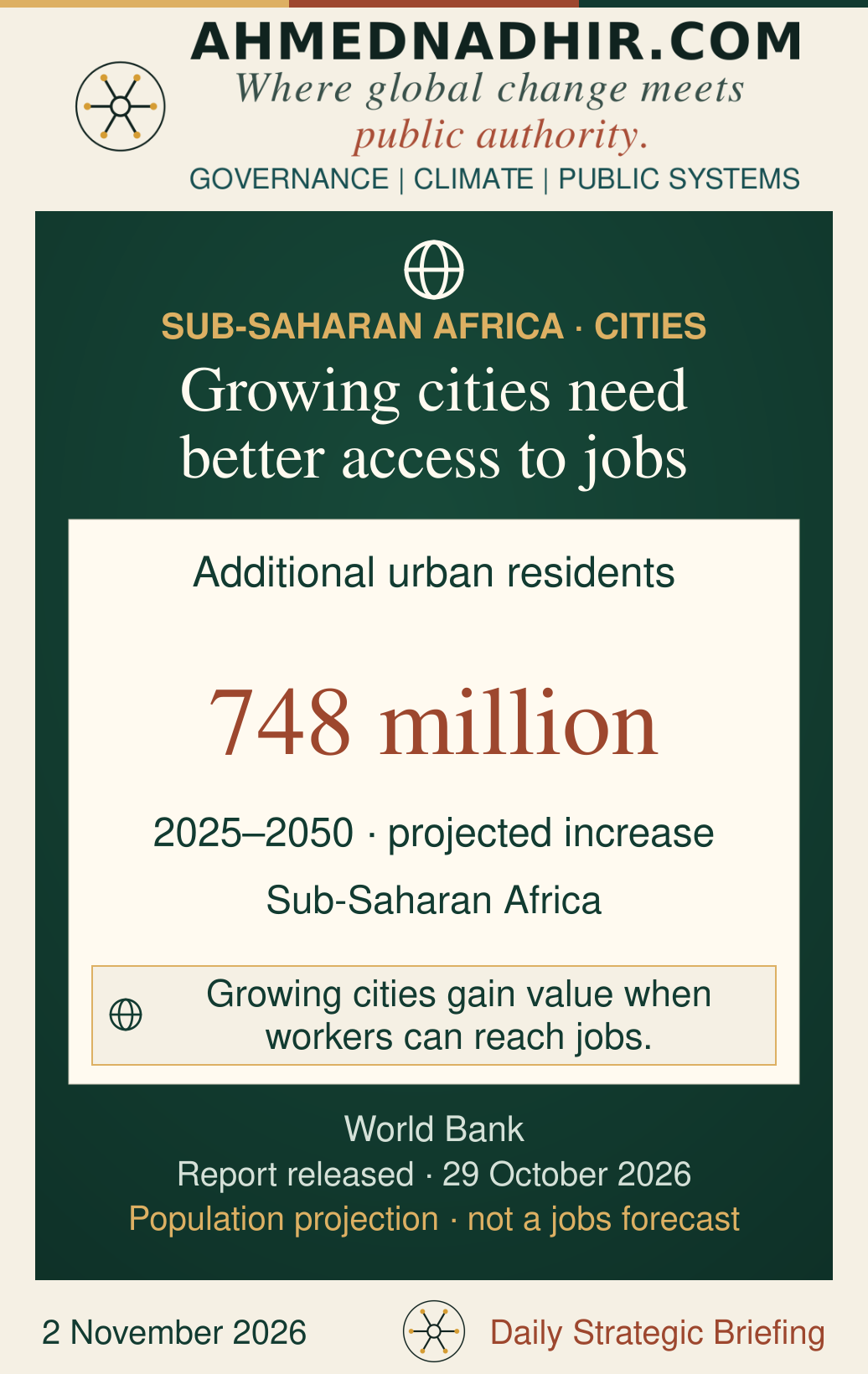
Sub-Saharan Africa is projected to add 748 million urban residents between 2025 and 2050, according to a World Bank report released on 29 October. Sub-Saharan Africa’s Urban Awakening examines how that growth could support more productive employment. The projection describes population change, not a forecast that an equivalent number of jobs will appear.
The report distinguishes established cities, expanding peripheries and smaller towns. It identifies access to employment clusters as a central urban constraint, and argues for reserving space for roads and essential infrastructure before peripheral development becomes entrenched. For smaller towns, it favours investment that reflects economic potential rather than a uniform development model. The accompanying report page also identifies unpredictable transfers and weak own-source revenue as obstacles to financing urban growth.
Health research and outbreak preparedness
South-East Asia · Consultation held in Kathmandu, Nepal
Nipah research partners develop a draft measure of disease severity
Account published: 30 October 2026. Expert consultation: 11–13 August 2026, Kathmandu. Refinement and validation remain ahead.
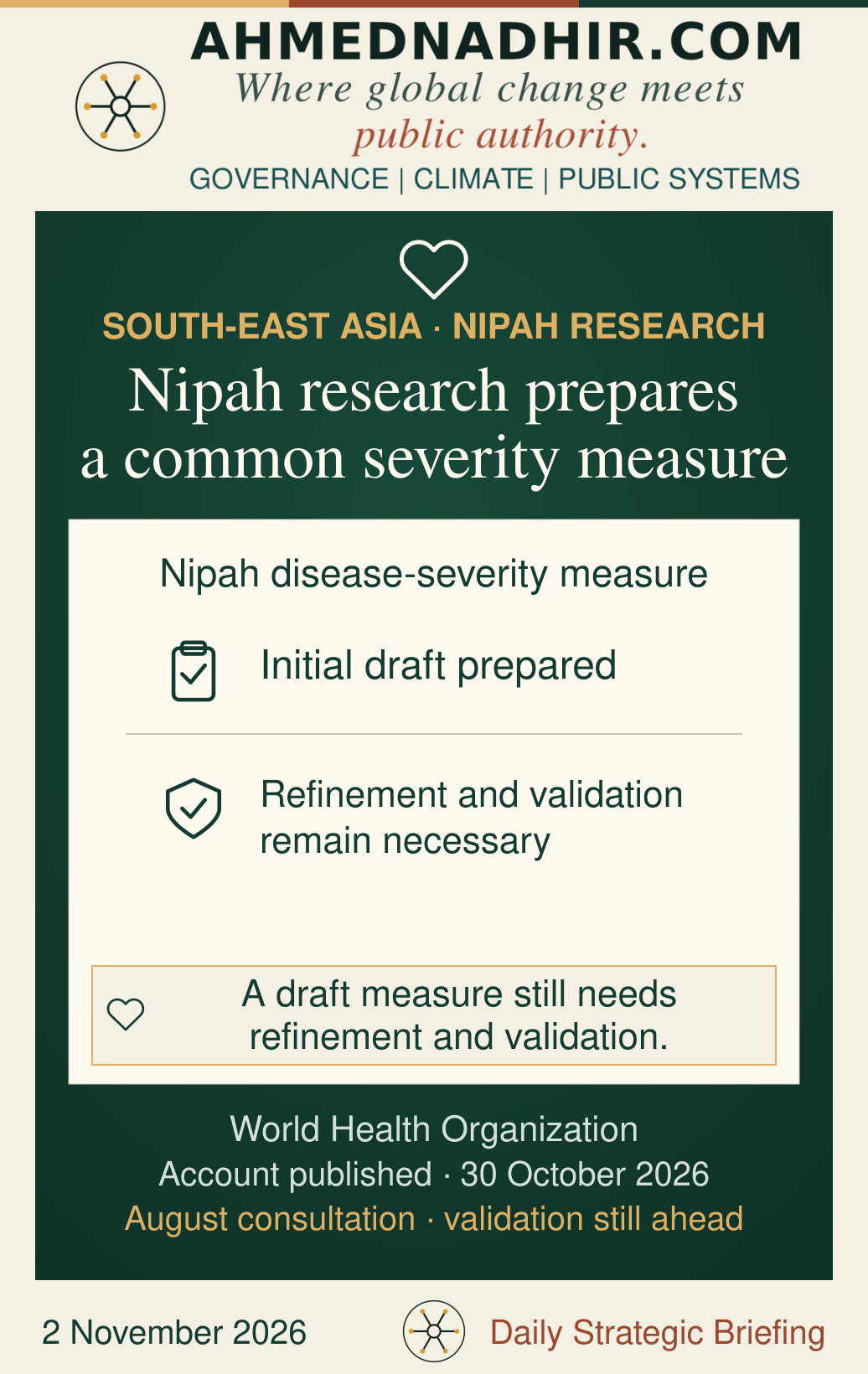
The World Health Organization (WHO) reported on 30 October that a Kathmandu consultation had produced an initial draft Nipah disease-severity score. Held on 11–13 August, the meeting brought together WHO’s South-East Asia office, the Coalition for Epidemic Preparedness Innovations and PATH with clinical and research specialists. The draft is intended primarily to help compare disease severity in future vaccine trials.
The account describes further refinement and validation, not a score ready for routine clinical use. It also explains that current outbreak patterns make vaccine-efficacy evaluation practically difficult; a larger outbreak could create different research conditions. Preparedness includes developing a trial protocol and a consistent outcome measure before that possible opportunity arises.
Public administration and economic policy
Portugal · Comparative institutional experience
New report proposes a renewed productivity council for Portugal
Report published: 30 October 2026. Earlier council established in 2018; its mandate expired in 2021. Renewal is a recommendation.
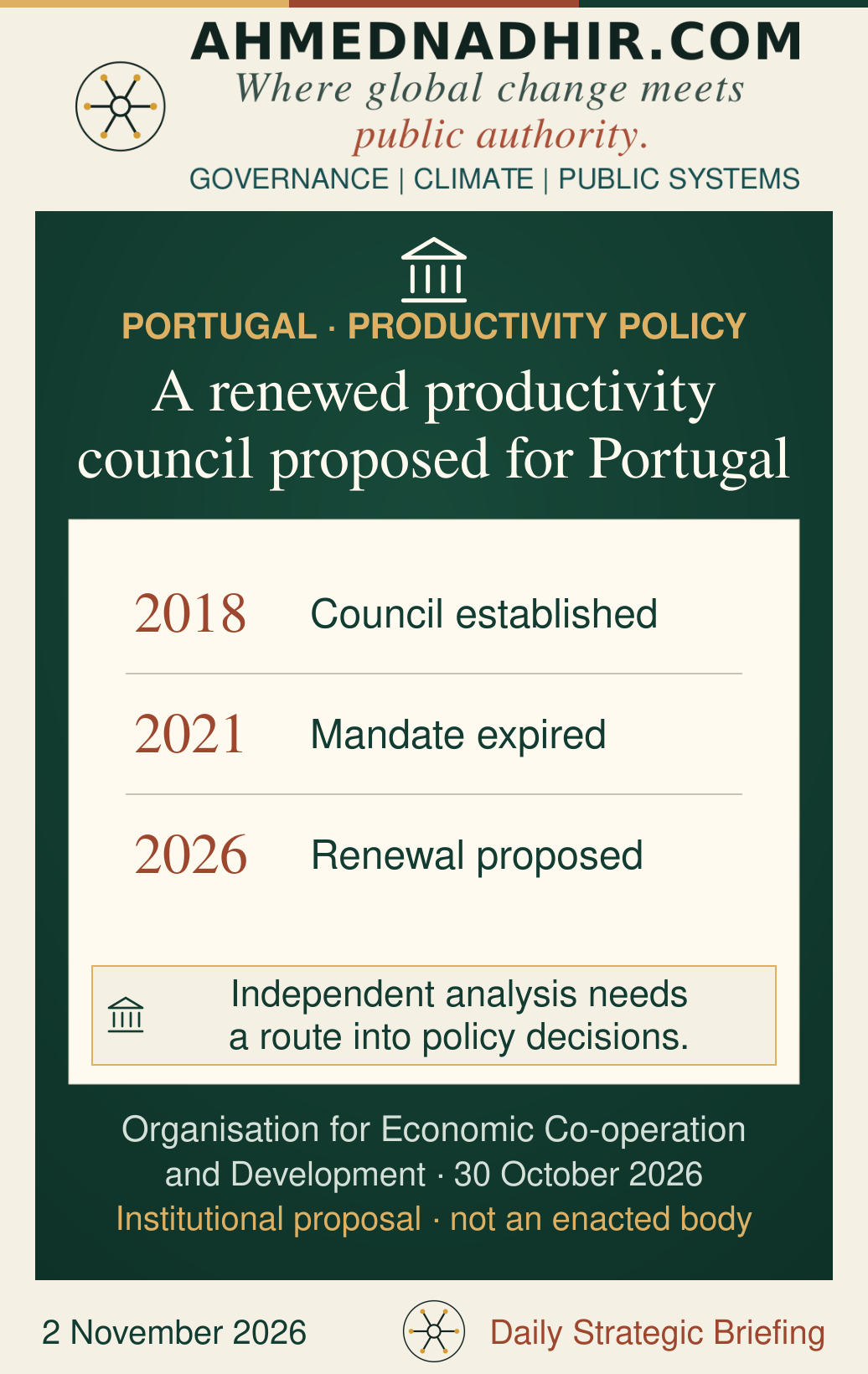
A report published on 30 October by the Organisation for Economic Co-operation and Development proposes a renewed Productivity Council for Portugal. The earlier council was established in 2018 and its mandate expired in 2021. Productivity analysis has continued in ministerial expert units, but the report identifies weak institutional connections between that work and policymaking.
The proposed council would be an analytical body rather than an implementing agency. The report emphasises independence, a stable mandate, access to detailed data and links to central decisions. It recommends government responses to its recommendations. These are proposed arrangements, not confirmation that Portugal has enacted a new council or achieved a productivity gain through it.