
Public administration and innovation
Estonia · Survey evidence and national administrative capacity
Estonia review finds public innovation depends heavily on individual champions
Report and government account: 3 November 2026. Survey fieldwork: December 2025–February 2026.
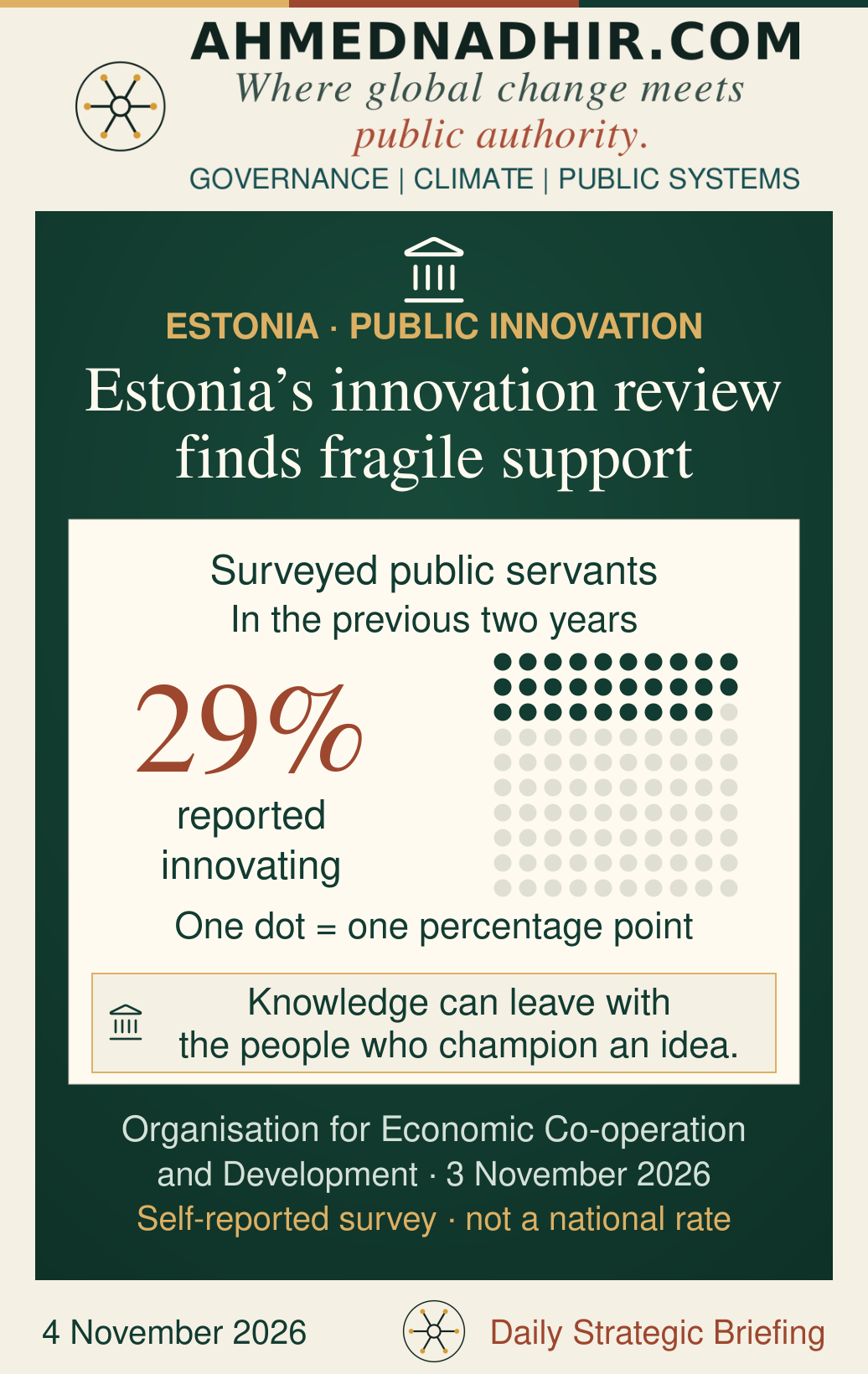
A report published on 3 November by the Organisation for Economic Co-operation and Development (OECD) finds uneven capacity for innovation across Estonia’s public administration. Twenty-nine per cent of surveyed public servants reported innovating in the previous two years. That is a survey response, not a measured share of all government work. The assessment concerns the institutions behind Estonia’s productivity and Eesti.ai ambitions; it does not establish gains from artificial intelligence.
The executive summary describes reliance on motivated individuals, temporary funding and limited evaluation. It warns that knowledge and capacity can disappear when those individuals leave. Estonia’s Government Office independently highlights the difficulty of moving tested ideas into sustained, wider use. Its 3 November account dates the survey to December 2025–February 2026 and identifies interviews, focus groups and document analysis as further inputs.
Health, food systems and regulation
Global proposal · National food labelling and regulatory systems
World Health Organization consults on a common model for identifying foods for regulation
Consultation announced and opened: 2 November 2026. Comments close: 27 November 2026.
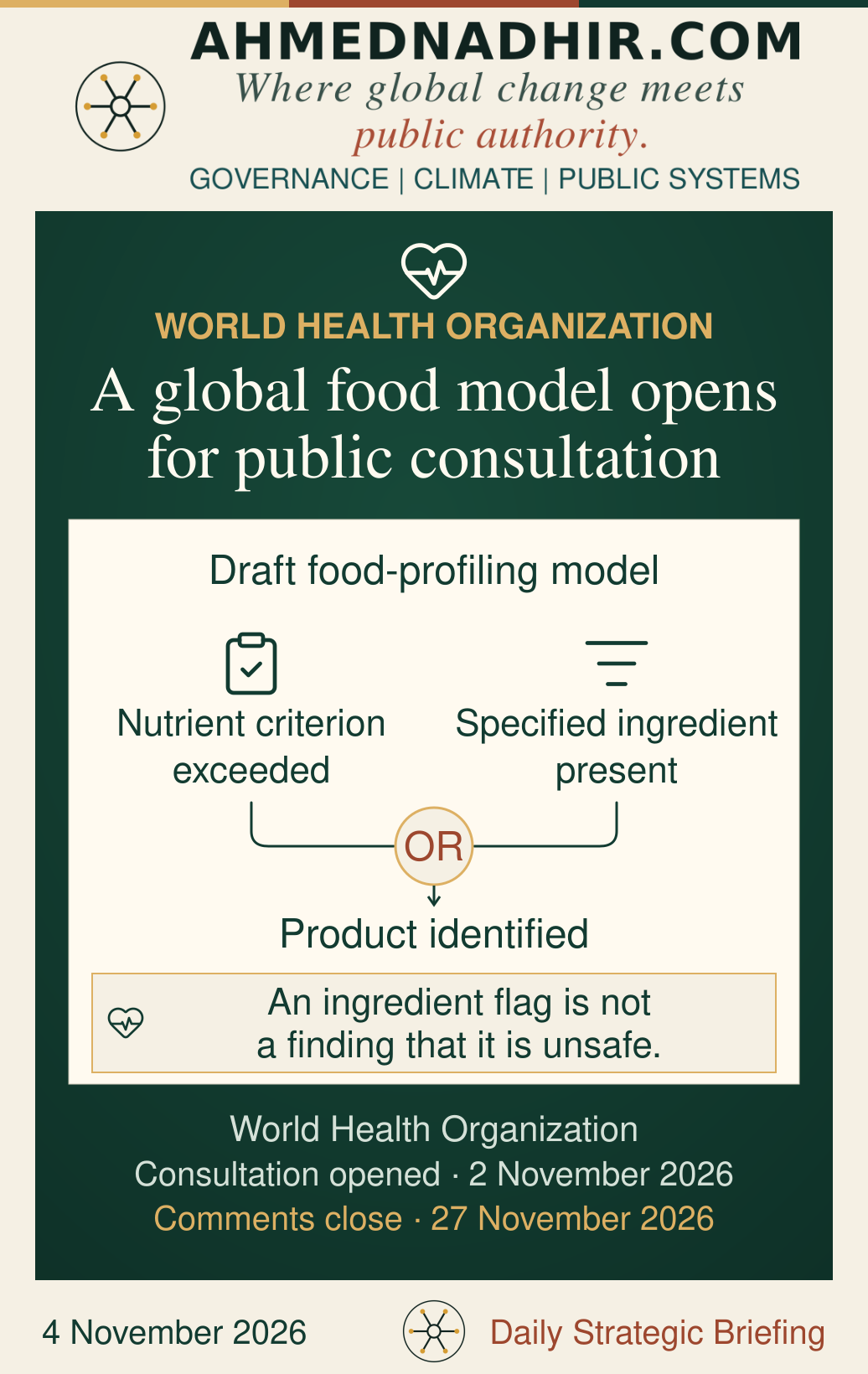
The World Health Organization (WHO) opened consultation on 2 November on a draft model for identifying industrially produced, pre-packaged foods that could fall within regulatory measures. It combines nutrient criteria with specified ingredients, including flavours, colours and sweeteners. A product is identified if it exceeds a nutrient criterion or contains a specified ingredient. WHO explicitly says the ingredient criterion does not mean those ingredients are unsafe.
The proposed model is intended to support more consistent decisions across measures such as marketing restrictions, labelling, fiscal policy and public food purchasing. Comments are due on 27 November. This is a consultation before finalisation, not an adopted global rule, a national legal change or an assessment of any named product.
Climate resilience, health and public finance
Marshall Islands · Majuro, Ebeye and national emergency services
Marshall Islands draws US$11 million as climate and dengue pressures overlap
Release announced: 3 November 2026. Government emergency declaration: 8 October 2026.
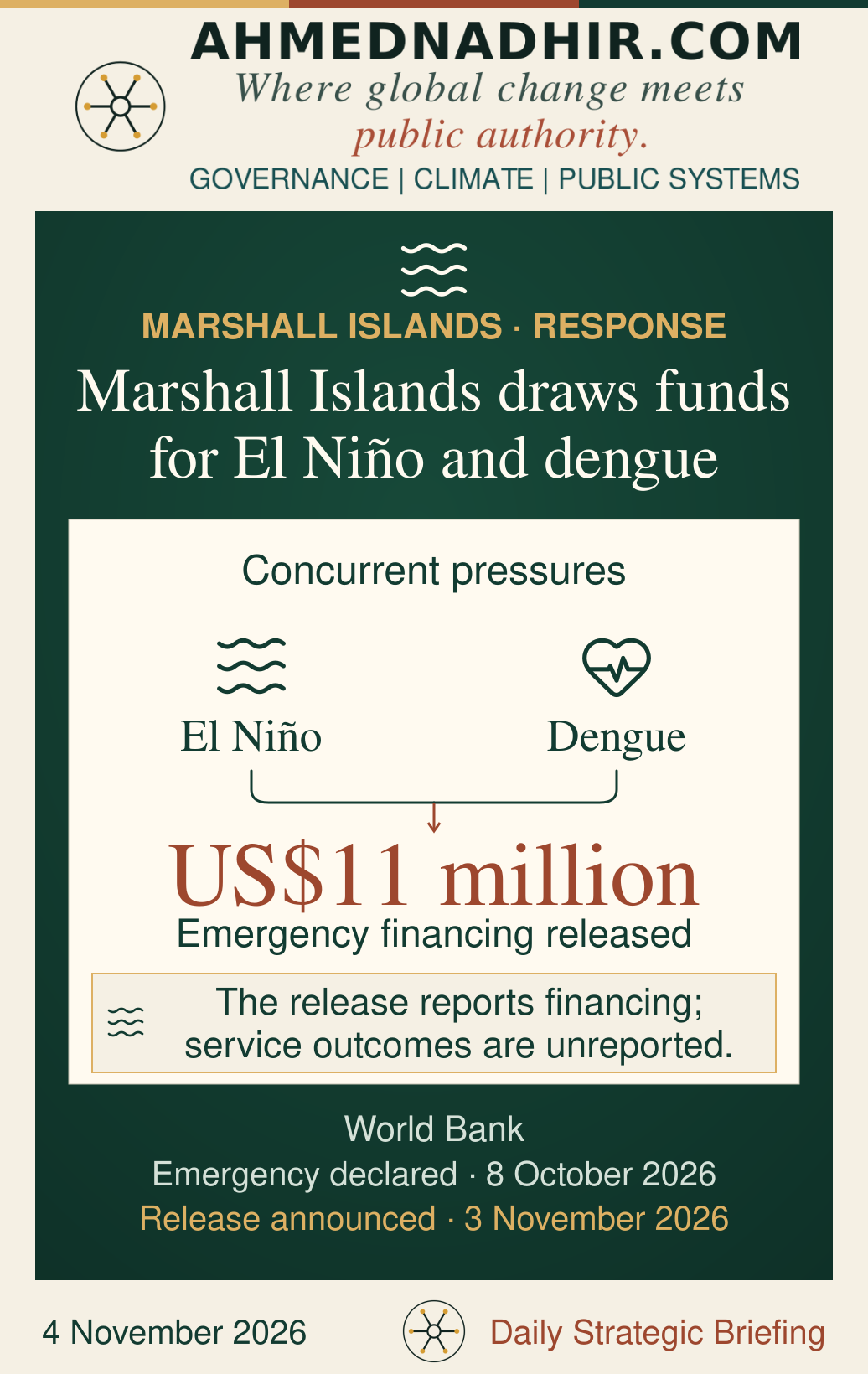
The World Bank announced on 3 November that it had released US$11 million to the Marshall Islands following the government’s 8 October emergency declaration and request. El Niño conditions are straining water supplies and livelihoods, while a dengue outbreak has affected Majuro and Ebeye. The financing comes from a Catastrophe Deferred Drawdown Option, which provides access to pre-arranged resources when a qualifying emergency occurs.
The announcement establishes a drawdown, rather than a proposal for future finance. It does not report how much has reached individual services or demonstrate health or recovery outcomes. An earlier US$3.6 million response to fuel pressures came through a different mechanism and existing portfolio resources; it should not be treated as part of this release.