
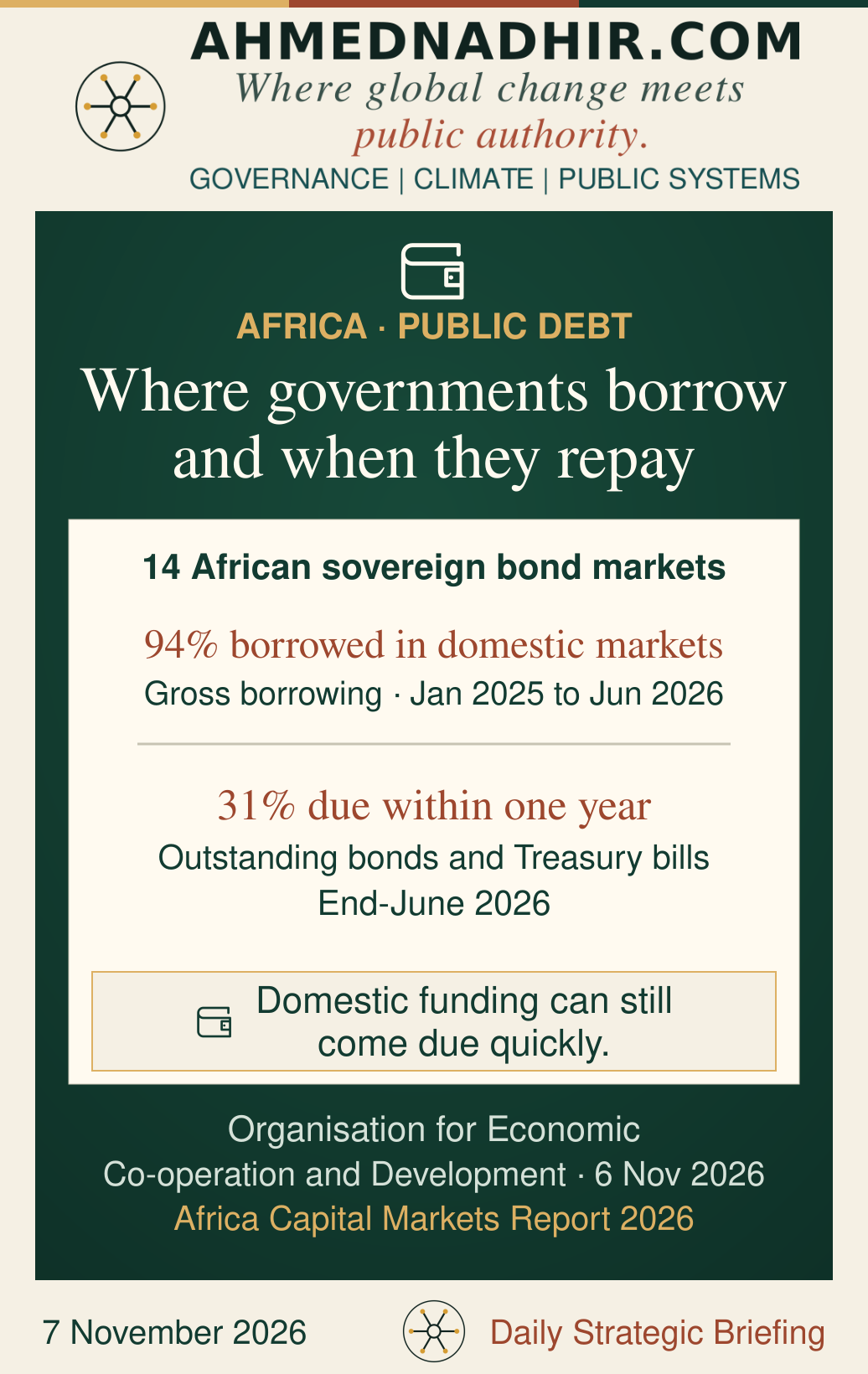
Governments in 14 African economies raised 94% of their gross borrowing in domestic markets between January 2025 and June 2026. At the end of that period, 31% of outstanding bonds and Treasury bills in the study were due within a year, the highest share since the third quarter of 2020. Both findings come from the Organisation for Economic Co-operation and Development (OECD), which released its Africa Capital Markets Report on 6 November. The figures describe different things: where governments borrowed during the period, and how soon the debt outstanding at its end would come due. [1]
A treasury can become less dependent on foreign markets while facing more frequent tests of investor demand. Tanzania’s railway financing offers a practical example of how governments can change the terms on which lenders take risk. An Australian study, in a different field, raises a related question: once a decision has been set in motion, what room does a public institution have to change course?
The risk in the repayment calendar
The OECD sample accounted for about 90% of African sovereign bonds outstanding in June 2026. The 31% figure is a snapshot for the sample; it does not report an individual country’s ratio or establish debt distress. A well-functioning domestic market can roll over large volumes of short debt. The exposure arises when a treasury has to return to market repeatedly and has little room to wait for better terms. [1]
The domestic share also tells different stories across countries. In Uganda, the report says the domestic share of borrowing in the 2024/25 financial year was 26 percentage points above target, mainly because external disbursements were delayed. A higher domestic share can reflect a deliberate strategy or a financing gap that has to be filled. Debt offices can distinguish them by publishing the cash and maturity profile alongside the planned financing mix. [1]
Tanzania can share the lender’s risk
On 4 November, the African Development Bank reported that Tanzania had signed a US$1.2 billion commercial facility for the Tabora to Kigoma section of its standard gauge railway. Tanzanian reporting dated the signing to that Wednesday. The syndicate’s commitments comprise US$720 million of guaranteed lending and US$480 million based on Tanzania’s sovereign credit without that guarantee. The Bank’s guarantee ceiling is US$800 million because it covers the principal of the covered portion and up to two years of interest. The ceiling is separate from the amount lent and must not be added to it. [2][3][4]
The guarantee gives lenders an additional source of payment on the covered portion. Tanzania remains the borrower. The announcement does not establish that the money has all been drawn, that the railway will earn enough to service the loan, or that the guaranteed terms were cheaper than every alternative. The finance ministry’s comparison belongs alongside the railway’s delivery timetable: when payments fall due, when the line could begin earning revenue, and how the budget would absorb a delay or a weaker shilling. [2]
Australia: when an automated decision needs correcting
In a report published on 5 November, Australia’s Centre for Public Integrity calls for an audit and a public register of government systems that make or help make decisions automatically. It also proposes independent oversight, reasons for decisions and effective routes to review. The Centre draws on failures documented by the Robodebt Royal Commission, whose 2023 report called for clear review routes and independent scrutiny of the rules used by automated systems. Robodebt concerned rule-based automation; the lesson applies to public bodies considering artificial intelligence (AI) without requiring those technologies to be treated as interchangeable. [5][6]
A register could tell a person where automation was used. A review has a different purpose: it must allow an authorised officer to examine the evidence, correct a wrong decision and, where the law allows, pause action while a dispute is resolved. In procurement, a public agency can ask a supplier to demonstrate how staff would do that in a disputed case. The Centre’s proposals are research recommendations; the report does not show that a new framework has been enacted or measure how well its proposals would work. [5][6]
The room to act when a plan goes wrong
The debt office needs to know how much comes due in a difficult month. The railway’s financiers need to know which payments the guarantee covers and what the state would carry if the line opened late. An agency using automation needs to know how an officer can intervene before a wrong decision does further harm. These are different responsibilities. In each case, the terms agreed at the start determine how much room a public institution has to act when its assumptions fail.