
A government can press businesses to cut emissions while buying from them on terms that reward little environmental improvement. A working paper dated 30 October, using Italian records from 2015 to 2024, finds that firms more reliant on public contracts subsequently report less green investment. The authors do not find the same negative relationship for green procurement. The authors’ explanation is that ordinary public demand can shelter suppliers from pressure to change.
That finding gives procurement a place inside climate policy. A public contract provides revenue and shapes the return on a firm’s next investment. Two further studies, on US tenders and European climate assemblies, show why the terms attached to access deserve scrutiny alongside the number of people or firms brought into a process.
Italy: the customer can weaken the climate incentive
Working paper dated 30 October 2026 · Records: 2015–2024
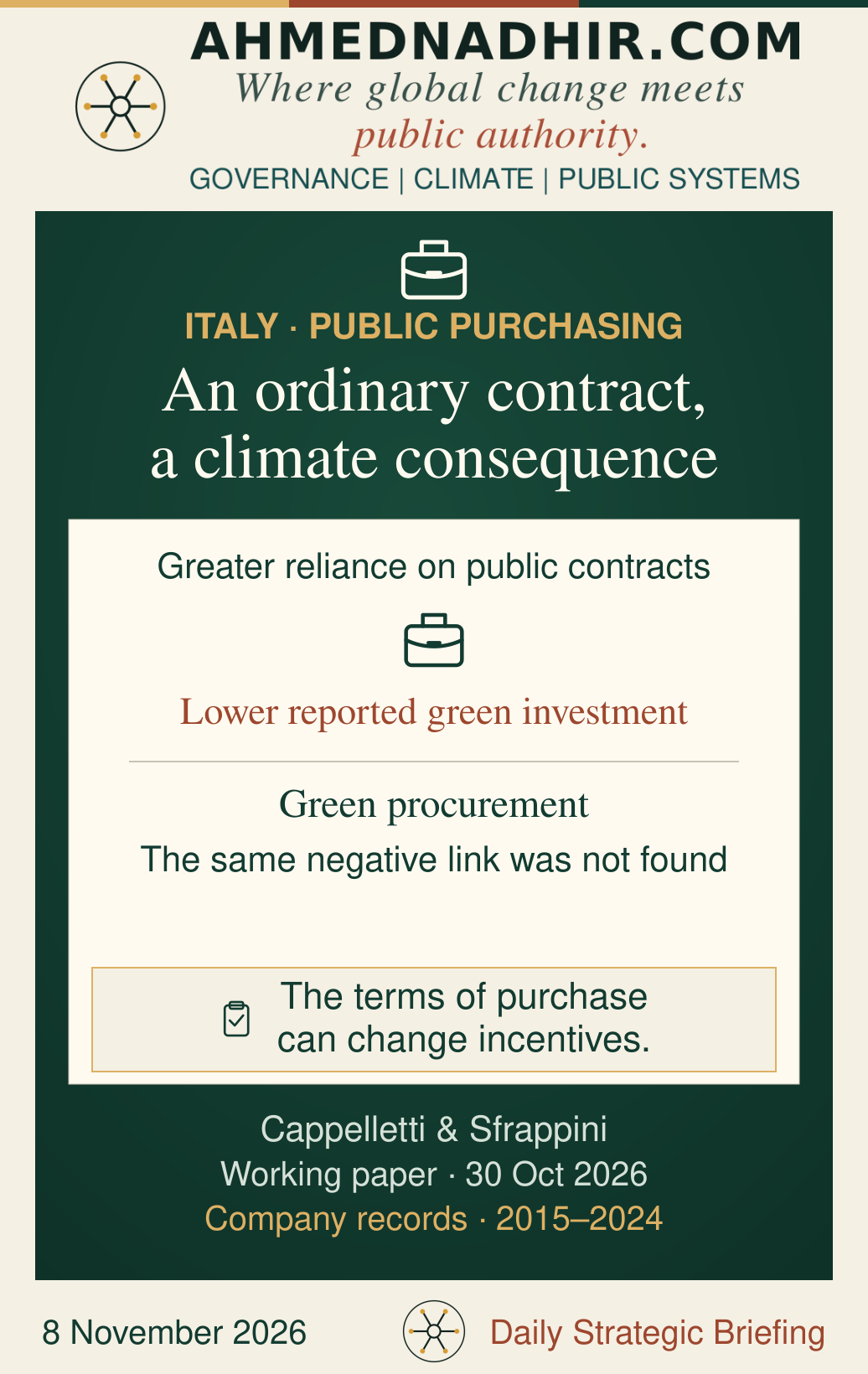
Matilde Cappelletti and Eleonora Sfrappini match procurement records with company accounts for 20,380 Italian firms. Their principal green-investment measure uses references to green technologies in the notes to financial statements. It captures reported investment in firms’ own operations, rather than the environmental performance of every purchase made by government.
The study uses several observational comparisons, including matched winners and losers within a tender. Its interpretation depends on assumptions about firms’ ability to anticipate additional contracts and on the reporting measure. This is a working paper, not a randomised trial or an estimate of emissions avoided. The absence of the same negative relationship in green procurement is suggestive; it does not establish that adding an environmental clause will improve every contract.
For a public buyer, the economic consequence extends beyond the product delivered today. A long stream of orders can influence what suppliers find worth investing in. Environmental requirements therefore need a credible means of verification and a price that can be assessed against delivery. A clause that smaller firms cannot demonstrate compliance with could also narrow entry. The institutional task is to make the desired investment commercially relevant without making access depend on expensive paperwork.
United States: more bidders can coexist with worse delivery
Journal issue: November 2026 · Earlier working paper: June 2024
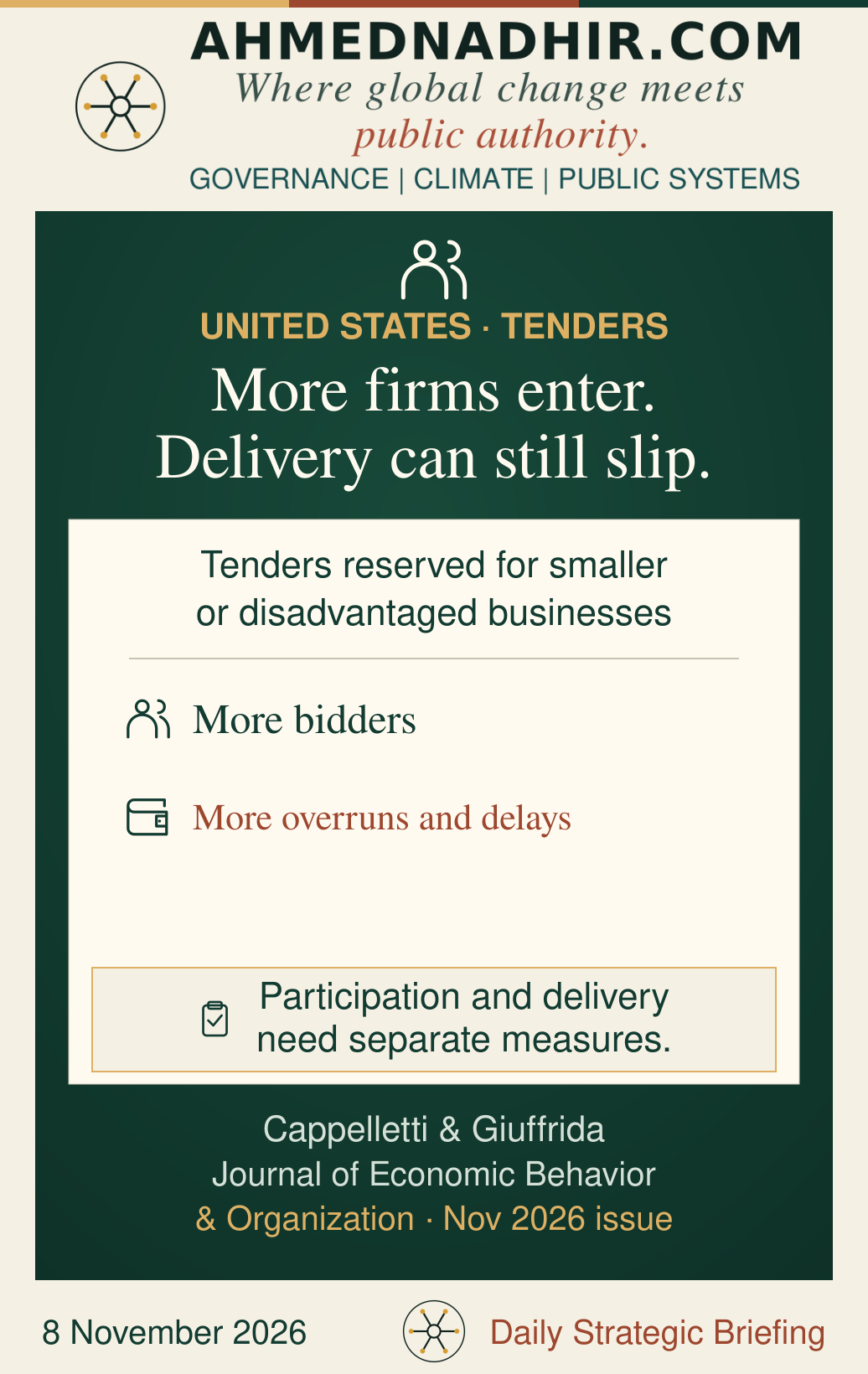
In the November issue of the Journal of Economic Behavior & Organization, Cappelletti and Leonardo M. Giuffrida examine a decade of US federal procurement. They study set-asides, which reserve tenders for small or disadvantaged businesses. Their analysis finds more competition: additional participation by eligible firms more than offsets the exclusion of other bidders. It also finds greater cost overruns and delays. Evidence of longer-term firm growth is mixed.
The tender comparisons use statistical weighting to address differences between reserved and other contracts; a separate analysis examines firms’ exposure to a spending change. These are not randomly assigned programmes. The findings do not establish that inclusion causes poor performance in every setting, or that an unrestricted tender would always be preferable.
The practical distinction is between entry and execution. An award can widen commercial opportunity while leaving a smaller supplier exposed to a difficult delivery schedule or demanding working-capital needs. Those are risks for a buyer to investigate, rather than mechanisms proved by this study. A procurement account that follows bidder entry through to final cost, completion and repeat business would make the trade-off visible. Counting tenders reserved for eligible firms cannot do that on its own.
European climate assemblies: influence needs a route into government
Study published 14 October 2026 · University account: 28 October 2026
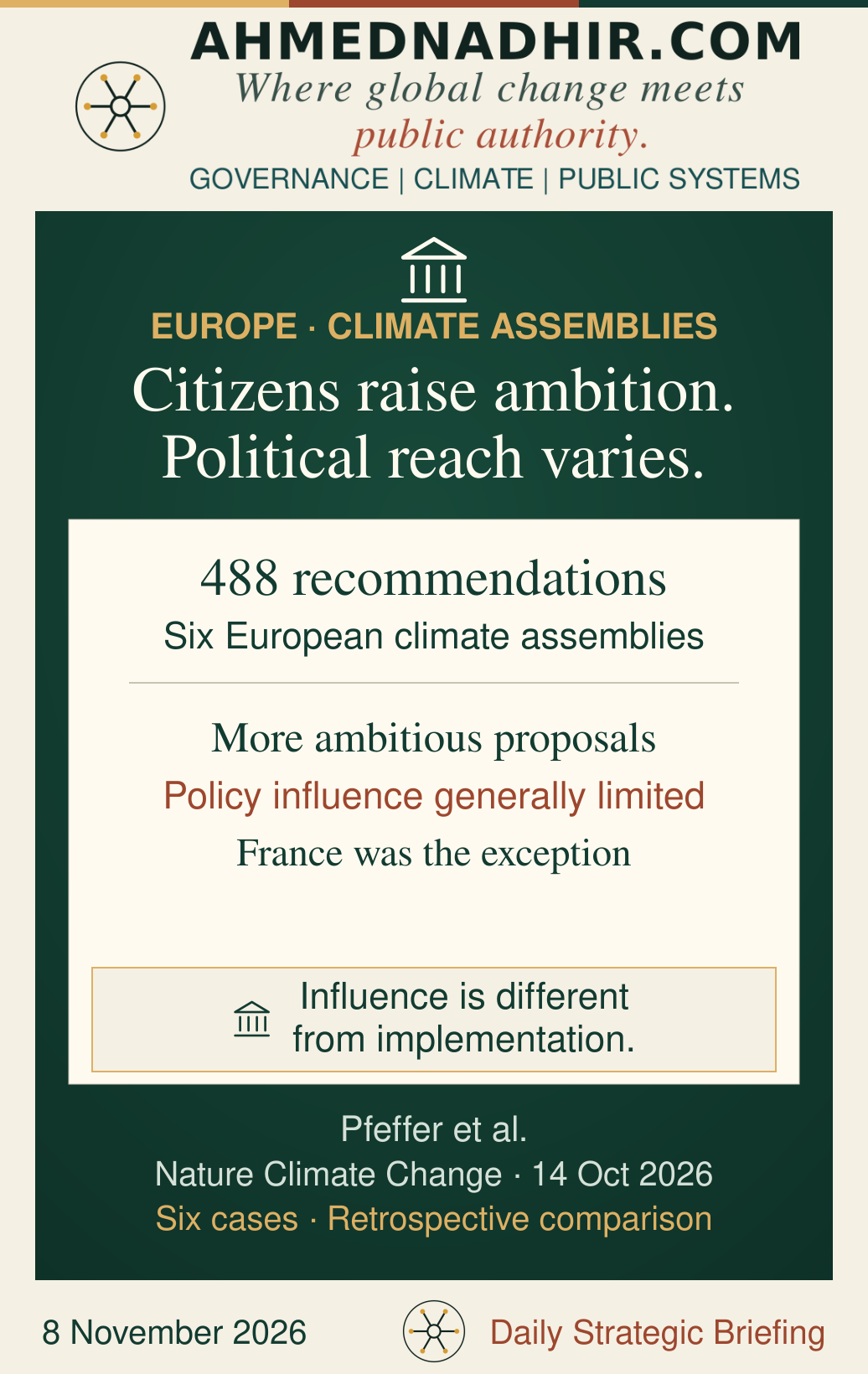
A study published in Nature Climate Change on 14 October assesses 488 recommendations from six climate assemblies in Austria, France, Germany, the United Kingdom, Scotland and Berlin. Janosch Pfeffer and colleagues compare the proposals with existing policy and trace their influence through documents and expert interviews. Citizens proposed more ambitious climate measures, but influence on political decisions was generally limited. France stood out: about a third of its recommendations influenced policy.
The researchers connect the French result with political leadership, delegated authority and public pressure. Influence is broader than full implementation. Six selected cases cannot establish that one institutional design will travel successfully to every political system.
An assembly and a supplier enter government through different doors. Neither gains influence simply by being invited in. For an assembly, the decisive arrangements include whether ministers must answer recommendations, whether a legislature can consider them and whether a budget process can fund them. These are implications of the comparison, rather than outcomes tested across the six cases. A published response that explains acceptance, rejection and subsequent action would make the public value of participation easier to judge.
The terms that make participation consequential
The three studies examine different outcomes and do not establish a single causal rule. Together, they expose a recurring weakness in how public action is assessed. The award, invitation or consultation is easy to record; its consequences emerge later. A more informative account follows the supplier’s investment, the contract’s final cost and the recommendation’s political fate. For public institutions in Kenya, elsewhere in Africa and across the Global South, the useful lesson is a method of scrutiny: trace the promise through the decisions and resources that could make it real. The foreign estimates themselves are not local forecasts.