
A college can point to students entering work related to their training while some of those students see little improvement in earnings. Research dated 5 November finds this divergence in Virginia: the fields later selected for targeted tuition support were more consistently associated with better job matching than with higher earnings, particularly for women. The distinction matters whenever government uses employer demand to decide which courses deserve public money.
Two further readings examine different promises of improvement. In Catalonia, recorded court output and lawyers’ experience of working with court staff tell different stories about remote work. Across ten emerging economies, researchers find that financial and data protection authorities often lack routine ways to handle problems crossing their mandates. The common concern is the distance between what an institution can readily demonstrate and the benefit a student, court user or customer actually needs.
Virginia: matching the course to a job leaves a second question about pay
Working paper dated 5 November 2026 · College entry cohorts: 2016–2020

Sade Bonilla and Daniel Sparks link community-college records with quarterly employment and earnings data. Their working paper compares entrants to workforce programmes subsequently eligible for Virginia’s Get a Skill, Get a Job, Get Ahead initiative, known as G3, with entrants to other workforce programmes. The initiative began in 2021; the students studied entered between 2016 and 2020. This is evidence about the pathways selected for support, rather than an evaluation of the aid itself.
The authors find stronger earnings trajectories for men in several selected fields, with limited earnings gains for women. Employment in an industry related to the programme increased for both. Students were not randomly assigned to fields, so the adjusted comparisons cannot establish that choosing a field caused the difference. Quarterly earnings also combine pay and the amount of work obtained; they are not a direct measure of hourly wages.
For a government funding vocational education, an employer shortage and a worthwhile opportunity for a student are connected judgements, with different evidence behind them. Filling vacancies may meet an industrial objective while leaving the distribution of earnings largely unchanged. Funding tied mainly to placement risks rewarding that outcome without examining it. Student advice, programme selection and public subsidy therefore have a stake in the quality of the work reached, alongside the match between a qualification and an industry. The Virginia estimates do not predict returns to courses elsewhere.
Catalonia: the court’s task count misses part of its service
November 2026 journal issue · Return-to-office mandate: December 2023 · Earlier working paper: July 2026
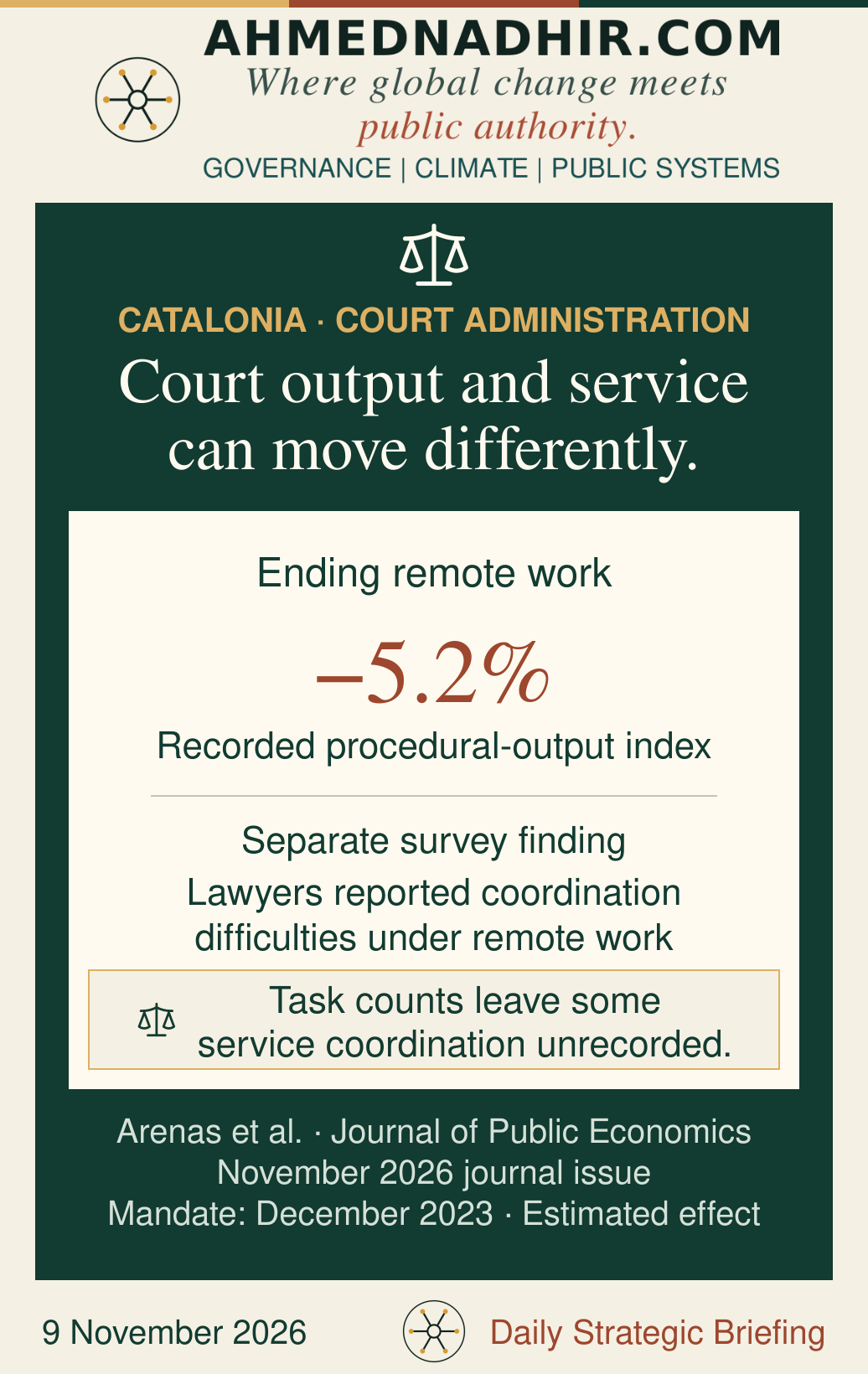
Andreu Arenas, Marc Bosch and Nerea Frias study the removal of remote working for administrative staff across 245 Catalan courts. Courts had used remote work to different degrees before the December 2023 mandate. Comparing their subsequent changes, the November Journal of Public Economics article estimates a 5.2% fall in recorded procedural output, with no detectable change in the document-quality or absence measures examined. This is an estimate of ending an established arrangement, rather than introducing remote work from scratch.
A separate survey reveals the tension. Managers and supervisors viewed remote working favourably, while lawyers reported coordination difficulties. The digital platform records document and case-processing tasks more readily than the synchronous work of coordinating with external users. The study does not estimate one overall welfare gain or loss, and perceptions of coordination are different evidence from the administrative output comparison.
The managerial choice is consequently about the organisation of tasks as well as staff location. An office-presence target can sacrifice useful processing time; a digital-output target can overlook the cost borne by someone trying to move a case forward. Protected contact periods and hybrid arrangements are plausible responses, although their superiority is not established by this study. For other public services, the transferable issue is which parts of service disappear from the performance record. The 5.2% estimate belongs to this setting.
Digital finance: a customer’s problem can cross two regulators
Report dated October 2026 · Cambridge research account: 2 November 2026 · Evidence cut-off: 30 September 2026
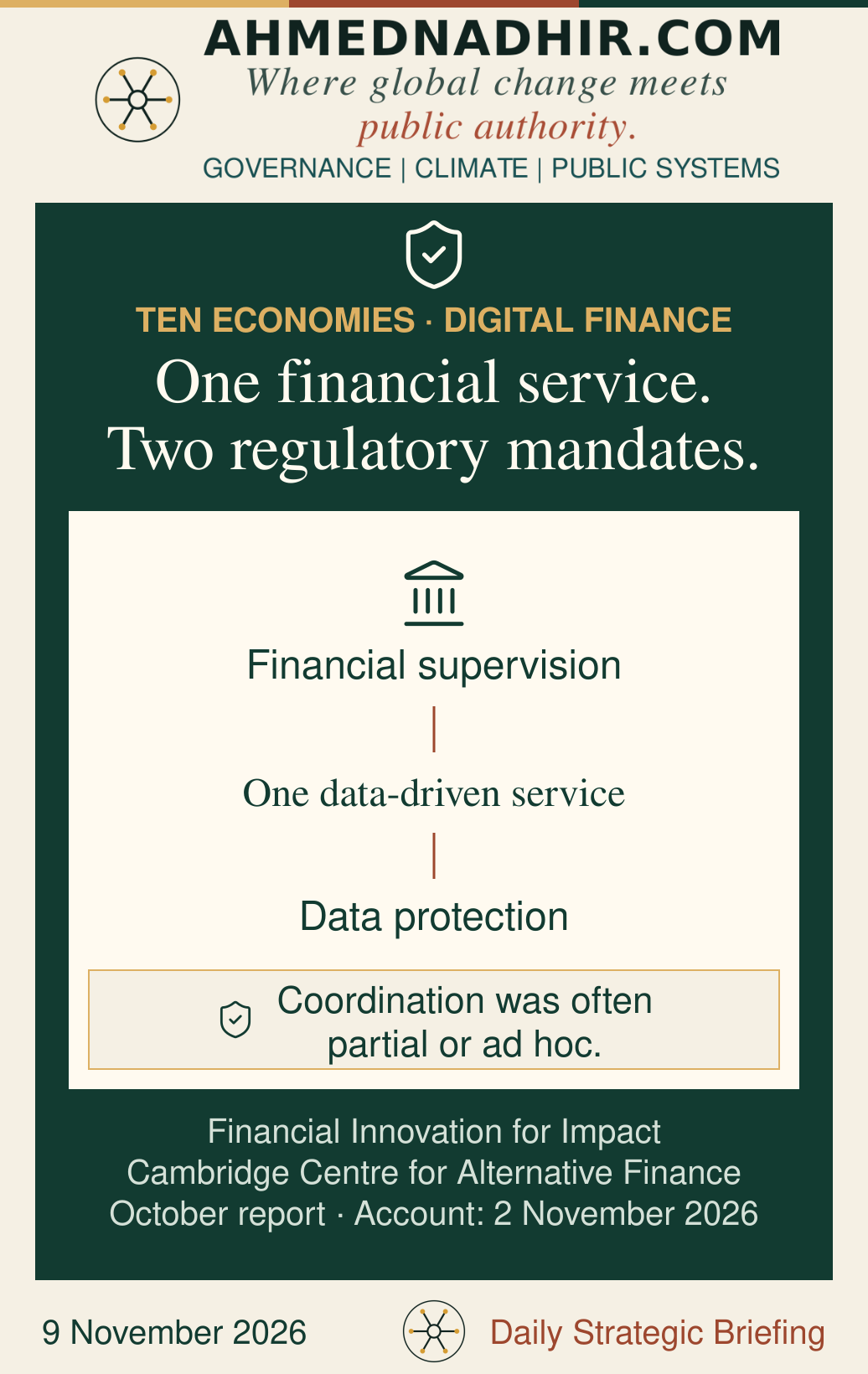
A customer disputing how personal data influenced a loan may need financial supervision and data protection to work together. Joined-Up Regulation, produced by Financial Innovation for Impact with the Cambridge Centre for Alternative Finance, examines this boundary across ten emerging economies, including Kenya, Uganda, Ethiopia, Nigeria and South Africa. The October report, presented by Cambridge on 2 November, draws on 27 interviews, four convenings and documentary research.
It finds cooperation frequently partial, ad hoc or dependent on individuals. In areas including fraud prevention and open finance, data protection authorities were often involved after financial frameworks had been designed. The report argues that much of the obstacle is institutional, although lawful information-sharing gateways still matter. Its evidence is qualitative and uneven across countries; its proposed coordination index records arrangements and practices, rather than proving that customers obtain better outcomes.
The consequence is especially important for smaller providers and people with limited resources to pursue a complaint. A regulator may fulfil its own mandate while an unresolved part of the problem passes to another authority. Treating the referral as completed can then leave the customer carrying the cost of institutional separation. The useful distinction is between agencies exchanging a file and agencies resolving a problem. A shared procedure has public value when it changes that experience, which requires outcome evidence beyond the existence of a forum or agreement.
The benefit beyond the recorded result
These studies do not measure a common effect. They expose three distinct ways in which a credible institutional result can be incomplete. A training field can connect students to an industry without comparable earnings gains. Court staff can complete more recorded work while external coordination suffers. Regulators can establish channels without demonstrating that a customer’s problem is resolved. For public institutions, the analytical advance is to recognise where success changes meaning as it passes from the organisation to the person using it. That changes which evidence deserves weight in a funding decision, a staffing arrangement or a regulatory assessment. A sound performance account preserves the useful result and makes the unresolved benefit visible.