
East African ministers have given the region two dates to watch. The East African Community Secretariat says it was directed to work with Kenya on a regional disaster dashboard by 25 November and to develop an implementation plan by 30 November. Ministers adopted the El Niño response plan on 6 November; the Secretariat announced it on 9 November. The deadlines concern tools for coordination. They tell us when to look for those tools, rather than when to expect flood protection on the ground.
The regional plan matters most where a local decision depends on information or resources from elsewhere: across a river basin, along a transport corridor or at a border crossing. The same dependence takes different forms in two further readings. A new connection relies on a grid that can keep supplying it. An official notice relies on routes by which people can find the current version. In each case the work extends beyond the institution that makes the initial commitment.
The next decisions sit on both sides of the border
Adopted 6 November 2026 · Secretariat announcement 9 November 2026
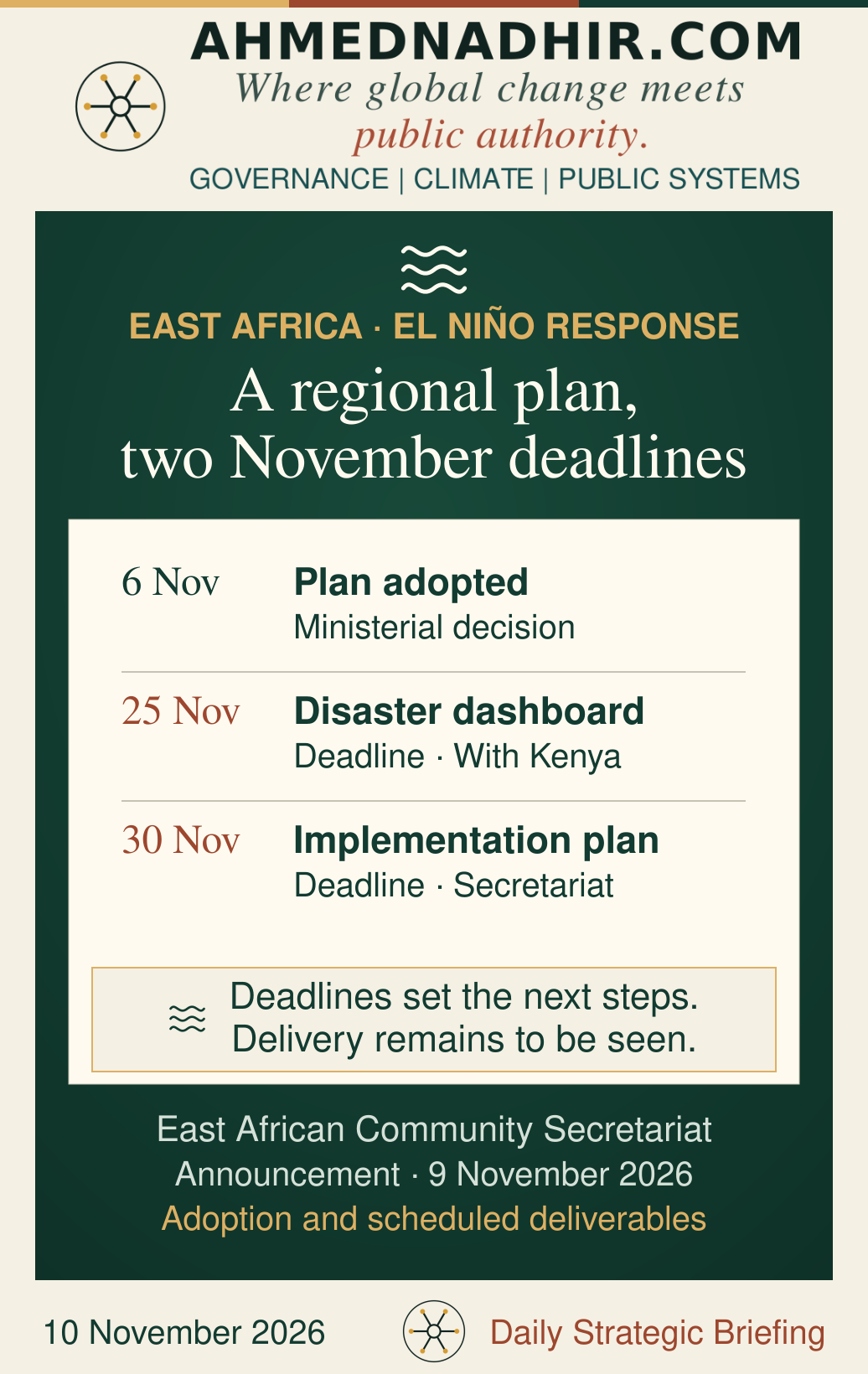
The East African Community plan complements national arrangements in places where separate responses can leave gaps. Its named priorities include the Lake Victoria basin, Kenya’s Tana River and coast, and Somalia’s Juba–Shabelle corridors. The Secretariat is to coordinate regional work through a steering committee, an emergency coordination unit and national focal points. The announcement also calls for resource mobilisation, without setting out a funded schedule of operations.
The distinction between a seasonal outlook and an operational warning is consequential. The regional climate centre’s September outlook describes the chance of wetter conditions over a season and advises users to consult shorter-range products. A seasonal signal gives agencies grounds to prepare. It cannot tell a roads officer when to close a particular crossing or a water authority when to warn a downstream settlement.
A shared dashboard could help if it resolves the questions that delay action: which warning is current, who received it and which authority can act across a boundary. A transport corridor may need a diversion before a route becomes impassable; an upstream warning is valuable only if it reaches the next authority in time to make that decision. The two deadlines therefore matter as opportunities to establish working arrangements. The Secretariat’s announcement does not establish that the dashboard is operational or that resources have been released.
Connections rose. Dependable supply was harder to establish
Evaluation published 22 October 2026 · Portfolio: fiscal years 2015–2025
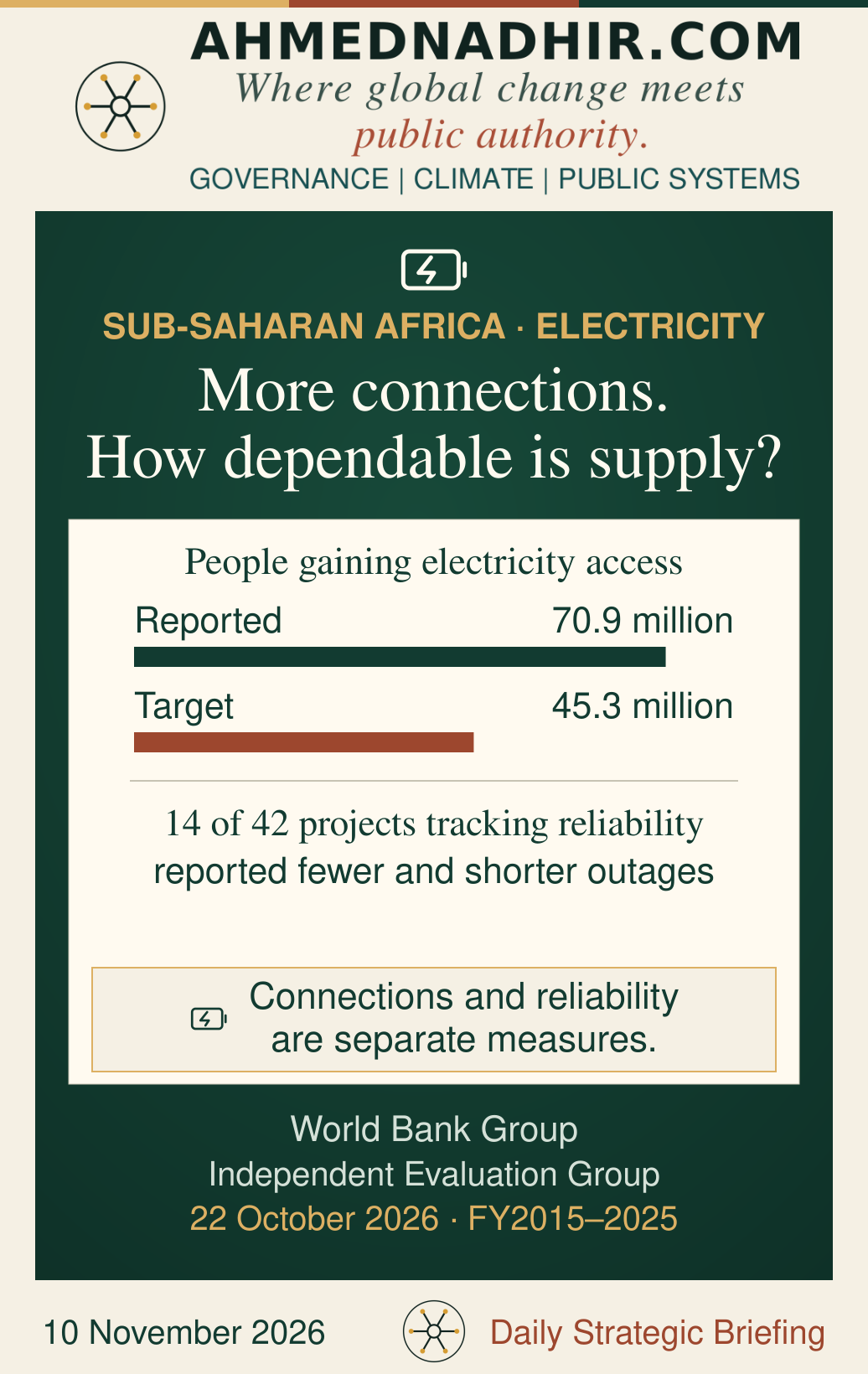
The World Bank Group’s Independent Evaluation Group found that closed World Bank operations tracking access reported about 70.9 million people gaining electricity access in sub-Saharan Africa, against a combined target of 45.3 million. Reliability evidence was thinner. Of 42 projects that tracked reliability outcomes systematically, 14 reported improvements for users through fewer and shorter outages. These are project-reported results for different subsets, rather than a count of all connections or outages in the region.
Kenya illustrates why expansion and reinforcement have to be considered together. In the evaluation’s account of the country’s electrification drive, access expanded while outage duration and system losses worsened in the project area it examines. The study identifies distribution growth without sufficient transmission reinforcement as a possible mechanism, drawing on case evidence and interviews. It does not isolate the effect of each investment, or establish the present condition of every Kenyan feeder.
A connection target is useful for deciding where to extend access. A different account is needed to judge whether the network can support workshops, shops and households at the hours they need it. A utility can bring many new customers onto a feeder and still face a bottleneck upstream. That changes the investment question for regulators and ministries: the return on an additional connection depends partly on the capacity and maintenance of the system to which it is attached.
An official notice may reach people through someone else
Report published 9 November 2026 · Government communicators surveyed in 2025
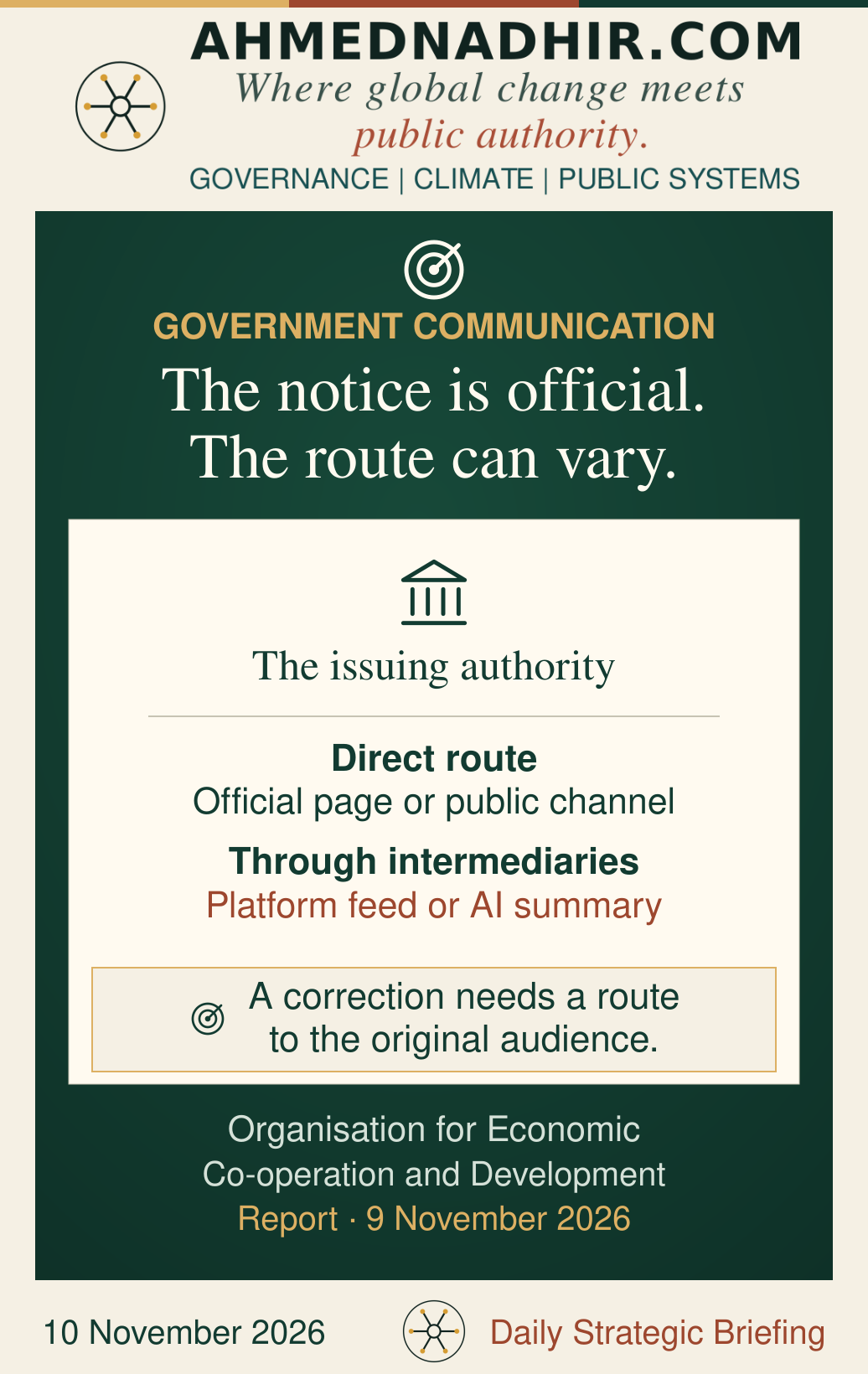
The Organisation for Economic Co-operation and Development’s new report on government communication draws on a 2025 survey of public communicators and country examples. It describes a change in distribution: people can encounter public information through recommended posts, online creators or answers generated by artificial intelligence (AI), without visiting the issuing authority’s page. Respondents also report uneven adoption of AI within their own teams. The survey describes officials’ experience; it is not a representative measure of what citizens see.
That change separates the authority to issue a notice from control over its circulation. A message about a road closure, for instance, may be useful in its original form and misleading once detached from its location or expiry. The issue is sharper when an initial notice is widely copied and a correction travels by a different route. A count of posts or views will tell a public agency little about whether the people affected found the corrected notice.
For a public institution, the practical choice is how much of the distribution it can entrust to intermediaries. A clearly dated original, a durable public address and a direct route for urgent corrections give residents something against which to check what circulates. Platform reach can complement that arrangement. The report does not test which combination works best in Kenya or quantify how often automated summaries lose an important qualification.
Where the service depends on the next link
The regional disaster plan needs agencies that can act on a shared warning. An electricity connection needs enough capacity upstream to serve the people it reaches. A public notice needs a route by which a correction can reach those who saw the original. These are different kinds of evidence, but they make a common point about institutional responsibility: the part a public authority can readily count or announce often depends on work carried out elsewhere. What matters to the user is whether those parts operate together, at the time they are needed.