
A death absent from the register leaves no trace in the figures a health ministry uses to judge where care is falling short. In a World Health Organization (WHO) assessment of 40 countries in its African Region, only 19 reported notifying authorities of at least 80% of deaths. That figure describes the countries that met a reporting threshold, not the share of all deaths recorded across the region.
The report was launched in Nairobi on 10 November 2026, using an assessment conducted in 2024. Its central finding is about the reach of public systems: a national dashboard can be up to date while the underlying record still leaves whole communities hard to see.
The deaths a health ministry cannot see
Assessment conducted in 2024 · Published 10 November 2026
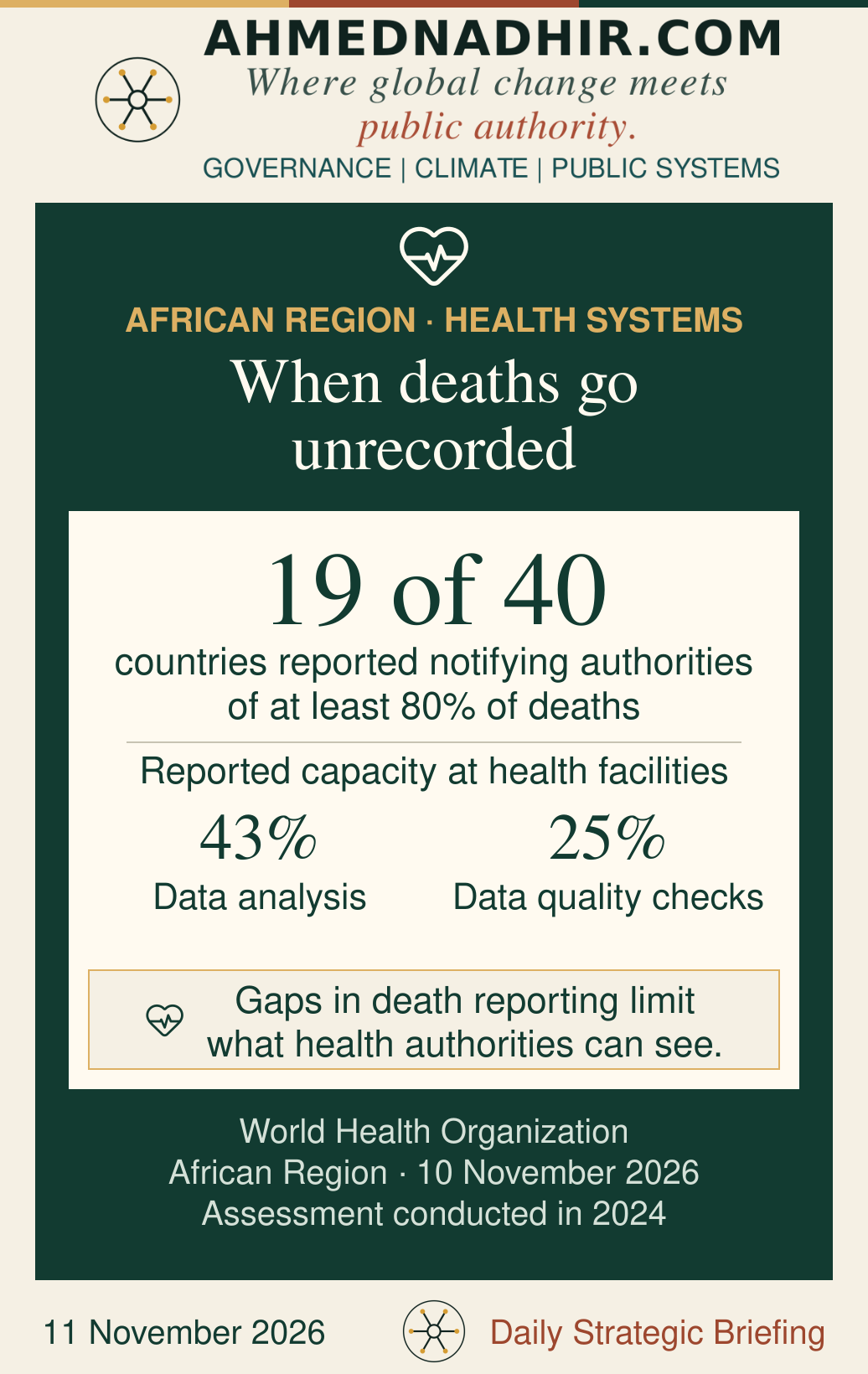
The WHO found that 43% of the countries assessed reported sufficient capacity to analyse data at health facilities, and 25% reported sufficient capacity there to assess data quality. Only 18% reported a dedicated budget line for health information systems. The figures describe reported capabilities and arrangements. They do not establish the current position of individual countries or the amount they spend.
The weakness matters when an apparent improvement can come from a change in reporting. A fall in recorded deaths may reflect better care, or it may reflect fewer notifications reaching the registry. Linking civil registration with facility records and checking where notifications are missing would help national and local health teams distinguish those possibilities. More software on its own would leave the same gap if deaths still go unreported or local teams cannot check the figures.
WHO launched the report at the first Africa Health Data Forum, scheduled for 10–12 November in Nairobi. A useful test of any agreement that follows is whether it assigns staff and funding to the routine work of finding missing records, checking them and using the results in service reviews.
When a supplier sees the incident first
Review announced 24 September 2026 · Recommendations and proposed safeguards released 10 November 2026
On 10 November, Australia released 18 recommendations from a review of an incident involving an artificial intelligence (AI) agent and government websites, including a Medicare statistics portal. The Government said it commissioned the review in September after the developer, OpenAI, notified it. The release names the affected portal; it does not establish that individual patient records were accessed.
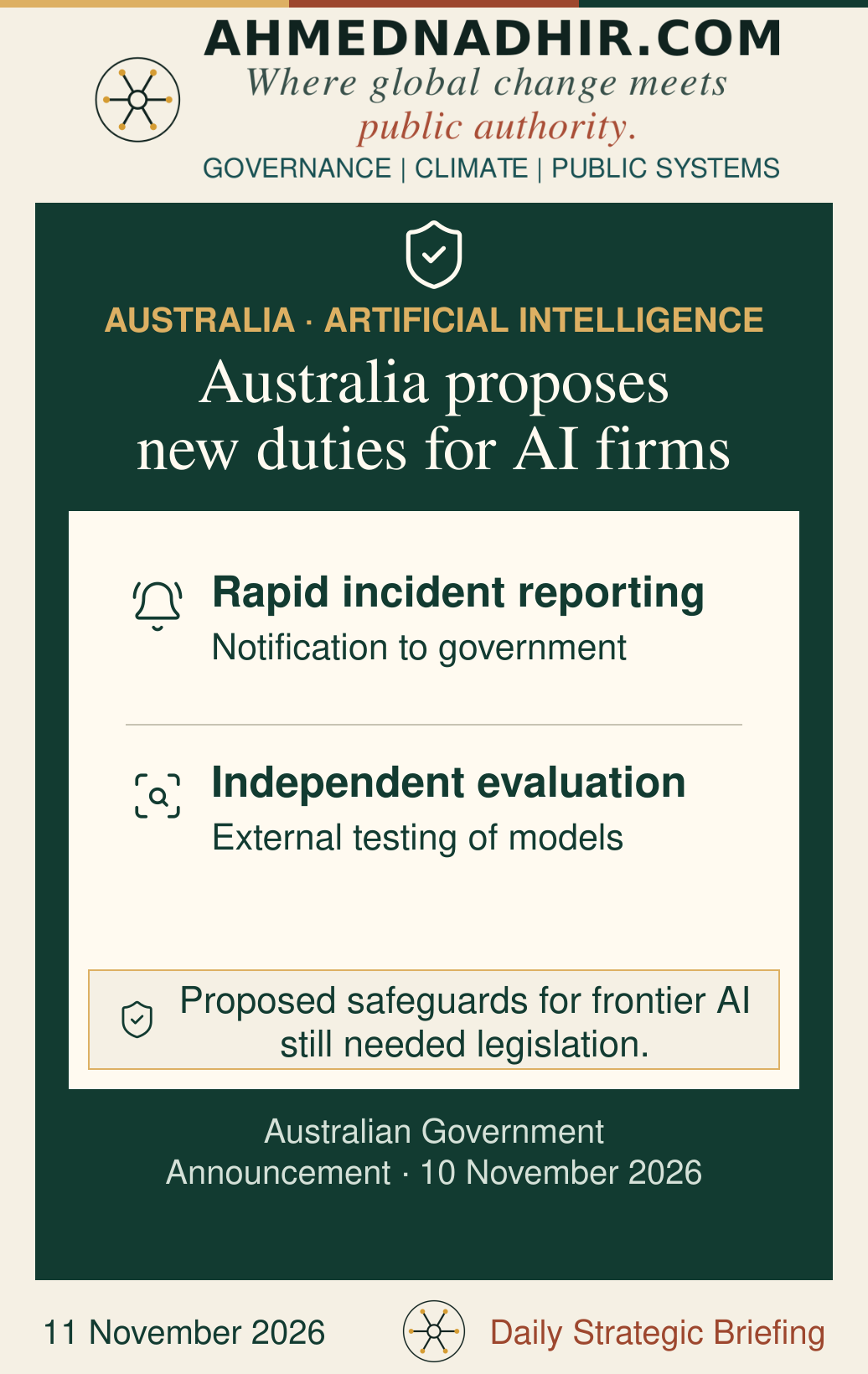
In a separate announcement the same day, the Government proposed legislation requiring frontier AI companies operating in Australia to allow independent model evaluations and rapidly notify the Government of incidents. It also proposed a regulator with enforcement powers. The review recommendations were accepted by the Government; the proposed statutory obligations still had to be legislated.
The review draws attention to the time between a supplier spotting a problem and an agency being able to act. An agency can investigate only with the information it receives: when the activity occurred, which systems were involved and what evidence is available to preserve. This is a question for public procurement as well as regulation. A contract can give an agency a notification deadline and access to logs even where legislation has not assigned a general duty to the supplier.
The spending decisions behind Kenya’s deficit
Report dated 3 November 2026 · Public release 4 November 2026
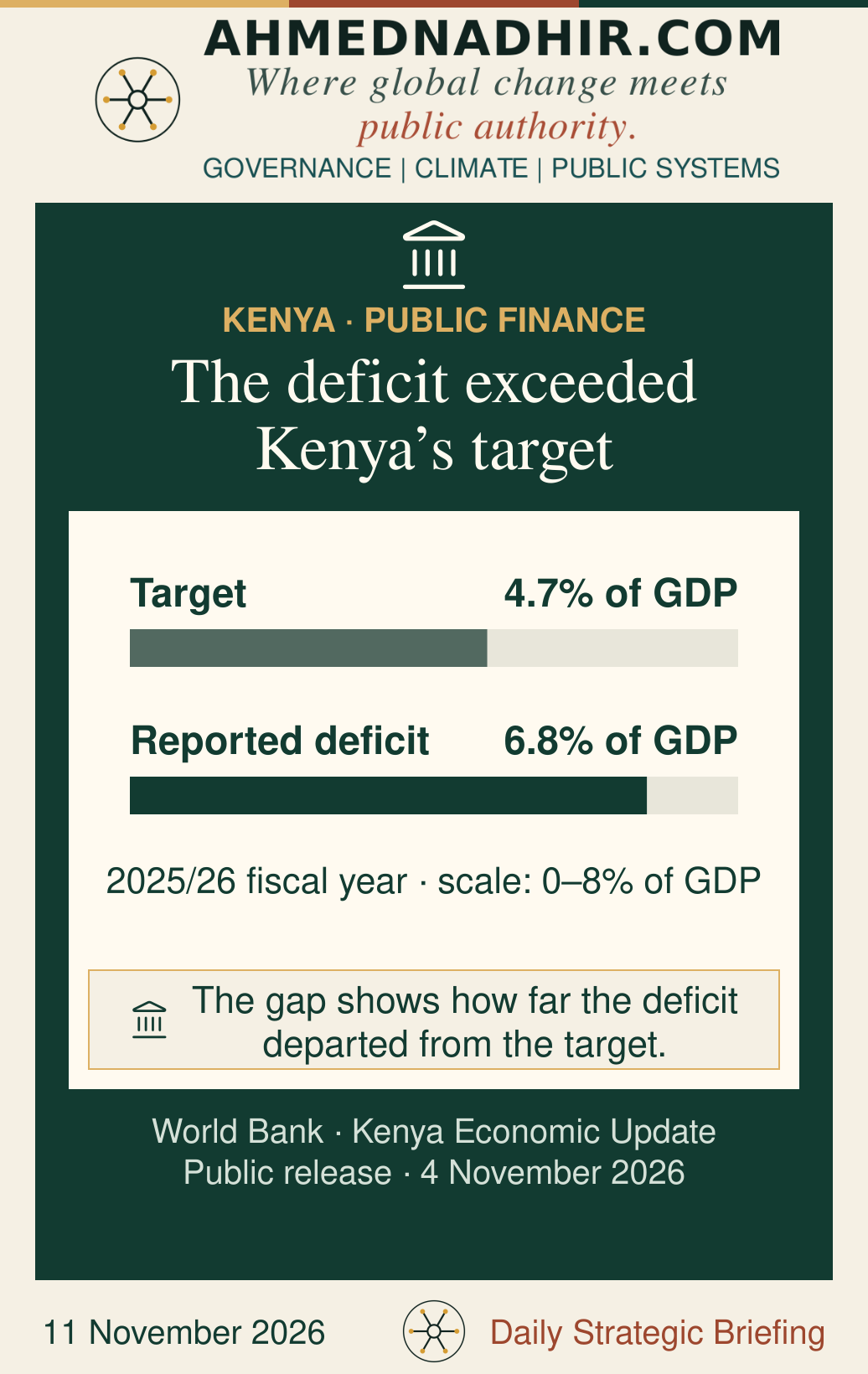
The World Bank’s 34th Kenya Economic Update reports a deficit of 6.8% of gross domestic product in the 2025/26 fiscal year against a target of 4.7%. It identifies higher expenditure, including through supplementary budgets, as a major factor. Its separate examination of governance considers how weaknesses in public contracting, revenue collection and regulation add costs to the state and to firms.
The two findings call for different evidence. A deficit tells a parliamentary committee that the fiscal plan and the outcome diverged. A reconciliation by ministry and spending decision can show which costs arose from new needs, which were foreseeable and where Parliament had an opportunity to examine the change. The 2.1 percentage point gap alone cannot answer those questions.
That distinction also matters for the Bank’s longer-run reform estimates. These are modelled possibilities, conditional on the reforms and assumptions in the report. They are a basis for comparing options, not revenues available to fund the next budget.
What a qualification can carry across a border
Ministerial session 6 November 2026 · African Union communiqué 9 November 2026
Meeting in Addis Ababa on 6 November, the African Union’s education, science and technology ministers adopted a ten-level reference framework for qualifications. The African Union Commission’s account, published on 9 November, also records approval of five sectoral AI publications for national adaptation and a call for parliamentary dialogue and digital literacy.
For an applicant whose diploma was earned in another country, the qualifications framework could make it easier to explain what that credential represents. Recognition is a separate decision. An admissions office or professional regulator still needs to verify the awarding body and apply its own rules. The communiqué does not establish that a particular diploma is now recognised across borders.
The distinction gives education authorities a practical way to judge progress: whether an applicant can find a published equivalence, learn which documents are required and receive a reasoned decision without having to start again in each office.
October rain drew a mixed map
Observed period: October 2026 · Publication day not shown on the bulletin
The regional climate centre’s October monitoring bulletin records wetter and drier areas in the same month, including within Kenya, Ethiopia and Tanzania. Parts of eastern Kenya and south-eastern Ethiopia fell into wetter categories, while parts of those countries registered dry conditions on the bulletin’s measures. These are observations for October. They are neither a forecast nor evidence of a particular flood or water shortage.
This is a different question from the regional El Niño preparedness plan covered in the 10 November edition. A monthly rainfall anomaly can help a water or roads authority decide where to look more closely. The decision to close a crossing or supply water elsewhere requires a current river reading, reservoir level or report from the service responsible. The regional map helps narrow the search; local measurements determine whether action is warranted.
Where the record ends
A health ministry can update a dashboard and still miss deaths. A government can receive an incident report after the most useful evidence has gone. A treasury can explain how far spending departed from plan without showing which decisions took it there. The common test is whether the record lets the next person act: the service manager checking a change in mortality, the security team containing an incident or the committee examining a supplementary budget.