
A government can pay benefits through a phone and still be unable to correct a failed payment without help from a supplier. A new paper by Melody Musoni asks how African governments can gain the benefits of shared digital systems while retaining the ability to change providers, protect personal data and resolve errors for the people who use them.
The distinction matters well beyond digital infrastructure. A home blood pressure reading is useful if someone can follow it up; a computer-generated category is useful if someone can challenge it. In each case, the ability to correct an error is part of the service.
A public service needs a way to change suppliers
Discussion paper published 4 November 2026 · Togo’s example began in April 2020
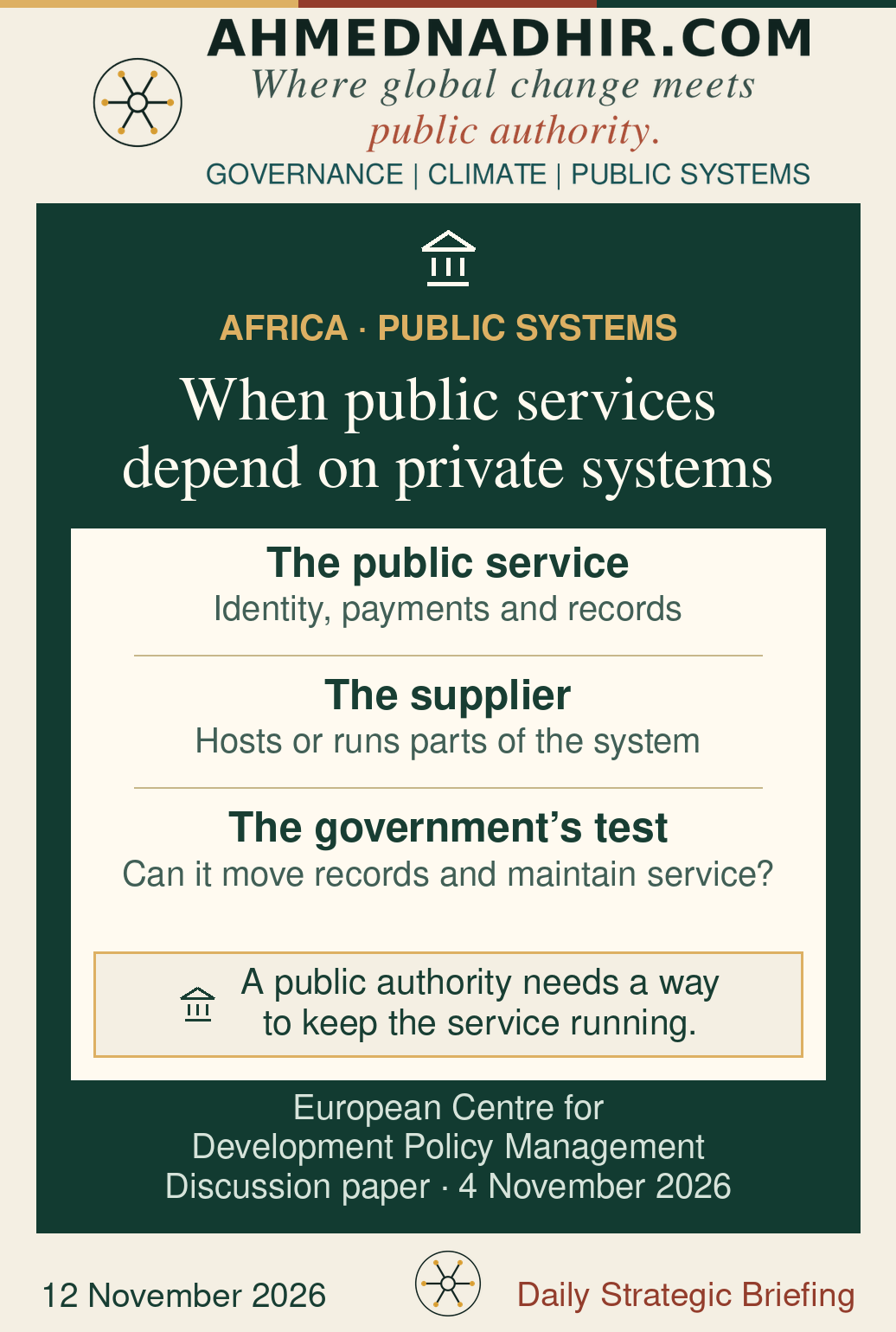
Writing for the European Centre for Development Policy Management, Musoni examines how shared digital identity, payments and data exchange can support public services across Africa. Togo’s Novissi programme illustrates the benefit: during the pandemic, the government used digital registration and mobile money to deliver emergency cash. Its early eligibility rules drew on voter registration, while access to the service depended on being able to register by phone. The programme shows how existing systems can speed up delivery and how their rules can shape who gets through.
The paper also examines what happens when essential parts of those systems depend on a few cloud providers. A ministry can commission the service and remain accountable to users while a supplier controls the tools needed to migrate records or restore an interrupted system. Musoni identifies that dependency as a risk. The paper is a comparative policy analysis; it does not measure the prevalence or cost of supplier lock-in across African governments.
For a ministry commissioning shared infrastructure, an early test is whether it could transfer records securely and keep benefits flowing if a supplier changed its terms or a contract ended. A separate question is how a person without a working phone or with a mismatched record can resolve the problem. The two safeguards answer different risks: dependence for the government and exclusion for the user.
Home blood pressure checks need a route to follow-up
Published online 6 November 2026 · Participants assessed from August 2023 to December 2024
In The Lancet Global Health, Ruth Lucinde and colleagues compared home readings supported by community health workers with daytime ambulatory monitoring in two rural surveillance populations in Kenya and The Gambia. The analysis included 1,279 adults aged 30 or above with valid readings from both methods. Workers trained participants to take readings at home over three to seven days. The study excluded pregnant women.
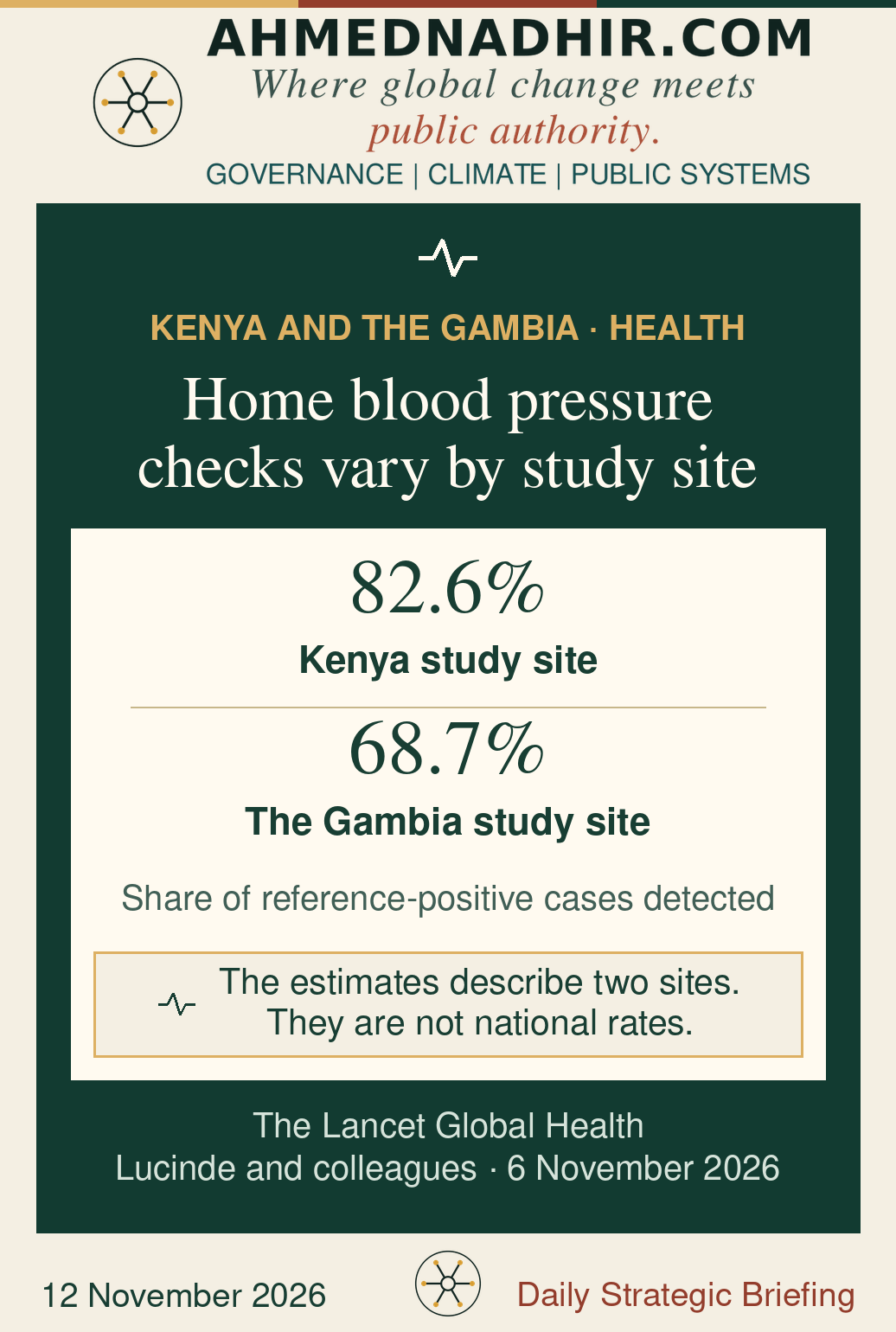
Against the daytime reference, age-standardised sensitivity was 82.6% in the Kenyan study population and 68.7% in the Gambian one. The corresponding estimates of specificity were 82.4% and 83.5%. Roughly six in ten participants with positive home results were also positive by the reference method, on the study’s age-standardised estimates. These are results for two populations, not national performance rates. The study did not test whether using the method improved treatment or long-term blood pressure control.
For a health service considering wider use, the cost of reaching a household is only one part of the decision. An expansion would also affect how many people need follow-up, how quickly they can be seen, and how the service catches cases the method misses. The two study populations are reason to test those demands locally before using a single accuracy estimate to plan staffing and referrals.
Two similar accuracy scores can produce different policy counts
Preprint posted 4 November 2026 · Experiment on 1,200 UK parliamentary questions
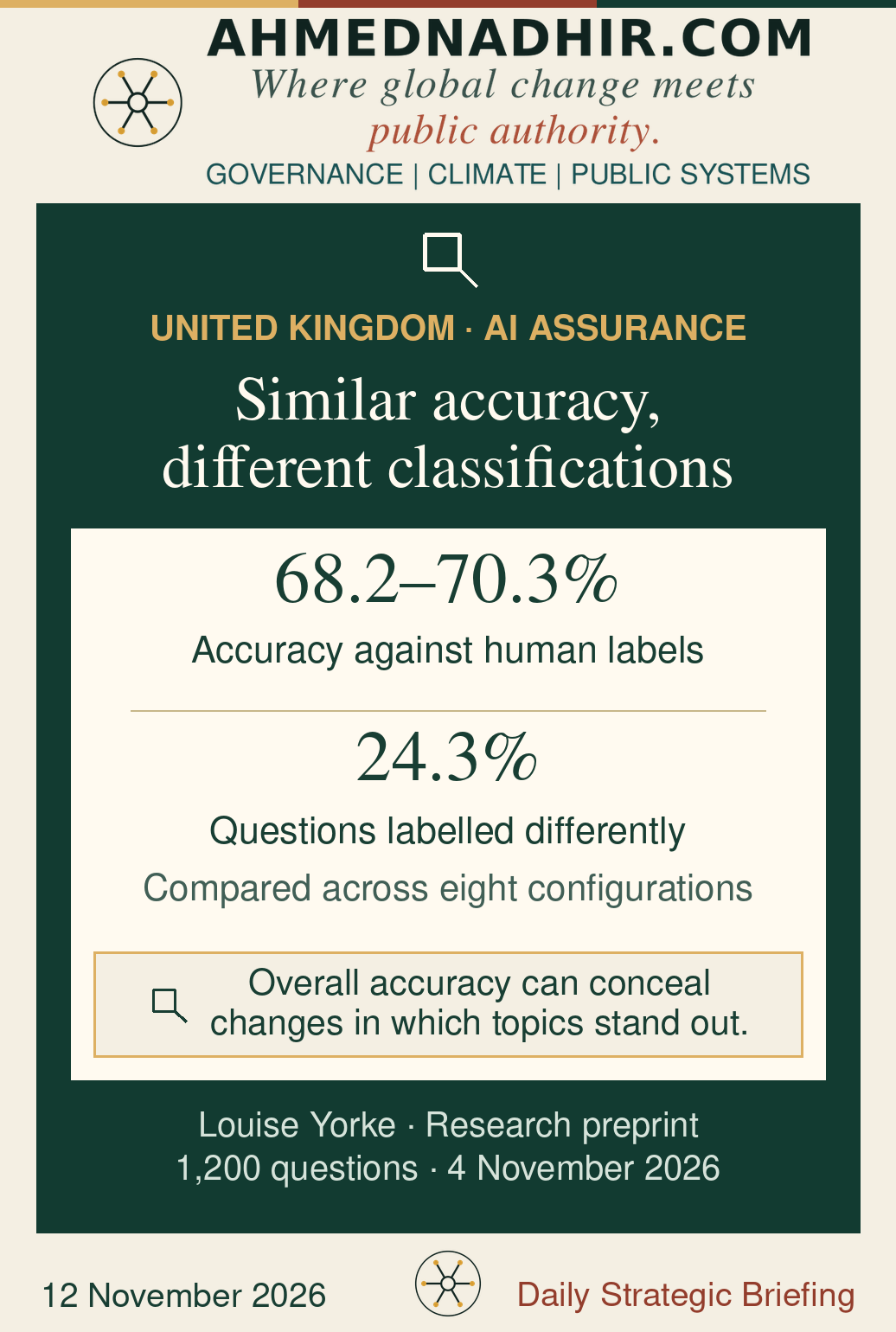
In a preprint posted on 4 November, Louise Yorke tested eight configurations of the same artificial intelligence (AI) model, GPT-4o, on 1,200 questions from the United Kingdom’s Prime Minister’s Questions. The task was to assign questions to policy topics. Accuracy against human labels ranged from 68.2% to 70.3%, but 24.3% of questions received different labels across configurations. The choice of configuration also changed topic shares and rankings.
A public agency might use a similar classification to decide which complaints deserve an investigation. Two versions could achieve almost the same overall score while putting different complaints in the group that triggers review. For an agency procuring such a tool, an acceptance test could examine which cases move into or out of that group, as well as the resulting review workload. It would need examples from its own services, languages and channels. One model and one parliamentary dataset do not establish an error rate for government services elsewhere.
Who can put it right?
For institutions in Africa and the wider Global South, these studies point to costs that a project budget can easily miss. A digital payment system needs a route for correcting a record and the means to keep paying if a supplier changes. A home reading needs clinical follow-up. An automated classification needs review where the label changes the action. These are different obligations, supported by different kinds of evidence.
The common question is whether the institution that answers to the public can also put the problem right. A procurement team can test whether records can move to another system. A health service can estimate how many follow-up appointments its screening programme would generate. An agency using artificial intelligence can test which cases would be routed differently. Doing that work before expansion makes the costs and responsibilities visible while there is still room to change the design.