
A firm that earns in shillings can take out a dollar loan and repay every instalment on time, only to find that the next one costs more because the exchange rate has moved. In the African corporate debt markets examined by the Organisation for Economic Co-operation and Development (OECD), just 17% of issuance in 2025 was in local currencies. The constraint is especially relevant to businesses whose income is local and whose investments take years to pay back.
Two other studies examine different kinds of access. In Bihar, researchers tested whether training changed how police officers received a complaint. In Ethiopia, a study of water scarcity asked what global planning tools overlook when people move with their livestock. Together, the three readings show why the availability of a market or a service says less than it seems about who can use it.
A bond market can grow without reaching more firms
Report published 6 November 2026 · Market figures for 2025
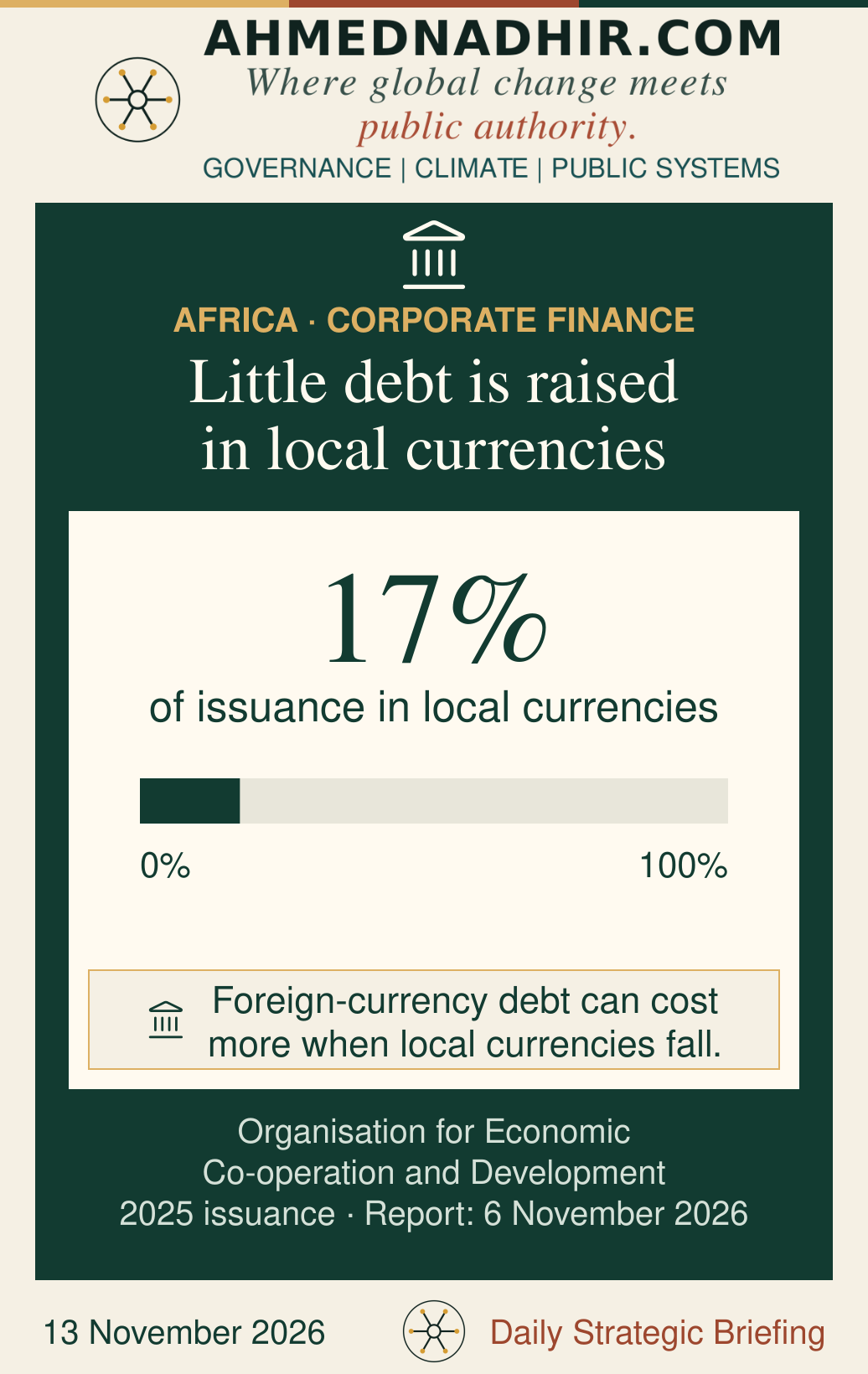
The OECD finds that syndicated loans, made by groups of lenders, accounted for 81% of outstanding corporate debt in the markets it tracked at the end of 2025. Six countries accounted for 80% of the outstanding total. The 17% figure measures something different: the currency of new borrowing during the year. The report covers corporate bonds, syndicated loans and private credit; it does not count all business lending.
Kenya’s Capital Markets Authority publishes national quarterly statistics that provide a starting point for a more specific test. A market review could examine which kinds of firms obtain long-dated shilling finance, how often they return to the market and how much is raised outside a few large issues. An increase in total issuance would be welcome, but it would take more than a larger total to show that firms previously dependent on bank credit had gained another option.
Local-currency borrowing reduces the exchange-rate mismatch for firms with local revenues. It can still be expensive or too short for the investment. The useful comparison is therefore between the currency, term and cost of the finance firms can actually obtain.
What changes at the police desk?
National Bureau of Economic Research working paper issued November 2026 · Standardised audits about a year after training
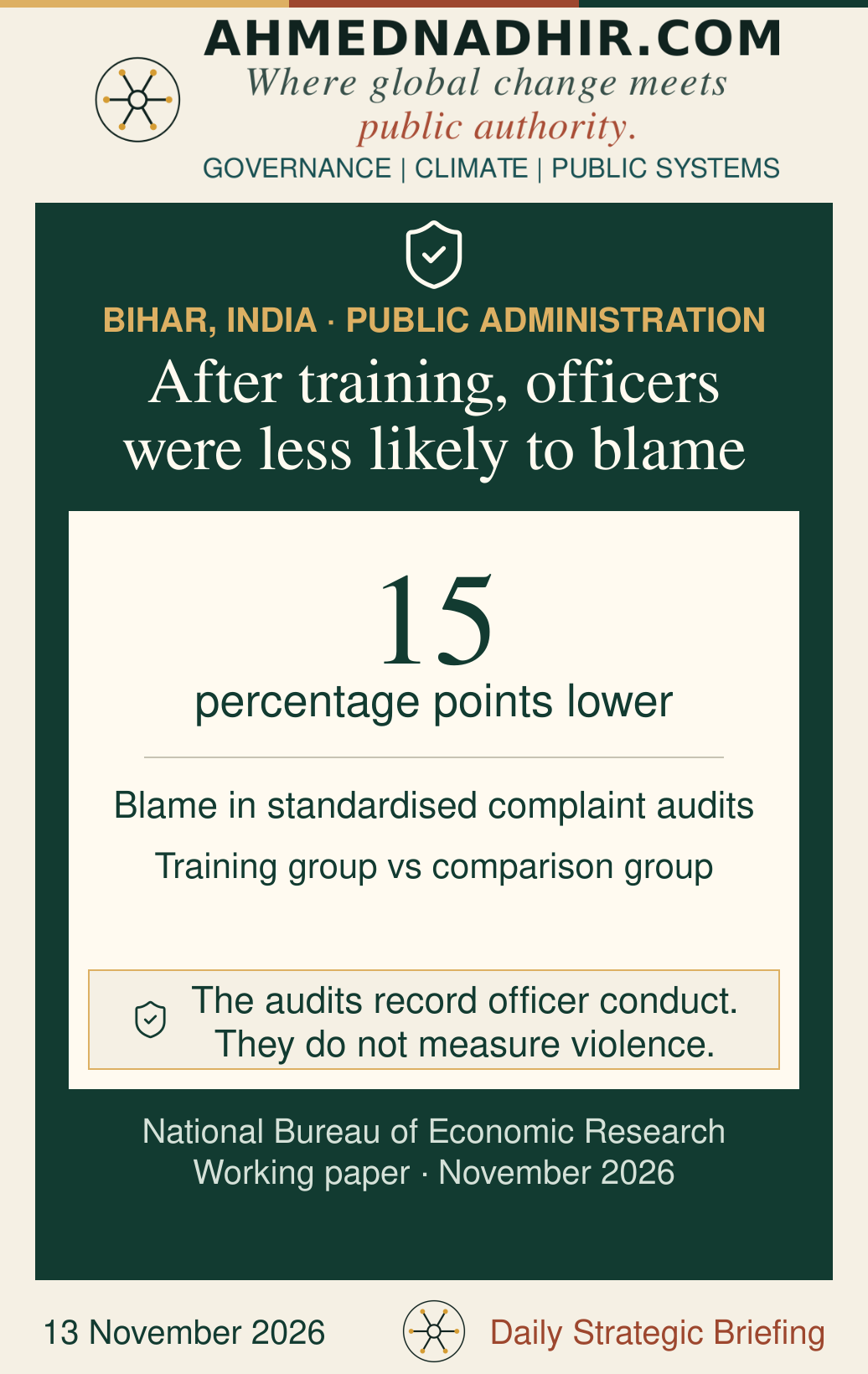
In a trial with Bihar Police, Sofia Amaral and colleagues studied a three-day programme that used theatre and role play to examine how officers respond to complaints of gender-based violence. The researchers randomly assigned police stations to receive the training or serve as a comparison and report results across 417 stations. About a year later, in standardised encounters, officers at stations assigned to training were 15 percentage points less likely to blame complainants. They also dismissed fewer complaints and gave more referrals. The authors report shorter delays in registering complaints in police records.
That difference matters for a police service deciding how to spend its training budget. Attendance tells managers whether staff received the programme; an audit of the encounter can show whether the response changed. Registration records can then help distinguish a change at the desk from a change in what happens later. The results come from one state and one intervention. A better response in an audit, or a rise in complaints recorded by the police, does not establish that violence fell.
Water plans can miss people who move
Study published 7 November 2026 · Three illustrative cases: Ethiopia, the Caribbean and the Rhine–Meuse Delta
In npj Climate Action, Julius Schlumberger and colleagues compare a global framework for planning under water scarcity with three illustrative cases. In their rural Ethiopian case, the global framework treated mobility-based strategies as broadly implausible across scenarios. For some pastoral communities, however, moving is already part of managing dry periods. The authors also show how a framework that assesses individual measures can overlook combinations, such as rainwater harvesting with expanded underground storage.
The study compares planning assumptions. It neither measures the performance of particular projects nor ranks investments for Ethiopia. For water authorities working in places with seasonal movement, the practical implication is to assess access from the routes people use and in the seasons when supplies are tight. A map of installed water points will not show whether households can reach and use them through a dry season.
What the totals leave out
In all three cases, the aggregate can improve while the people facing the greatest barrier remain hard to see. A larger debt market may serve the same issuers. A completed training programme can leave a complainant’s experience unchanged. A higher count of water points says little about a household whose route changes when the rains fail.
The distinction matters in Kenya and elsewhere in the Global South when institutions decide where to spend their next increment of money. A securities regulator might learn more from the terms offered to first-time issuers than from a record volume of bonds. For a water authority, the better investment might be a point that remains accessible during the dry season, even if it adds less capacity on paper. In both cases, the public return depends on a barrier the headline total cannot show.