
In the three months to June, East African Community members sold US$3.2 billion in goods to one another, about a third more than a year earlier. Even so, the share of the bloc’s goods exports sold to fellow members fell from 12.8% to 12.1%. Sales to markets outside the Community grew faster. The United Nations Economic Commission for Africa brought that distinction into focus in Windhoek on 10 November, as it examined the links between growth, trade and structural change.
For Kenya and its neighbours, the figures pose a practical question: can a firm use the regional market as readily as the trade agreements suggest? The question reaches beyond customs. The equipment a firm needs may depend on recognition of a test certificate, and a programme meant to improve the border may rely on several funding agencies working to different timetables.
Exports within the bloc rose. Their share fell.
Windhoek assessment presented and reported on 10 November 2026 · Trade bulletin released 16 September 2026
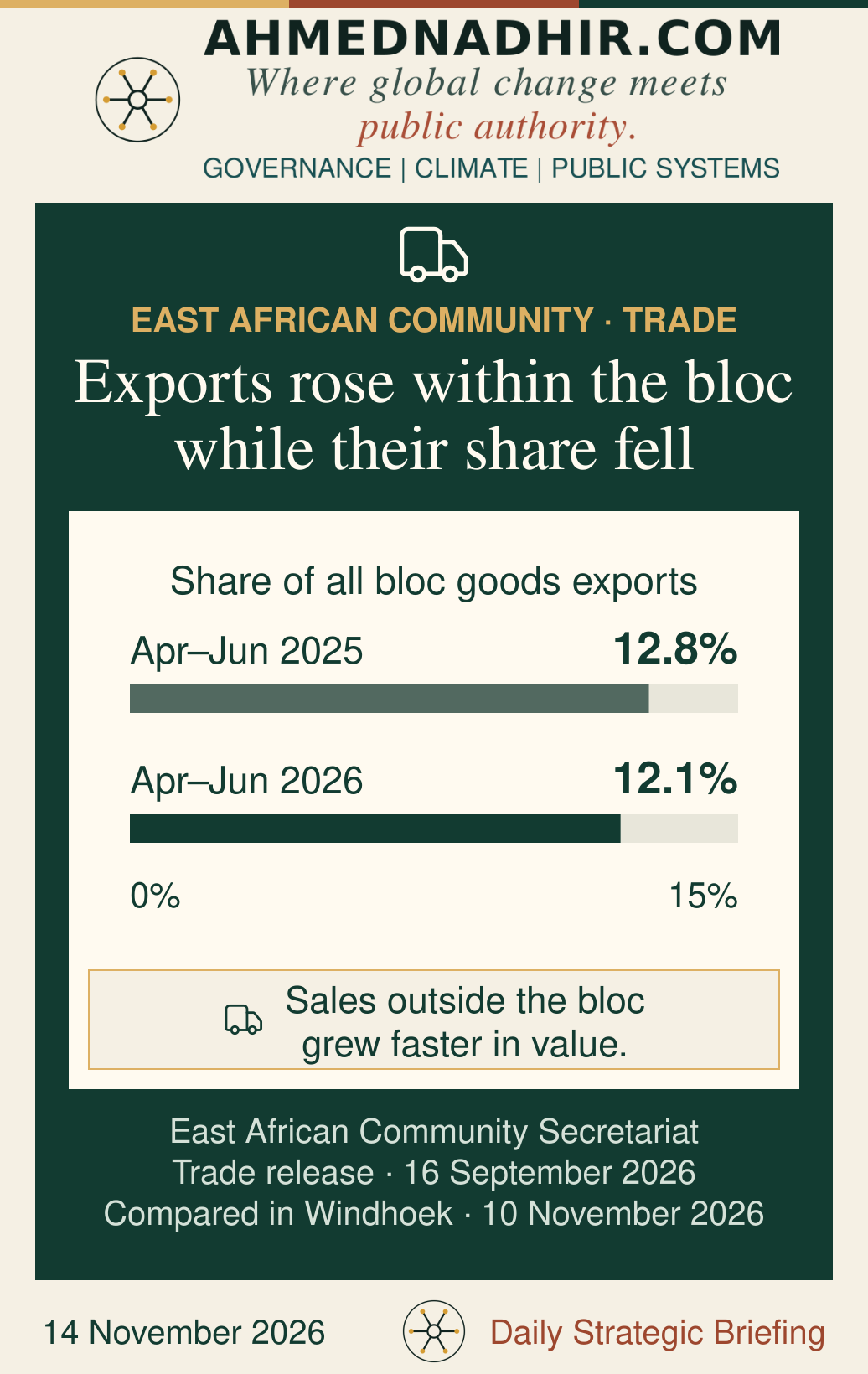
The East African Community (EAC) Secretariat reported increases on both fronts. Exports within the bloc rose by 33.2% in value from the same quarter of 2025. Exports to African markets as a whole reached US$7.2 billion, or 27.5% of all goods exports. These categories overlap. The November assessment frames those flows alongside an economy still reliant on commodities. In the EAC’s release, copper and precious metals together made up 61.9% of all goods exports in the quarter.
The figures are in current US dollars. They do not establish how much of the gain came from greater volumes, higher prices or more firms starting to export. Nor does the fall in share show that the internal market contracted. A Kenyan trade ministry deciding where to spend on corridor improvements would learn more by pairing the trade values with shipment volumes and crossing times for individual products. Rising exports of a high-value commodity can otherwise obscure whether a manufacturer or food processor can ship regularly across the same border.
Equipment can clear customs and still be difficult to use
UN Trade and Development update published 9 November 2026 · 41 national assessments completed from 2015 onwards
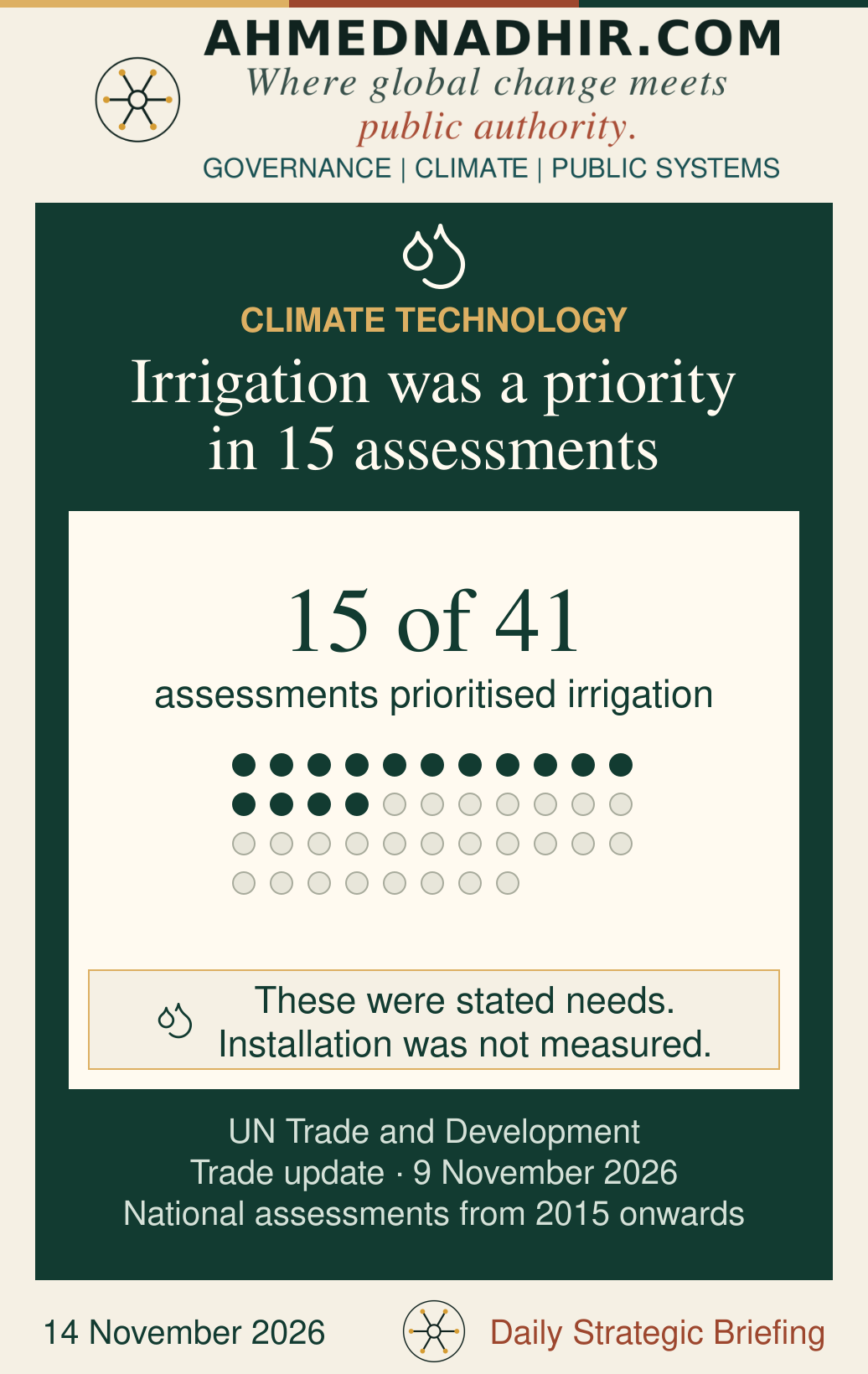
UN Trade and Development reviewed climate technology needs assessments from 41 developing countries. Twenty-one identified increasing crop resilience as a priority, and 15 identified irrigation systems. A country can appear in more than one category. The counts describe priorities in the assessments, rather than installed equipment, financed projects or measured impacts.
Irrigation illustrates why the rules behind trade matter. A pump may be affordable at the port and expensive to keep in service if seals, control units or a trained repairer are difficult to obtain. Common standards and compatible certification can help where they let a reliable supplier serve more than one market without duplicating tests. They cannot resolve a shortage of maintenance funds or establish that taking more water is sustainable.
For a public buyer, a low equipment price is a weak saving if a replacement part only arrives after the planting season. A joint review by trade, standards and procurement authorities could identify which components are repeatedly delayed, which tests can be recognised across borders and which service commitments belong in the tender.
Who can settle conflicting timetables for development aid?
Comparative report published 13 November 2026 · Bilateral aid disbursements in 2023–24
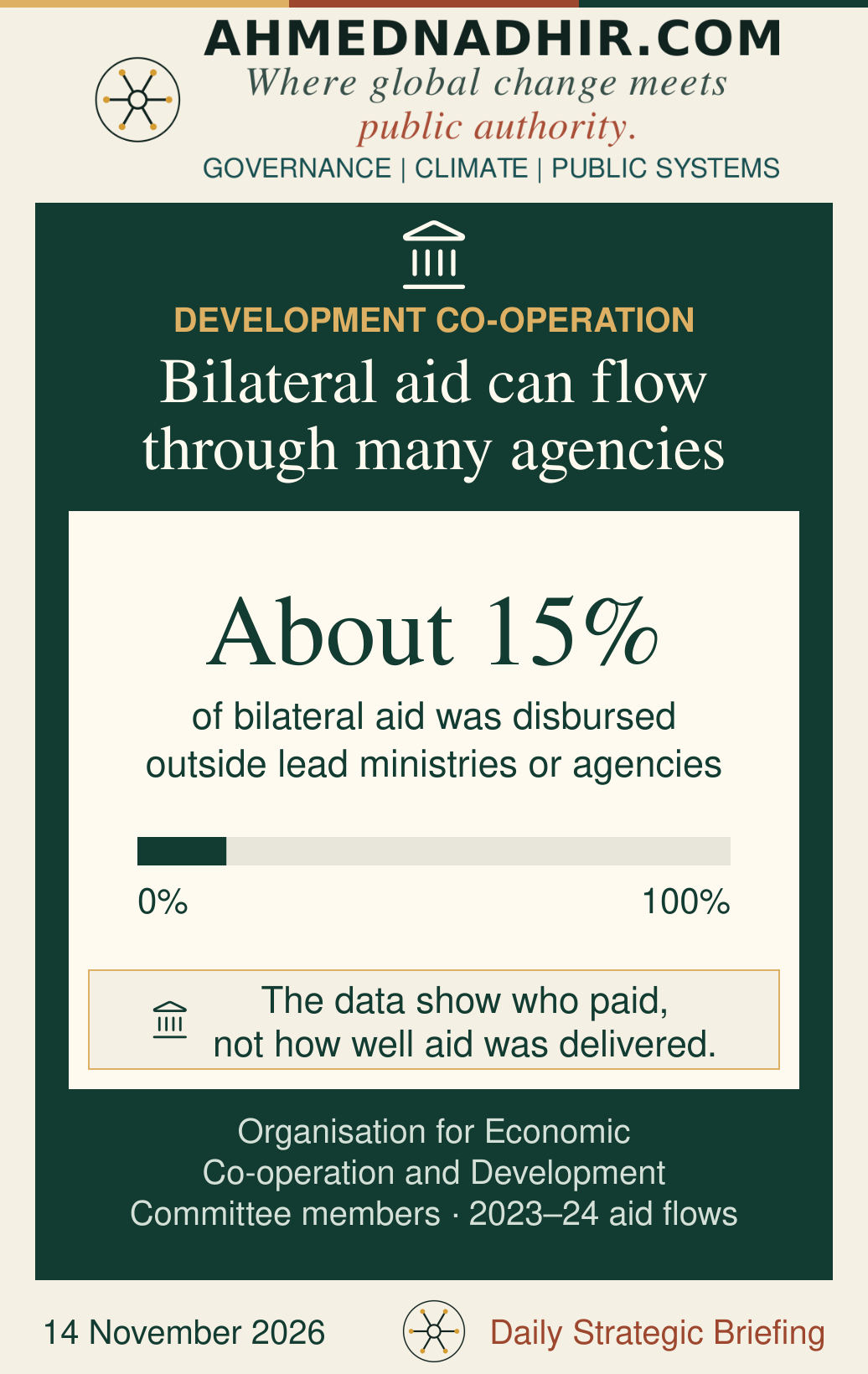
The Organisation for Economic Co-operation and Development (OECD) reports that, across members of its Development Assistance Committee, about 15% of bilateral official development assistance in 2023–24 was disbursed by bodies other than the lead ministry or development agency. The report examines arrangements ranging from centralised systems to those with responsibilities spread among several institutions. The 15% is a share of disbursements across the members studied; it does not describe the share received by Kenya or the share that was poorly co-ordinated.
Specialist agencies can bring expertise a single ministry cannot supply. The report’s comparative cases show why that benefit depends on who can resolve differences over priorities, budgets and delivery. The study does not measure how much any single model improves outcomes.
A corridor programme provides a concrete test. A lender might finance scanners while another partner pays for the software and staff training. If the delivery dates slip apart, a finished contract can leave the crossing no faster. For a finance ministry or regional secretariat, a shared timetable would reveal that risk only if it shows which commitments depend on one another and who can change the sequence when one slips.
What makes a route usable?
The East African figures describe where goods were sold and what they were worth. They leave open whether a new exporter can make the journey regularly. It might need equipment that can be serviced locally, a certificate accepted at the next border and a crossing that works at the hour the goods arrive.
Each of those conditions falls to a different institution. The strongest case for public investment is where it removes a specific obstacle that firms encounter repeatedly. A faster crossing helps most when the paperwork and equipment needed on either side are ready at the same time.