
A train can make one part of a journey faster while a long walk or an unreliable connection eats up the saving. Bengaluru has laid 7.5 km of elevated track for the first section of its Pink Line. The measure that matters to a passenger is how much easier it is to get from home to a destination, at the time they need to travel and at a fare they can afford.
Two other readings ask a related question. In Antalya, a white paper asks how insurance could reward investments that prevent losses. In Colorado, researchers tested whether an artificial intelligence assistant improved the decisions made by benefits examiners. Each puts the emphasis on what changes for the people a service is meant to reach.
What six new stations change for a commuter
Bengaluru inauguration and announcement: 13 November 2026 · Commuter study: July 2023
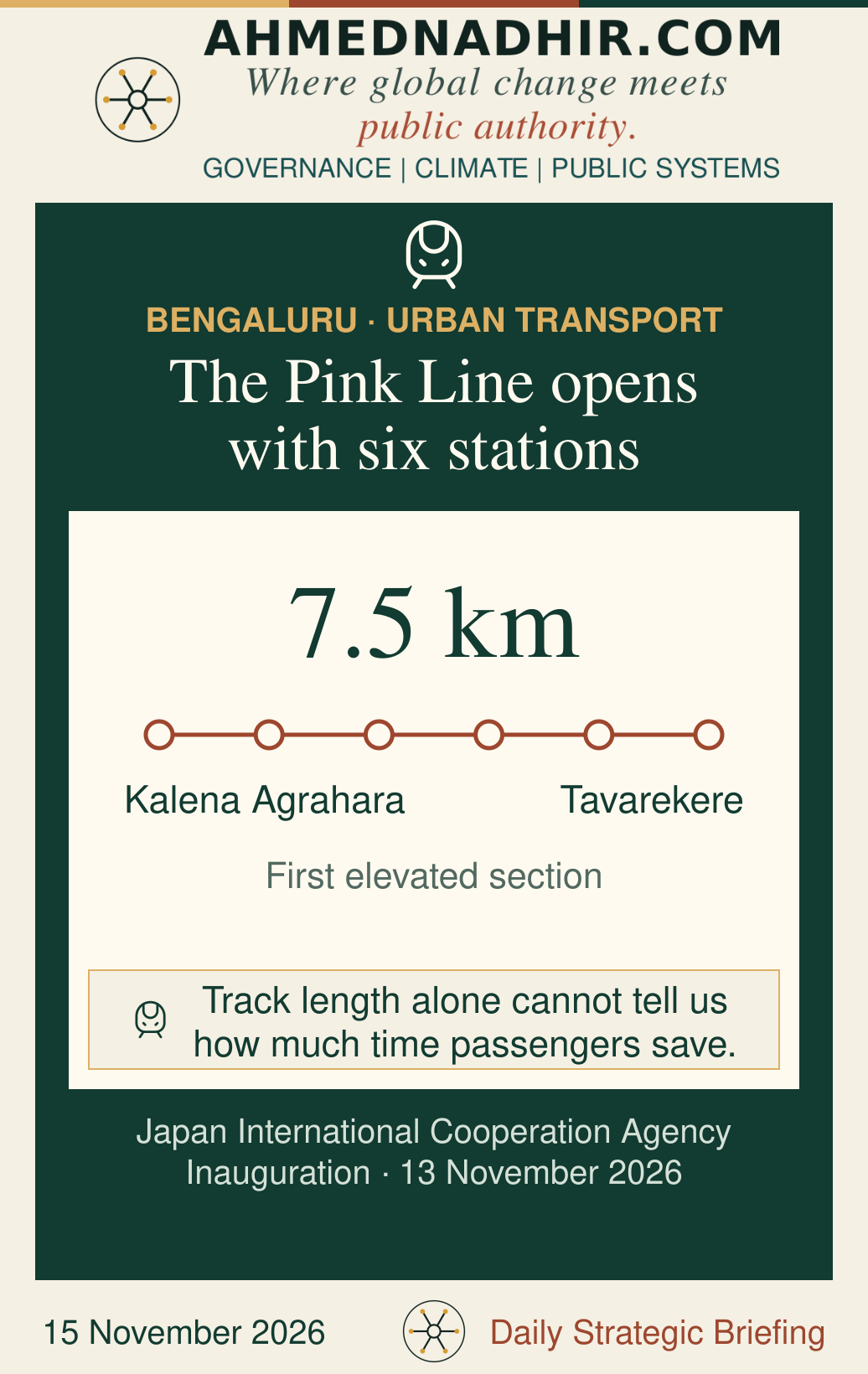
Prime Minister Narendra Modi inaugurated the elevated section between Kalena Agrahara and Tavarekere on 13 November. The Japan International Cooperation Agency, which helped finance the wider metro expansion, identifies it as the first operational section of the Pink Line. The inauguration establishes which stretch has been built and brought into service. It gives no measure of how much time passengers will save.
A July 2023 working paper by World Resources Institute India and the Toyota Mobility Foundation offers a clue. Its Bengaluru survey, conducted in March 2023, found that 66 per cent of trips from the metro station to the final destination were made by non-motorised means, principally on foot. The survey covered people already using the metro, before the Pink Line opened. It therefore says little about people who could not use the network in the first place.
Bengaluru’s metro and bus operators could compare the time and total fare for the same journeys before and after the opening, including walks, waits and transfers. Trips starting beyond comfortable walking distance deserve a separate look, as do journeys by passengers who need step-free access. In rapidly growing cities in Africa and elsewhere, the distinction can change where the next transport budget goes: an extra train, a more reliable feeder bus or a safer crossing to the station solve different problems.
Insurance can cover a loss. Who pays to prevent it?
White paper launched and announced in Antalya: 13 November 2026
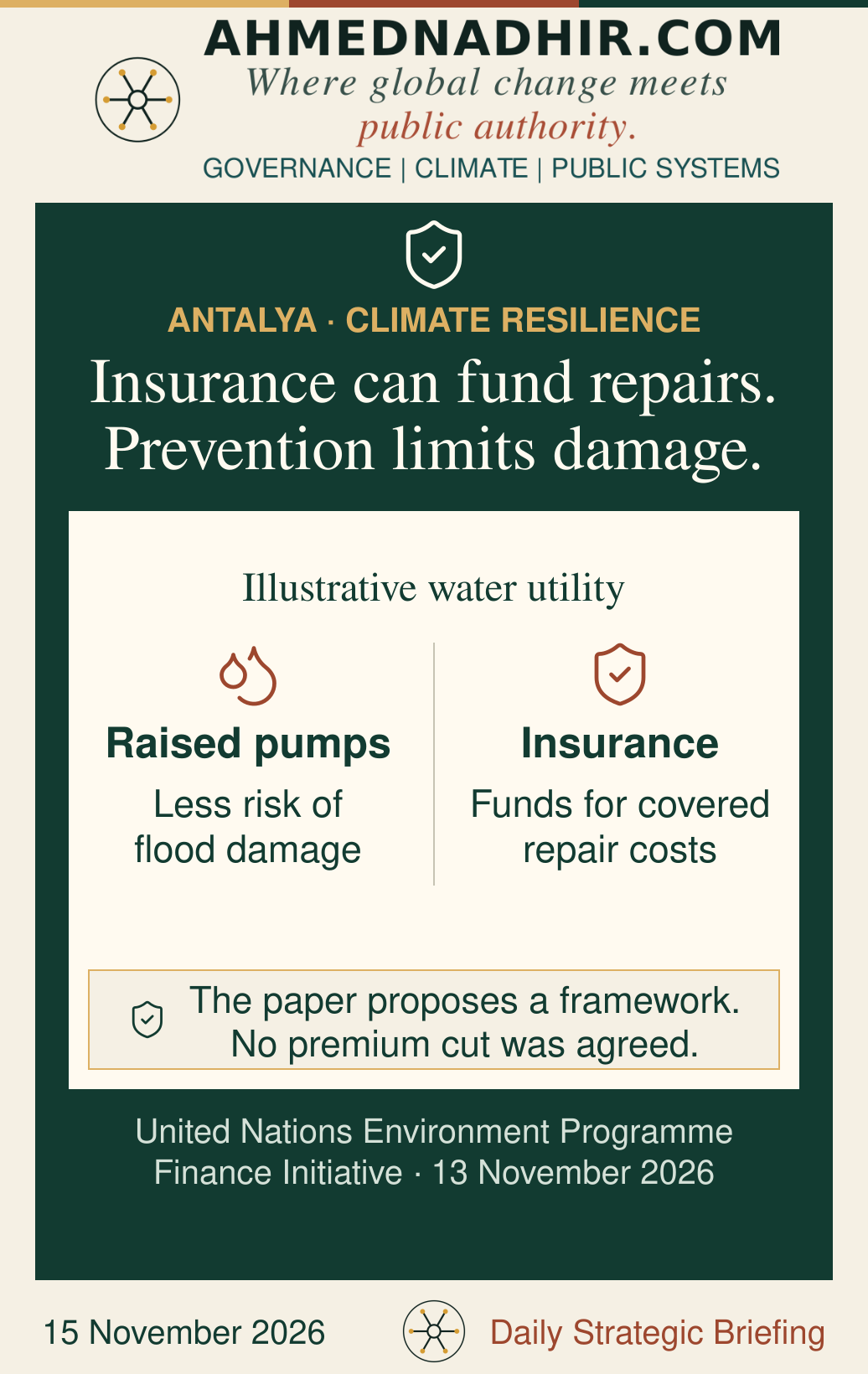
The United Nations Environment Programme’s Principles for Sustainable Insurance initiative released From Vulnerability to Insurability at the climate conference in Antalya. The paper argues that insurers can use claims and hazard data to identify where preventive work could reduce losses and reflect credible improvements in the price or terms of cover. It also describes insurance for losses that physical improvements cannot prevent. The paper sets out an industry framework; it records neither an agreement among governments nor a commitment by insurers to reduce premiums.
Kenya’s own Disaster Risk Financing Strategy 2026–2030, launched on 24 June, calls for a better account of what damage to public assets and state-owned enterprises could cost government. For a public water utility, protecting pumps against inundation, arranging funds for immediate repairs and insuring larger losses are three distinct decisions. A payout can finance repairs after a flood. It cannot restore the service in time if a replacement pump or an alternative supply is unavailable.
For the Treasury and the utility, an appraisal that compares the likely cost of service interruption as well as the premium would show where preventive work offers better value. Whether particular measures attract better insurance terms would depend on the asset, its exposure and what an insurer is prepared to cover.
An AI assistant can feel helpful without improving decisions
Stanford issue brief: 11 November 2026 · Colorado trial report: May 2026
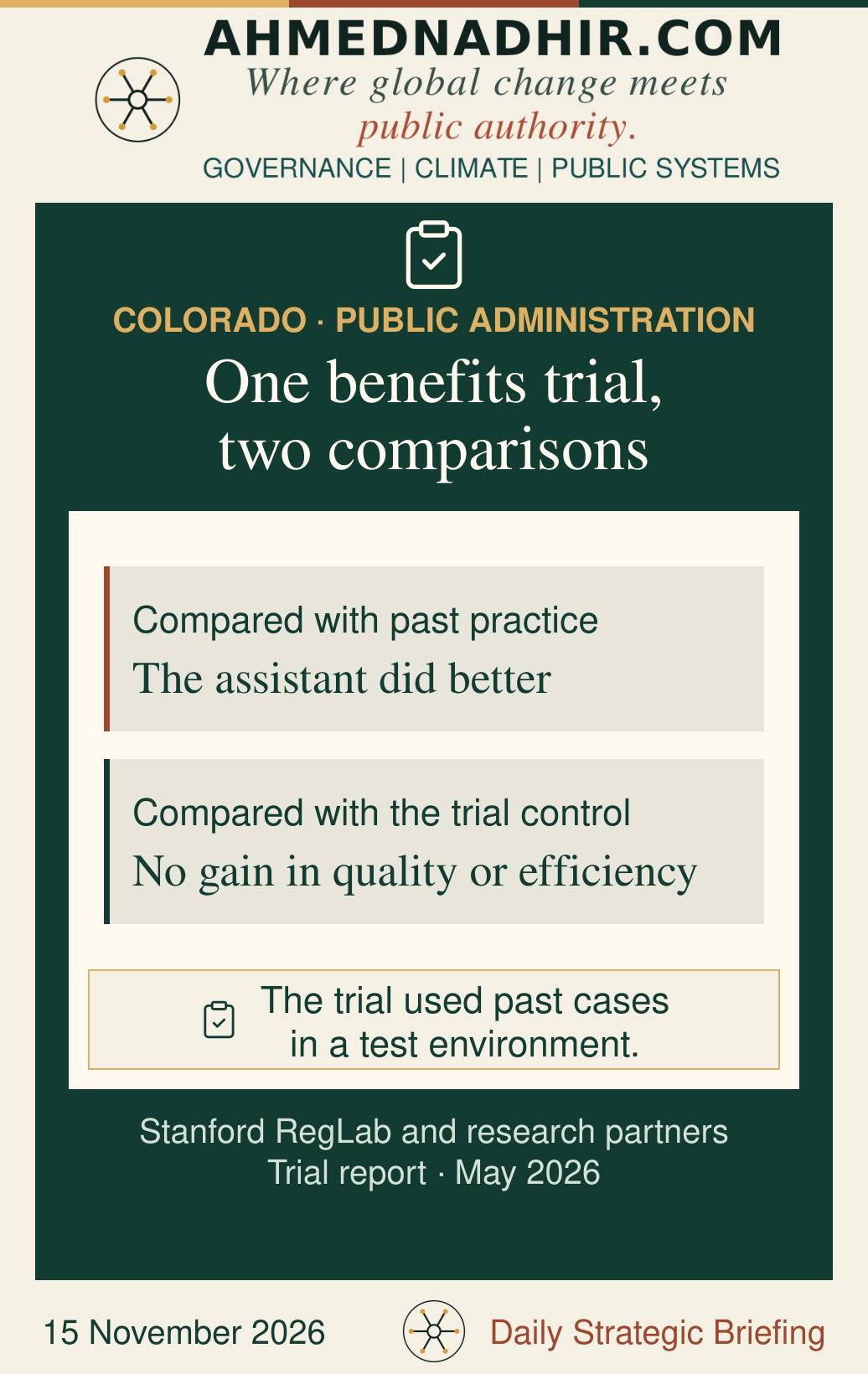
An 11 November brief by Stanford researchers Danielle Sutton, Vera Lummis and Daniel E. Ho argues that agencies need to compare artificial intelligence (AI) tools with the way staff already work. It returns to an experiment with the Colorado Department of Labor and Employment and the United States Department of Labor. Examiners tried an AI assistant for gathering facts in unemployment insurance cases, using real historical files in a test environment. They rated the assistant highly. It compared favourably with historical practice, but researchers found no improvement in quality or efficiency against the trial’s concurrent comparison group.
The distinction matters when an agency is deciding whether to buy a tool. Comparing the assistant with a weak historical baseline may credit it for improvements that the test environment or changes in working practice could also produce. A contemporaneous comparison gives procurement officers a firmer basis for judging what the tool adds. The Colorado trial concerned one task and did not measure effects on live claimants, payment times or appeals.
For a benefits agency, the useful measures would include whether staff ask for the missing facts needed to reach a defensible decision, how much time they spend checking the assistant’s output and which cases are sent for review. Existing files can provide test cases if the agency has a lawful and privacy-protecting way to use them. The files themselves can also preserve past errors, so expert review remains necessary.
Measure the whole service
A metro operator can count boardings without knowing whether a commuter gets home sooner. An insurer can price a claim without knowing how quickly a water utility can restore supply. A benefits office can find that staff like an assistant without seeing a change in the quality of decisions. The better measure follows the journey, the interruption or the case to the point where it affects someone.
That matters for the next budget. In Bengaluru, the binding constraint could be a connection to the station. For a utility, it could be the equipment that determines how long an outage lasts. For a benefits office, it could be the time examiners spend checking evidence. In each case, measuring the part of the service people actually struggle with makes it easier to see which investment could improve it.