
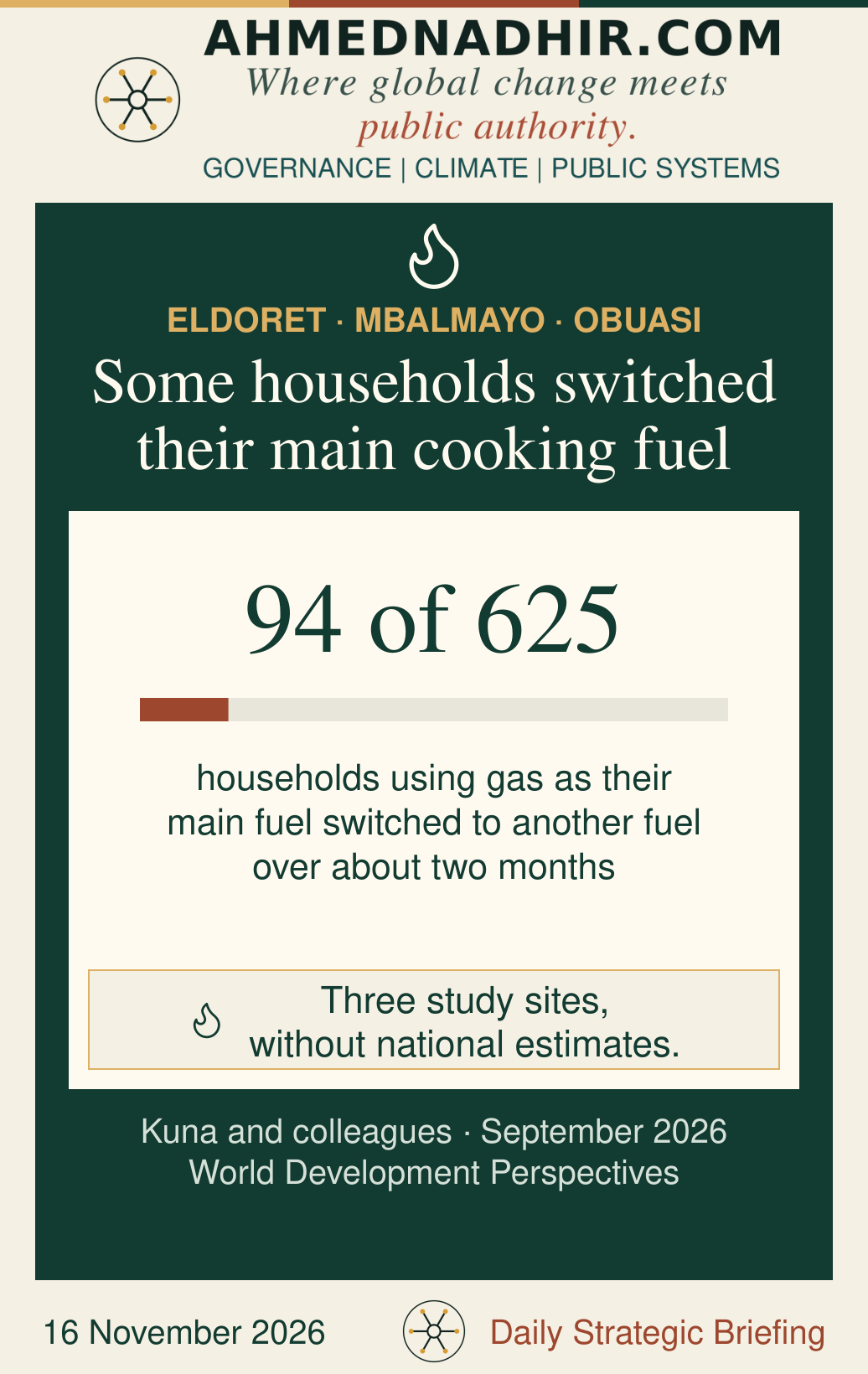
A family can buy a gas stove on Monday and cook with charcoal on Friday if a refill is out of reach. That possibility should shape what gets financed when Kenya hosts the next Summit on Clean Cooking in Africa. In a study that included Eldoret, 94 of 625 households that began as main users of cooking gas reported a different primary fuel about two months later. The figure covers study sites in three countries, and cannot tell us how often that happens today.
At the Antalya climate conference on 12 November, Tanzania and its partners put African clean cooking back before ministers and financiers. The evidence from households gives Nairobi’s January meeting a more exact question: what does the money pay for after a family acquires a stove? Brazil’s new tax timetable and research on medicines purchasing in China illustrate a related problem. What an institution can count most readily often leaves out a cost someone else has to bear.
The price of a stove does not settle the price of dinner
Antalya roundtable and report: 12 November 2026 · Household study: September 2026
The International Energy Agency (IEA), Tanzania and the Turkish conference presidency brought together leaders and development financiers in Antalya. The IEA reported that more than a third of the over US$2.2 billion committed at the 2024 Paris summit had been deployed in projects across 28 African countries. Its account reiterated US$900 million in additional commitments ahead of the next summit, scheduled for 27 and 28 January 2027 in Nairobi. The US$900 million was reported before Antalya; it is neither a fresh pledge made there nor money already paid out.
Abdul-Azeez Kuna and colleagues surveyed cooks in Eldoret in Kenya, Mbalmayo in Cameroon and Obuasi in Ghana. Better reported availability at retailers and use of a stove with several burners were associated with keeping liquefied petroleum gas as the main fuel. The interviews took place in 2019. The three sites offer a clue about what sustains use; they do not give national rates, current refill prices or proof that changing retailer supply alone would prevent the switch.
Kenya’s cooking transition strategy already treats affordability and supply as separate problems. That distinction has a budget consequence. A stove subsidy reduces the cost of getting started. Where fuel is hard to find, however, a subsidy on equipment leaves the household with the same shopping trip and the same risk of doing without. For energy ministries and development lenders, a funding proposal that counts new stoves and checks primary fuel use several months later would reveal which problem it actually solved.
Brazil gives some businesses longer to change their invoices
Brasília briefing and joint act dated 11 November 2026 · Joint act published 13 November 2026
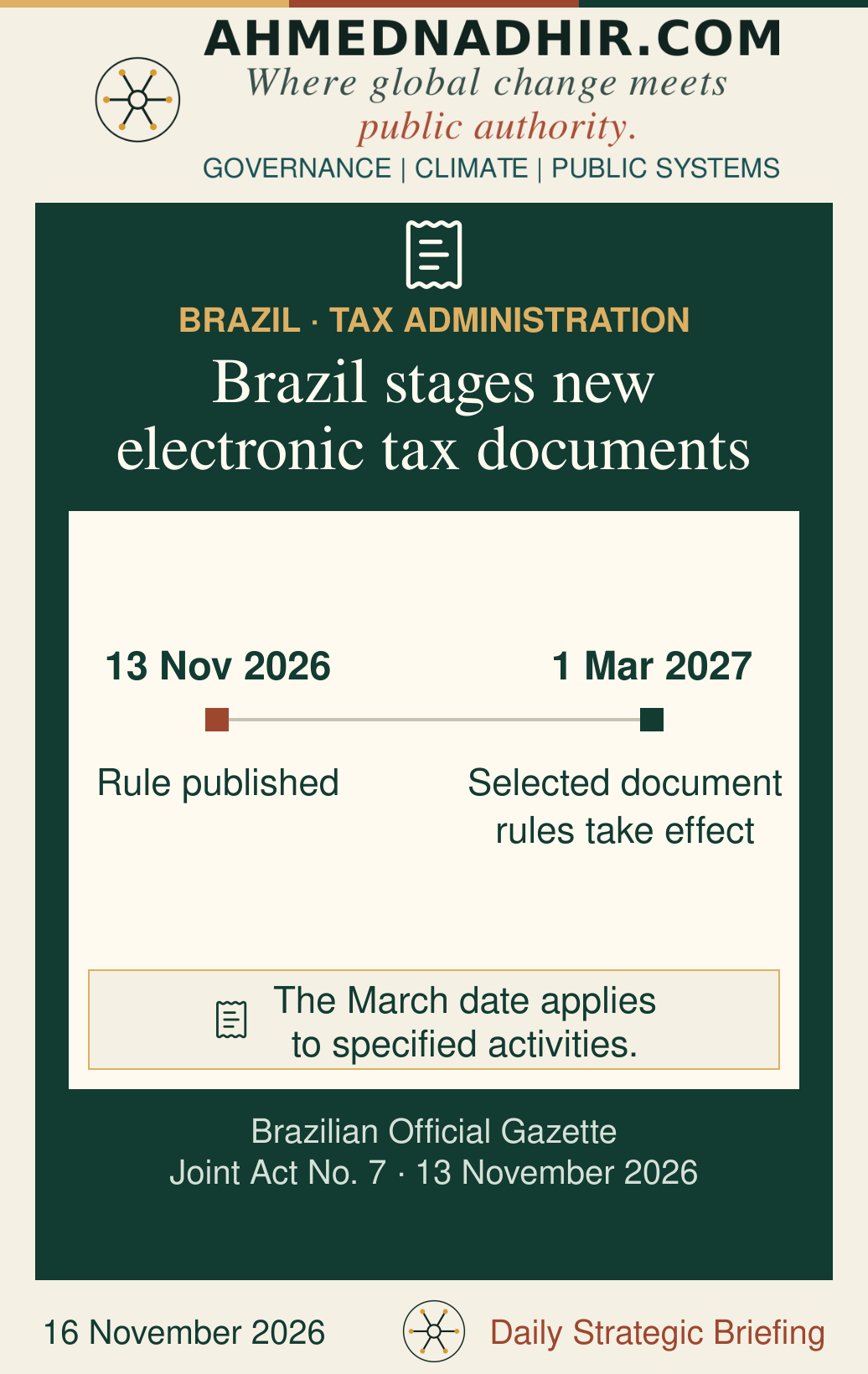
Brazil’s Federal Revenue Service outlined taxpayer support on 11 November as businesses prepare for the next phase of consumption tax reform. It described help with fiscal documents and a November plan to open the pilot environment to all taxpayers. Separately, a joint act with the committee responsible for the goods and services tax was published on 13 November. It sets 1 March 2027 for mandatory electronic documentation for specified activities, including certain platform services and air passenger transport. Other categories named in the act retain a January start. The changes concern particular documents and activities.
The timetable matters to a firm whose invoice software has to classify every transaction under the new rules. A legal start date gives the firm a deadline. A working pilot provides something different: a way to discover that its software produces a document the system will not accept while there is still time to change it. A large platform can assign engineers to that work; a small supplier may be paying an accountant or waiting for a software update.
Revenue agencies introducing electronic invoicing elsewhere face the same distinction. The spread of rejection and correction rates across firms would tell an agency where its transition is proving expensive. A national count of submitted invoices can look healthy even while smaller suppliers are spending hours getting a document accepted. Brazil’s announcement and act establish the timetable and the intended help. They offer no evidence on those costs so far.
A cheaper tender can leave a child without the right formulation
Systematic review published 12 November 2026 · Literature searched to August 2026
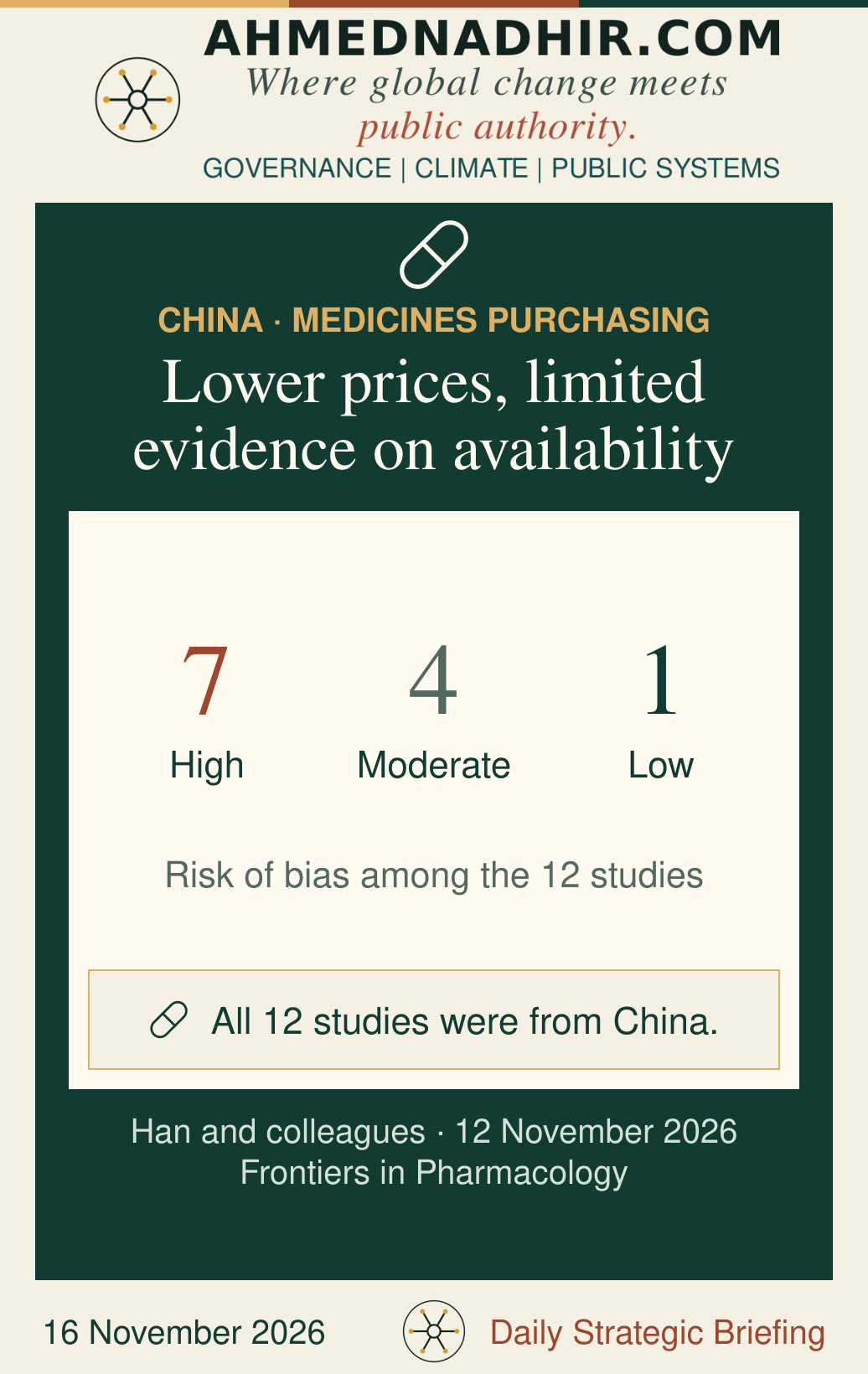
Lu Han and colleagues examined whether centralised purchasing changed the price and availability of medicines used by children. The 12 studies that met their criteria all came from China. Several reported lower prices or costs for selected products. The authors also identified problems in obtaining some of the formulations and strengths children need, and found reports of greater use or cost of alternatives. Seven of the studies were judged at high risk of bias and just one at low risk; the review does not establish a transferable saving or a general effect on clinical outcomes.
Purchasing in volume can make a large order attractive to suppliers. It can also leave a health service choosing from a narrower list if the tender favours products already common in the adult market. An award for a medicine in tablet form does little for a clinic that needs a suitable liquid. In that case the successful price may describe the product a buyer ordered while the clinic still has to find and pay for another one.
For national and local health services, the useful comparison is between medicines suitable for the intended patients, with the cost of substitutes visible. Tender prices and dispensing records answer different parts of that question. Linking them would show whether a sound purchase translated into a medicine a child could actually receive. The Chinese studies identify a measurement problem; they provide no basis for importing a particular purchasing model.
The bill after the first purchase
A stove subsidy, a later deadline for some tax documents and a pooled medicines tender act on different costs. The subsidy changes what a household pays to get started. Brazil’s timetable gives certain businesses more time to correct their systems. The tender can reduce the unit price. Each looks more attractive on paper when the cost of the next transaction is left outside the calculation.
The choice facing a finance ministry is therefore more precise than whether to spend more or less. If every refill means a costly trip, the next shilling may do more for families when it improves distribution. If invoices are rejected because software is unready, a firm needs a usable test before it needs a penalty. If the product awarded at the lowest price proves unsuitable, the saving belongs in the ledger only once that substitute is counted. Better accounts start with the cost as experienced by the person who has to pay it.