
An enterprise can have customers and still struggle to secure a loan. It can qualify to supply government and still find the tender beyond its reach. A young person can finish training and still face a labour market with too few openings. These are different failures, each requiring a different institutional response.
Three new readings examine the connections between finance, public demand and employment. Their value lies in explaining how opportunity is organised: what makes a business legible to a lender, a contract accessible to a supplier, or a support service useful to someone seeking work.
The credit gap begins with what lenders can see
World Bank Group release: 17 November 2026. International Finance Corporation estimates: 2019 and 2023, using a revised comparable series.
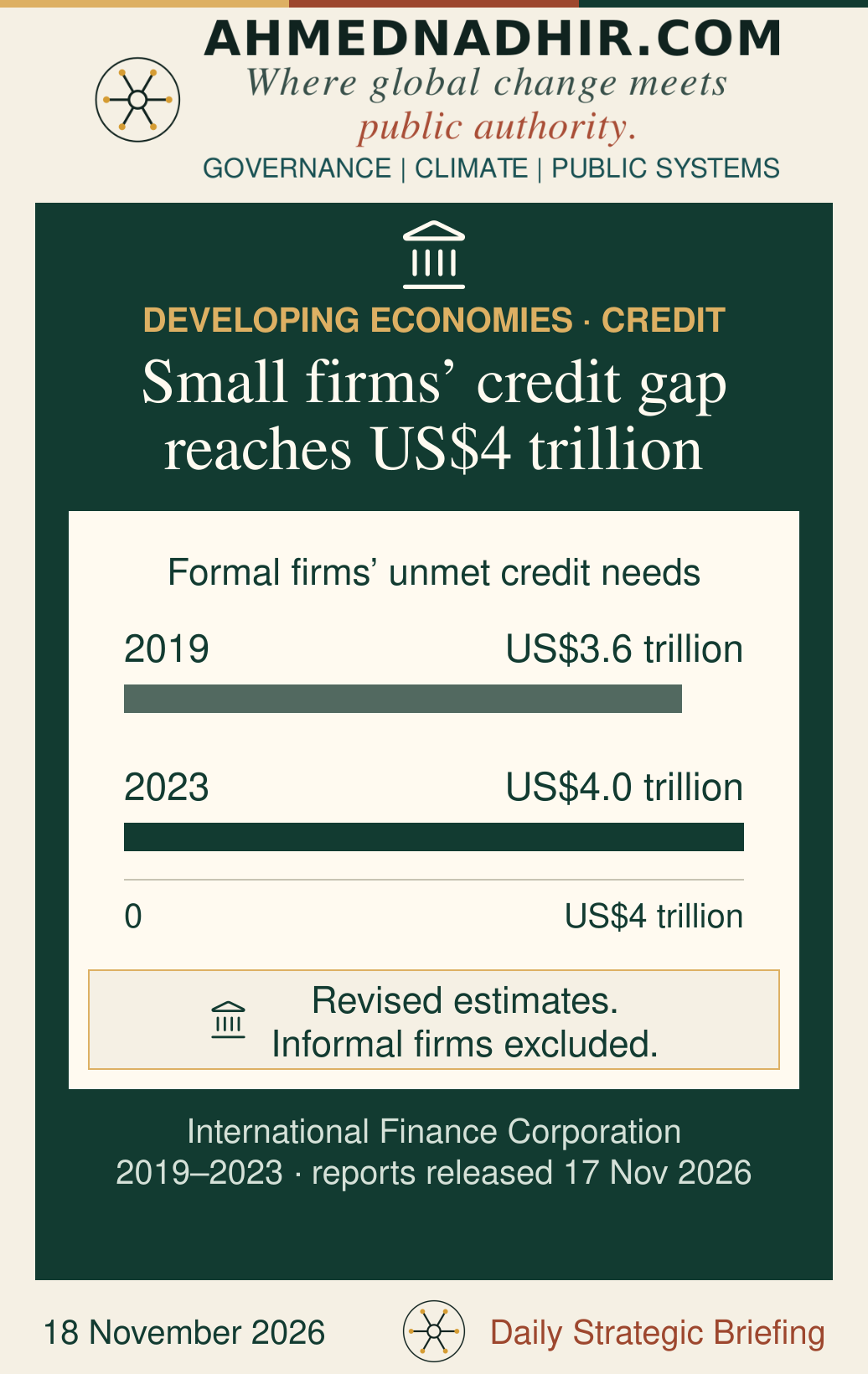
Formal micro, small and medium enterprises face an estimated US$4 trillion credit shortfall, according to research released by the World Bank Group on 17 November. The International Finance Corporation (IFC) estimates that the gap grew from US$3.6 trillion in 2019 to US$4 trillion in 2023 across 114 emerging and developing economies. This measures the difference between estimated financing needs and available credit; it is neither a count of rejected applications nor an estimate for 2026.
The mechanism matters. Small loans can be expensive to assess and service. A firm without conventional collateral or reliable business records may struggle to demonstrate its capacity to repay. IFC’s revised method combines enterprise data, reported credit supply and a benchmark for financing needs. Informal firms are excluded from the headline figure, and older editions cannot be used as a directly comparable historical series.
For African and other Global South institutions, the implication extends beyond adding another lending facility. Usable transaction records and fair access to financial information can change the cost of assessing a business. But formalisation and digital visibility also create obligations: borrowers need understandable terms, a means to correct errors and protection against inappropriate use of their data. More information is valuable when it improves lending decisions without becoming another barrier to entry.
The figure establishes the scale of estimated unmet credit needs. It does not establish that financing every estimated gap would produce profitable firms or additional jobs. Public guarantees and lending programmes still require evidence on repayment, business survival and whether finance reaches firms previously excluded.
Government demand can build a market, if suppliers can enter it
University College London announcement: 13 November 2026. Policy report: November 2026; workshop: September 2026. The Belém Declaration dates from November 2025.
A new policy report by Mariana Mazzucato and Brazil’s public management minister, Esther Dweck, examines what it takes to turn sustainable procurement commitments into purchasing decisions. Announced by University College London (UCL) on 13 November, it draws on collaboration with Brazilian officials and a September 2026 workshop, including experience in Recife and Bahia. Its government co-author is also responsible for the policy under discussion. This is an institutional analysis, rather than an independent impact evaluation.
Its argument is that a government cannot secure different products and production methods simply by adding sustainability language to tender documents. Fragmented purchasing, limited technical expertise and fear of legal challenge can preserve established buying practices. Coordinated demand can give suppliers a clearer reason to invest, while procurement teams need the ability to assess performance over a product’s useful life.
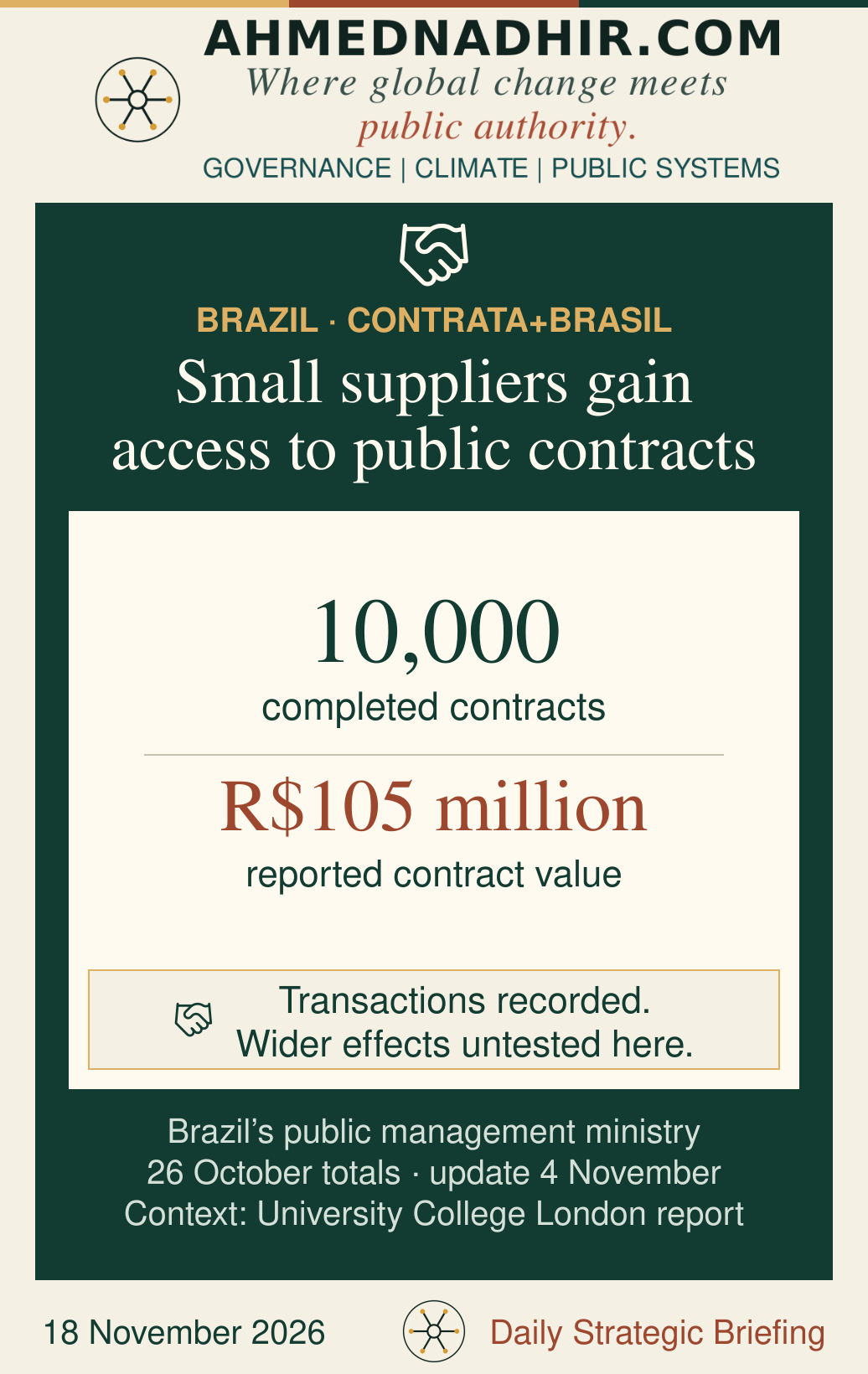
Brazil’s Contrata+Brasil platform offers a concrete example of widening access. A ministry update published on 26 October and updated on 4 November reported 10,000 completed contracts worth R$105 million, covering small suppliers and family farmers. Those administrative totals demonstrate transactions, not additional employment, lower emissions or better value for money.
For African public purchasers and their counterparts elsewhere in the Global South, the transferable issue is how an industrial or environmental ambition changes the contract itself. Predictable orders can help a smaller supplier plan production. Accessible specifications, proportionate qualification requirements and reliable payment determine whether that supplier can participate. Aggregating demand may support investment, but oversized contracts can also favour incumbents. The procurement strategy has to reconcile those pressures.
A route into work has to connect services with real vacancies
Milburn final review, government response and Institute for Fiscal Studies assessment: 17 November 2026. Delivery commitments and wider proposals have different statuses.
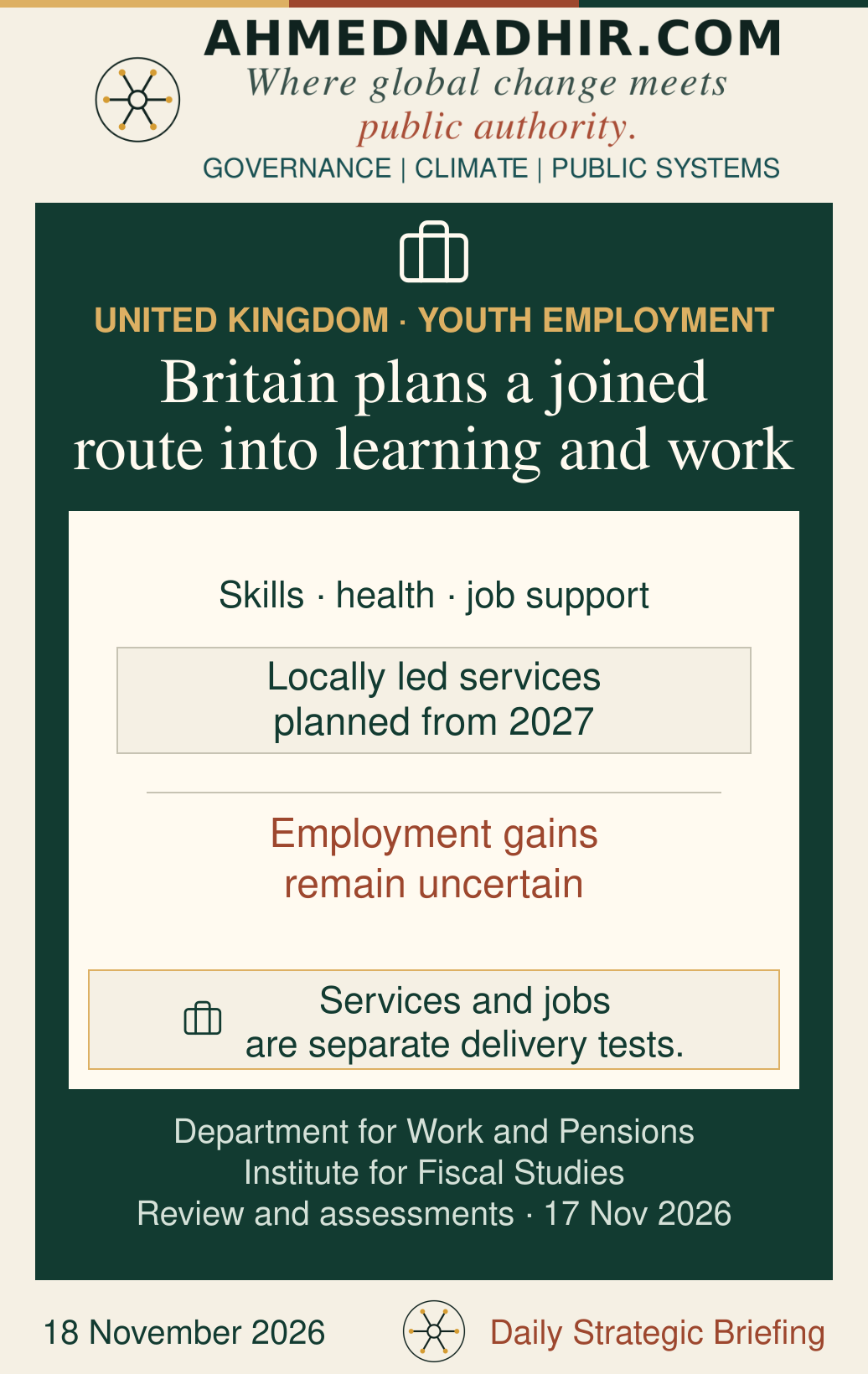
Alan Milburn’s final review proposes reorganising support for young people around a continuing route into education, training or work. Published on 17 November, it argues that responsibility is fragmented across education, employment, health and welfare institutions. The government accepted core principles and announced locally led services starting in 2027; it has not adopted every recommendation.
The review’s design gives local institutions a clearer role in assembling support around a person and connecting with employers. Its proposed guarantees would cover young people outside education, employment or training, including those outside the benefits system. It also states that new opportunities and support should be in place before the proposed changes to benefits.
An assessment published the same day by the Institute for Fiscal Studies identifies the difficult economics beneath that promise. Hiring subsidies can shift opportunities between groups rather than create wholly additional jobs. Service capacity takes time to expand. Some young people could lose cash benefits without earning enough from work to replace them. Projected long-run savings depend on employment gains that remain uncertain.
The relevance to African and wider Global South employment systems is the relationship between coordination and demand. A better referral system can reduce the burden of navigating public services; it cannot create an employer’s vacancy by itself. Where informal work is important, a programme assessed only through formal placements may also miss livelihood gains or deteriorating job quality. Britain’s proposals offer a design to interrogate, not a ready-made model to transplant.
The institutions between investment and opportunity
Finance, procurement and employment policy operate on different parts of the same economic process. A loan can fund production; an accessible public contract can create demand; effective employment support can help people take up the resulting work. None of the three readings proves that combining these instruments will produce a particular growth or employment gain.
Their joint value is a more exact account of public authority. Development finance institutions influence which firms obtain capital. Public purchasers influence which suppliers gain orders. Employment agencies influence which people can reach an opening and sustain it. For African and Global South governments, the strategic opportunity is to examine those connections without erasing the separate tests of creditworthiness, procurement integrity and decent work. The costs of joining a market are themselves a matter of public policy.