
A tax authority assessing a copper export needs more than the day’s metal price. The product, processing charges and terms of sale can change the value against which a related-party transaction is judged. That makes specialist knowledge part of the state’s ability to collect what its law provides for.
This is the starting point for three readings on public authority in practice. A new copper-pricing framework addresses the evidence behind a tax assessment. Britain’s evaluation of its AI Standards Hub examines the distance between understanding standards and using them. A US housing study follows assistance beyond the referral. Their common question is how institutions establish what their interventions have actually achieved.
A world-market quote leaves the contract to be examined
OECD and Intergovernmental Forum publication: 18 November 2026.

The Organisation for Economic Co-operation and Development (OECD) and the Intergovernmental Forum on Mining, Minerals, Metals and Sustainable Development have issued a copper-specific transfer-pricing framework. It applies the Comparable Uncontrolled Price method: assessing a related-party sale against a sufficiently comparable independent transaction. The stated aim is appropriate taxation of copper exports in developing countries. This is technical guidance, rather than an evaluation demonstrating additional revenue.
The final framework distinguishes copper concentrates from refined cathodes. Copper products differ, and sale agreements specify such matters as the quotation period, transport and processing charges. Concentrate sold for further treatment cannot simply be valued as if it were refined metal ready for delivery. A justified adjustment and an unjustified deduction can both lower an invoice. The headline benchmark cannot distinguish between them.
For a mineral-exporting African or other Global South economy, this changes the administrative investment being considered. A higher statutory rate applies to a value that still has to be established. The useful expertise may sit across revenue administration, mineral testing and commercial analysis. Bringing those functions together can make an assessment more defensible, including when the taxpayer challenges it. This is an institutional interpretation of the pricing problem, not a measured return from the new framework.
There is a balance to preserve. Treating every difference from a quoted price as avoidance would disregard genuine commercial terms. Accepting every contractual deduction would leave those terms beyond meaningful scrutiny. The authority needs enough evidence to explain its comparison, while the producer needs a predictable route to contest an adjustment. Appropriate taxation depends on both.
The public asset is the ability to value a particular sale credibly. A commodity-price subscription supplies one input; it cannot replace evidence about the product and agreement being assessed.
Understanding AI standards is a different gain from adopting them
Government publication: 16 November 2026. Evaluation covers April 2023–March 2025; final report dated March 2026.
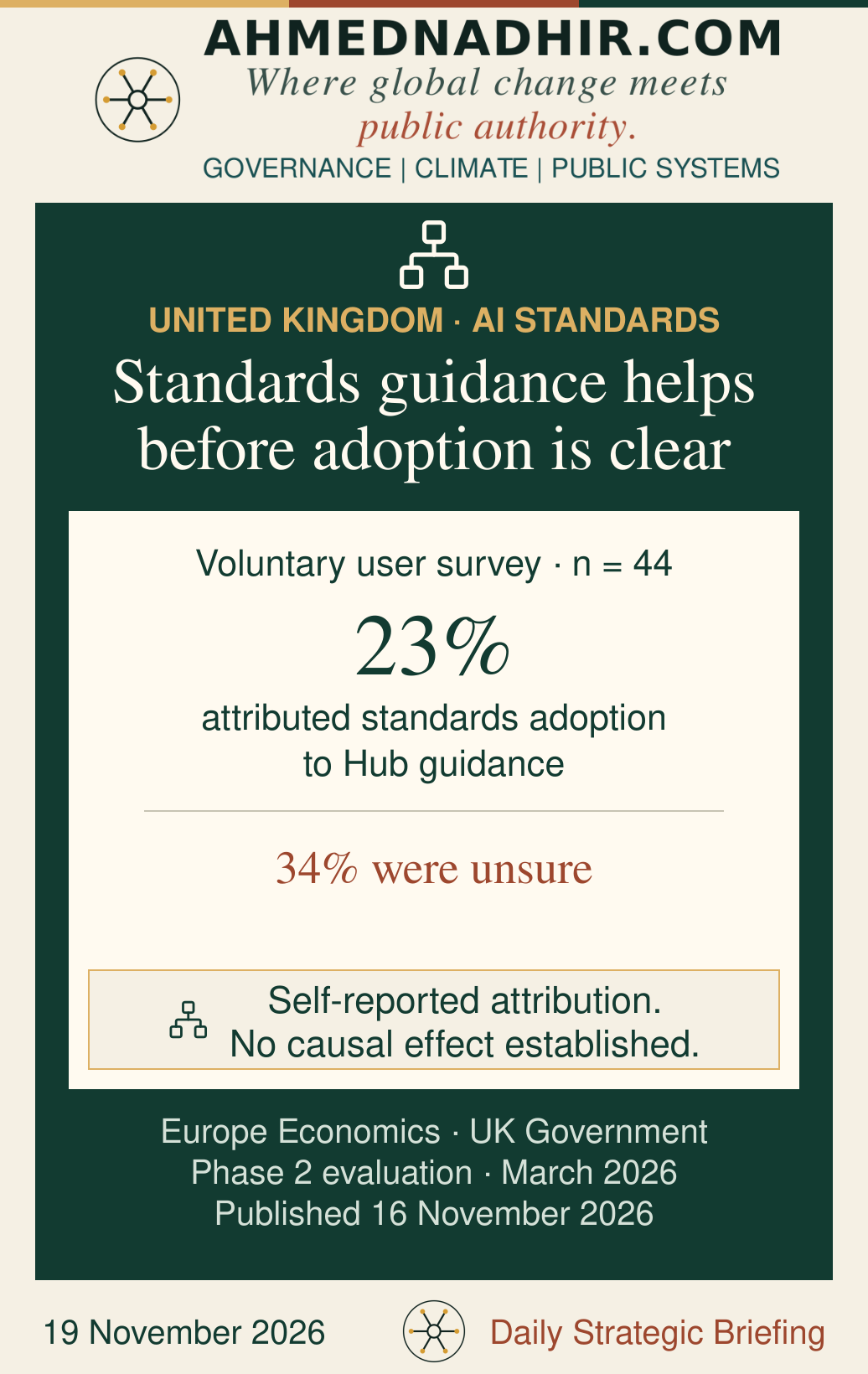
A government can endorse responsible artificial intelligence (AI) while its agencies struggle to navigate the standards behind that commitment. The UK AI Standards Hub brings information, training and convening into one place. Europe Economics’ independent evaluation, published on 16 November, finds stronger evidence of learning and coordination than of downstream adoption.
The assessment combines monitoring, interviews and a voluntary user survey with 44 core responses, collected in December 2025 and January 2026. The sample is not representative. Twenty-three per cent reported adopting standards directly because of Hub guidance, while 34% were unsure. Those answers do not measure the safety of deployed systems or establish the Hub’s causal effect.
The distinction matters for institutions deciding whether to fund shared technical support. Reducing the effort needed to find and interpret standards can be useful before it changes an organisation’s procurement or assurance practice. Counting visits and events as implementation would overstate that achievement. Equally, evaluating the whole offer only through immediate adoption could miss a service that makes informed participation possible.
For African and other Global South standards bodies, the transferable question concerns the division of work. A shared information resource could reduce duplication across agencies or countries, while each jurisdiction retains responsibility for its own decisions. Participation also requires people able to examine a draft, test its assumptions and return to the next round. The UK evaluation does not establish the cost or effectiveness of reproducing that arrangement elsewhere.
A useful standards institution can make technical choices easier to understand and contest. Evidence of that contribution deserves its own measure, alongside the separate question of whether organisations change practice.
A housing referral begins a service relationship
Journal of Community Health publication: 18 November 2026. Programme observations: January 2024–April 2026.
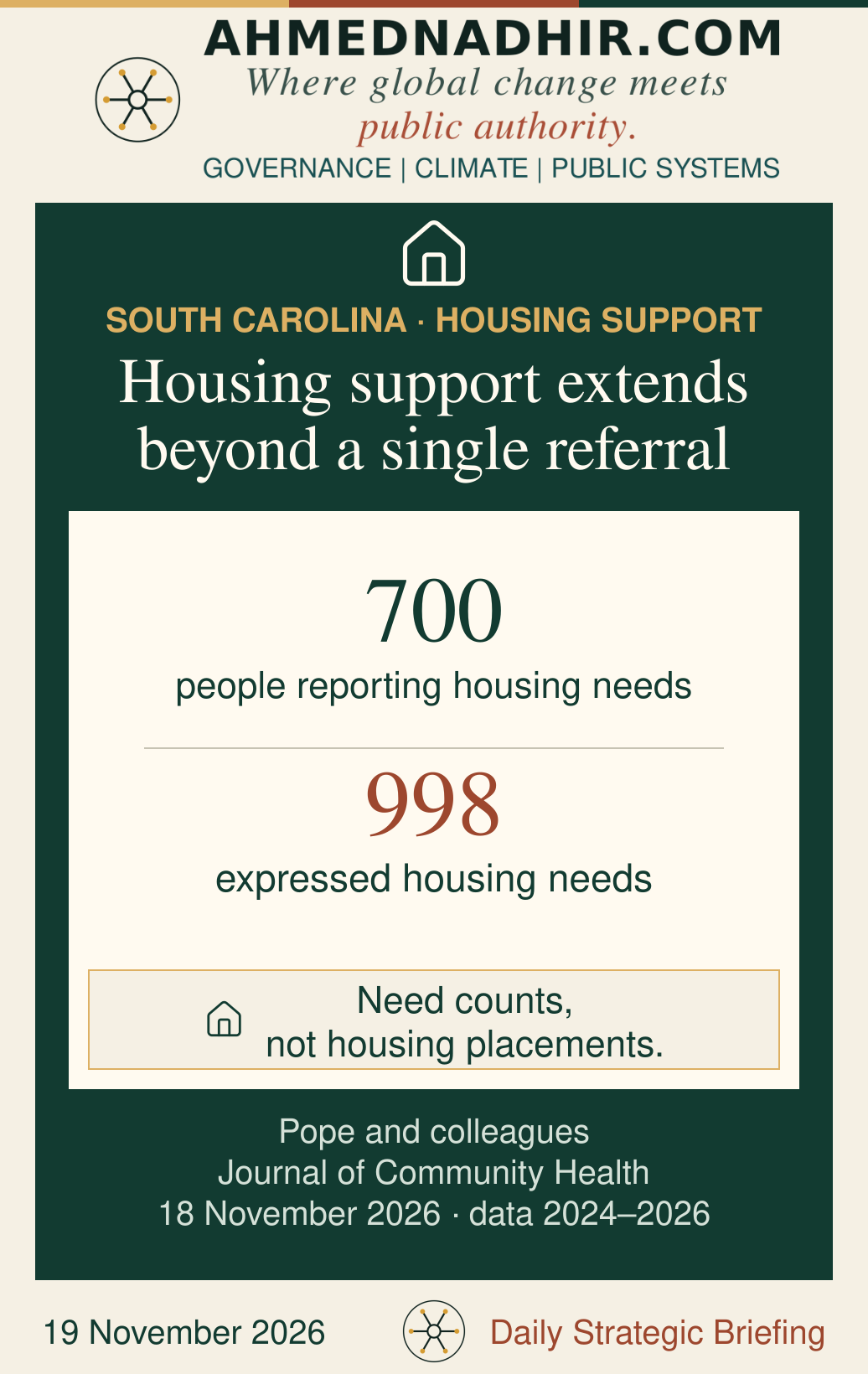
For someone facing unstable housing, identifying the appropriate service is one step in getting help. Holly C. Pope and colleagues examine that work in South Carolina’s Community Health Alignment Initiative. Their longitudinal observational evaluation uses programme records from January 2024 to April 2026. Of 6,767 participants, 700 reported housing needs.
The 700 participants reported 998 housing needs. Workers coordinated care, advocated and provided direct assistance. Housing-risk measures improved in the groups assessed repeatedly, but these selected groups did not represent the full caseload. Without a comparison group, the changes cannot be attributed causally to the programme.
A substantial share of referrals was still in progress when observation ended. That status records an unfinished process, rather than proving that help failed. The distinction has budgetary consequences: a service assessed at referral may appear productive before another organisation has accepted the case. A service assessed only at closure may penalise staff managing the hardest cases or the longest waits.
The study therefore offers a useful question for public systems beyond the United States: what happens after a person is directed elsewhere? Its improvement figures cannot be transferred to African housing programmes with different tenure arrangements, eligibility rules or service capacity. The more portable insight concerns following an expressed need through successive organisations. Better navigation can help people obtain available support; whether it can overcome a shortage of suitable housing is a different question, which this evaluation does not settle.
A completed referral and a more secure home are different outcomes. The gap between them belongs in an assessment of service performance, without turning cases still underway into recorded failures.
The evidence public authority needs to keep
These readings concern different kinds of proof. A copper assessment needs a defensible comparison between transactions. An AI standards service needs evidence of what users learn and what organisations subsequently adopt. Housing support needs to follow a person beyond the first referral. None can be assessed adequately by counting the initial contact alone.
The consequential choice is often how to sustain expertise and follow-up after the visible launch. A public institution that commissions a portal, publishes guidance or opens a referral route also inherits a continuing task: interpreting difficult cases, maintaining information and explaining decisions. Funding the opening without that continuing work can leave the formal offer intact while weakening what people can obtain from it.
For institutions working with limited resources, shared specialist capacity is worth examining, with clear boundaries. Tax agencies might share analytical expertise without surrendering legal accountability. Standards bodies might pool research while retaining national judgement. Service providers might coordinate follow-up without distributing sensitive personal records indiscriminately. These are propositions for appraisal, not effects established by the three publications. Their value would depend on cost, lawful access to information and whether the arrangement improves decisions that someone can challenge.