
Malaria control has gains that can be lost
Sub-Saharan Africa · Research published 19 November 2026
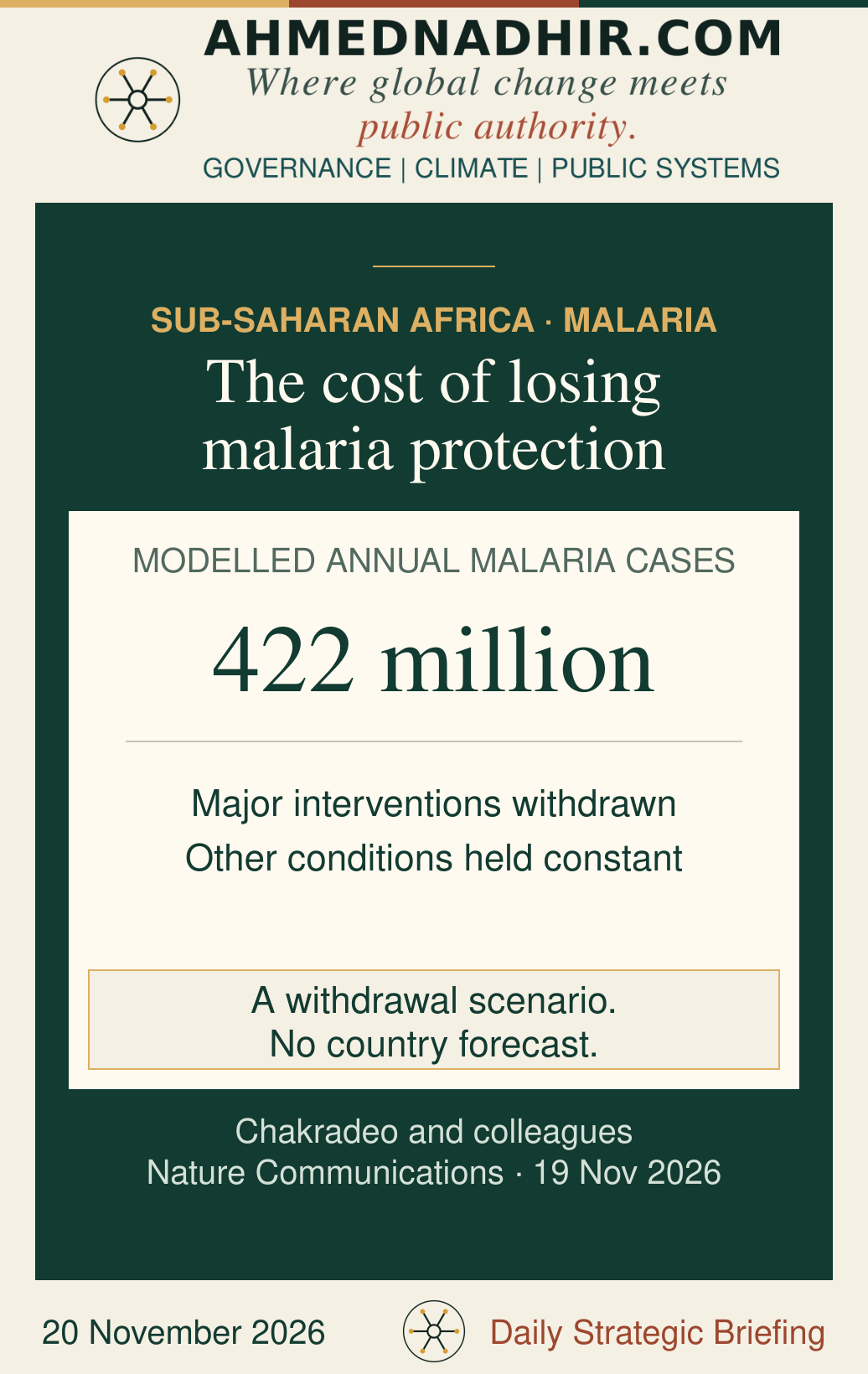
Kaustubh Chakradeo and colleagues estimate that sub-Saharan Africa could face around 422 million malaria cases a year under a scenario in which major interventions are withdrawn and broader ecological and demographic conditions stay constant. Published online in Nature Communications on 19 November, the accepted paper uses satellite imagery to characterise the environment in a statistical model and applies 2024 population estimates.
The study gives no timetable for those cases to occur. Its regional estimate cannot price a specific local cut. It does show why a budget comparison that sets this year’s prevention costs beside last year’s caseload can miss the work that kept those cases down.
For Kenya and its neighbours, the useful question is where coverage would lapse first if funding or deliveries were delayed. Procurement records can show when replacement supplies are due; surveillance and local coverage data can help judge which interruptions warrant priority. The answer belongs to national and local evidence.
For Costa Rica, the harder loss may be expertise
Costa Rica · OECD report published 19 November 2026
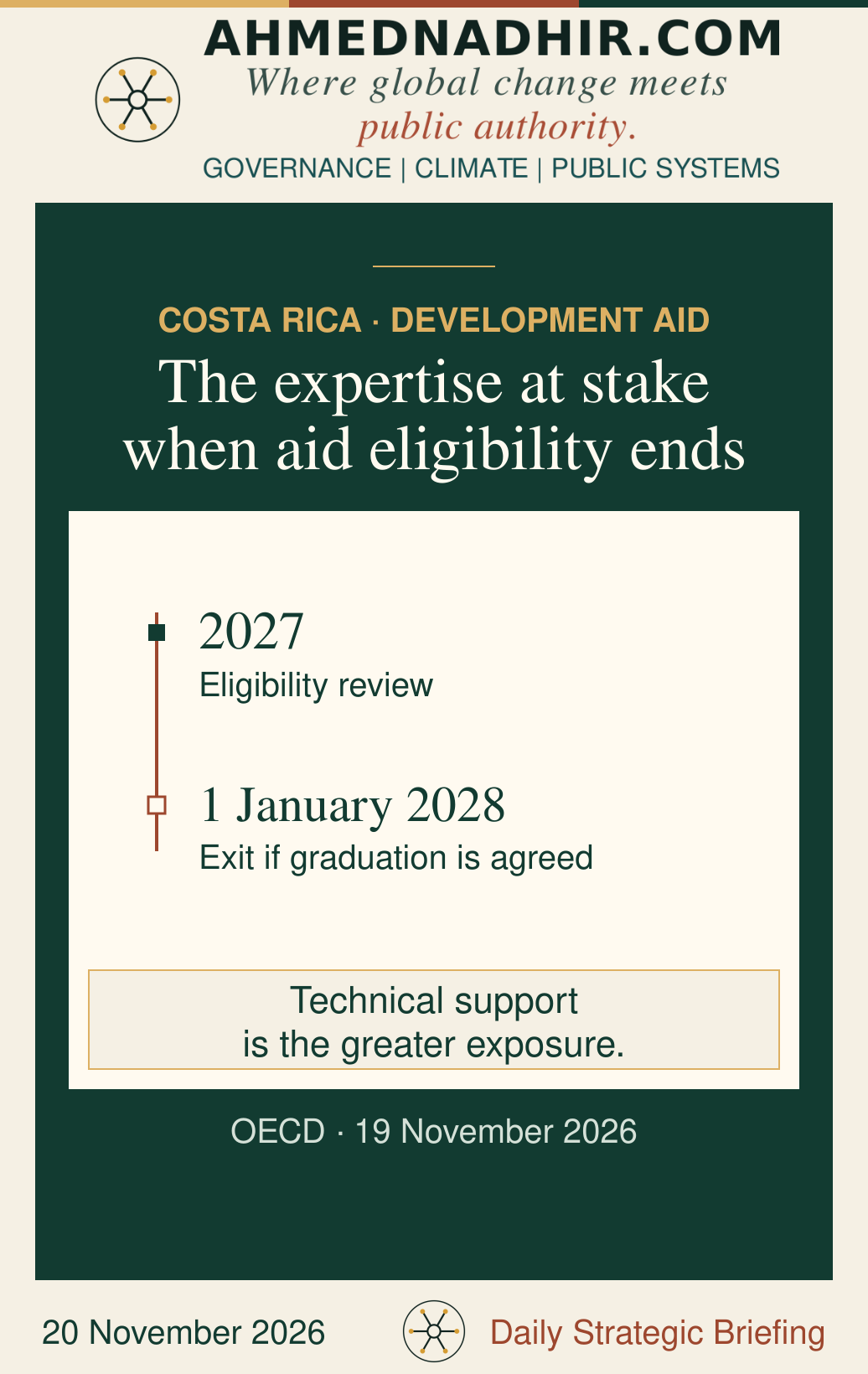
When a country approaches the point at which it no longer qualifies for official development assistance, the obvious question is how much financing it stands to lose. The Organisation for Economic Co-operation and Development’s pilot assessment of Costa Rica points elsewhere. Drawing on engagement with national institutions and development partners, it identifies technical co-operation, policy dialogue and access to expertise as the more exposed forms of support.
Costa Rica is due to be considered at the Development Assistance Committee’s 2027 review if it meets the income criterion. Under the current rules described in the report, a graduation decision would end eligibility on 1 January 2028. The assessment examines a prospective transition, so it cannot tell us what happens afterwards.
A grant amount can be recorded in a budget. The engineers, advisers and specialist networks that come with a partnership are harder to value. If a ministry still depends on that work, a transition agreement has to establish who will provide it, who will pay, and for how long. Costa Rica’s limited financial exposure should not be assumed elsewhere.
Thailand wants research to reach the firms that can use it
Thailand · OECD policy paper published 19 November 2026
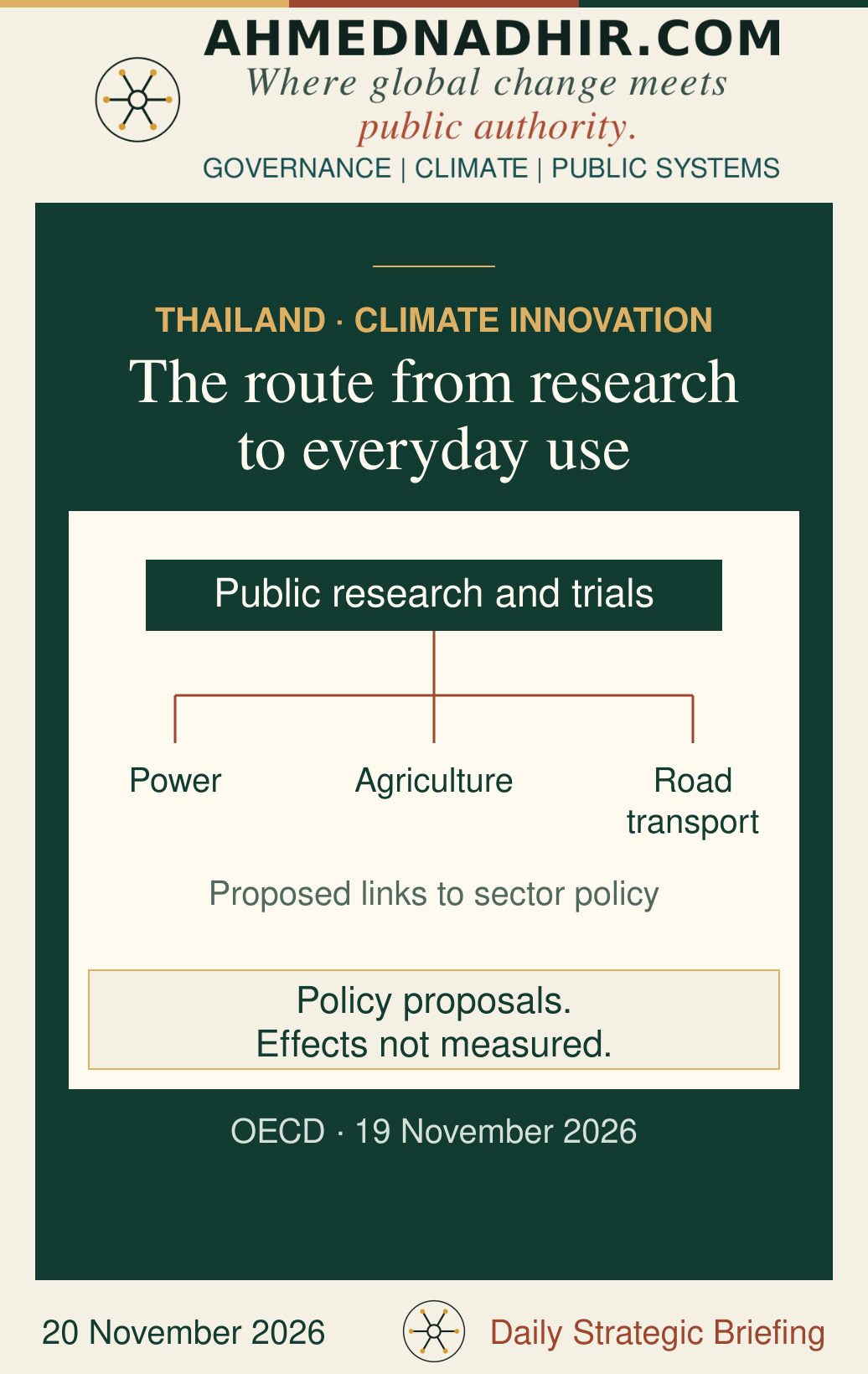
Thailand’s ambition to achieve net zero while raising incomes places a difficult demand on its innovation system: useful technologies must find buyers and operators. After consulting Thai authorities and other stakeholders, a new policy paper argues for bringing innovation policy closer to decisions in electricity, agriculture and road transport. It sets out reforms to consider; it does not establish their effects or confirm their adoption.
An electricity technology can work in a trial and still struggle to find its place in a regulated system. A more efficient farming practice can fail to spread because households cannot finance the change. In both examples, a research grant solves one part of the problem. Regulation, adoption costs and the organisations that put a technology to use determine whether it travels beyond the trial.
For African and other economies designing their own industrial strategies, the comparison is useful at the level of institutions. A science ministry can support experimentation; a sector ministry or regulator can determine whether the result can be used at scale. The Thai paper offers a reason to examine that handover before committing public money, rather than a template for choosing technologies elsewhere.
What the next budget must carry
Each reading exposes a different expense that is easy to overlook. In malaria control it is the cost of keeping protection in place. In development co-operation it is the specialist work that can disappear when a funding category changes. In innovation it is the cost of getting a useful technology from trial to ordinary use. Each belongs in the decision before a programme is cut, transferred or expanded.