
Antalya: a decision closes one item of business
Antalya, Türkiye · Plenary of 20 November 2026
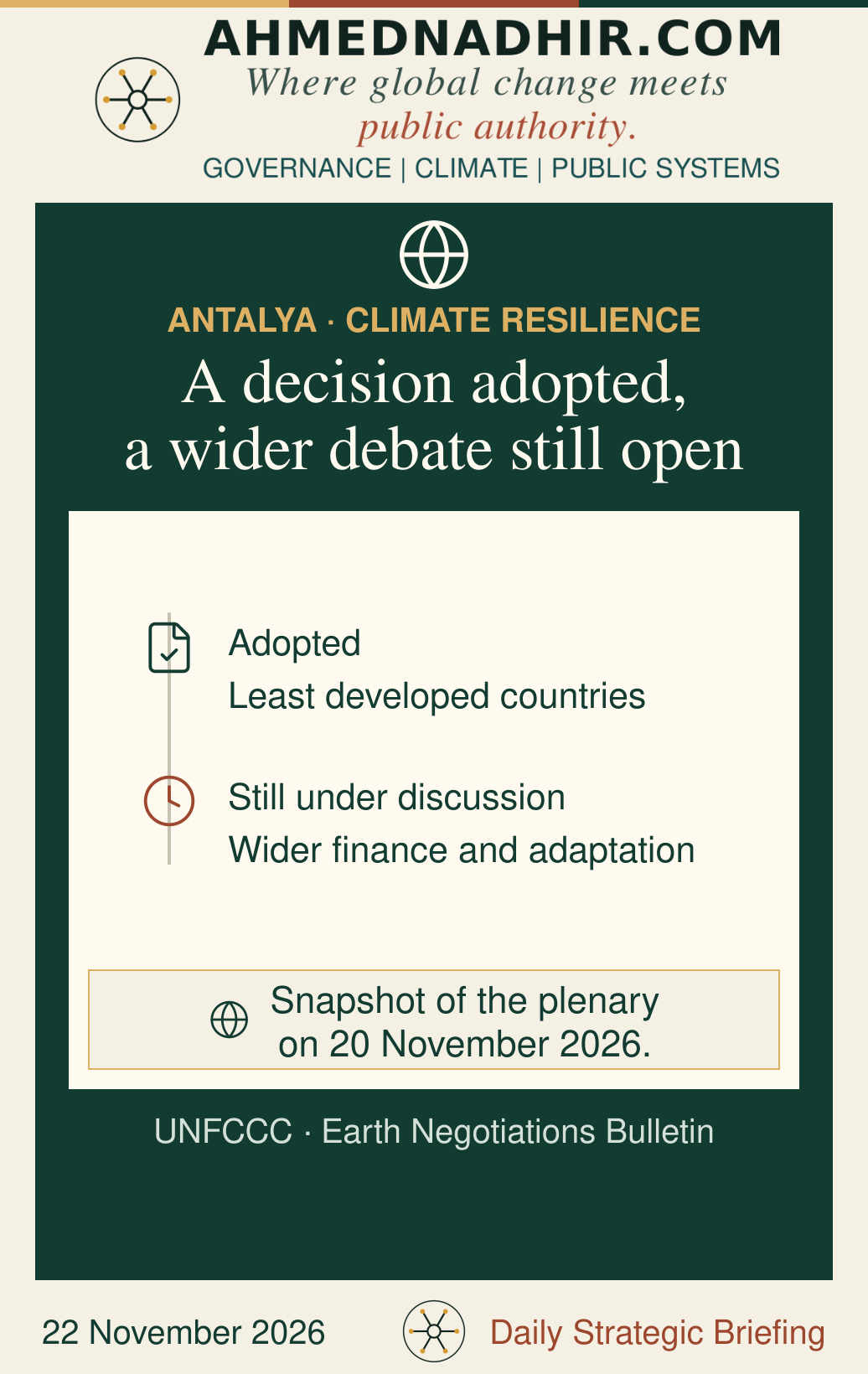
At the 20 November plenary of the United Nations climate conference, parties adopted a decision on matters relating to least developed countries. The United Nations Framework Convention on Climate Change records the item as adopted as presented. The Earth Negotiations Bulletin corroborates the adoption and reports that wider questions on adaptation, finance and other issues remained open at that point.
A decision on one agenda item cannot be read as a settlement on the wider finance package, or as money available to spend. East African administrations preparing water, drainage or other adaptation investments still need to establish the financing window, the eligible applicant and the funds available for preparation. Kenya’s planning teams should read the least-developed-country decision for regional context and check the rules of the funding channel relevant to each Kenyan proposal.
A water authority preparing a scheme has work it can do before a financing decision: specify where the system fails in a dry year, who would operate the new capacity and how it would be maintained. That preparation retains value even if the route to finance changes.
Nigeria: a research centre is one part of a vaccine supply chain
Nigeria · Africa CDC account published 21 November 2026
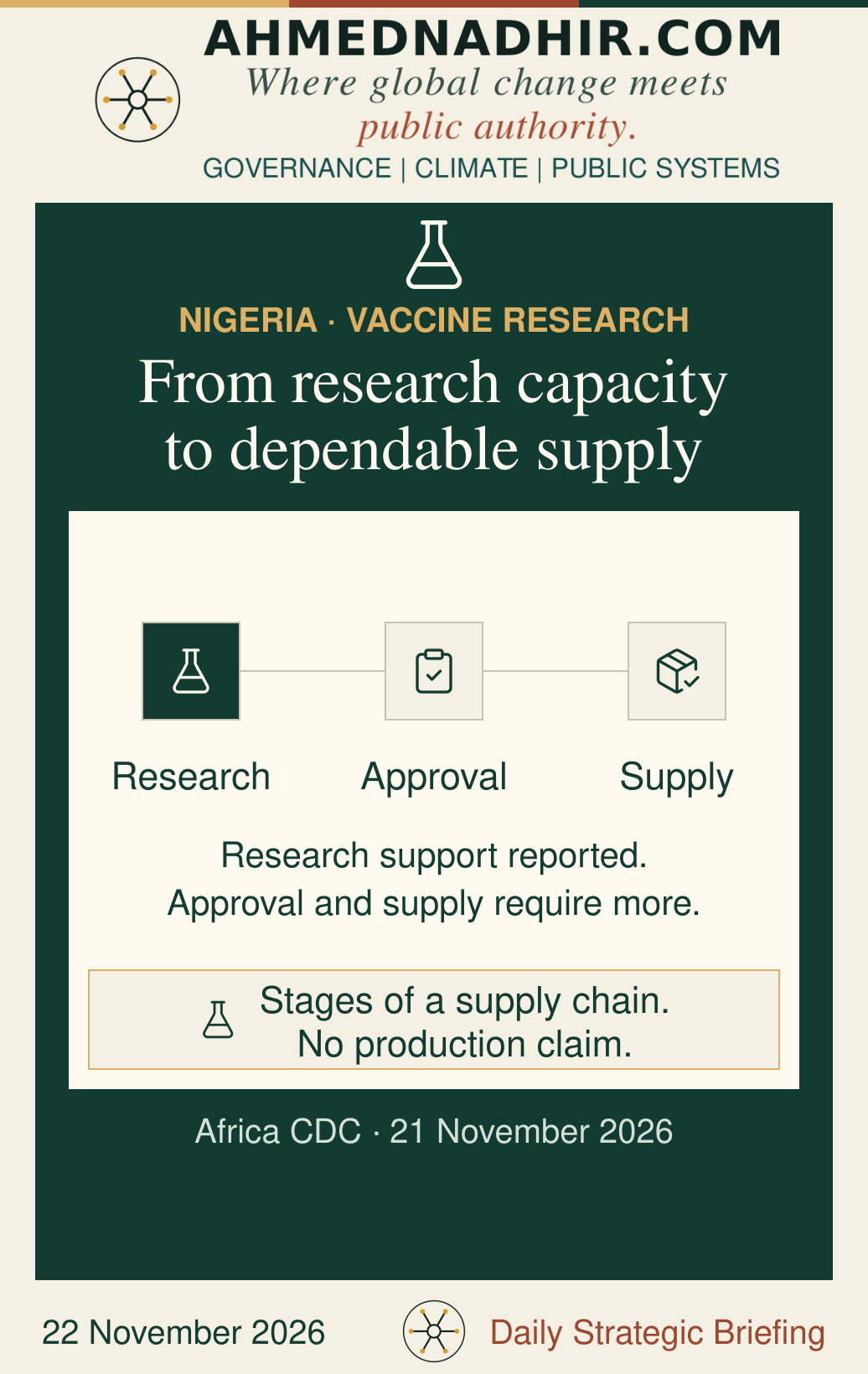
Africa Centres for Disease Control and Prevention described work towards vaccine research and manufacturing capacity linked to a leadership project by Ikrama Hassan, chief medical director of the Federal University Teaching Hospital in Lafia. Its 21 November account says Nigeria’s health minister, Muhammad Ali Pate, expressed government support during a visit to the Centre for Vaccine Research and Development. The account does not give the date of that visit or substantiate a production milestone.
Research capacity can give African public institutions a greater role in deciding which products receive attention. Bringing a product into routine use also requires a regulator able to judge the evidence, a reliable producer and a purchaser with a credible commitment. Procurement agencies and national regulators can use those distinctions to ask which part of the chain an investment is intended to strengthen.
China: drought and lung disease warrant closer study
Accepted research published online in BMC Pulmonary Medicine, 21 November 2026 · observations from 2011–2018
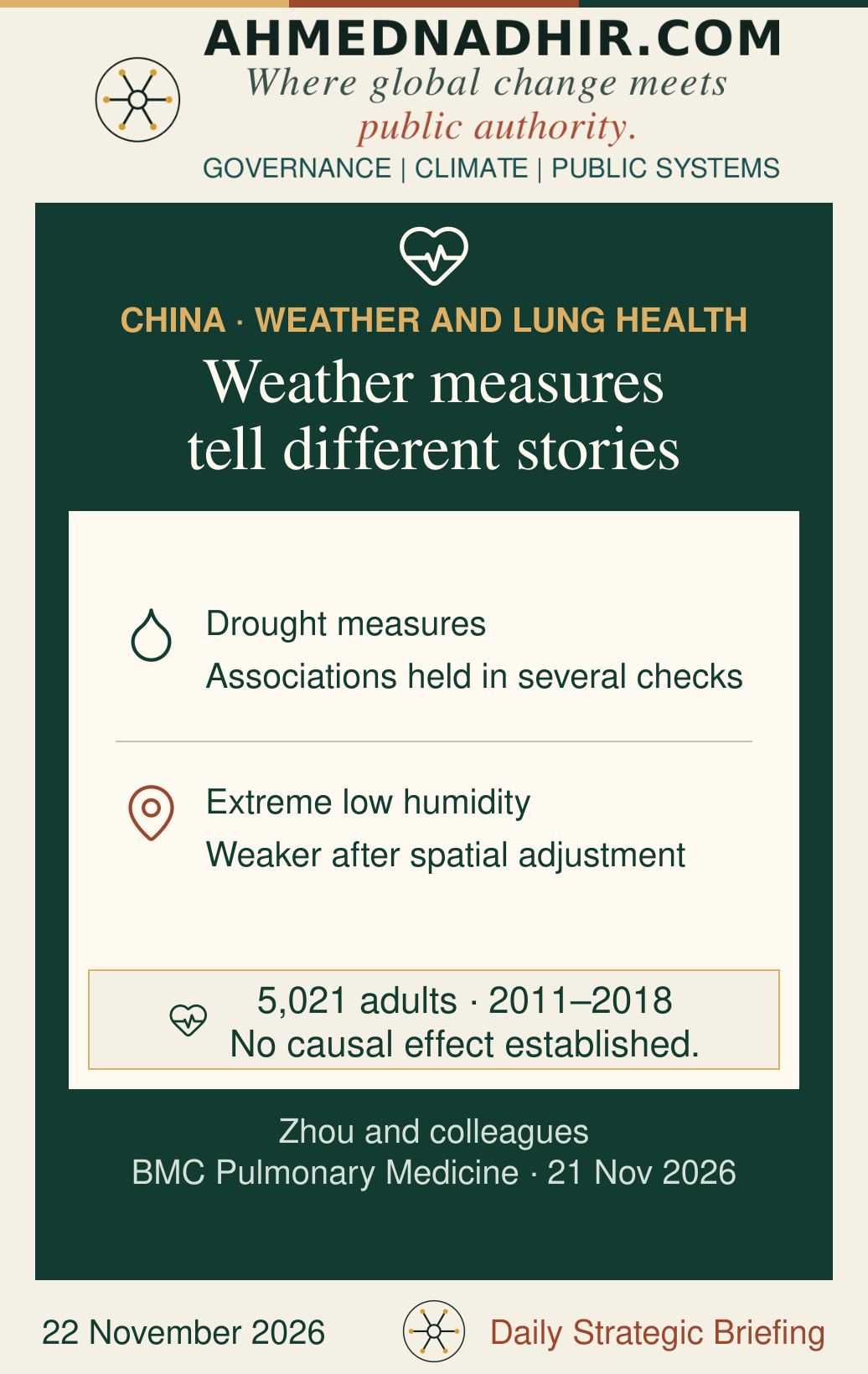
Min-feng Zhou and colleagues followed 5,021 adults aged 45 and over who did not report chronic lung disease at the outset. They linked city-level weather indicators to participants’ residential cities. Over the study period, they identified 664 new cases. Both drought measures were associated with higher lung-disease incidence in their principal analysis and were comparatively consistent across several checks. The association with days of extreme low humidity weakened after stronger geographical adjustment.
Weather measured for a city approximates what its residents experience. The outcome was self-reported, and other regional differences may explain part of the pattern. For health and meteorological agencies in Kenya and elsewhere, the useful question is whether local respiratory records show a similar pattern after accounting for exposures such as smoke and dust. The Chinese result offers a question to investigate; it supplies no Kenyan risk estimate.
Where public responsibility begins
A climate decision, a research initiative and a cohort study each give institutions something different to work with. Treasuries can distinguish eligibility from cash; health ministries can distinguish laboratory capability from dependable supply; and surveillance teams can distinguish a signal worth investigating from a risk they can already quantify. The benefit to the public depends on whether the next institution in the chain has the means and authority to act.