
Antalya closes without an overarching agreement
Türkiye · Conference closed 22 November 2026
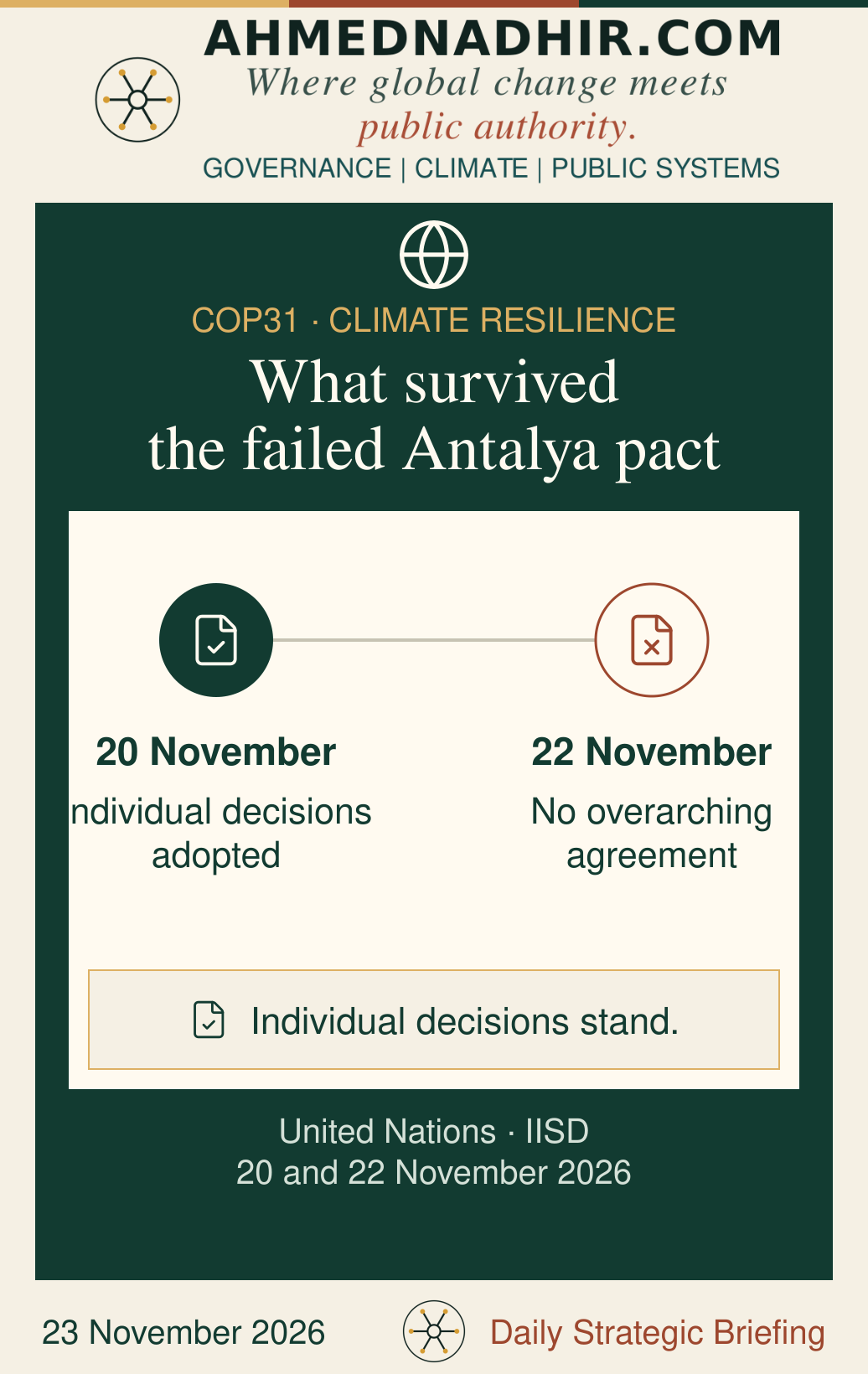
The United Nations confirms that the Antalya climate conference closed on 22 November without consensus on an overarching outcome. The International Institute for Sustainable Development independently reported that the proposed Antalya Pact failed to secure agreement. That is the development since Friday’s plenary: the conference ended without the common text that negotiators were still seeking. Individual decisions, including the decision concerning least developed countries covered in the previous edition, stand on their own. The absence of a pact does not erase them.
For Kenya and other East African administrations preparing adaptation projects, the immediate budget question is which work can proceed under an existing mandate and confirmed financing. A flood project may warrant surveys or designs before construction funds are secured. A water scheme may need a credible operating budget before anyone can judge the value of new infrastructure. The useful distinction is between preparatory work that holds its value under several financing options and spending that depends on a new commitment. A proposed pact cannot be entered as revenue.
Vietnam’s air makes a case for looking beyond the provincial boundary
Accepted study published 22 November 2026 · province data for 2011–2023
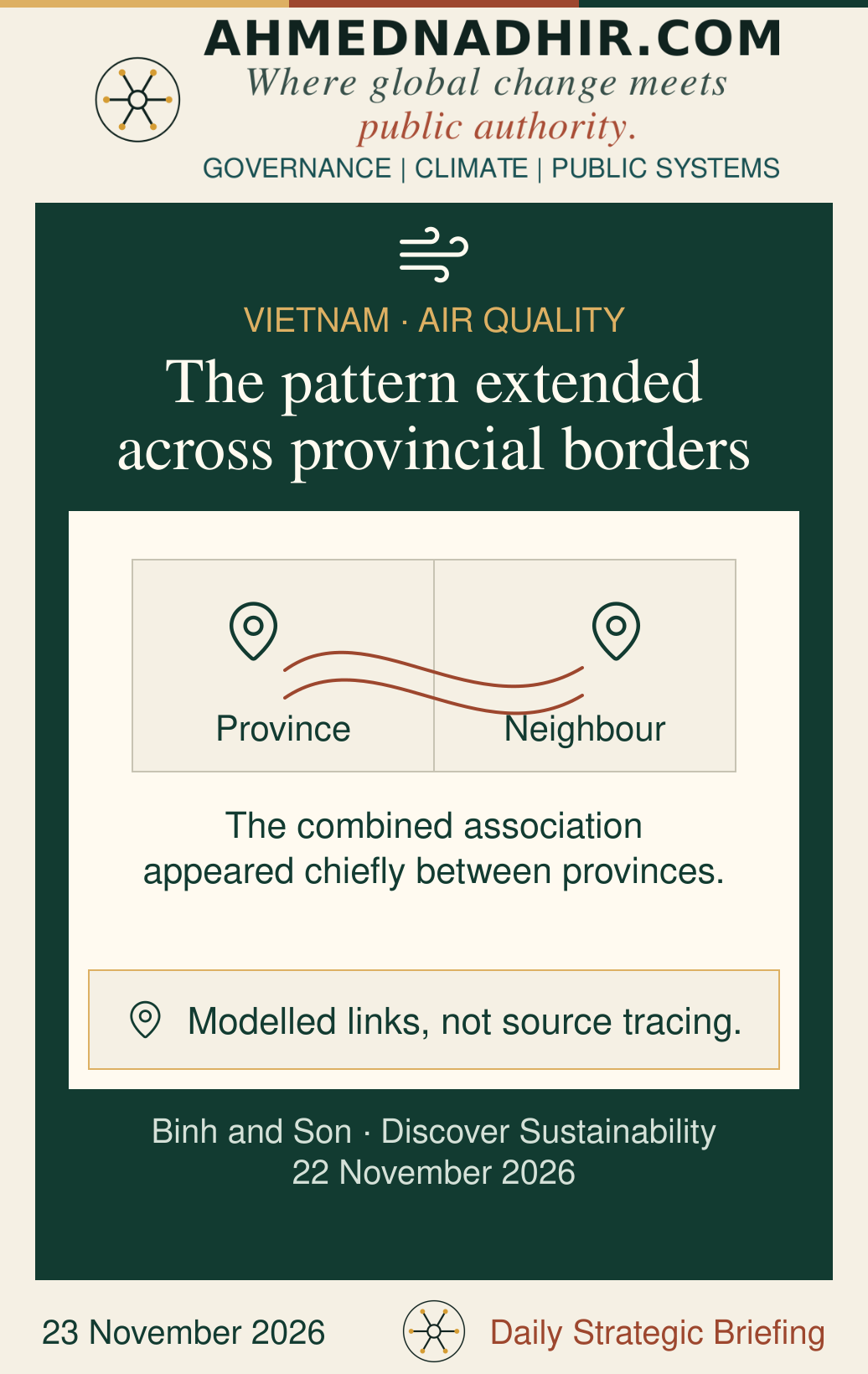
Nguyen Dinh Binh and Nguyen Ngoc Truong Son examined fine particulate matter (PM₂.₅) across Vietnamese provinces. Their spatial model found that pollution levels were related across provinces. Neither of the two governance measures, economic governance capacity and public governance effectiveness, considered separately, was associated with a statistically significant direct reduction within a province. Their interaction was associated with lower pollution chiefly through the modelled links between provinces.
That result does not trace particles back to particular sources or establish the causal effect of a reform. For Kenyan and regional air-quality authorities, the question it raises is practical. If one jurisdiction acts on an industrial or transport source, can neighbouring jurisdictions tell whether exposure changed on their side of the boundary? Compatible monitoring, common reporting periods and a way to investigate anomalies together would make the answer easier to establish.
Export participation cannot certify a cleaner factory
Accepted study published 22 November 2026 · 61 countries, 2008–2022
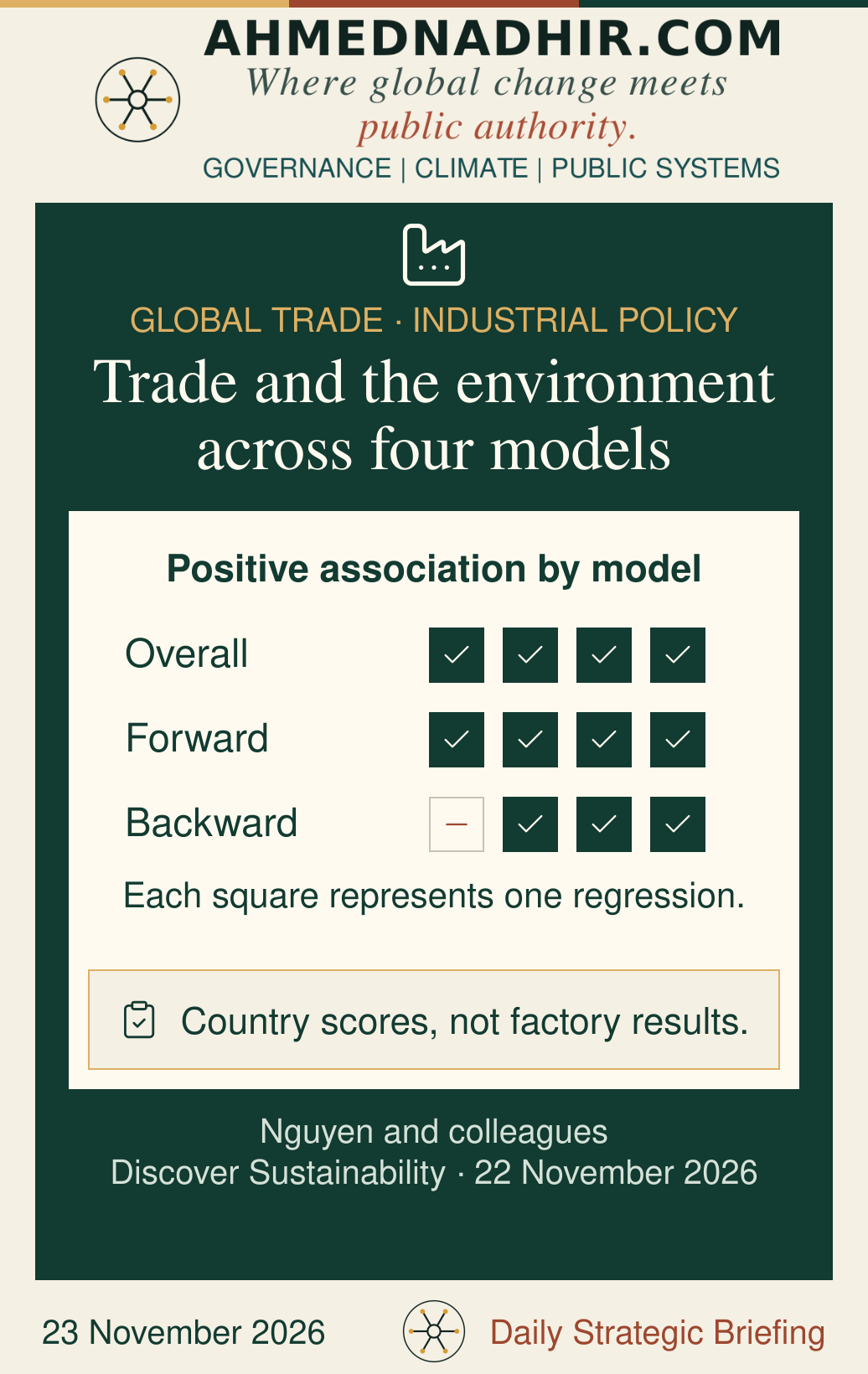
Linh Thi Phuong Nguyen and colleagues compared participation in global value chains with scores on the Environmental Performance Index. Overall participation and forward participation, where domestic inputs enter other countries’ exports, were positively associated with the index across all four reported regression approaches. Backward participation, where foreign inputs enter a country’s exports, was positively associated in three approaches but not in the pooled regression.
These are country-level associations with a composite index. They do not show that entering a supply chain makes a particular factory cleaner or that the same relationship will hold for an African export sector. That distinction matters when a trade or industry ministry promises both export growth and better environmental performance. Export receipts can show whether a firm found a market. Evidence on energy, waste and pollution at the plant is needed to establish what happened at the point of production.
Follow the decision to where its consequences fall
Antalya’s closing record tells public authorities which commitments they can cite. The Vietnam study asks where an environmental effect might be detected, and the trade study shows why a national score cannot settle what happened at a factory. Each makes the case for a better match between the decision and its evidence: identify the financing that can actually be drawn, monitor exposure across the territory it can reach, and verify a production claim where the production takes place.