
Climate, health and resilience
Seven of nine planetary boundaries are now assessed as breached
- Report
- 21 September 2026
- Published
- 21 September 2026
- Evidence
- Multidisciplinary scientific assessment; boundary crossings indicate rising systemic risk, not the timing of a tipping point
The Planetary Health Check 2026 finds that climate change, biosphere integrity, land-system change, freshwater change, nutrient flows, novel entities and ocean acidification are all outside their assessed safe operating space—and all seven pressures are worsening. Stratospheric ozone and atmospheric aerosols remain within the global boundary, although severe regional air pollution persists.
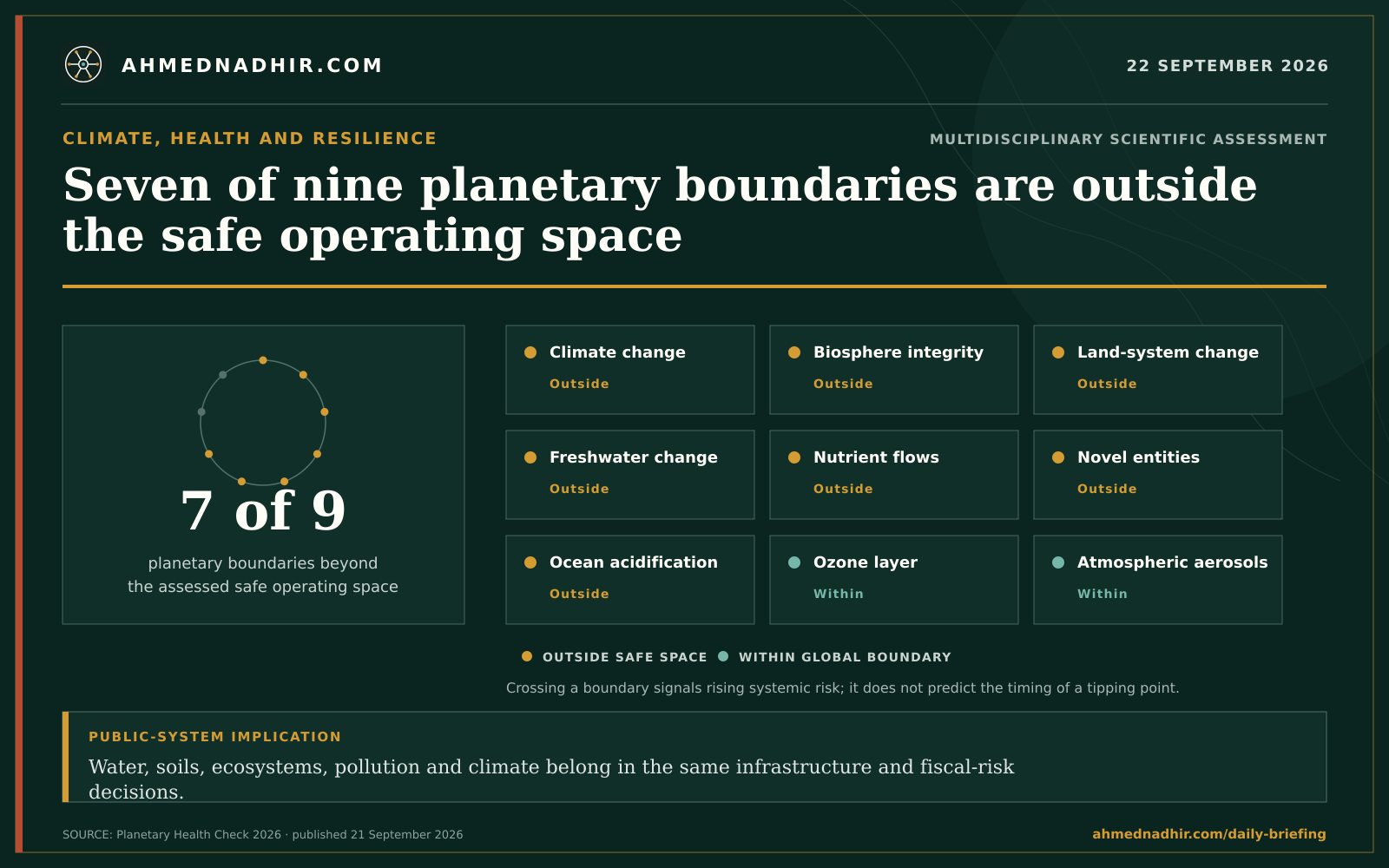
Environmental risk is no longer separable into isolated files. Stress across water, soils, ecosystems, pollution and climate can erode the same buffers on which health, food security and public finance depend.
Kenya should bring water stress, ecosystem condition, pollution and land degradation into infrastructure appraisal, spatial planning and fiscal-risk analysis. Across Africa, catchments, soils, forests and wetlands should be treated as economic and health infrastructure.
Health and health systems
Pennsylvania’s measles outbreak reaches 792 confirmed cases
- Data
- 21 September 2026
- Published
- 21 September 2026
- Evidence
- Official state surveillance confirming case totals, hospitalisations and geographic spread
Pennsylvania confirmed 792 measles cases across 39 counties, 25 more than three days earlier and 116 more than on 11 September. The state reported 155 hospitalisations. Nationally, the United States had recorded 3,471 cases by 17 September. The ten-day increase shows that transmission is still accelerating.
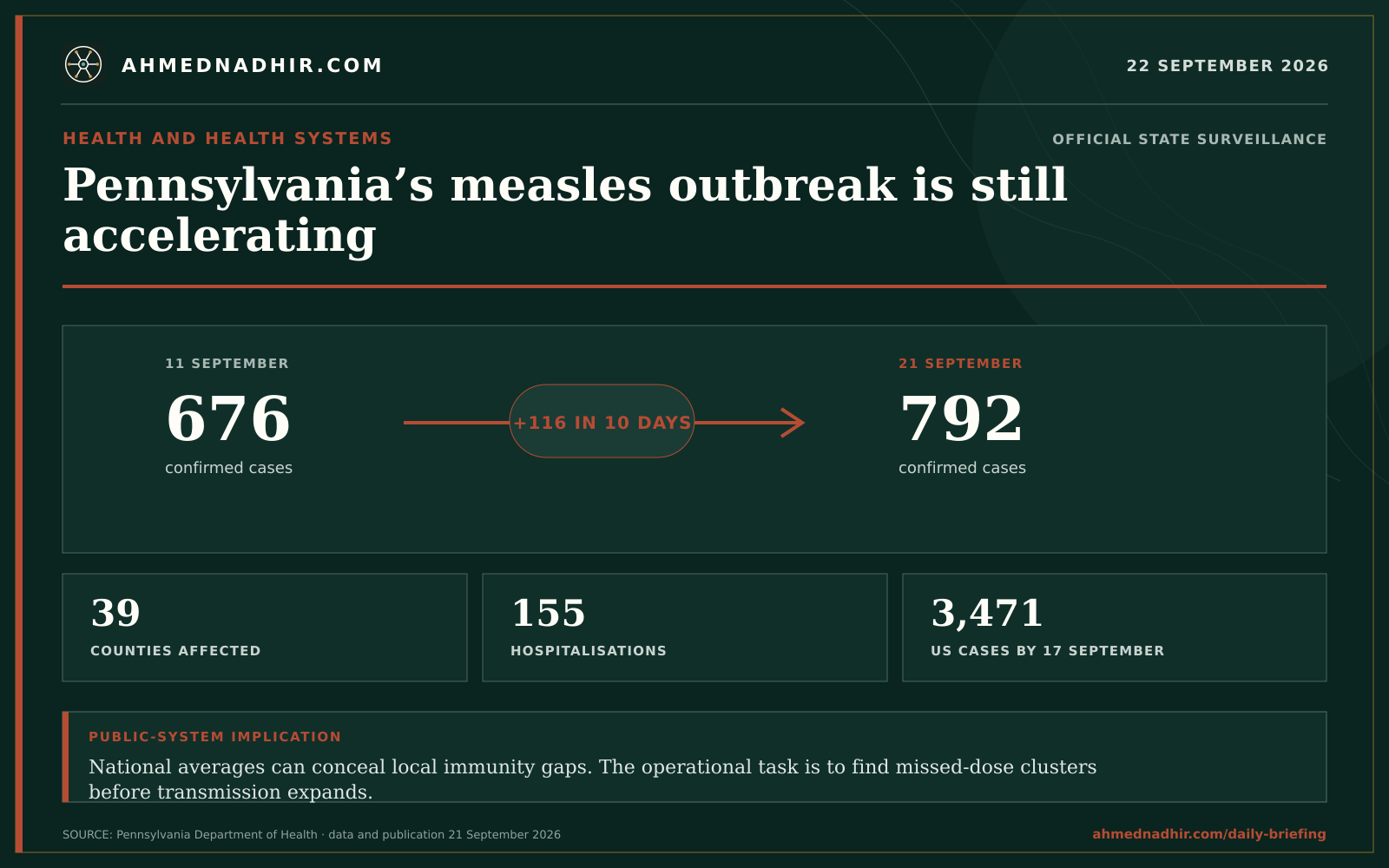
A highly preventable disease can expand rapidly through local immunity gaps even where national vaccination coverage appears reassuring. Aggregate figures do not reveal which communities remain susceptible.
Kenya’s health system should map missed-dose clusters at facility and sub-county level, strengthen defaulter tracing and fever-and-rash investigation, and communicate emerging risk without waiting for a national average to deteriorate.
Governance, public administration and AI infrastructure
Texas freezes new data-centre permits pending a system-wide audit
- Directive
- 21 September 2026
- Published
- 21 September 2026
- Evidence
- Confirmed executive directive; the audit’s findings, permit criteria and duration of the pause remain open
Texas Governor Greg Abbott directed the state environmental regulator to halt permits sought by data centres until the grid operator completes an audit of electricity and water demand, tax benefits and infrastructure costs. More than 470 gigawatts of data-centre and other large-load projects are reportedly waiting in the connection queue—over five times the state’s peak electricity demand.
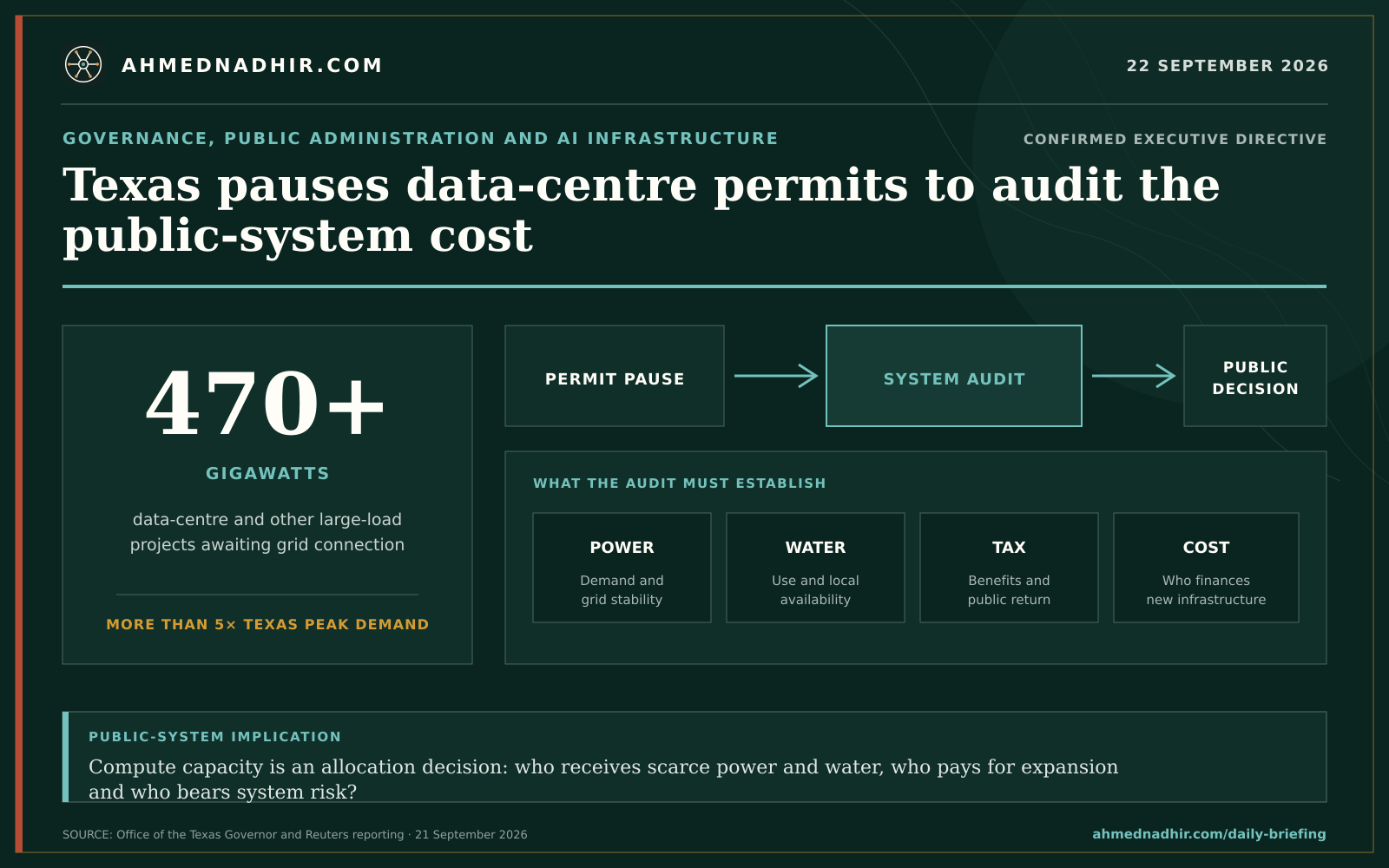
AI compute is becoming a public-infrastructure allocation decision. Approval determines who receives scarce power and water, who finances network expansion and which risks move from private developers to the wider system.
Kenya needs clear data-centre approval rules covering additional generation, credible water budgets, grid-stability tests, connection-cost responsibility and tax transparency before projects receive land, power or fiscal concessions.
Global technology and financial governance
The ECB opens central-bank settlement to tokenised wholesale markets
- Launch
- 21 September 2026
- Published
- 21 September 2026
- Evidence
- Operational launch confirmed by the Eurosystem; adoption, scale and claimed efficiency gains remain to be demonstrated
The Eurosystem launched Pontes, a bridge linking distributed-ledger and tokenised-asset platforms to TARGET services so wholesale transactions can settle in central-bank money. Pontes serves financial-market institutions and is separate from proposals for a retail digital euro. The operational launch follows the Eurosystem's 2024 tests of distributed-ledger settlement.
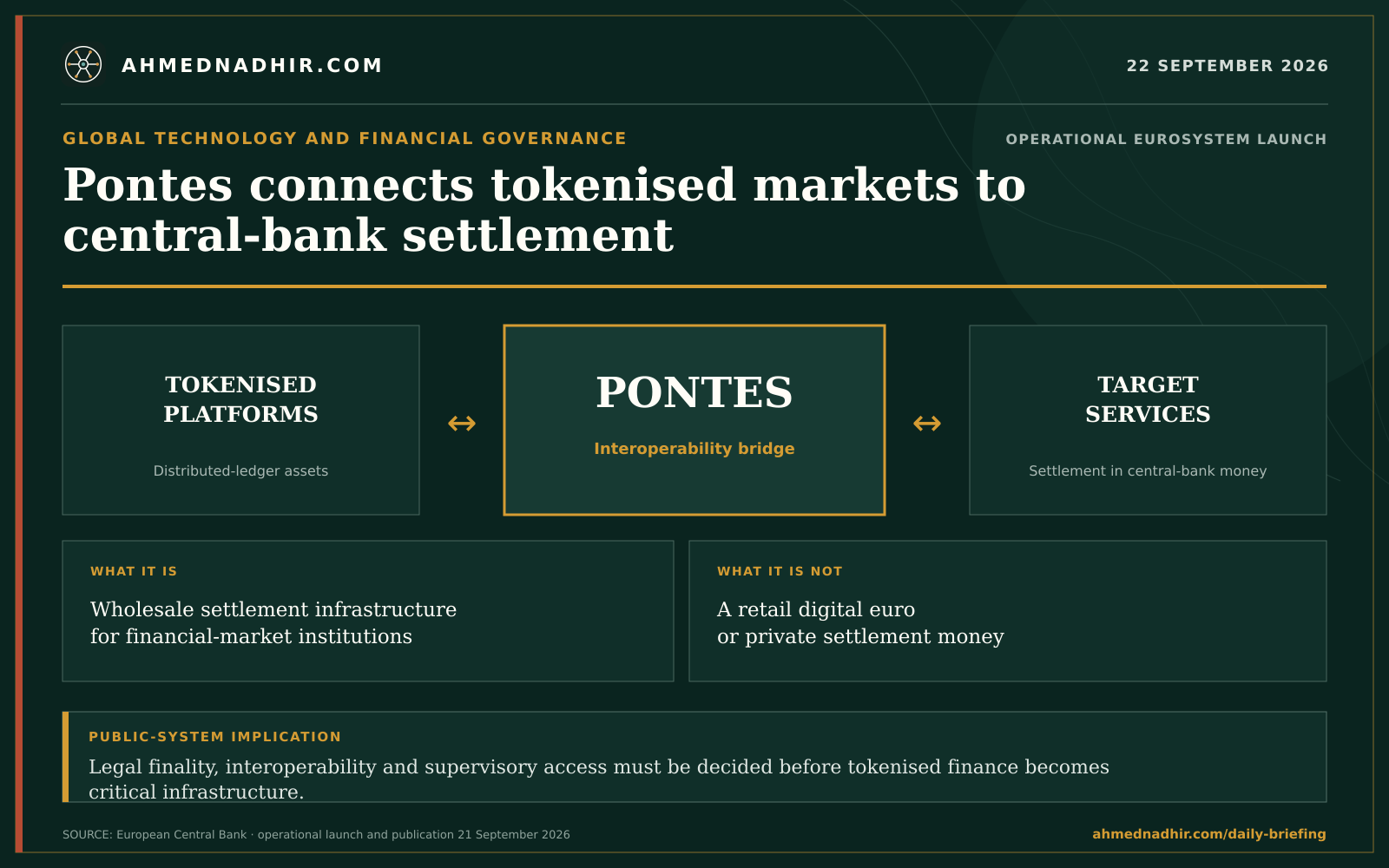
The launch brings public settlement infrastructure into tokenised finance rather than leaving the market to private stablecoins and fragmented platforms. Its importance lies in legal finality, interoperability and institutional trust.
Kenya and African regional payment initiatives should settle the rules before the technology: legal finality, cyber resilience, interoperability, supervisory access and cross-border consumer and market protection must be designed into the rails.