
Social protectionKenya
When risk changes, can Kenya’s safety net respond?
Conference programme: 29 September–1 October 2026Secretariat notice published 28 September 2026
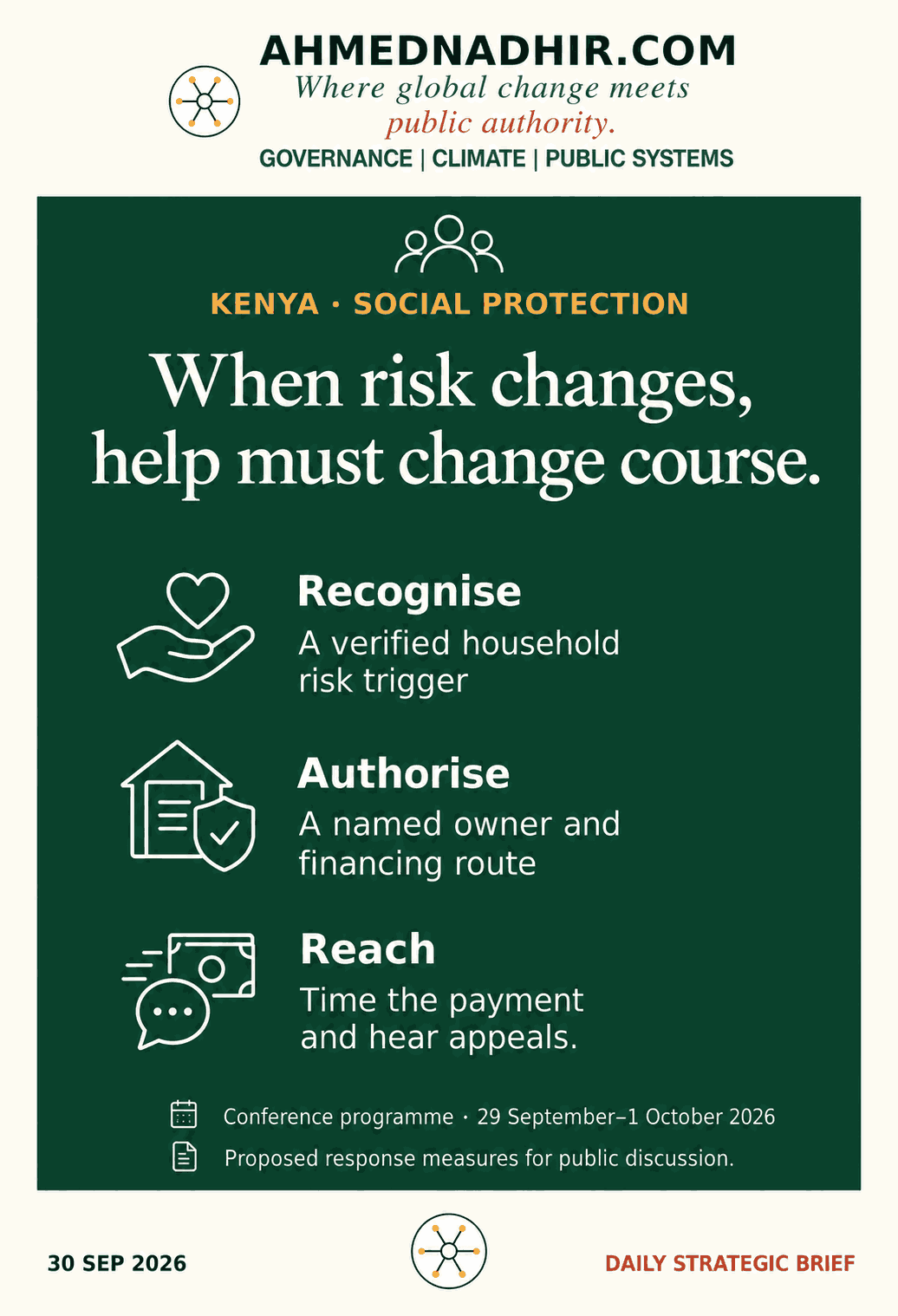
Kenya’s fourth social protection conference is scheduled from 29 September to 1 October at the Kenya School of Government in Kabete, Nairobi. The State Department for Social Protection and Senior Citizens Affairs says government cash transfers reach 1.7 million households.
For a household newly exposed to a flood, failed harvest, lost wage or illness, the useful measure is how quickly help can adapt. The organiser’s coverage figure supplies no national measure of emergency enrolment or payment speed.
The official programme moves through registries, digital payments and financing before turning on 1 October to shock response. It is a timely agenda for a country where a flood, failed harvest, lost wage or illness can change a household’s position between ordinary payment cycles. The programme anticipates a joint call to action at the close. The closing statement remains scheduled for 1 October.
A practical question for the State Department, county governments and the agencies issuing early warnings is how a verified change in risk reaches the cash-transfer system. They can specify the trigger, the official who authorises a temporary expansion, the budget line that pays for it, and a way for a wrongly excluded household to be heard. A published timetable from alert to payment would let the public judge response speed without confusing enrolment with delivery.
Health response safeguardsDemocratic Republic of the Congo
Women in Bunia learn how to report abuse during the Ebola response
WHO Africa feature published 29 September 2026
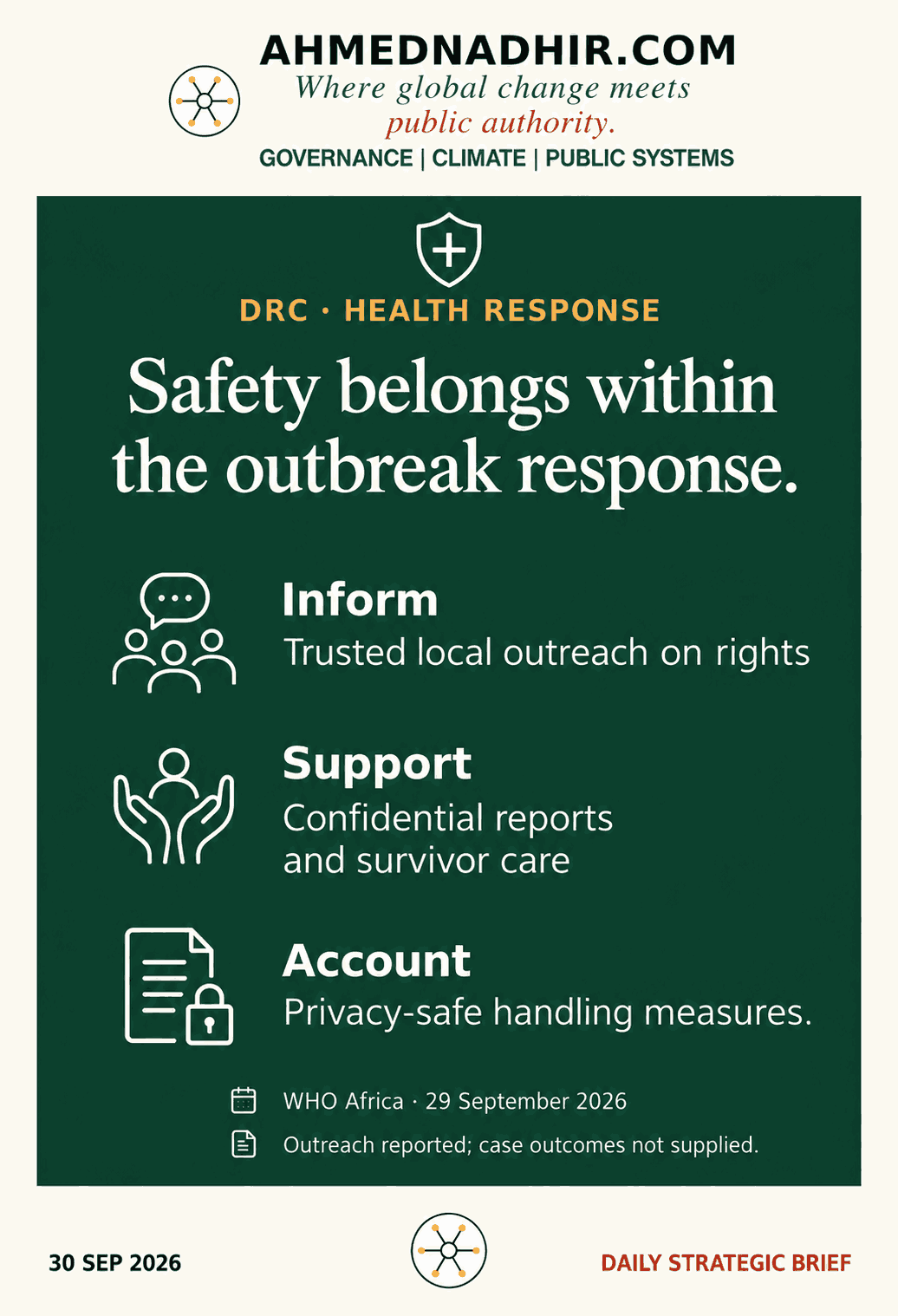
In Bunia’s Cinquantenaire Market, members of the local women’s organisation COSCES are explaining how to report sexual exploitation, abuse and harassment by people working in the Ebola response. WHO’s account, published on 29 September, describes outreach with a local organisation that women already know. It also says WHO has trained personnel, deployed specialist staff and established reporting channels in affected provinces.
The work follows the harm exposed during the DRC’s 2018–20 Ebola outbreak. WHO says the current response has a four-part plan covering prevention, support for survivors, community engagement and coordination. A complaint mechanism can only protect people if someone can use it safely, receive care promptly and expect a credible decision. Market outreach makes the right to complain visible beyond the clinic gate.
WHO, national health authorities and response partners could publish the languages and locations of confidential reporting routes, set a referral standard for survivor support and disclose aggregate handling times without identifying complainants. Contracts with implementing partners and suppliers should carry the same duties. Local women’s organisations need a funded role in explaining the system and testing whether it works in practice.
WHO’s feature describes outreach, reporting channels and staff training. It supplies no current complaint count, resolution rate or measured survivor outcome.
Energy governanceCentral Africa
Six countries plan a shared account of their energy systems
Ministerial meeting held 25 September 2026African Union / AFREC account published 28 September 2026
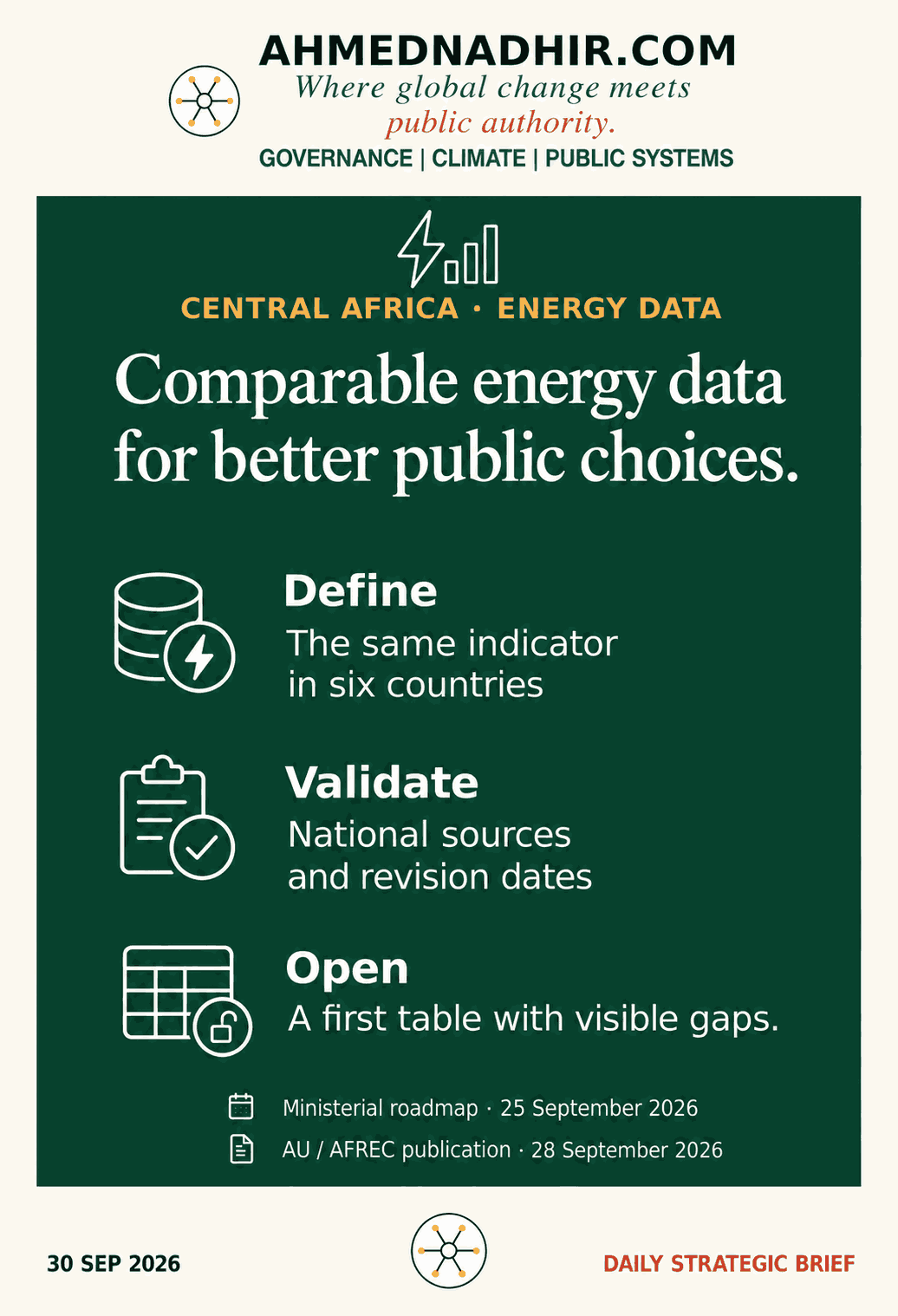
Energy ministers from the six-member Central African Economic and Monetary Community met in Libreville on 25 September. An African Union account published on 28 September says the meeting followed technical discussions and produced a roadmap for a regional energy information system, known as CEMAC-EIS.
The proposed arrangements cover national data focal points, transmission channels, production schedules, validation and public access. A shared definition of electricity access, generation and demand would help authorities compare needs, assess subsidies and plan connected grids. Comparable figures matter to citizens as well as investors when promised infrastructure competes with other uses of public money.
The CEMAC Commission and national energy ministries can start with a small published set of indicators, name each source and revision date, and show where a country’s data remain incomplete. AFREC’s technical role and World Bank-backed statistical support can help establish methods. Public access rules should distinguish genuinely sensitive operational information from basic numbers needed to assess investment and service delivery.
The next public milestone is a live, harmonised regional series. The release establishes a roadmap and working arrangements; service gains will need their own evidence.