
Artificial intelligence · development evidence
United Nations · global systems
A new UN chatbot draws on more than 800 publications
Launch account published in the October 2026 UN DESA Voice; a pilot was described in September.
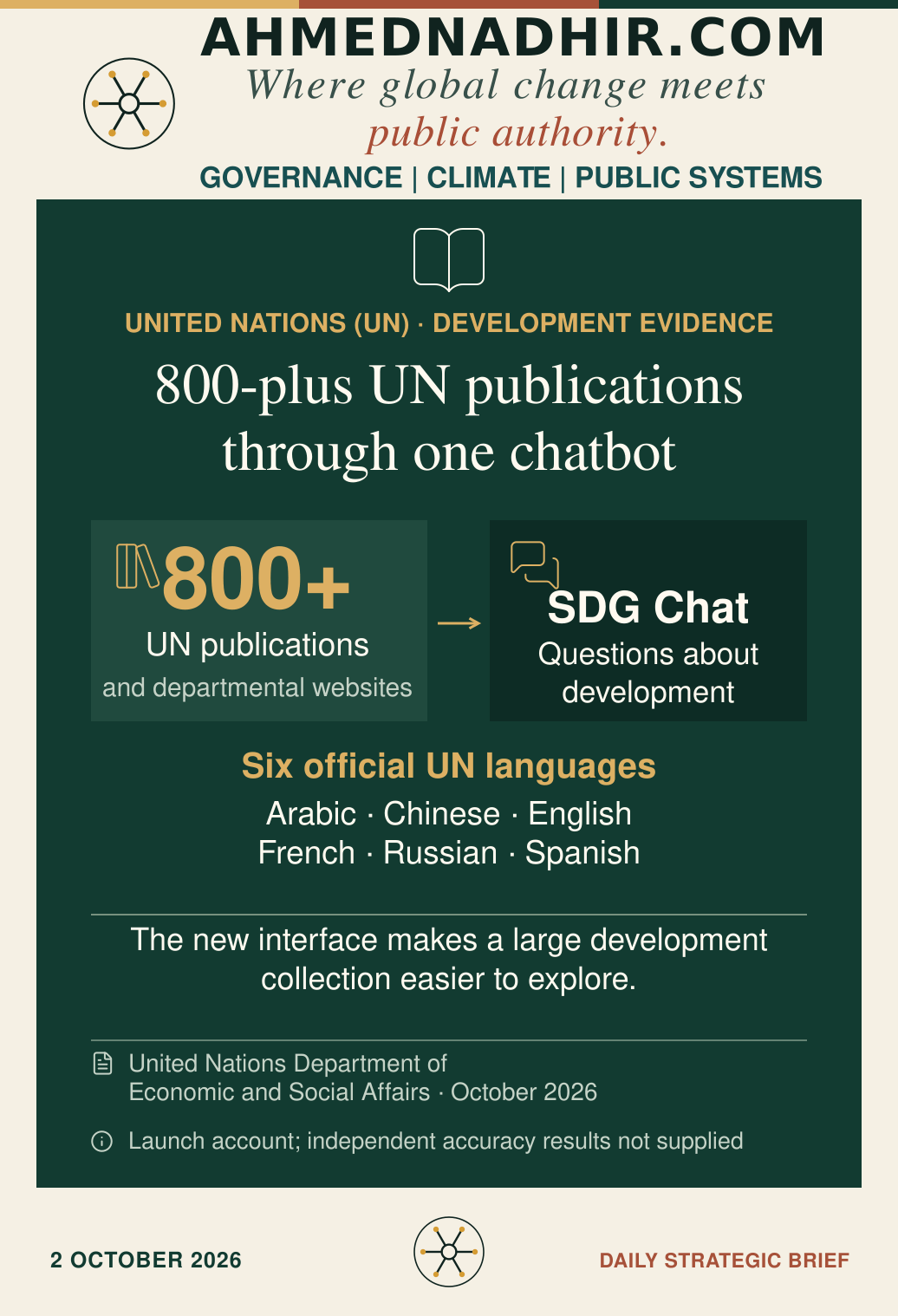
The United Nations Department of Economic and Social Affairs (UN DESA) has introduced SDG Chat, an artificial intelligence (AI) tool for finding information about the Sustainable Development Goals (SDGs). Its October feature says the chatbot draws on more than 800 UN publications and departmental websites, answering questions in the six official UN languages: Arabic, Chinese, English, French, Russian and Spanish.
The change is in how readers enter that collection. A question about financing public services, population change or sustainable development can become a starting point for finding a relevant report. For officials, researchers and civil society across Africa and the Global South, that offers a more approachable route into material scattered across publications and websites.
UN DESA curated the knowledge, the UN Office of Information and Communications Technology provided guidance on responsible AI, and Accenture contributed technical expertise. A September account had already described a pilot. The October launch feature does not establish the exact day the service went live.
The useful public test is whether a reader reaches the right original document and understands its date, geographical scope and limits. A global estimate, for example, cannot become a national statistic simply because it appears in a fluent answer. UN DESA describes the chatbot as an entryway into its work; the launch account provides no independent assessment of answer accuracy or time saved.
Public finance · sovereign borrowing
Africa
AfDB announces help for countries preparing for credit ratings
President’s announcement in London and Reuters report: 1 October 2026.
The African Development Bank (AfDB) will launch support for countries preparing for credit ratings through the African Legal Support Facility (ALSF). President Sidi Ould Tah announced the effort at an S&P emerging-markets conference in London on 1 October. Reuters reports that better economic data and transparency will be central to the work.
A sovereign credit rating expresses a judgement about a government’s ability and willingness to repay. The ALSF’s own analysis describes how agencies assess institutions, economic strength, public finances, external accounts and monetary flexibility. Consistent debt and revenue records help an assessment reflect the country’s actual position.
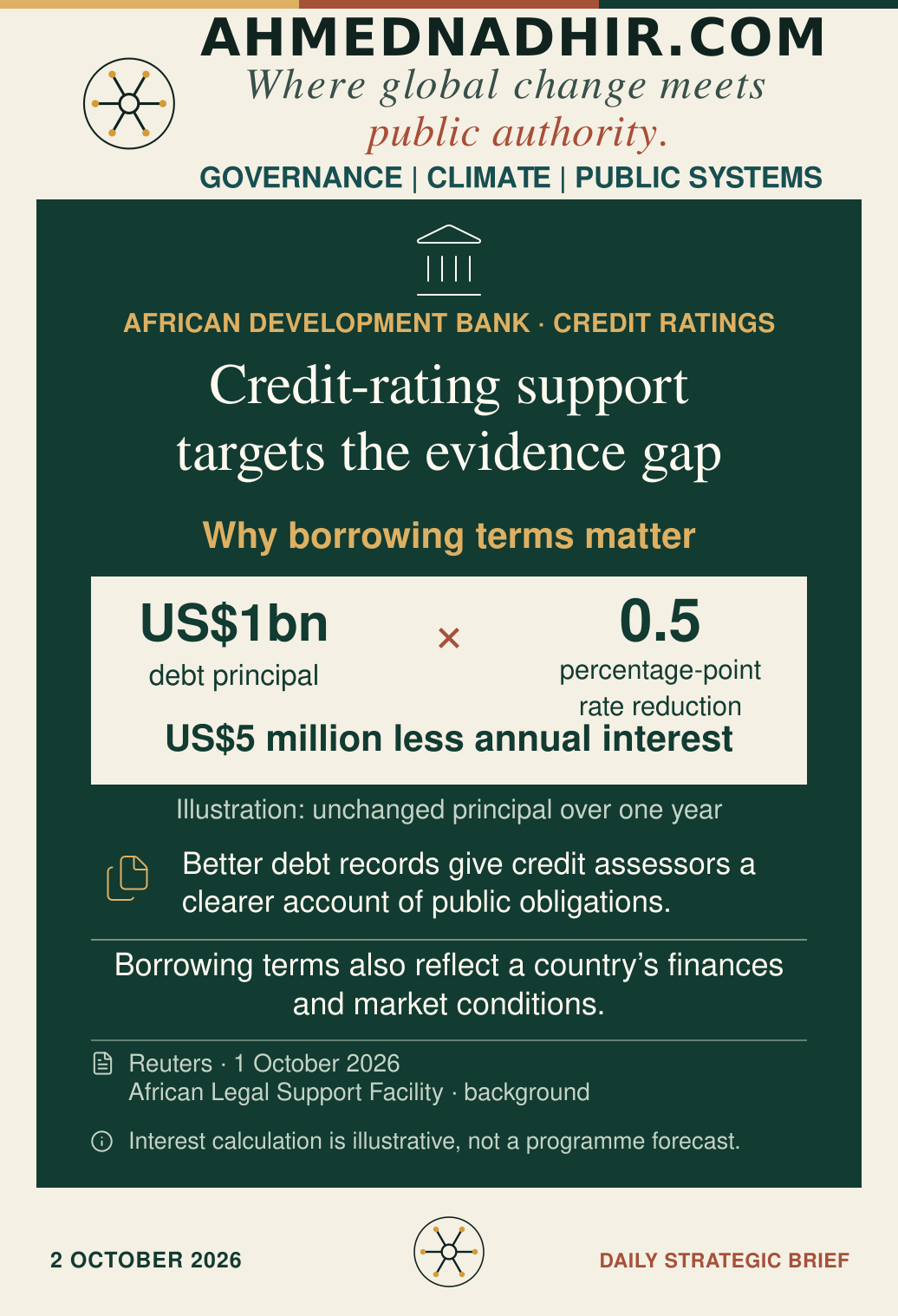
That matters beyond the bond market. Interest payments draw on revenue also needed for schools, healthcare and infrastructure. For scale, a half-percentage-point reduction in the annual rate on US$1 billion saves US$5 million in one year, with principal unchanged. This is an illustration of borrowing costs, rather than a forecast of savings from the announced effort.
Better disclosure strengthens the evidence available to lenders and citizens. Repayment capacity, fiscal performance and market conditions still affect financing terms. The president’s announcement establishes intended support; it does not establish a rating upgrade, lower interest costs or an operational timetable.
Climate · resilience and essential services
East and Southern Africa · Indian Ocean
El Niño brings different preparations for rain and water stress
Regional statement: 17 September 2026 · WMO update: 1 October 2026.National seasonal outlooks: Tanzania, 18 August · Malawi, 2 September 2026.
The World Meteorological Organization (WMO) says an established, strengthening El Niño will influence rainfall, heat and cyclone patterns across the South-West Indian Ocean. Its 1 October update covers October–December 2026 and January–March 2027. It identifies wetter northern areas and drought pressures farther south, including parts of South Africa, Mozambique and Madagascar.
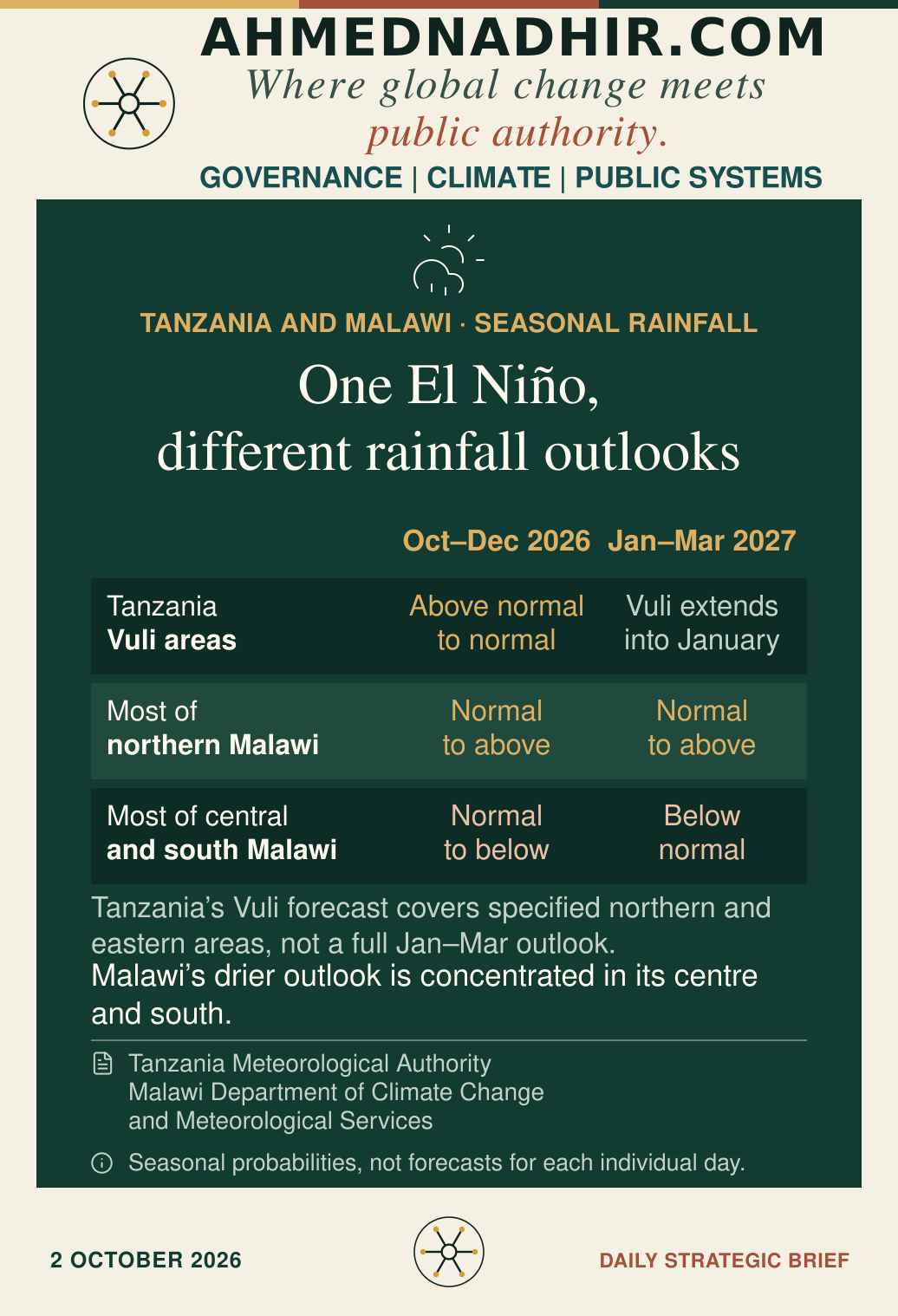
Tanzania’s national forecast is more specific than a countrywide wet-season label. The Tanzania Meteorological Authority (TMA) forecasts above-normal to normal Vuli rainfall in the northern coast, northeastern highlands, Lake Victoria zone and northern Kigoma. Vuli is the October–December season in these areas, which have two rainfall seasons each year. The bulletin expects rain to continue into January 2027; it does not provide a national January–March Vuli forecast.
Malawi’s Department of Climate Change and Meteorological Services retains normal-to-above-normal rainfall over most northern areas in both quarters. Most central and southern areas are normal-to-below in October–December and below normal in January–March. The regional statement gives a broader below-normal January–March signal for Malawi. The national and regional accounts therefore differ on the north; local planning needs the national and district forecasts alongside subsequent updates.
Short-range weather adds another layer. Tanzania’s 1–10 October bulletin combines rain in parts of the northern zones with dry conditions elsewhere. Malawi’s latest bulletin, issued on 2 October for 3 October, warns of thunderstorms, heavy rain in some areas and strong Mwera winds over water bodies. A drier seasonal outlook does not remove the immediate risk of a heavy storm.
| Location | October–December 2026 | January–March 2027 |
|---|---|---|
| Tanzania’s Vuli zones | Above normal to normal | Rain expected to extend into January; no full-quarter national Vuli forecast |
| Most of northern Malawi | Normal to above normal | Normal to above normal |
| Most of central and southern Malawi | Normal to below normal | Below normal |
Tanzania’s named Vuli zones: the northern coast, northeastern highlands, Lake Victoria and northern Kigoma. Malawi’s national northern signal differs from the broader regional January–March outlook. These are seasonal probabilities, not daily weather predictions.
Health · care and public responsibility
Global South · world
More countries adopt long-term-care policies; funding lags
Secretary-General’s report transmitted: 28 September 2026.World Health Organization update published: 1 October 2026.
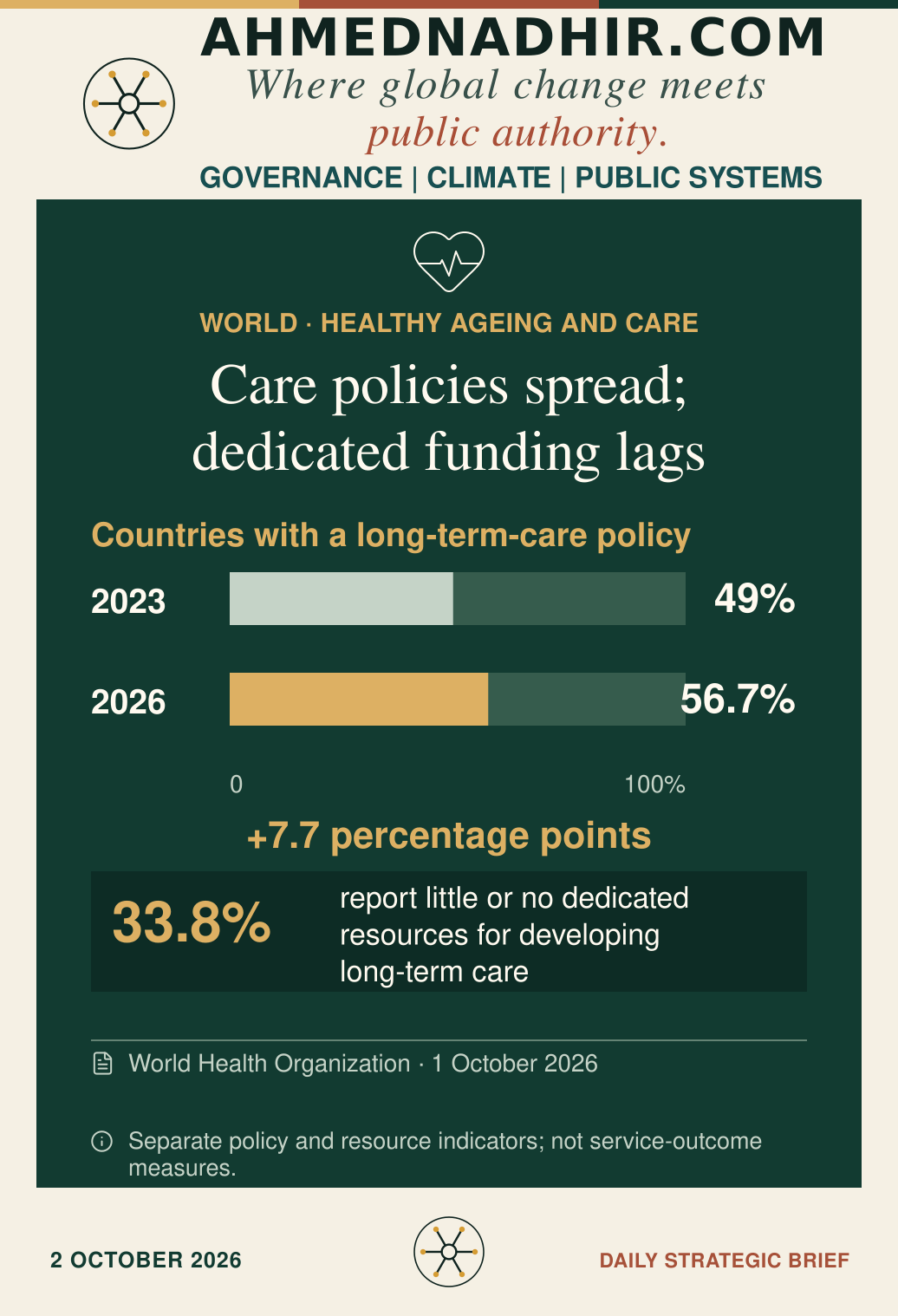
The World Health Organization (WHO) reports progress at the midpoint of the United Nations Decade of Healthy Ageing. National long-term-care policies now exist in 56.7% of countries, up from 49% in 2023. Yet 33.8% of reporting countries have very little or no dedicated resources to develop long-term care.
The population aged 60 and over is projected to reach 2.1 billion by 2050, with the fastest growth in low- and middle-income countries. Only 22.7% of countries can track older people’s health over time. These are global indicators of policy and system capacity, rather than measurements of care delivered in an individual African country.
Long-term care concerns the support a person needs to live with dignity when everyday tasks become difficult. It reaches beyond a clinic visit: help at home, accessible transport, assistive devices and a referral that connects one service to another. Family members often carry those responsibilities, with consequences for their own work and income.
For health and social-protection authorities across the Global South, longer lives make the connection between policy, finance and delivery increasingly important. A national policy offers direction; a funded care pathway determines whether someone receives support where they live.