
WORLD · FOOD PRICES AND RESILIENCE
FAO links rising world wheat prices to shipping disruption and dry weather
Data: September 2026 · Published: 2 October 2026
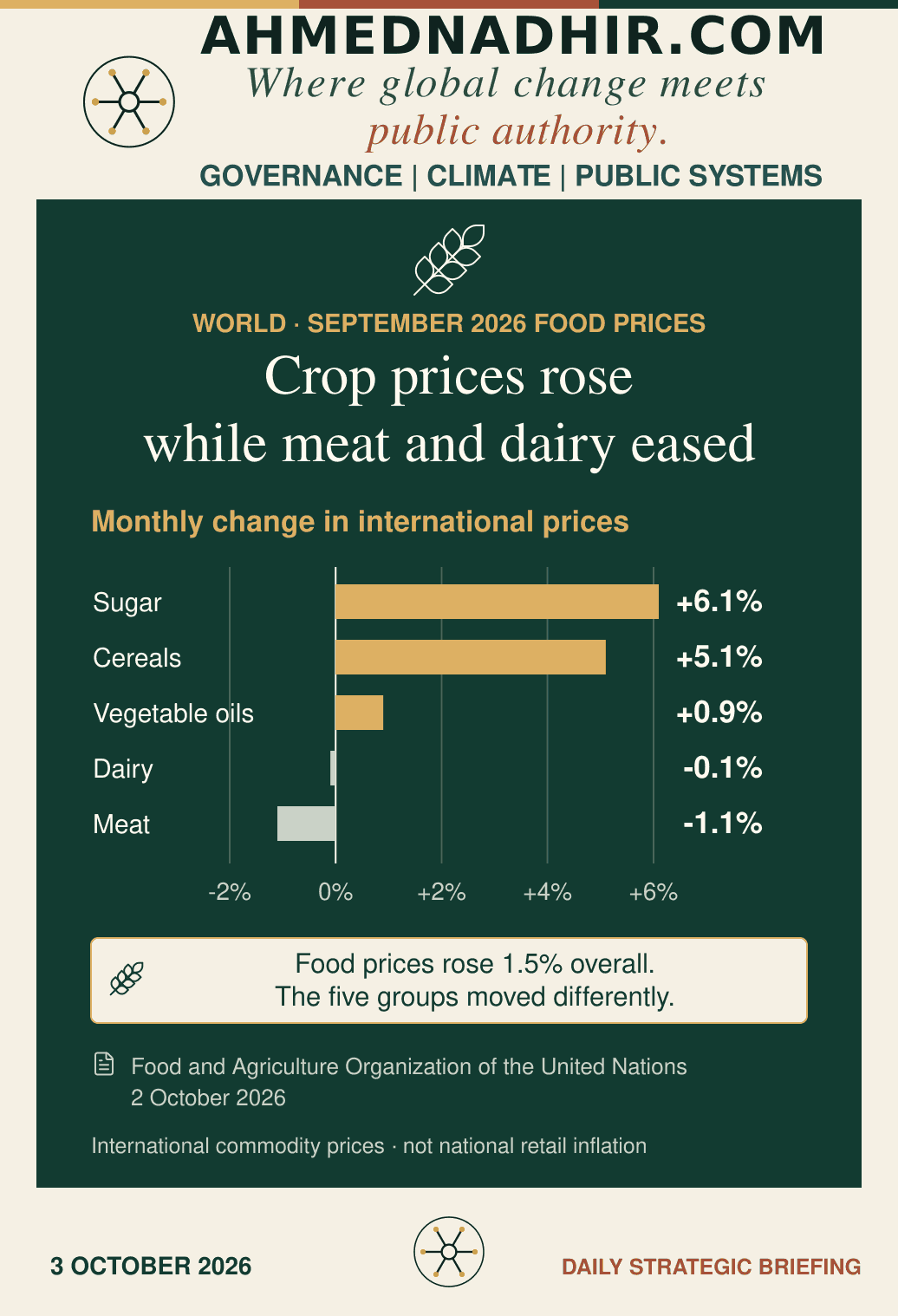
The Food and Agriculture Organization of the United Nations (FAO) reported on 2 October that its world food-price index averaged 136.0 points in September, up 1.5% from August and 5.8% from a year earlier. Cereals rose 5.1% over the month and sugar 6.1%; meat and dairy moved slightly lower.
The increases have specific causes. FAO links wheat prices to Black Sea shipping constraints and dry weather in North America; sugar faces a tighter supply outlook and disrupted harvesting in Brazil. Its forecast still puts the 2026 cereal harvest at 2,979 million tonnes, the second largest on record, although 2.1% below 2025. A large worldwide total does not settle what a buyer pays for the right crop, an available shipment and delivery to its destination.
For food-importing economies, freight and the exchange rate help determine the final bill. Kenyan procurement teams can read the international figures alongside domestic harvests, stocks and market prices to distinguish a global price pressure from a local supply problem. The FAO index measures traded commodities, while household food inflation measures prices paid in shops and markets.
The index tracks international commodity prices. Forecasts and recent index readings are revised as information improves.
WORLD · HEALTH SYSTEMS
WHO estimates noncommunicable diseases caused 74% of global deaths in 2023
Estimates: 2000–2023 · Released: 2 October 2026
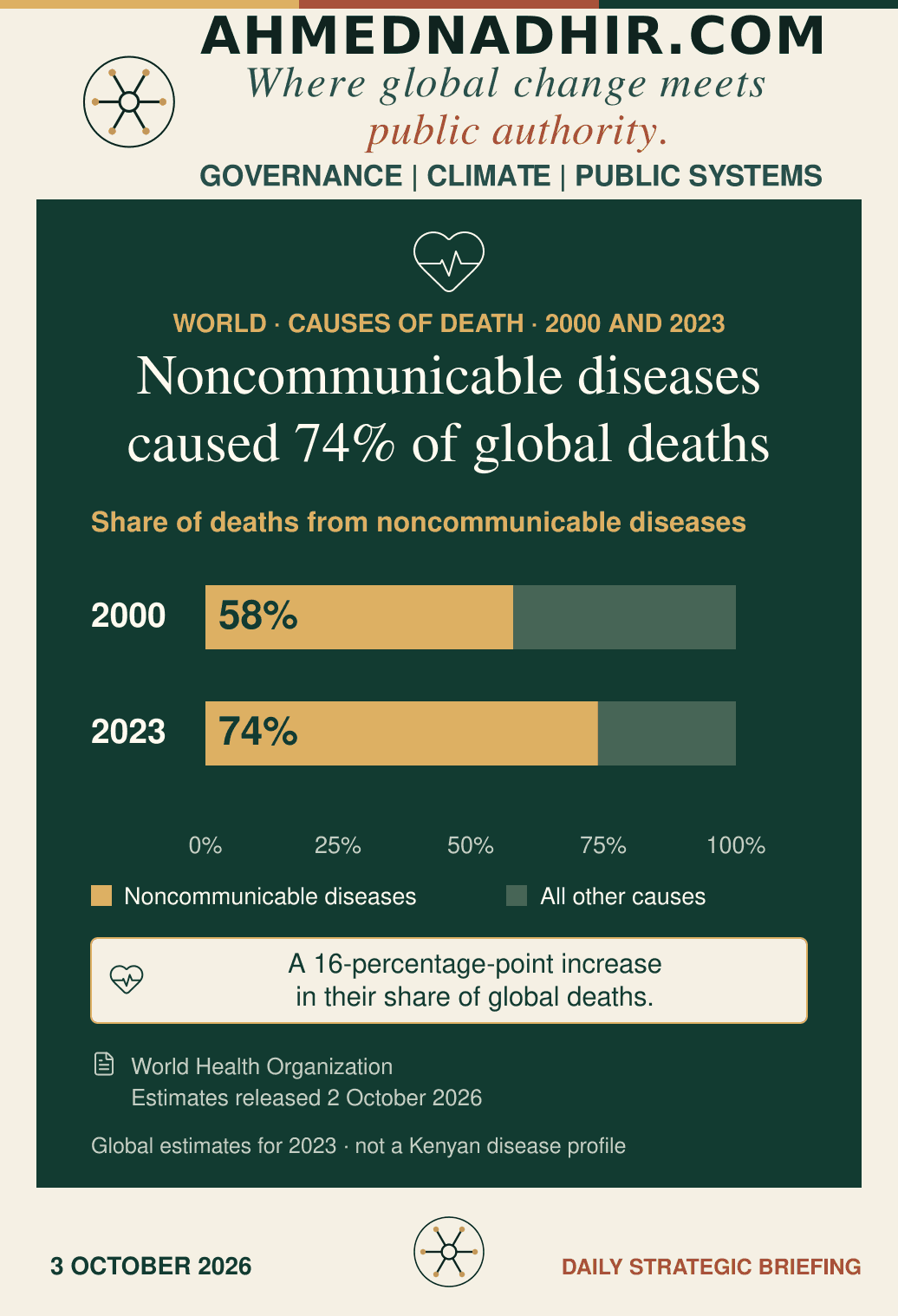
New Global Health Estimates released by the World Health Organization (WHO) on 2 October show noncommunicable diseases, including heart disease and diabetes, accounting for 74% of deaths worldwide in 2023, compared with 58% in 2000. Global life expectancy had recovered to 73.3 years, close to its 2019 level; healthy life expectancy, at 62.8 years, remained below its pre-pandemic level.
A growing share of deaths from chronic conditions changes what a dependable health service has to provide. Hypertension or diabetes care involves repeated appointments, medicines, monitoring and referral when needed. The value of an initial diagnosis rests partly on the patient’s ability to return and continue treatment. That makes service continuity a financing and management question as well as a clinical one.
Across African health systems, the planning task is to expand that continuing care alongside infectious-disease services and emergency preparedness. The global percentage cannot stand in for Kenya’s disease profile or a county’s caseload. National estimates, death registration and facility records offer the evidence for deciding where staff, medicines and diagnostic capacity are needed.
These are estimates for 2023 released in 2026. Changes in the share of deaths do not, by themselves, measure an individual’s risk of disease.
EMERGING MARKETS · SMALL-BUSINESS FINANCE
IFC and SMBC announce US$500 million in supplier finance, starting in Latin America
Announced: 2 October 2026 · First buyer: Latin American food sector
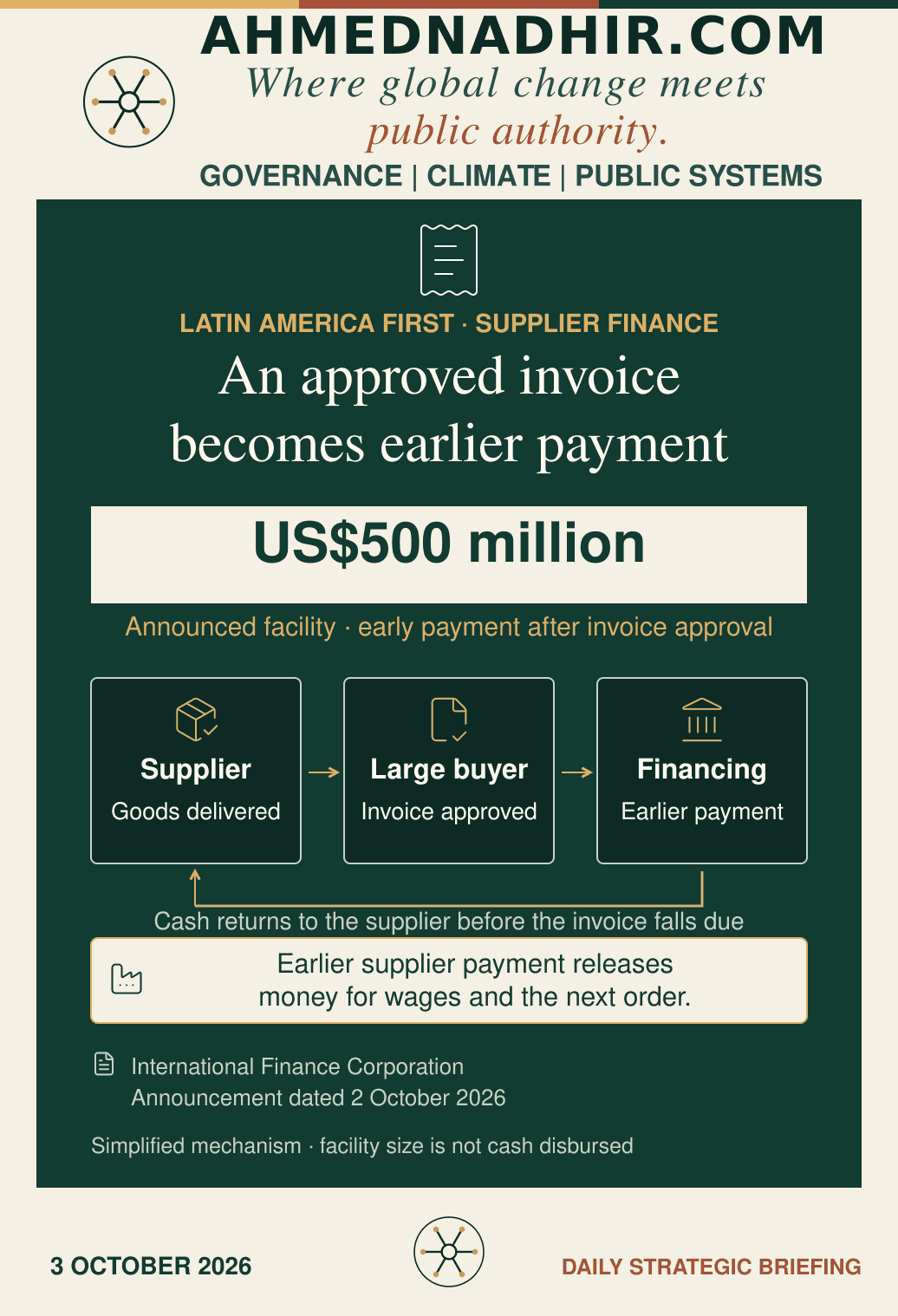
The International Finance Corporation (IFC) and Sumitomo Mitsui Banking Corporation (SMBC) announced a US$500 million supply-chain finance facility on 2 October. IFC is committing up to US$250 million, with the bank providing the other half. The first participating large buyer is a food manufacturer in Latin America.
The mechanism addresses a familiar business problem: an accepted delivery can leave a supplier waiting for cash while wages and the next order need funding. Once the buyer approves an invoice, financing allows earlier payment. Credit rests on the established buyer’s financial strength rather than solely on the small supplier’s borrowing history. The supplier gains usable cash against a transaction it has already completed.
For Kenyan and other African businesses, this is a financing model to examine, rather than an announced local facility to apply to. Its usefulness depends on the total financing cost, the time taken to approve invoices and clear treatment of disputes. Faster payment after approval does not resolve a delivery or invoice that remains unaccepted.
The 2 October release announces a US$500 million facility. IFC’s older disclosure, updated on 25 September, lists signing as pending. Neither source supplies a disbursement total, borrower rate or Kenyan eligibility.
CAMEROON AND CENTRAL AFRICAN REPUBLIC · TRADE
Cameroon authorises a World Bank loan agreement for the Douala–Bangui trade route
Decree: 2 October 2026 · World Bank programme approval: 12 June 2026
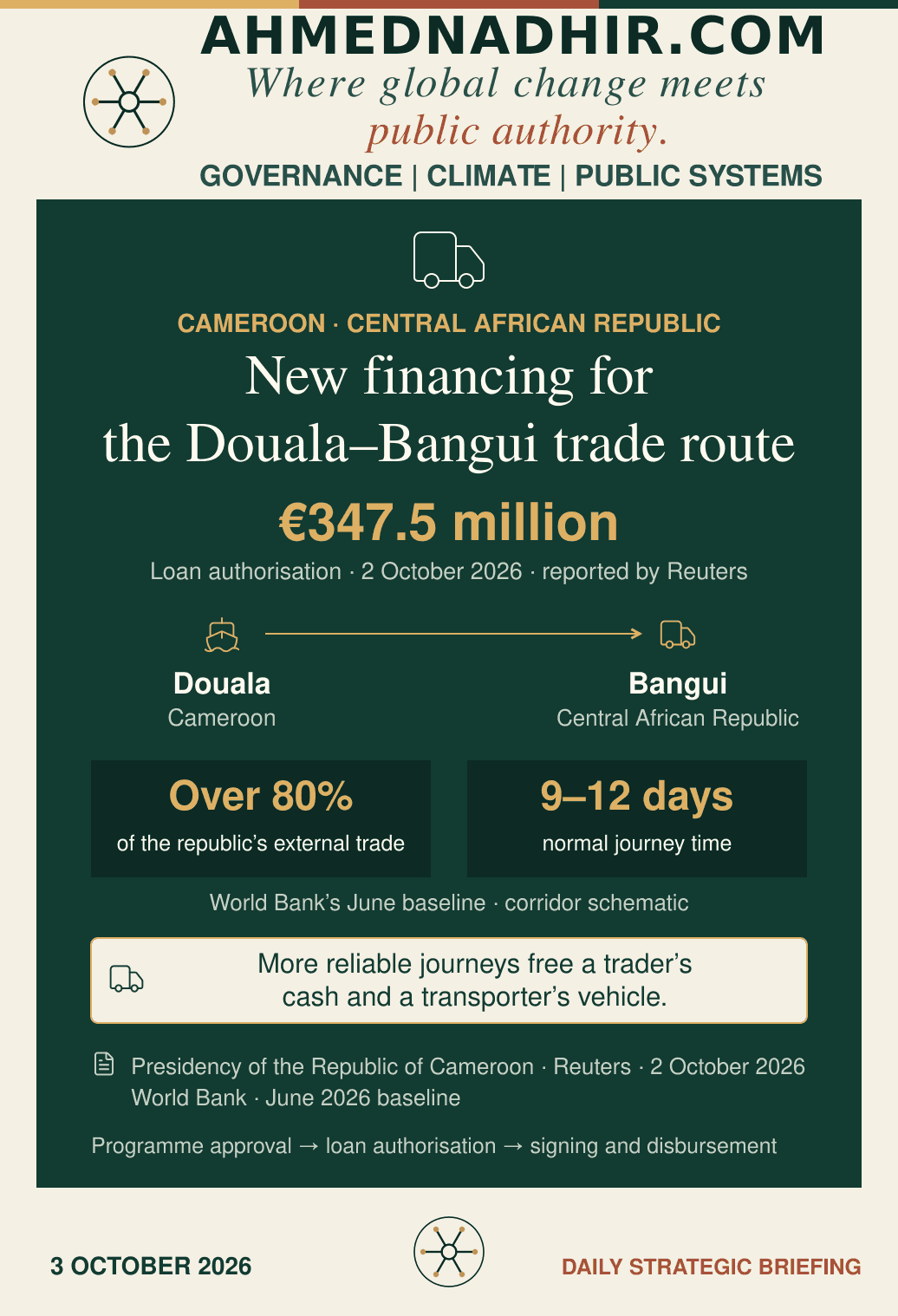
Cameroon’s Decree No. 2026/321, dated 2 October, authorises the signature of a loan agreement for the Douala–Bangui Economic Corridor. Reuters reports the amount as €347.5 million from the World Bank’s International Bank for Reconstruction and Development. The decision advances financing for a route central to the landlocked Central African Republic’s trade.
The route links Douala in Cameroon with Bangui in the landlocked Central African Republic. The World Bank’s programme announcement of 12 June describes a corridor longer than 1,400 kilometres carrying more than 80% of the Central African Republic’s external trade. It reported normal journeys taking nine to twelve days, alongside deteriorated roads and numerous checkpoints.
Long and unpredictable journeys tie up a trader’s cash and a transporter’s vehicle. More reliable travel makes replenishment easier and releases vehicles for the next load. The programme combines roads built to withstand climate hazards with logistics facilities, trade facilitation and maintenance reforms. Its economic purpose is a cheaper, more dependable journey from the port to the customer.
The June journey and trade figures are a baseline, not measured October improvements. Loan authorisation, signing and disbursement are separate stages. The authorisation is not counted as additional funding on top of the June programme.