
CHAD · ENERGY FINANCE
Qair announces the first financing payment for two solar plants in Chad
Qair announcement and Proparco account: 25 September 2026
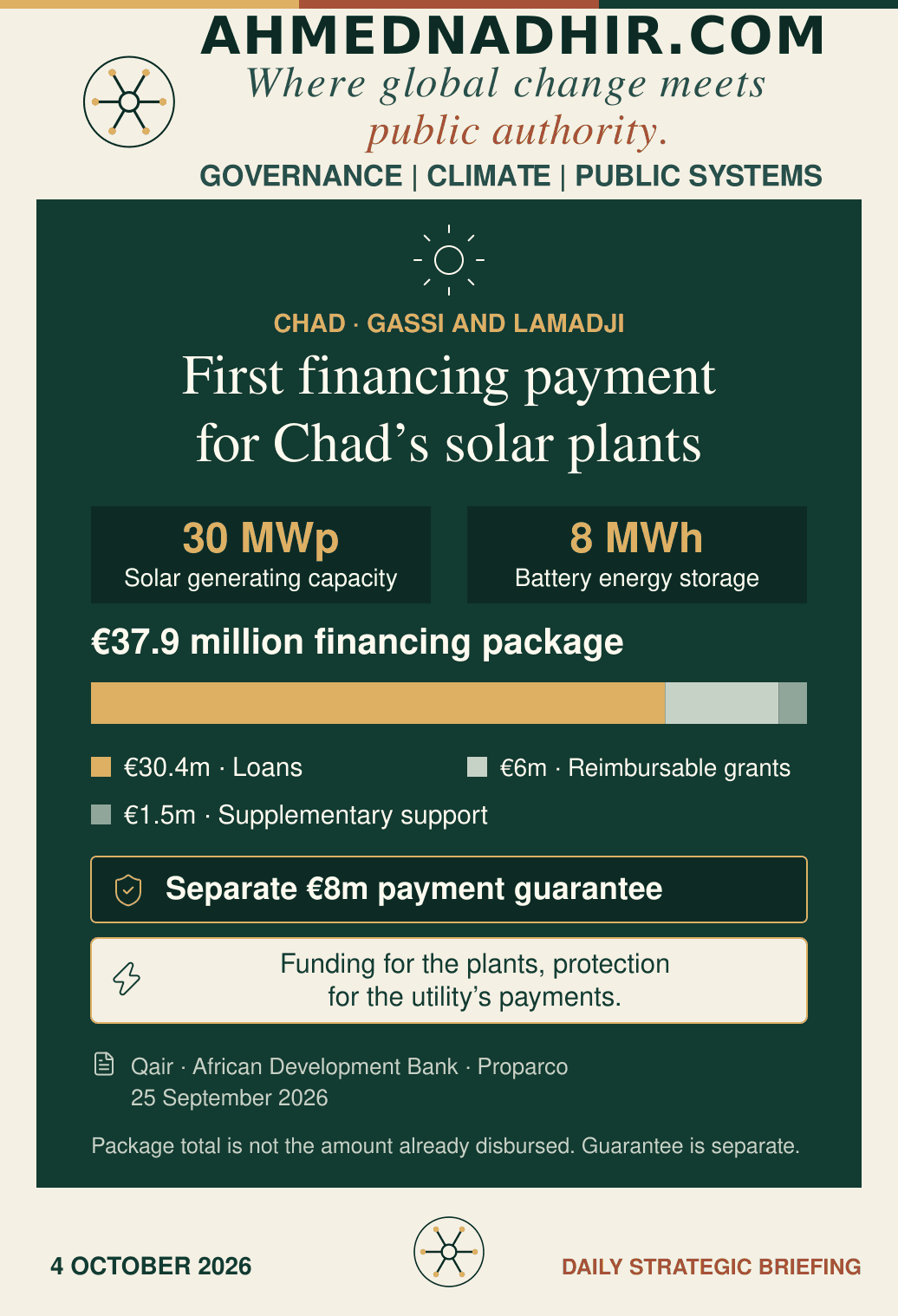
Qair announced the first disbursement from a €37.9 million financing package for its Gassi and Lamadji projects on 25 September. Near N’Djamena, the two plants combine 30 megawatts peak of solar generation with 8 megawatt-hours of battery energy. The solar figure measures generating capacity; the battery figure measures how much energy can be stored. The first payment’s amount is not disclosed.
Loans of €15.2 million each from the African Development Bank and Proparco provide €30.4 million of the package. Reimbursable grants of €6 million and supplementary support of €1.5 million complete the financing. A 20-year power purchase agreement with Tchadelec, Chad’s national electricity utility, establishes a buyer for the output.
Qair also describes a separate €8 million partial risk guarantee supporting Coris Bank’s letter of credit for utility payments. The guarantee helps address payment risk; it is not another €8 million invested in the plants. For lenders, confidence in the buyer’s payments sits alongside confidence in the generating equipment.
Proparco reports that Chad’s electricity generation relies mainly on diesel and heavy fuel oil. Solar generation replaces fuel use in the generation it displaces; batteries make some output available later. Grid connections, maintenance and payment arrangements determine how those assets become a dependable service. The announcements do not quantify a tariff reduction or realised fuel savings.
For Kenya and other African electricity systems, this is a useful financing example: generating equipment, storage, a grid connection and a credible buyer form one project. The economic benefit is assessed through electricity delivered, reliability and the cost of supply once the plants are operating.
ZAMBIA · HEALTH EMERGENCIES
Zambia trains more than 60 professionals for emergency response
World Health Organization account: 3 October 2026
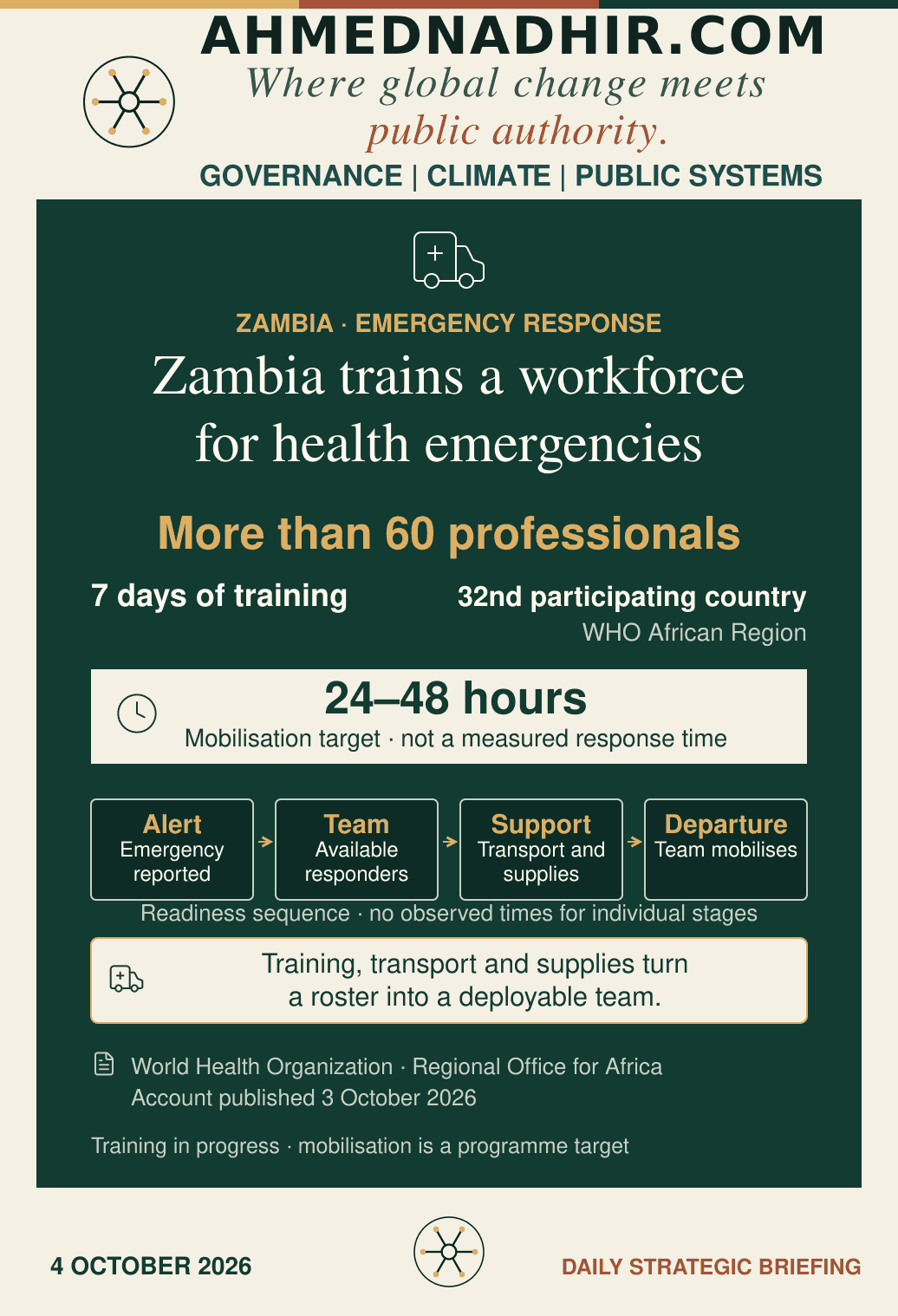
More than 60 Zambian professionals are receiving seven days of emergency-response training, the World Health Organization (WHO) reported on 3 October. Zambia is the 32nd country in the WHO African Region to introduce the regional training. Participants come from health institutions, agriculture and livestock services, and the military.
The programme’s goal is mobilisation within 24–48 hours. That is a readiness target, rather than a response time already achieved. Zambia’s wider roadmap includes an active responder roster, emergency operations centres and reliable supplies.
The useful distinction is between trained personnel and a team able to depart. Staff release, transport, protective equipment, communications and an assigned destination connect the course to help in an affected community. A simulation can reveal exactly where that journey slows down.
INDIA · ADULT IMMUNISATION
Goa launches targeted adult vaccination through existing health services
Policy launch and government release: 23 September 2026. Research account: 2 October 2026.
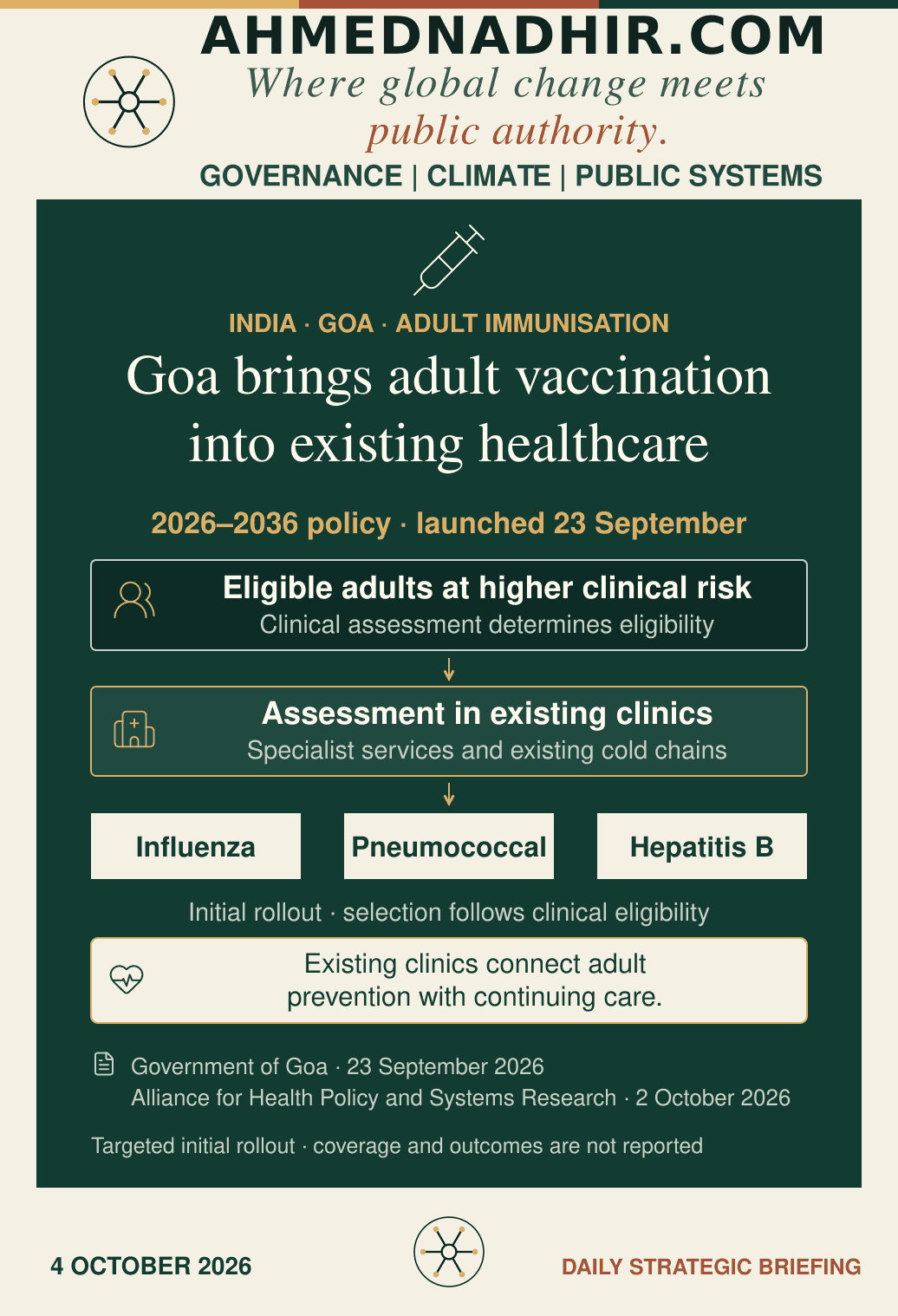
Goa launched its 2026–2036 life-course immunisation policy on 23 September. An account published on 2 October by the Alliance for Health Policy and Systems Research, hosted by WHO, explains how researchers worked alongside officials and clinicians to shape the choices. Goa’s government describes it as India’s first dedicated state policy of its kind.
The initial rollout prioritises influenza, pneumococcal and hepatitis B vaccines for eligible adults at higher clinical risk, including people with chronic diseases, immunocompromised patients and healthcare workers. It is not an immediate universal programme for every adult. The government’s delivery plan uses existing clinics for noncommunicable diseases, specialist services and cold chains.
This is a useful design choice. A person already attending a clinic has an established point of contact for clinical assessment and follow-up. Adding an eligible preventive service there connects vaccination to continuing care. It also makes staff time, stock availability and record-keeping part of the same service budget.
For Kenya and other countries considering broader adult immunisation, Goa offers a process to examine: clinical priorities assessed alongside affordability and delivery capacity. National technical recommendations and locally relevant evidence must guide any adaptation. The sources establish a policy and delivery model; coverage and health effects will emerge through implementation.
WORLD · ARTIFICIAL INTELLIGENCE AND EDUCATION
An international workshop examines how artificial intelligence can serve learning
Workshop account: 2 October 2026 · Digital Learning Week: 8–11 September 2026, Paris
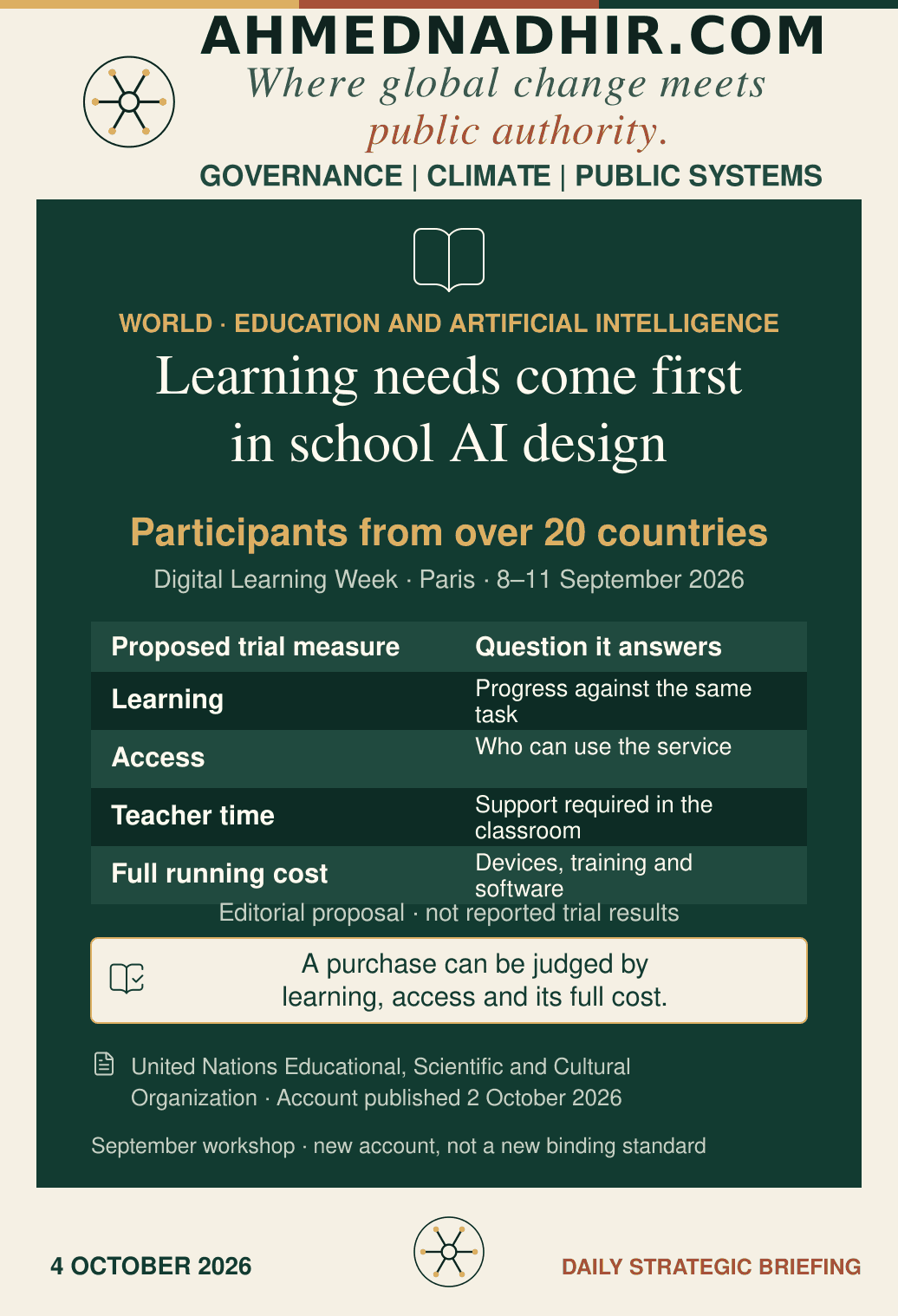
An account published on 2 October by the United Nations Educational, Scientific and Cultural Organization (UNESCO) describes a workshop on artificial intelligence (AI) in education, with participants from more than 20 countries. Held during September’s Digital Learning Week, it began with problems faced by learners and teachers, then examined where AI belonged in the response.
Participants used a simplified ethical impact assessment before deployment, considering the proposed system and its effects. UNESCO’s existing assessment tool also covers government procurement and contractual requirements. The account describes a design exercise; it does not establish improved learning outcomes or announce a new binding standard.
The budgetary point is straightforward. A ministry buying a reading-support tool needs to know which reading difficulty it addresses, who can use it, and what evidence will show progress. The comparison includes teacher support, books and other interventions. The relevant cost includes devices, connectivity, training and supervision as well as the software licence.
For Kenyan schools and education systems across the Global South, a tightly defined trial creates a better purchasing decision. The same learning task, assessed before and after the trial and against a credible comparison, can show whether the tool adds value. Teacher review and access across language, disability and device availability belong in that assessment.