
UGANDA · IMMUNISATION AND LOCAL DELIVERY
Uganda’s final vaccination push meets a school-access gap in Wakiso
Campaign: 1–5 October 2026 · Progress and district reports: 4 October · School arrangements: as of 3 October
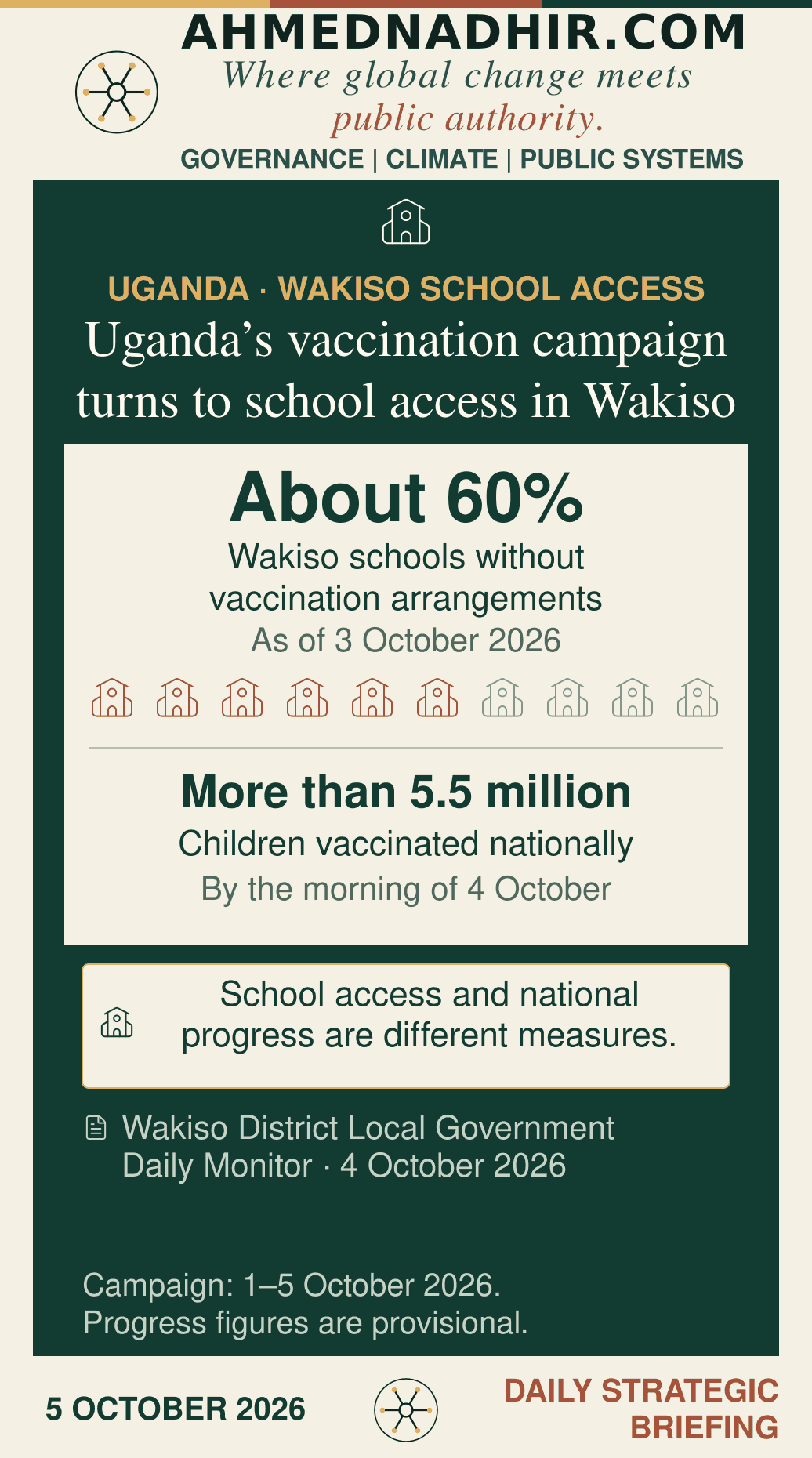
Uganda’s measles-rubella campaign had vaccinated more than 5.5 million children by the morning of 4 October, Daily Monitor reported, quoting the national immunisation programme manager. Launched on 1 October, the five-day campaign is scheduled to end today, 5 October. The World Health Organization (WHO) describes a nationwide effort across 146 districts and cities, for children aged 9–59 months.
In Wakiso, one remaining obstacle is access through schools. The district government reported on 4 October that about 60% of its schools had not arranged vaccination access as of 3 October. Some private schools had requested parental consent forms before admitting authorised health teams. The figure describes school arrangements in one district; it does not measure the share of children unvaccinated nationally.
WHO’s earlier research among nearly 1,900 caregivers found strong demand for vaccination in the communities studied. That matters for the response: willingness and access are separate questions. Clear information can address a parent’s concern, while an agreed visit, suitable space and available staff resolve a practical barrier. The campaign supplements routine immunisation, which remains necessary after the five-day exercise.
For Kenya and other African health systems, Wakiso offers a specific lesson in cooperation between health and education services. A national target becomes achievable through arrangements at the places children actually attend. The next useful measure is how many eligible children were reached, followed by the routine appointments and follow-up that sustain protection.
TANZANIA · ECONOMIC GROWTH AND JOB QUALITY
Tanzania’s growth outlook puts better-paying work at the centre of economic policy
World Bank report and launch: 2 October 2026
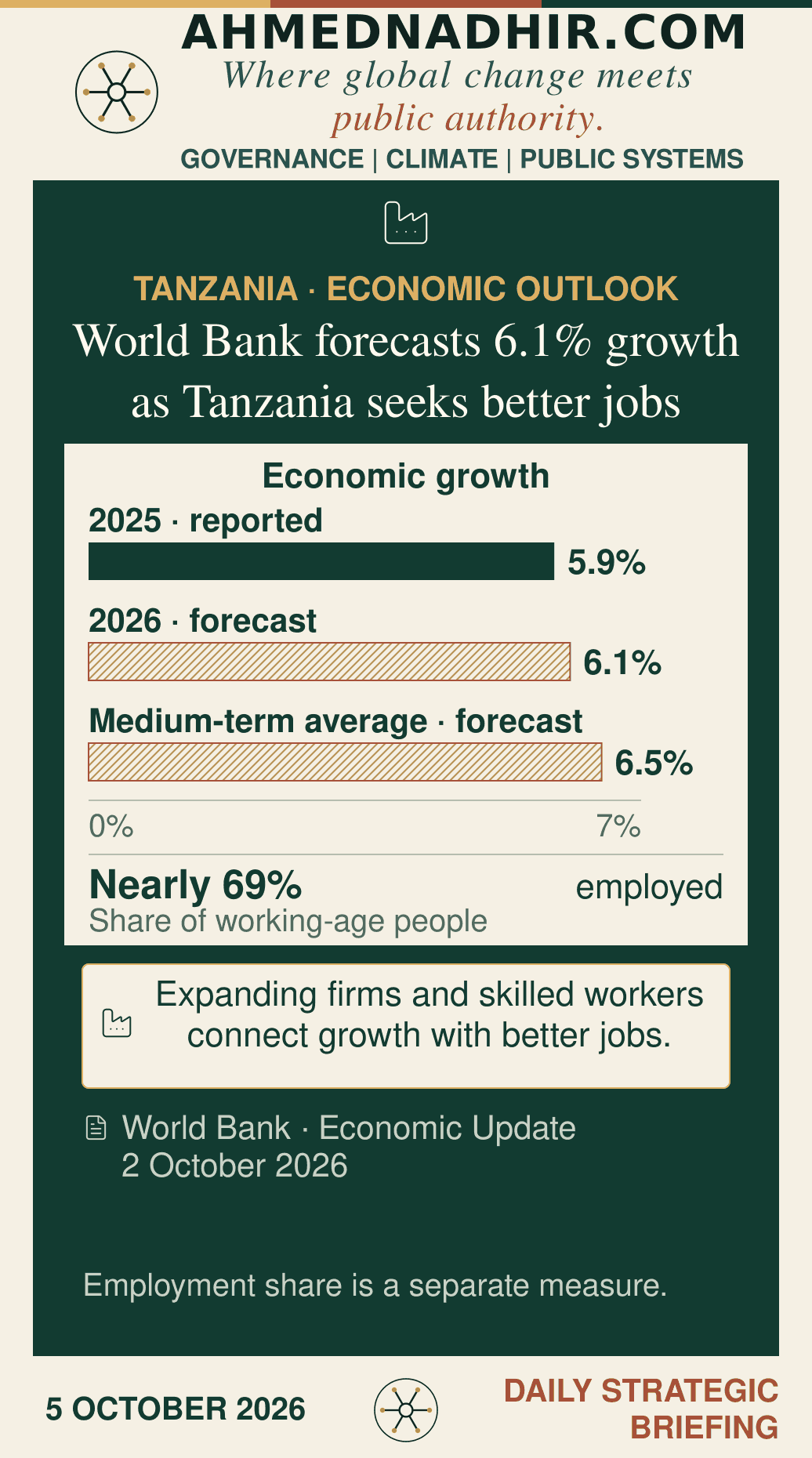
Tanzania’s economy grew by 5.9% in 2025. The World Bank’s update, launched on 2 October, forecasts 6.1% growth in 2026 and an average of 6.5% over the medium term. Its central question is how that expansion becomes better-paying, more secure work. Nearly 69% of working-age people are employed, the overview reports, yet many earn their living in low-productivity agriculture and informal activities.
The report identifies two connected routes to improvement: productive firms able to expand, and workers equipped to participate. For firms, access to finance, simpler registration and dependable land records affect the decision to invest. For workers, foundational skills, recognition of experience gained in informal employment and support for care responsibilities affect access to better jobs.
These are complementary investments. Training alone does not create an employer; a growing business does not automatically make its vacancies accessible to everyone. Connecting the two means understanding an actual firm's orders and hiring needs, alongside the skills and practical constraints of people seeking work. Kenya and other East African economies can examine that relationship without treating Tanzania’s growth forecast as their own.
The outlook establishes an economic forecast and a diagnosis of job quality. Earnings, job security and continued employment are the measures that will show how far the proposed reforms improve people’s working lives.
AFRICA AND BRAZIL · SUSTAINABLE COOLING
Cooling grants connect climate finance with hospitals, public buildings and food chains
United Nations Environment Programme spotlight: 30 September 2026 · Call-guidance webinar: 21 July 2026
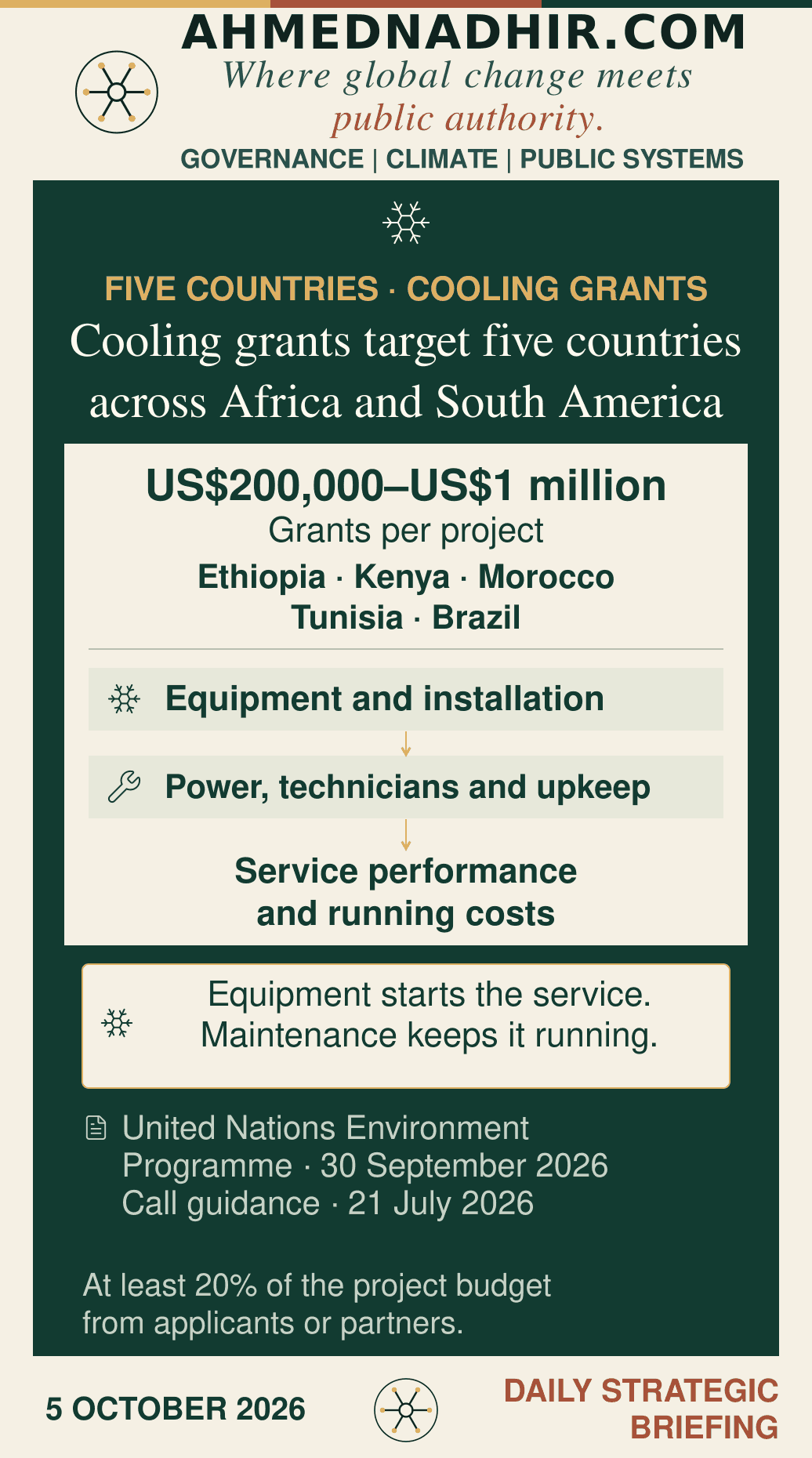
A United Nations Environment Programme (UNEP) spotlight on 30 September highlights grants of US$200,000–US$1 million for sustainable cooling projects in Brazil, Ethiopia, Kenya, Morocco and Tunisia. The support is delivered through Enabling Pledge Implementation for Cooling (EPIC) Deploy, backed by Italy. The programme’s published call guidance dates from July; the September spotlight is a recent account of the opportunity.
The guidance identifies international consortia of public, private or research organisations, with at least 20% of the total project budget provided by applicants or partners. Its scope includes hospitals, universities and public buildings, alongside industrial and food-chain cooling. A cold room that preserves food and a cooling system that keeps a hospital usable address different services, but both need dependable power, maintenance and trained staff.
The programme uses monitored pilots to build evidence for wider investment and policy. That gives Kenyan counties, service providers and research partners a practical opportunity: a defined site, a known service need and a comparison of performance and running costs. Electricity use, temperatures, interruptions and maintenance records explain what the equipment delivers and what it costs to sustain.
These are funding opportunities and a pilot design, not awards or measured savings. The programme’s value will be demonstrated through useful cooling, affordable operation and evidence that supports the next investment decision.
VIET NAM · OLDER WORKERS AND PUBLIC POLICY
Viet Nam connects an ageing workforce with skills, suitable jobs and social protection
Government decision: 3 September 2026 · Government account: 4 September · International Labour Organization account: 1 October
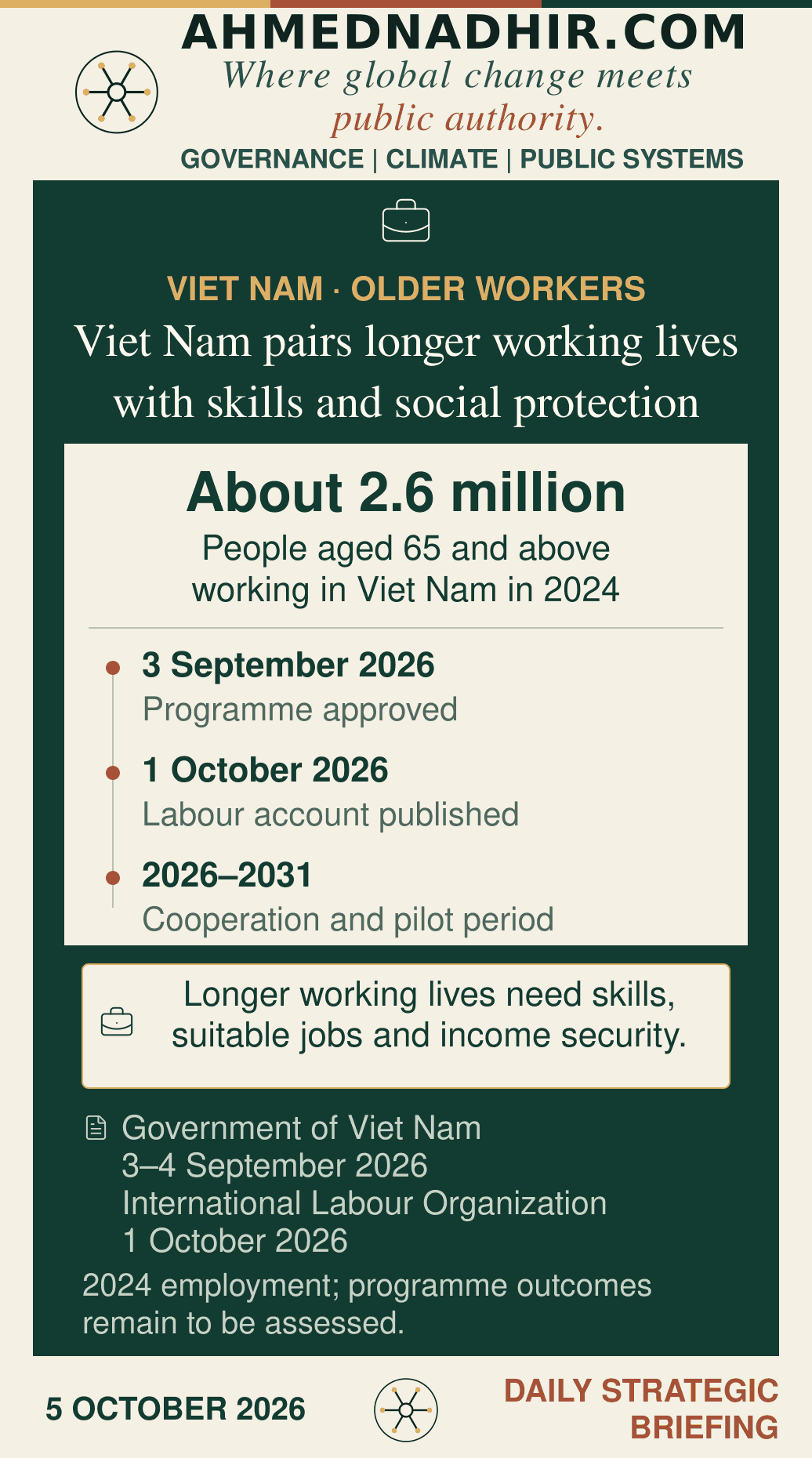
Viet Nam’s 2026–2031 international cooperation programme on older people connects an ageing society with skills, suitable workplaces and social protection. Approved through a government decision dated 3 September, it was examined by the International Labour Organization (ILO) on 1 October. Around 2.6 million people aged 65 and above were working in 2024, the ILO reports, citing national statistics.
The programme seeks international support for reskilling, longer working lives, age-inclusive employment and care. The government sets a target of at least five cooperation programmes, projects or models that can be piloted, evaluated and expanded. The ambition also includes products, services and technologies designed for older people, connecting labour policy with the development of a care economy.
The economic distinction is between an opportunity to work and a need to work without adequate income protection. Skills and suitable job design help older workers continue contributing by choice. Pensions, social insurance and care support a secure older age, including for people unable to continue working. A higher employment count alone cannot establish that either purpose has been met.
For Kenya and other countries preparing for demographic change, the useful connection is between labour, training and social protection systems. Viet Nam’s population profile and policy targets remain its own; the programme offers a national example to examine, with results still to be assessed through implementation.