
CLIMATE AND HEALTH
Five-country evidence
Maternity professionals report rising heat-linked complications across five countries
Survey released and discussed at Pre-COP in Fiji: 5 October 2026 · Fieldwork: 17 September–1 October 2026
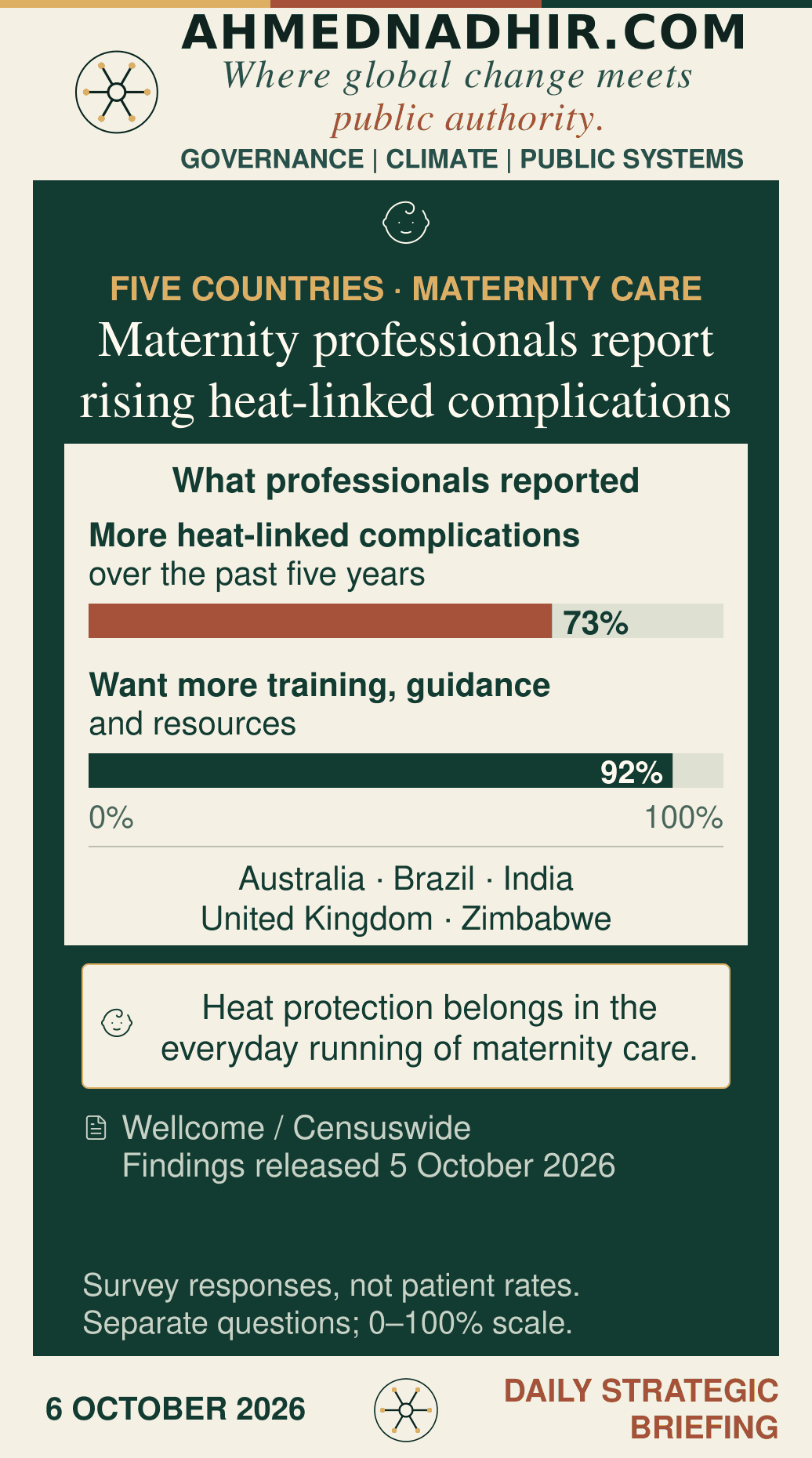
Seventy-three per cent of maternity professionals surveyed for Wellcome reported an increase over five years in cases or complications they associated with extreme heat. Ninety-two per cent wanted more training, guidance and resources. The research covered Australia, Brazil, India, the United Kingdom and Zimbabwe. These figures describe professionals’ experiences and needs, rather than rates of complications among pregnant women.
At the Pre-COP climate meeting in Fiji on 5 October, United Nations climate chief Simon Stiell used the findings to press for maternal and newborn care to be included in climate adaptation and heat-health planning. The public response extends from an outdoor worker’s exposure to the temperature of a waiting area, reliable water and power, and the journey to a referral hospital.
The policy opportunity is to bring adaptation spending into the ordinary management of maternity services. A roof that reduces heat, dependable water, staff preparation and a functioning referral route belong in one service plan. Their maintenance costs matter as much as their installation.
ARTIFICIAL INTELLIGENCE
Africa
A new partnership connects African AI developers with computing support and industry networks
Announcement and both partners’ publication dates: 2 October 2026
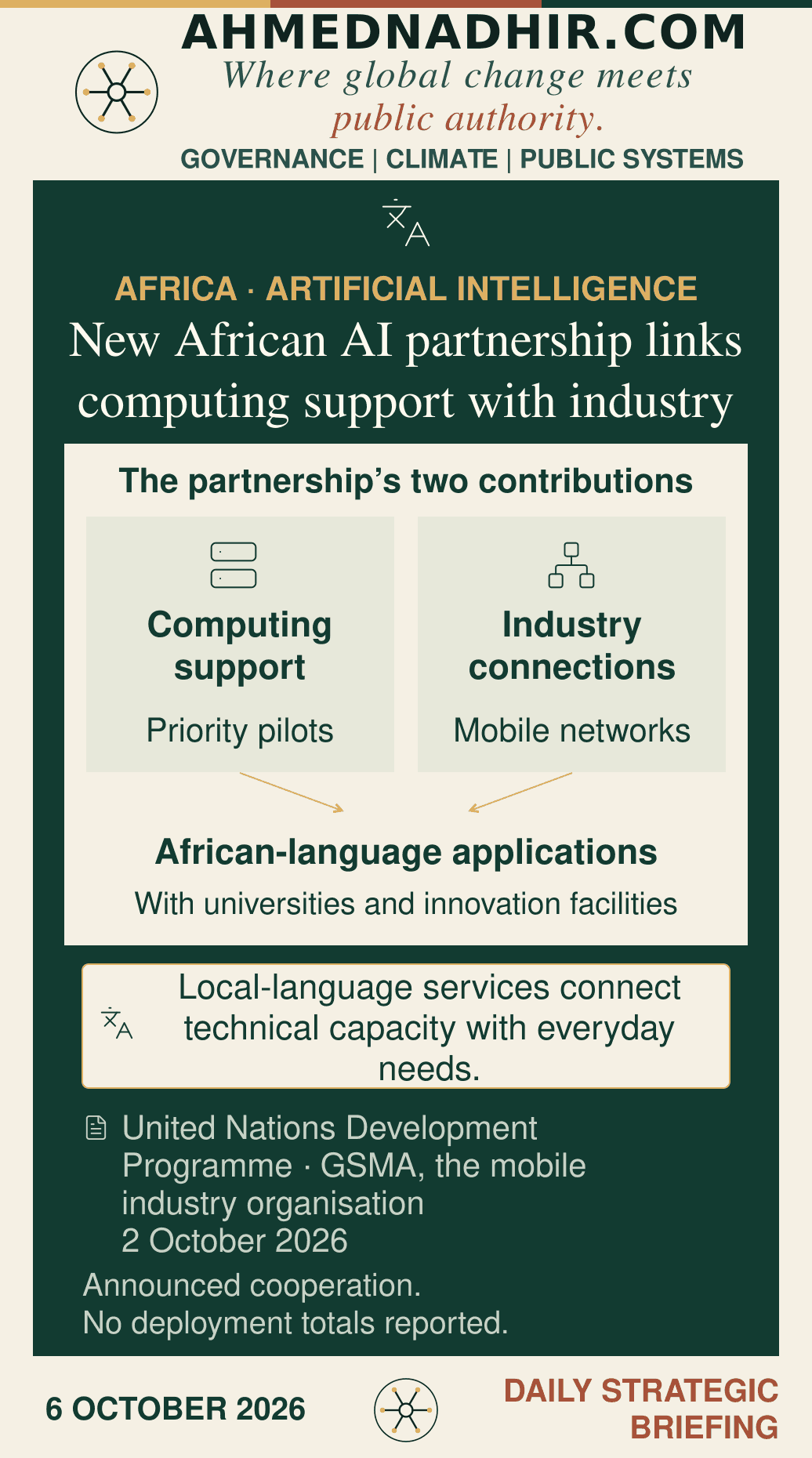
The United Nations Development Programme and GSMA, the organisation representing the mobile industry, have announced a partnership supporting African-led artificial intelligence (AI), including services in African languages. Through the timbuktoo initiative, the partners intend to improve access to computing infrastructure for priority pilots and connect developers with practical applications.
The combination addresses two different needs: the computing capacity to develop and run a service, and industry relationships through which it reaches users. Universities, innovation facilities and AI laboratories are part of the intended network.
For African public institutions, local-language technology offers a practical area for testing: whether people understand an explanation, complete a task and obtain human help when the system fails. Those results give public buyers evidence about a service’s usefulness. The partnership establishes a route to cooperation; its releases do not yet quantify funding, computing allocations or deployment results.
PUBLIC ADMINISTRATION
World and Africa
New global estimates put teacher recruitment needs at 50 million by 2030
United Nations education fact sheet announced: 5 October 2026 · African conference scheduled: 5–7 October, Mbabane, Eswatini
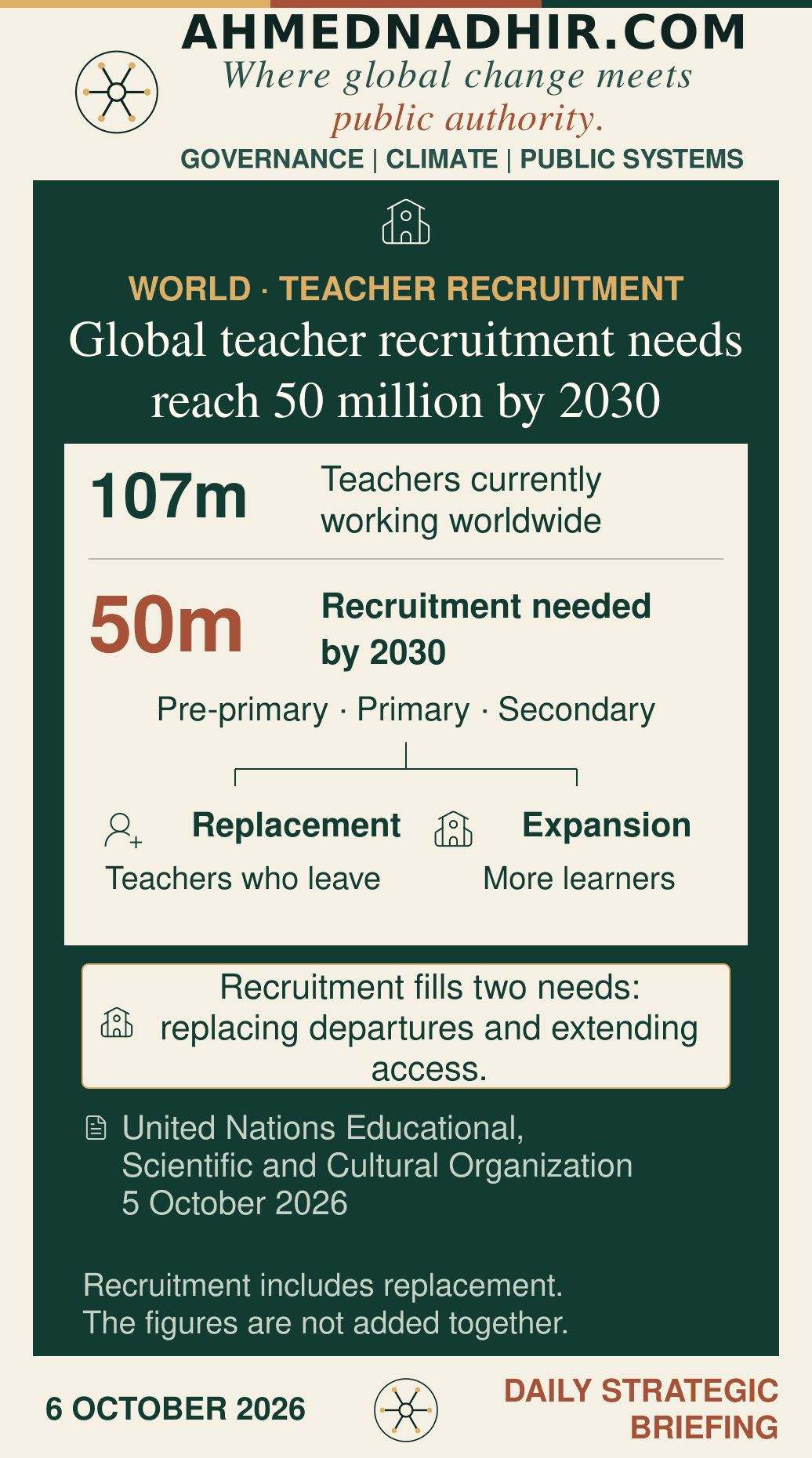
The United Nations Educational, Scientific and Cultural Organization says the world needs to recruit 50 million teachers by 2030 to achieve universal access across pre-primary, primary and secondary education. Its World Teachers’ Day release places that requirement alongside a current workforce of 107 million.
Recruitment serves two purposes: reaching additional learners and replacing teachers who leave. A large intake therefore does not, by itself, establish that classrooms have gained more teachers. Retention, deployment and the distribution of subject expertise shape what pupils experience.
The African Union’s 5–7 October conference programme in Mbabane, Eswatini, brings qualification recognition, teacher mobility and professional development into the same discussion. Recognition across borders helps make qualifications usable in another system. Funded posts and deployment decisions determine where that expertise reaches learners. A recruitment campaign and a retention policy therefore address different parts of the same staffing need.
HEALTH SYSTEMS
Asia-Pacific
Asia-Pacific countries’ drug-resistance plans face uneven domestic funding
World Health Organization release: 5 October 2026 · Country progress presented in Tokyo: February 2025
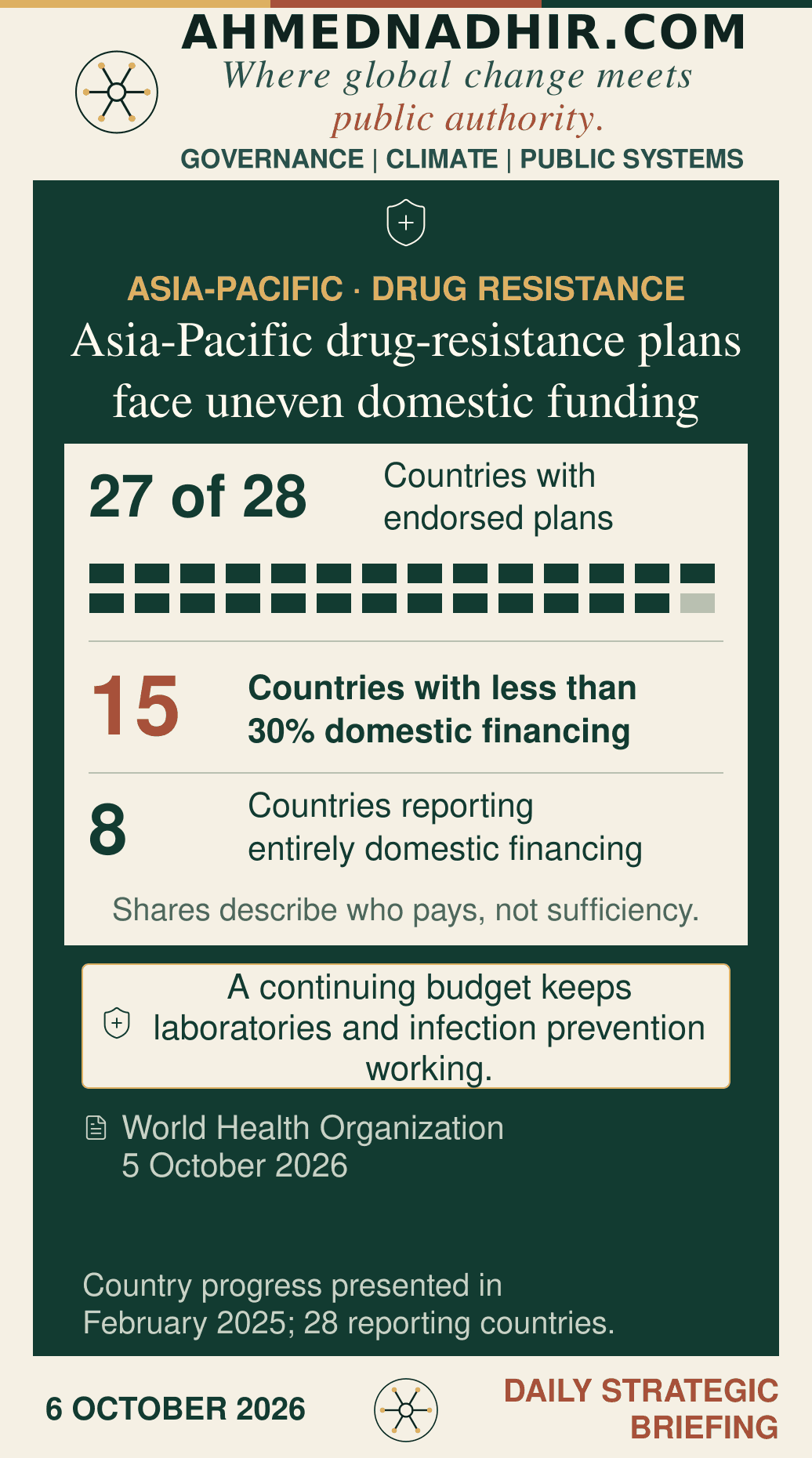
A World Health Organization account of a newly published regional analysis draws on reporting from 28 Asia-Pacific countries. Twenty-seven had endorsed a multisectoral plan against antimicrobial resistance. Yet 15 reported that domestic sources supplied less than 30% of their financing for this work; eight reported entirely domestic funding. The progress was presented in Tokyo in February 2025.
The distinction is consequential. Calculating a plan’s cost does not secure the money to run it. A service still needs staff, laboratory supplies, infection prevention and reliable access to appropriate medicines. External finance and domestic budgets therefore have to meet at the point where those recurring costs are paid.
For African health systems, this is a financing lesson from another region. A programme becomes dependable when essential activities have a continuing budget and a responsible service manager. The domestic share explains who pays; adequacy depends on whether the total resources cover the work required. Even an entirely domestically financed programme can fall short of that need.