
HEALTH SYSTEMS
Kenya and regional health security
Kenya confirms an imported Ebola case as contact follow-up begins
Case announced: 6 October 2026 · Ministry account posted: 7 October · Arrival: 3 October · Death: 5 October
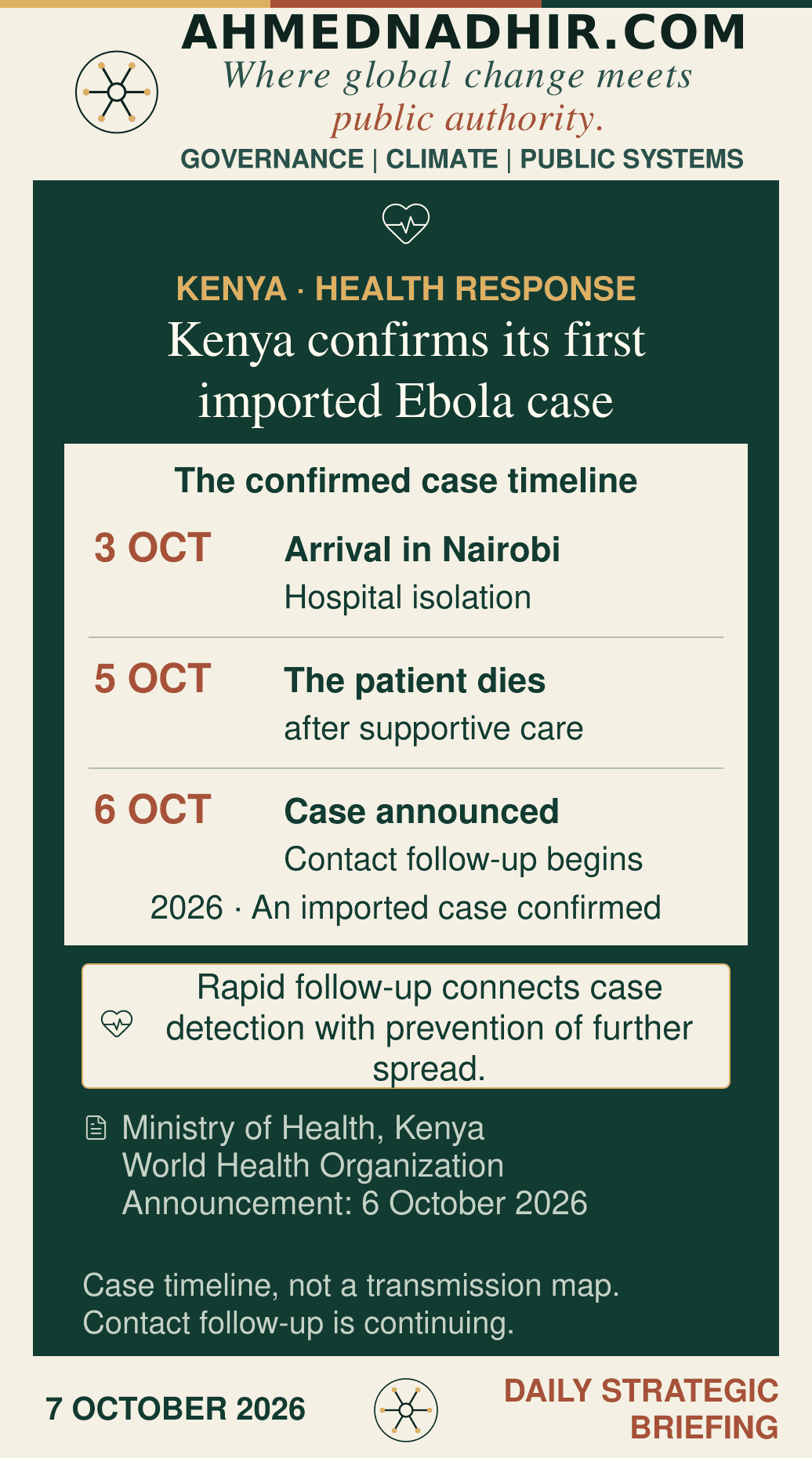
Kenya has confirmed its first imported case of Bundibugyo virus disease, a form of Ebola disease. The Ministry of Health and the World Health Organization (WHO) report that the Kenyan patient became ill while living in the Democratic Republic of the Congo, travelled through Uganda and arrived in Nairobi on 3 October. The patient was isolated in hospital, tested positive at two national laboratories and died on 5 October.
On 6 October, authorities were following 28 identified contacts and tracing 23 passengers and four crew members from the flight. These are people requiring assessment and follow-up, not additional confirmed cases.
The Africa Centres for Disease Control and Prevention announced on 6 October that a multidisciplinary team was travelling to Kenya. Its response statement calls for stronger cross-border information sharing, laboratory readiness and infection prevention. The immediate work connects hospitals, laboratories and contact teams: recognising a suspected case, returning a test result and reaching the people who need follow-up.
WHO advises against restrictions on travel or trade with Kenya, Uganda or the Democratic Republic of the Congo on the information available. Its general guidance identifies direct contact with infected blood, body fluids or contaminated materials as the route of spread. Clear explanations protect cooperation and help keep ordinary health services accessible.
AFRICAN ECONOMIES
Sub-Saharan Africa
World Bank raises sub-Saharan Africa’s 2026 growth forecast to 4.3%
Africa Economic Update released by the World Bank: 6 October 2026 · Forecast period: 2026
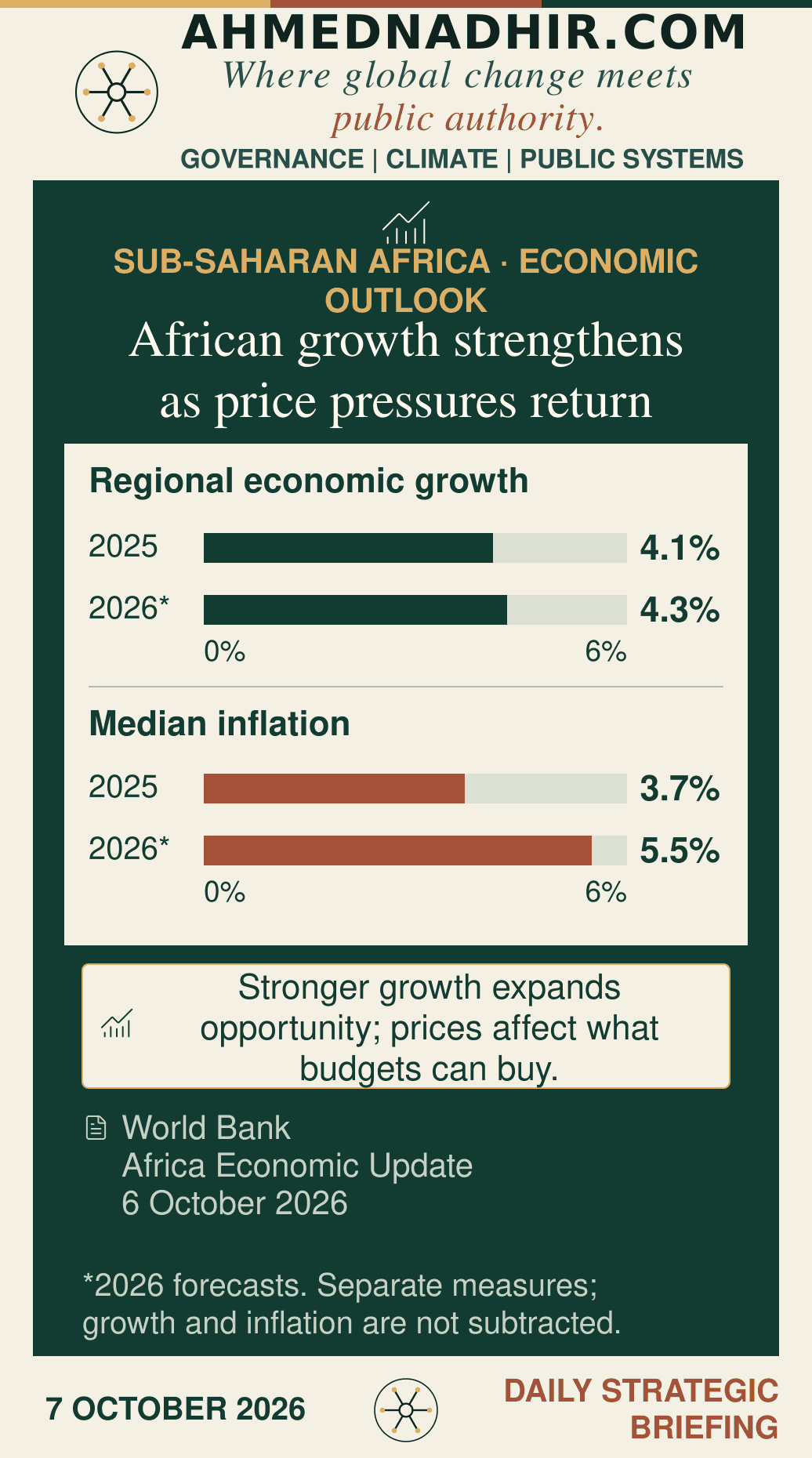
The World Bank now projects sub-Saharan African growth of 4.3% in 2026, up from 4.1% in 2025 and 0.3 percentage points above its April forecast. Stronger domestic demand and investment support the improvement. The Bank has raised growth forecasts for nearly three-quarters of the region’s countries.
But it also projects median inflation rising from 3.7% to 5.5%. Debt-service costs continue to constrain spending on health, education and infrastructure. Regional growth and median inflation describe different aggregates; neither is a forecast for every African country.
For public budgets, the practical distinction is between an expanding economy and cash available to deliver services. Revenue must first be collected; debt payments and the cost of supplies then determine what remains. Higher nominal receipts can coexist with fewer medicines, school meals or kilometres of road maintenance purchased from a fixed allocation.
The policy opportunity is to use the improvement to make spending more dependable. Predictable payments help suppliers plan. Protecting recurring costs helps keep existing facilities staffed and supplied. An expanding economy creates opportunities for stronger services; the budget determines which of them reach the public.
CLIMATE AND RESILIENCE
Sahel and Horn of Africa
New Great Green Wall funding connects restoration with rural income
Programme announcement: Saint-Louis, Senegal, 6 October 2026 · United Nations Environment Programme release: 6 October
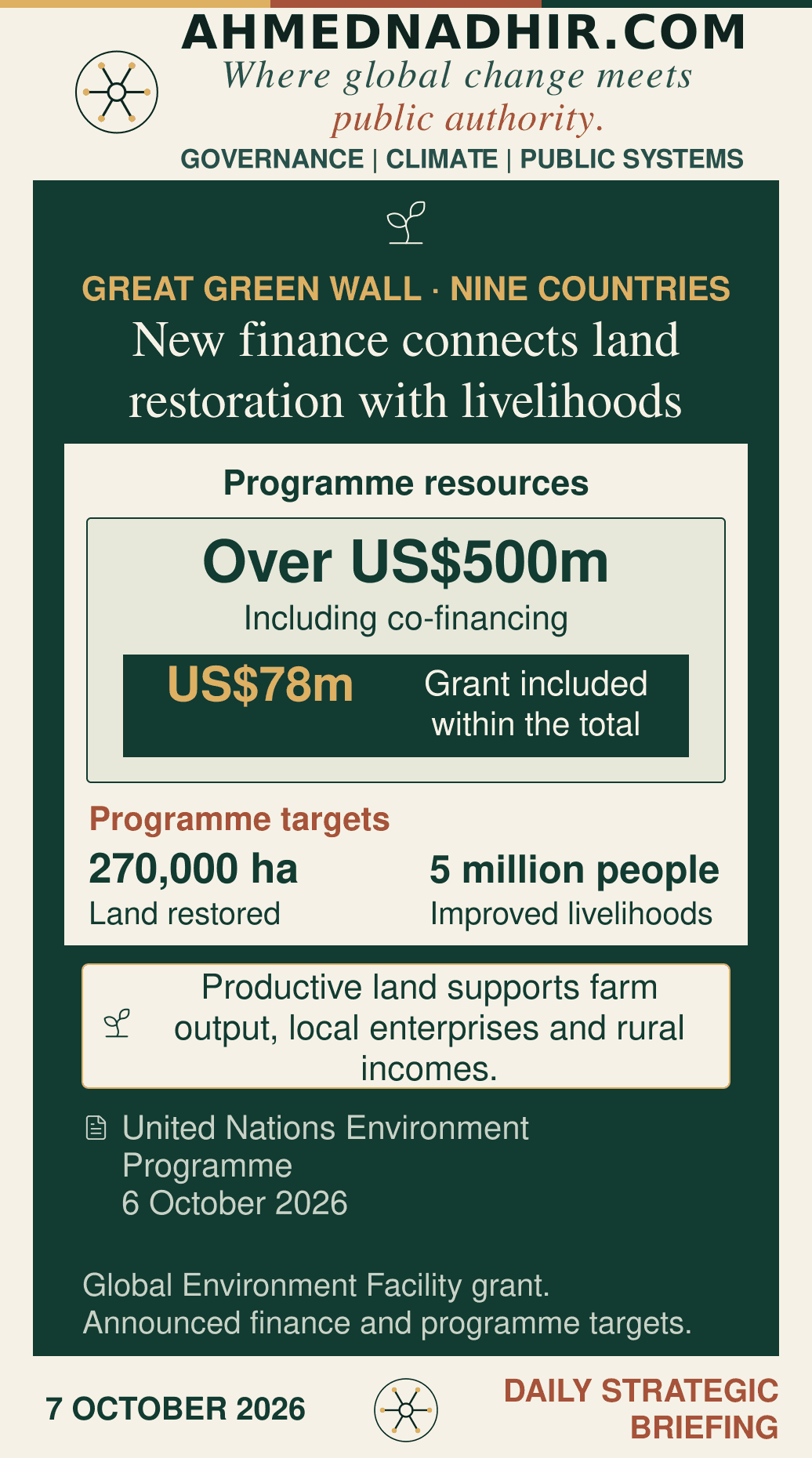
A new Great Green Wall programme has a US$78 million grant commitment from the Global Environment Facility. The United Nations Environment Programme says associated co-financing brings programme resources above US$500 million.
The nine participating countries are Burkina Faso, Chad, Ethiopia, the Gambia, Mali, Mauritania, Niger, Nigeria and Senegal. Ethiopia’s component targets 22,000 hectares for restoration and 40,000 hectares of natural forest for improved management. These activities require different measures of progress.
The economic value of restoration reaches beyond planting. Healthier soil, usable grazing and dependable water support the productive assets on which rural households rely. Local work in nurseries, land preparation, maintenance and monitoring creates one route to income; stronger farm and livestock production creates another. These are the economic opportunities for programme design, not an estimate of jobs already created.
Public agencies can make that pathway visible by linking each restored area to its users, its maintenance arrangements and the income it supports. A hectare count records activity. The more informative account explains whether the land remains productive and who benefits from it.
ARTIFICIAL INTELLIGENCE
South Asia
South Asia’s new outlook highlights AI in farming advice and eye care
South Asia Economic Update, Adopting AI for Growth: released 6 October 2026
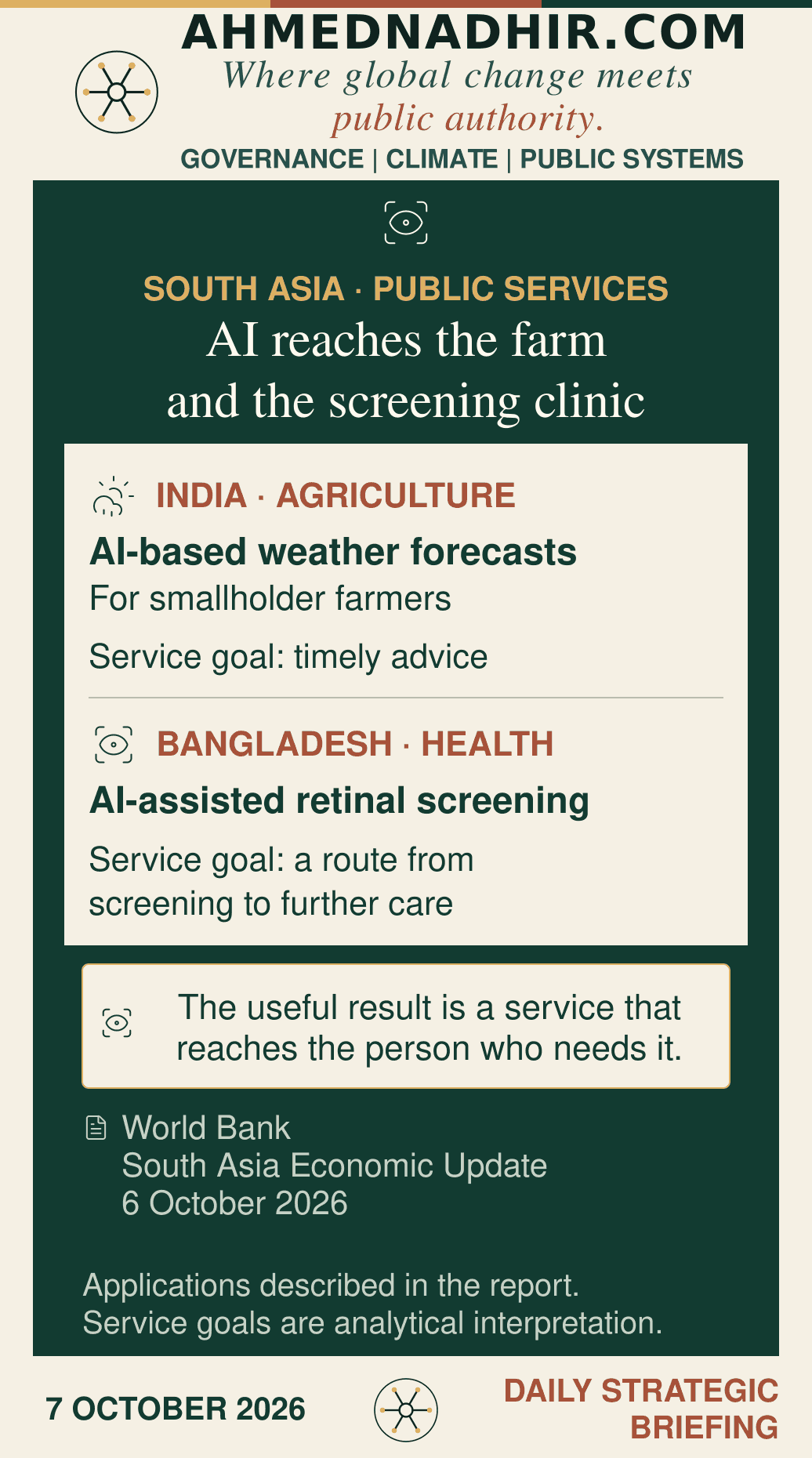
The World Bank’s new South Asia outlook highlights artificial intelligence in two recognisable services: weather forecasts delivered to smallholder farmers in India and assisted retinal screening in Bangladesh. Its central argument is that useful adoption requires applications suited to local conditions, including basic devices and limited connectivity.
A farmer needs advice in time to make a decision. A patient needs a reliable route from screening to care. The useful question is how the complete service performs, including the staff, equipment and follow-up that turn a digital result into something a person can use.
For African institutions, the transferable lesson is a way to evaluate investment, rather than a claim that a tool will perform identically elsewhere. A low-cost application can still be expensive to use if it requires new devices, continuous connectivity or scarce staff time. Conversely, a modest tool becomes valuable when it improves a service that already reaches people.