
HEALTH SYSTEMS
World · Health systems
World Health Organization issues its first obesity-care guidelines for children and adolescents
Guidelines and news release: 7 October 2026 · World Health Organization
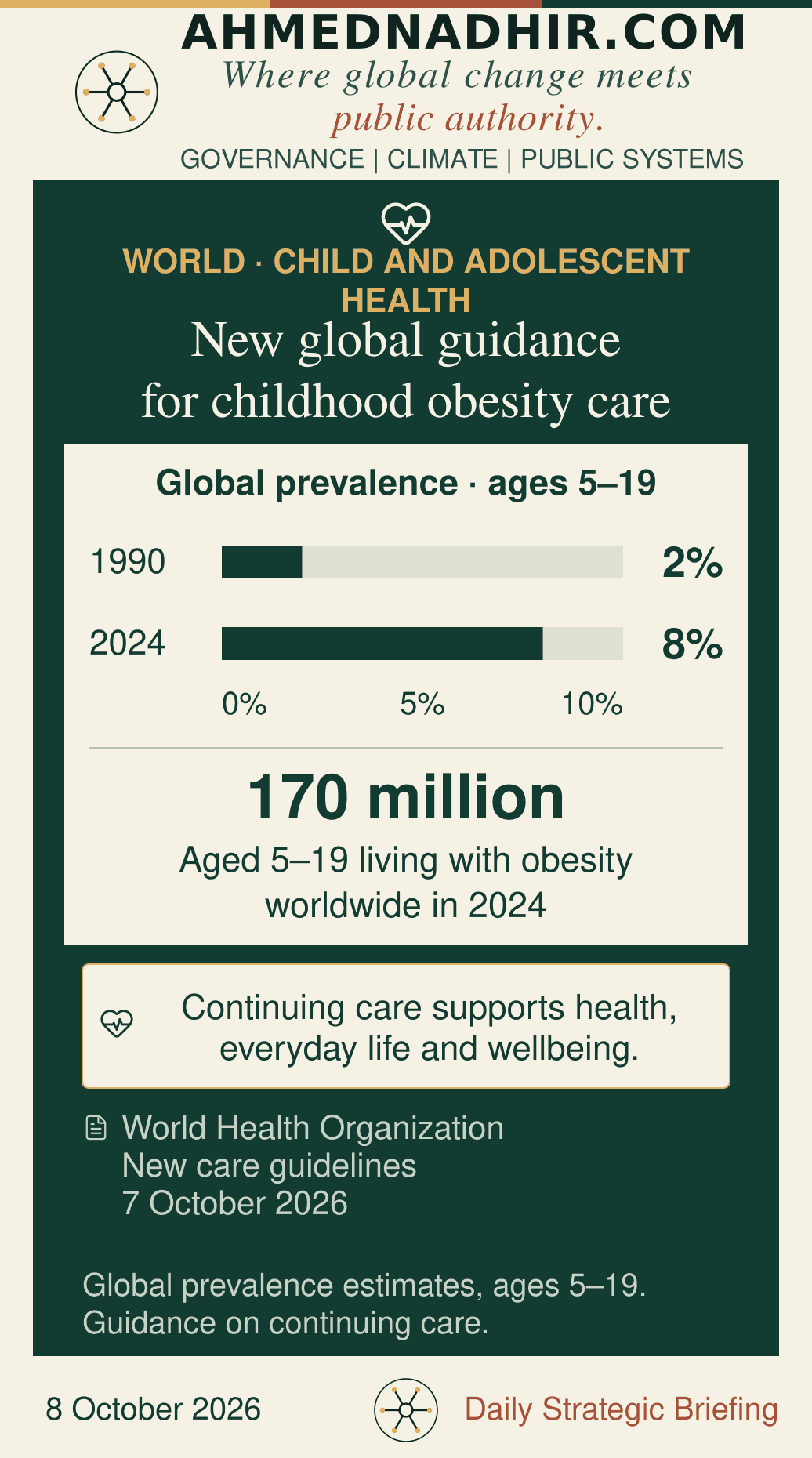
The World Health Organization has issued its first guidelines on obesity care for children and adolescents. They recommend structured support for diet, physical activity and behaviour, with care adapted to age and family circumstances. The aim extends beyond weight loss to health, functioning and wellbeing.
In 2024, an estimated 170 million people aged 5–19 were living with obesity worldwide. Prevalence rose from 2% in 1990 to 8% in 2024. These are global estimates, not measures of prevalence in Kenya or any other individual country.
The practical issue for a health service is continuity. Identifying a child’s needs creates a responsibility to offer an accessible next step: a trained professional, a referral where needed and follow-up that a family can attend. Counting assessments alone misses whether that care is available afterwards.
For Kenya and other countries adapting the guidance, financing and service design belong in the same discussion. Appointment times, travel costs and affordable food affect whether advice is usable. Health and education authorities have distinct responsibilities: clinical support belongs alongside school environments that make healthy eating and activity easier, without singling children out for blame.
GOVERNANCE
Ghana · Public investment
Ghana and African Development Bank tackle procurement and payment delays
Clinic: 22–25 September 2026, according to the Bank · Ministry account: 28 September · Bank account: 6 October
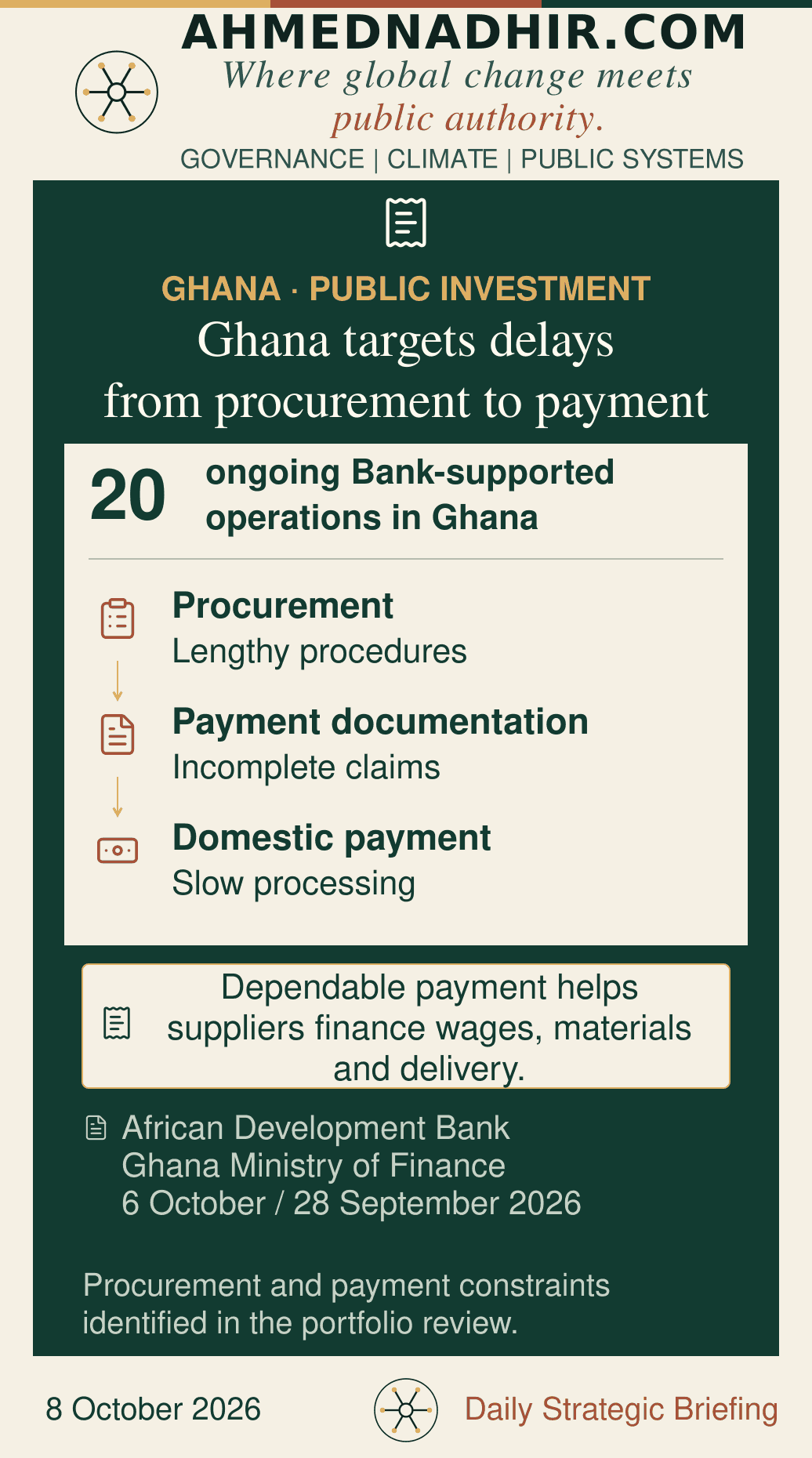
Ghana’s Ministry of Finance and the African Development Bank have brought project teams together to address procurement, financial management and implementation. Both institutions identify 20 ongoing Bank-supported operations. The Bank’s 6 October account points to lengthy procurement, incomplete payment documentation and slow domestic payment procedures identified in a 2025 portfolio review.
The significance lies in the distance between financing a project and delivering its service. An allocation does not pay a contractor, and a completed invoice does not itself release cash. Each unresolved handover can hold up the work that public funding was intended to support.
Payment reliability also affects the firms doing the work. A supplier waiting for a valid payment must finance wages, materials and other obligations for longer. Shortening avoidable delays therefore has a commercial value as well as an administrative one. It frees working capital and makes delivery more predictable.
The clinic gives project teams a starting point for corrective action. Progress will be visible in shorter processing times and completed services. For other African administrations, the transferable lesson is to distinguish a missing document, a pending decision and a funding constraint: each needs a different remedy.
CLIMATE AND RESILIENCE
Guinea-Bissau · Coastal livelihoods
Guinea-Bissau develops ten climate-project ideas around local needs
National launch: 6 October 2026 · Consultations scheduled: 7–8 October · United Nations accounts: 6 and 8 October
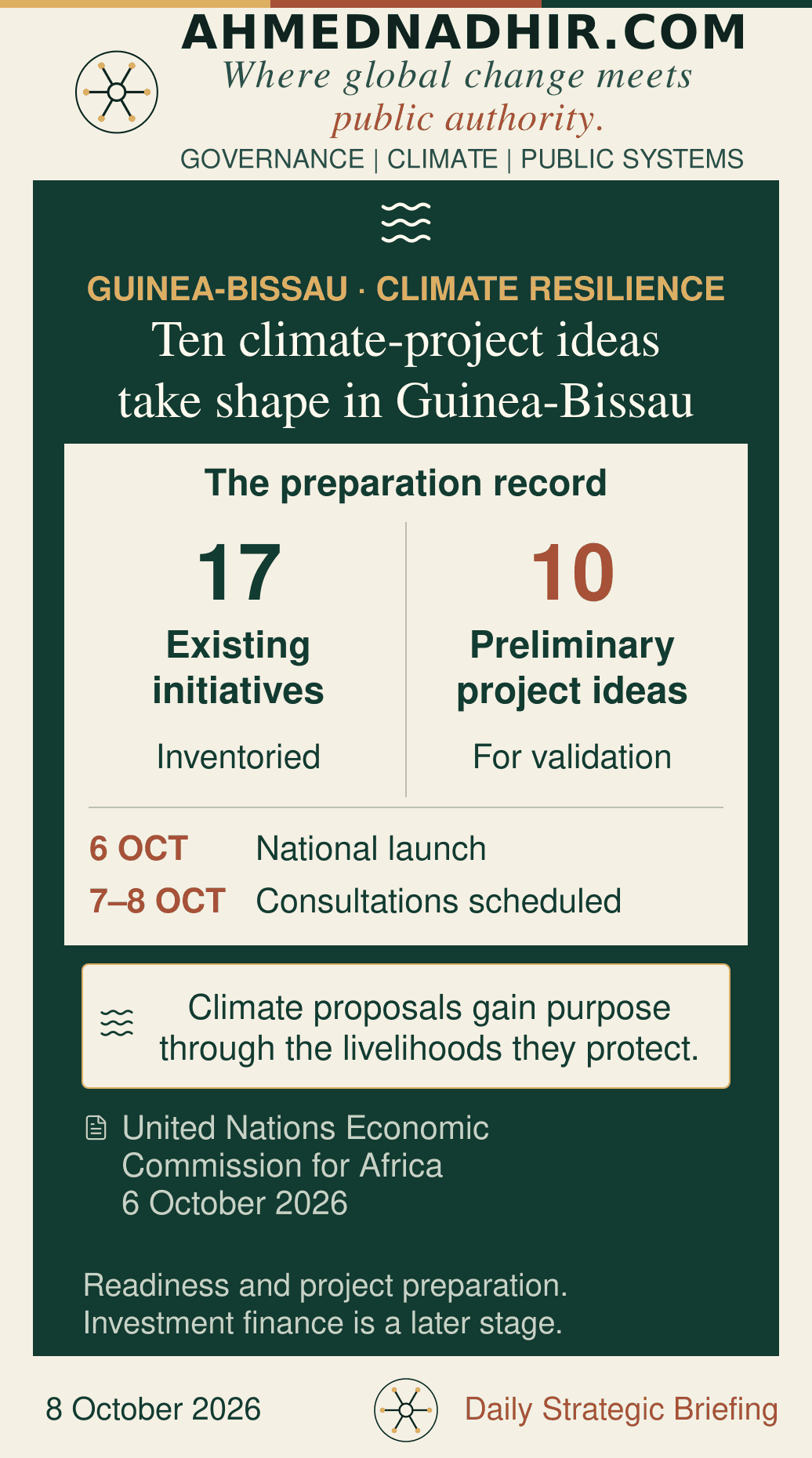
Guinea-Bissau has launched its national RESIslands work to assess climate risks and develop investment proposals. The initiative is funded by the Green Climate Fund and implemented by the United Nations Economic Commission for Africa. A preliminary inventory records 17 existing initiatives; ten project ideas have been identified for discussion and validation.
The ideas span early warning, coastal resilience, agriculture, water, fisheries, urban resilience and renewable energy for essential services. This preparatory work gives national institutions the evidence and developed proposals needed to seek investment. The ten ideas are awaiting validation and subsequent financing decisions.
An 8 October reflection from the United Nations Economic Commission for Africa gives these priorities a human scale. It recounts the minister’s discussion of fish-processing technologies that reduce pressure on mangroves while sustaining income, and national meteorological advice that adjusts planting calendars to local conditions. These examples concern earning a living and protecting productive resources.
A stronger investment proposal connects that everyday use with its operator and full cost. Equipment requires skills, repairs and supplies. A warning needs to reach people before they commit seed, labour or money. Reviewing existing initiatives alongside new ideas helps institutions identify gaps and shared facilities, so preparation funds build on work already under way.
ENTERPRISE
Colombia · Women-owned businesses
Colombian trial shows how training helps women-owned firms enter supply chains
World Bank working-paper listing: 7 October 2026 · Reproducibility record: 14 September 2026
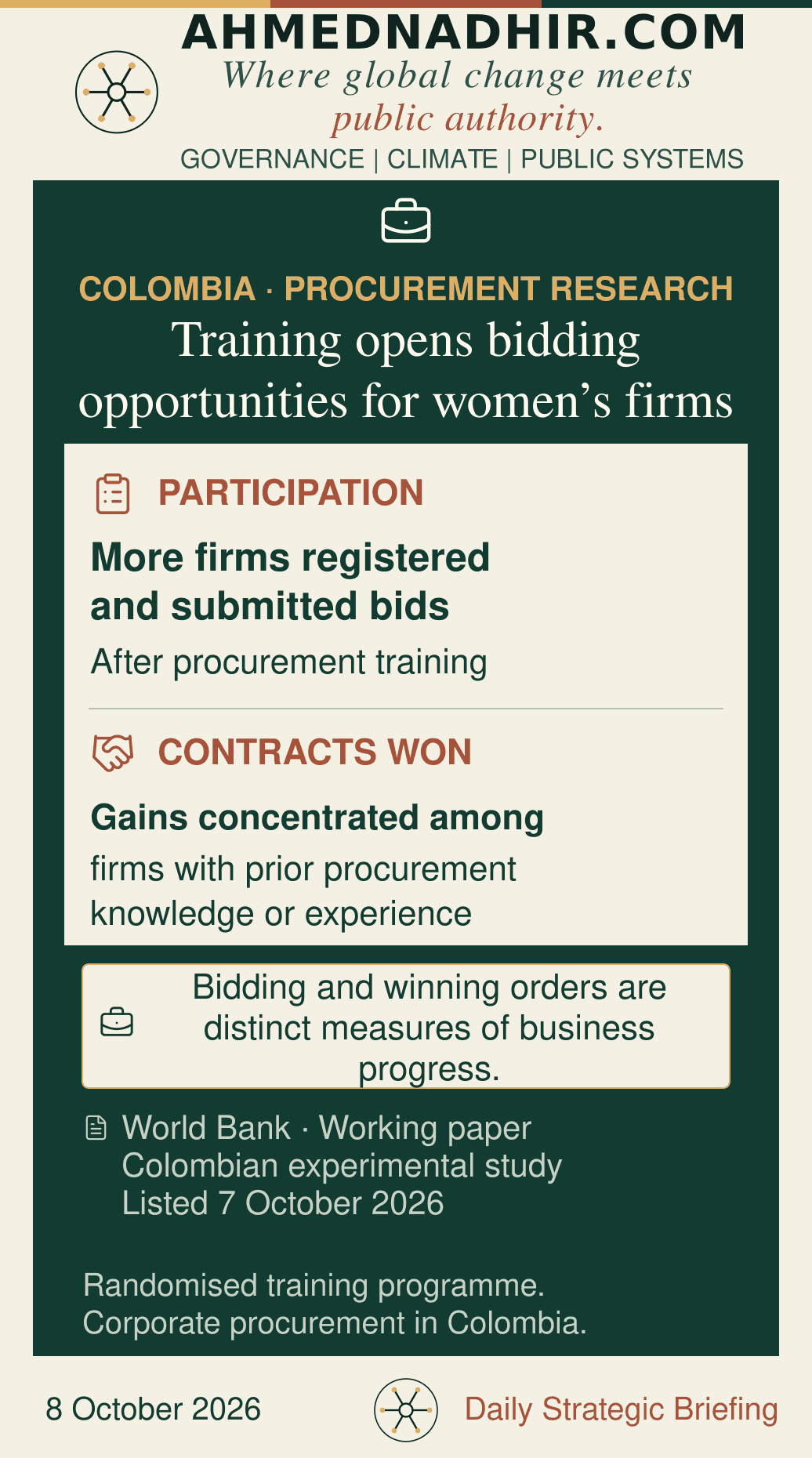
A new World Bank working paper examines a phased randomised trial of corporate procurement training for women-owned or women-led small and medium-sized enterprises in Colombia. The programme improved procurement knowledge and readiness, increased registration on corporate portals and encouraged bidding. Gains in winning contracts were concentrated among firms with previous procurement knowledge or experience.
The distinction matters. Entering a purchasing system and securing an order are different achievements. A programme can help firms understand the process while leaving further commercial work between a submitted bid and a successful contract.
For enterprise agencies, the analytical lesson is to tailor assistance to a firm’s starting point. A first-time bidder needs to understand eligibility and documentation. A business already competing for orders may need more targeted help with costing, production capacity or financing delivery. These are practical applications of the findings, rather than additional effects established by the experiment.
The evidence comes from corporate procurement in Colombia. For African enterprise and public-purchasing programmes, its value is a way to assess progress: follow firms from registration through bids and awards, then examine delivery and payment. Attendance alone cannot show whether a business has gained a durable customer.