
CLIMATE AND RESILIENCE
World · Greater Horn of Africa and Indian subcontinent
International forecasts point to a December El Niño peak and strong conditions into early 2027
Updates issued: 8 October 2026 · Forecast periods: October–December 2026 and early 2027
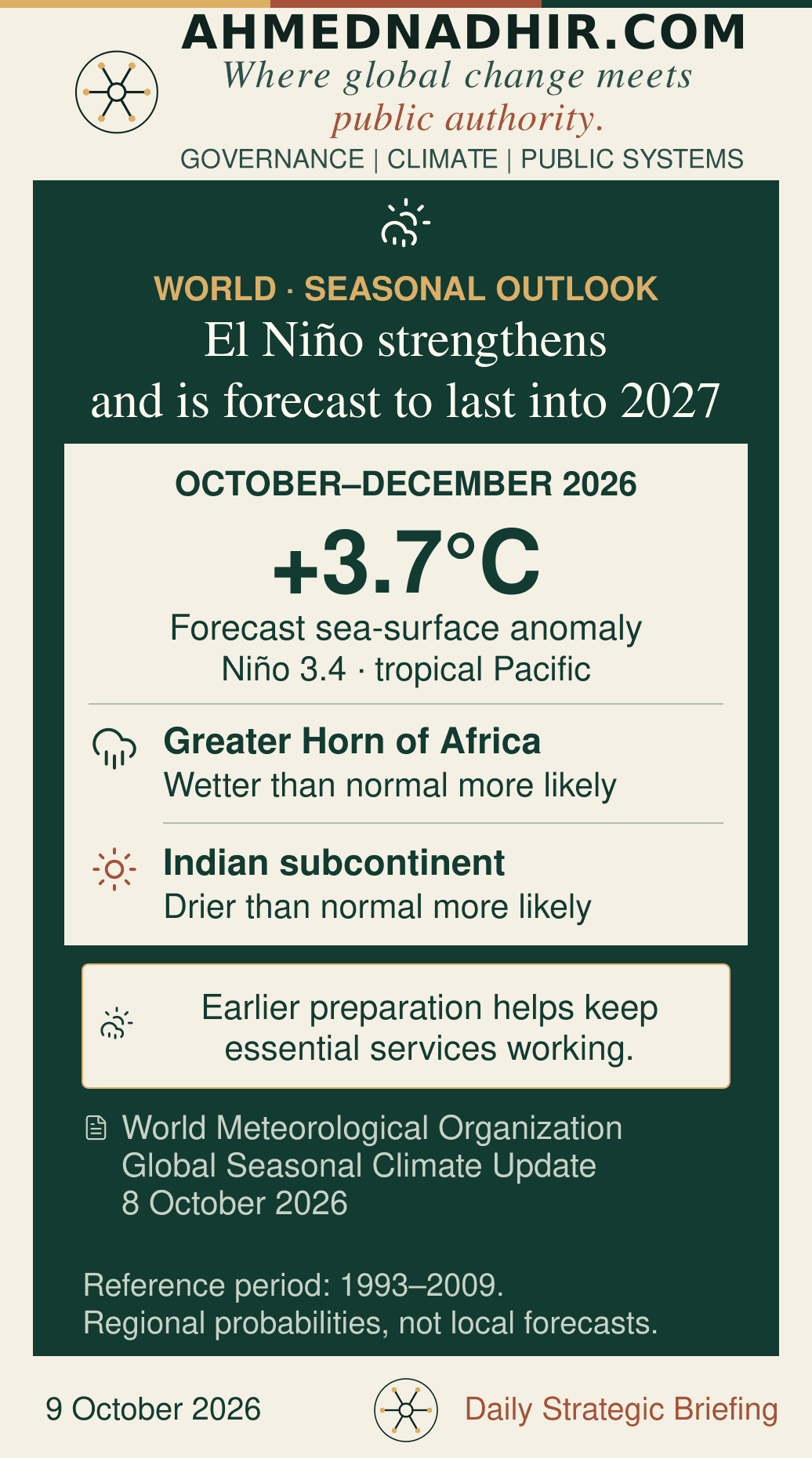
The World Meteorological Organization expects El Niño to intensify towards a December peak. Its new seasonal outlook forecasts an October–December average sea-surface temperature anomaly of approximately +3.7°C in the Niño 3.4 region of the tropical Pacific, relative to its 1993–2009 reference period. This measures a forecast ocean-temperature departure, not warming of local air or the planet as a whole.
A separate 8 October update from the US Climate Prediction Center puts the probability of strong-to-very-strong El Niño conditions through January–March 2027 above 83%. Its index differs from the measure used in the World Meteorological Organization graphic. The two updates support the same broad finding: a strengthening event with effects extending beyond this year.
The global October–December outlook makes wetter-than-normal conditions more likely across the Greater Horn of Africa and drier-than-normal conditions more likely over the Indian subcontinent. These are regional probabilities. National forecasts and shorter-range warnings determine the local response; other climate influences, including the Indian Ocean Dipole, also shape rainfall.
The public value of this longer horizon is preparation time. Water managers can review reservoir operations, health services can organise supplies and staffing, and road agencies can clear drains and repair culverts before seasonal pressures intensify. The appropriate action differs by place. Putting the relevant national forecast beside an agency’s maintenance schedule and budget makes the outlook useful to the people relying on that service.
PUBLIC FINANCE
Nigeria · State budgets and services
Nigerian states’ revenues rose 93% after inflation between 2023 and 2025
World Bank announcement: 8 October 2026 · State finances: 2023–2025, at constant 2019 prices
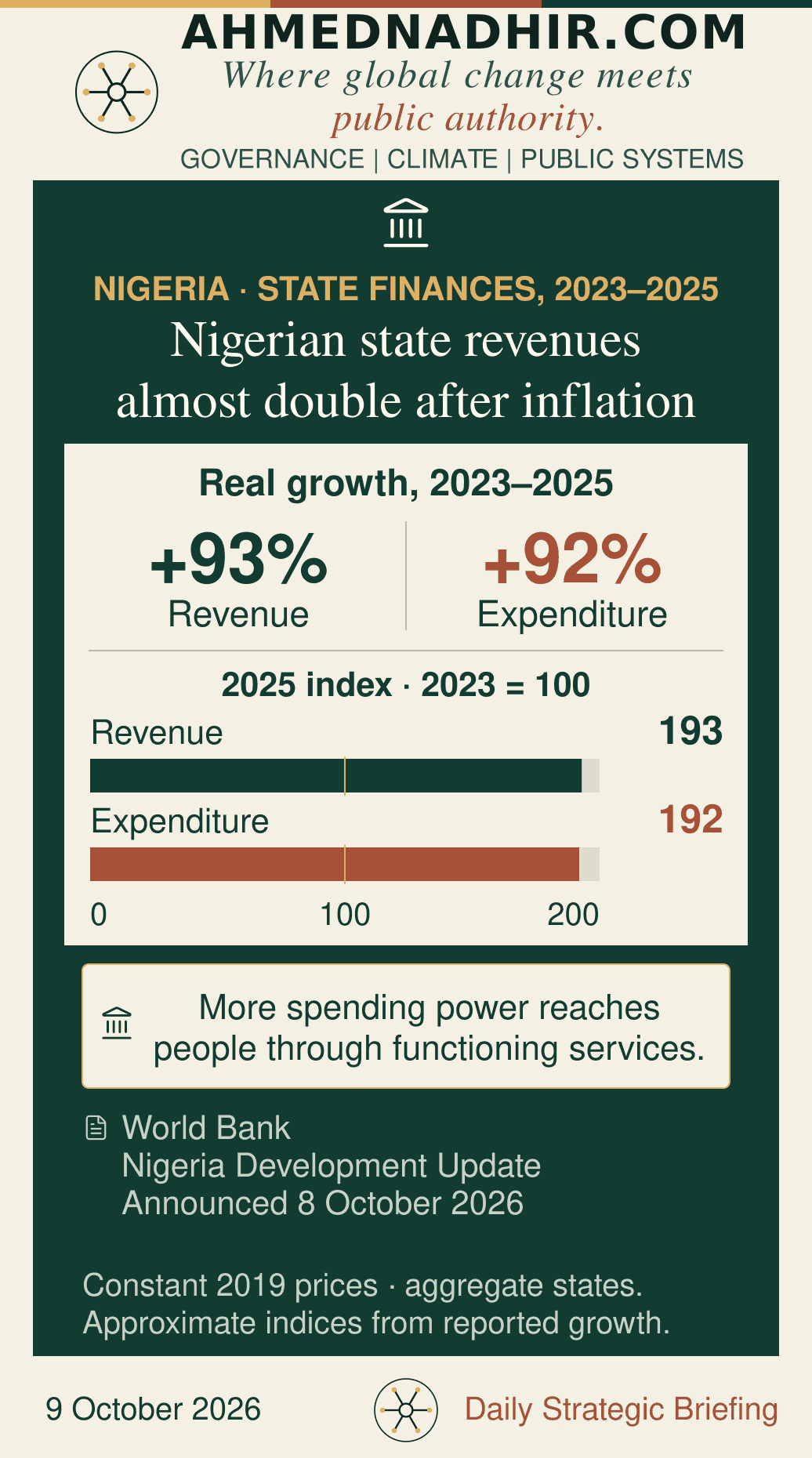
Nigerian states’ aggregate revenues rose by about 93% in real terms between 2023 and 2025, while expenditure rose by about 92%, according to the World Bank’s latest Nigeria Development Update announcement. Removing inflation reveals an expansion in spending power, rather than simply larger naira amounts.
The Bank links the broader rise in federation revenues to exchange-rate reforms, the removal of the petrol subsidy and stronger revenue administration. States also benefited from higher allocations, refunds and settlements of federal obligations. These different sources matter for planning: a settlement of an old obligation is not the same revenue stream as a recurring tax receipt.
Transport recorded the largest spending increase. Health, education and social protection spending also rose, but more slowly than economic infrastructure. A smaller budget share therefore does not, by itself, mean less money was spent. Aggregate figures also leave differences between individual states to be examined.
The opportunity extends beyond construction. A road’s economic value depends on upkeep and connections to places people need to reach. A health centre needs staff, medicines and functioning equipment. For Nigerian states, and other administrations receiving more revenue, capital and operating decisions belong together: the complete service determines what households and businesses gain from the investment.
HEALTH SYSTEMS
World · Maternity and continuing care
World Health Organization launches a roadmap for high blood pressure in pregnancy
Roadmap published: 7 October 2026 · Launch: 8 October · Programme: 2026–2035 and beyond
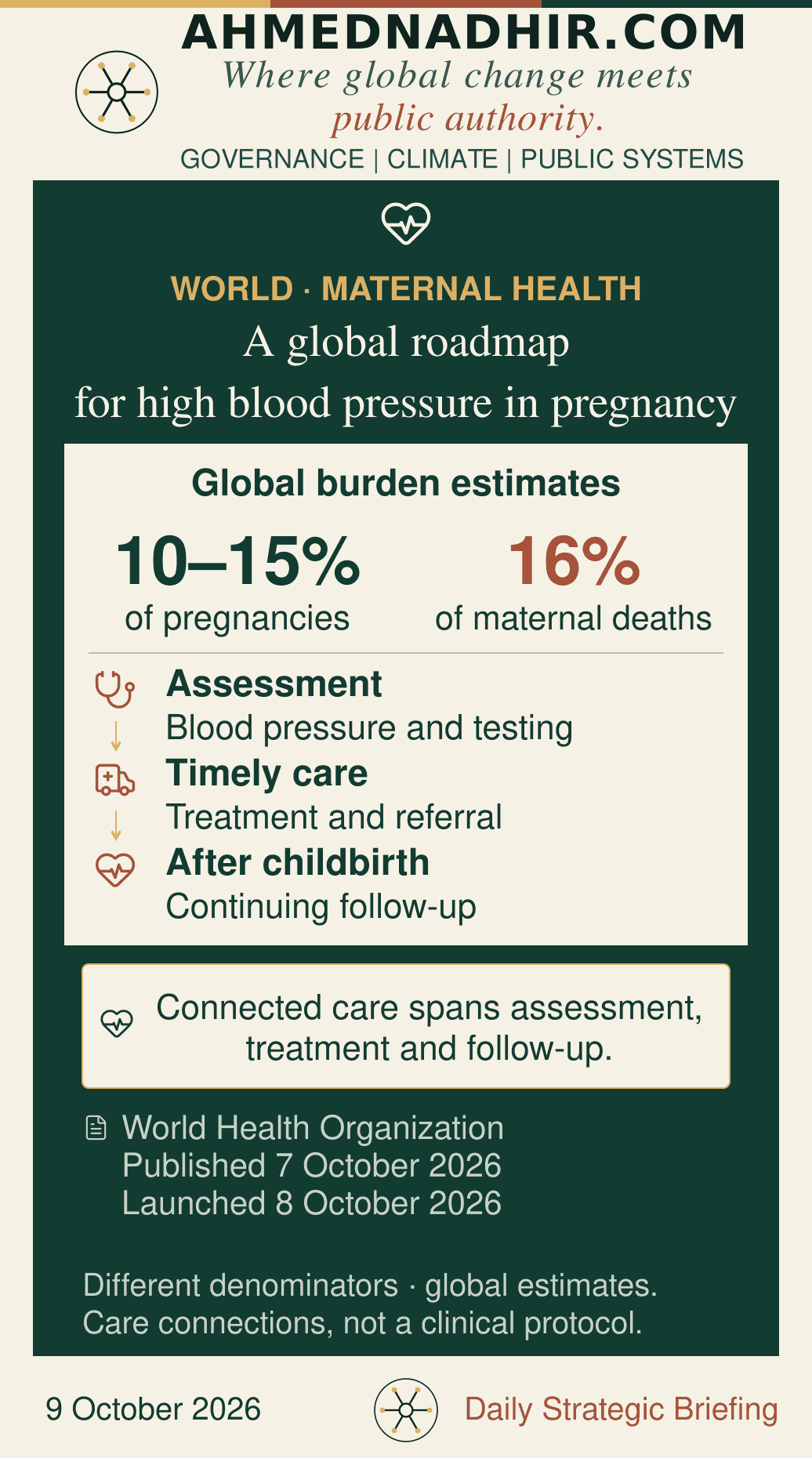
The World Health Organization and partners have launched a global roadmap for hypertensive disorders of pregnancy, including pre-eclampsia. These disorders complicate an estimated 10–15% of pregnancies and account for about 16% of maternal deaths worldwide. The two percentages describe different groups: pregnancies affected and maternal deaths attributed to these conditions.
Published on 7 October and launched the following day, the roadmap joins research, clinical guidance, medicines and diagnostics with implementation and accountability. Its horizon extends from 2026 to 2035 and beyond. The launch account identifies gaps in blood-pressure measurement, testing, essential medicines, trained teams and referral services that can delay care.
The institutional task is to connect recognition with treatment. A blood-pressure reading has value when a trained team can interpret it, provide appropriate care and arrange emergency referral when required. Buying equipment, stocking medicines and organising transport are parts of the same service, even when different offices control their budgets.
Care also continues after childbirth. Women affected by these disorders face higher later-life cardiovascular and kidney risks. Linking maternity follow-up with primary care gives health systems a practical way to address that longer horizon. The roadmap establishes priorities for action; progress will depend on the care women can actually reach.
ARTIFICIAL INTELLIGENCE
World · Legal research and building standards
World Bank tests artificial intelligence on building rules in 119 cities
Authors’ account: 8 October 2026 · Model use: March–August 2026 · Dataset expected: spring 2027
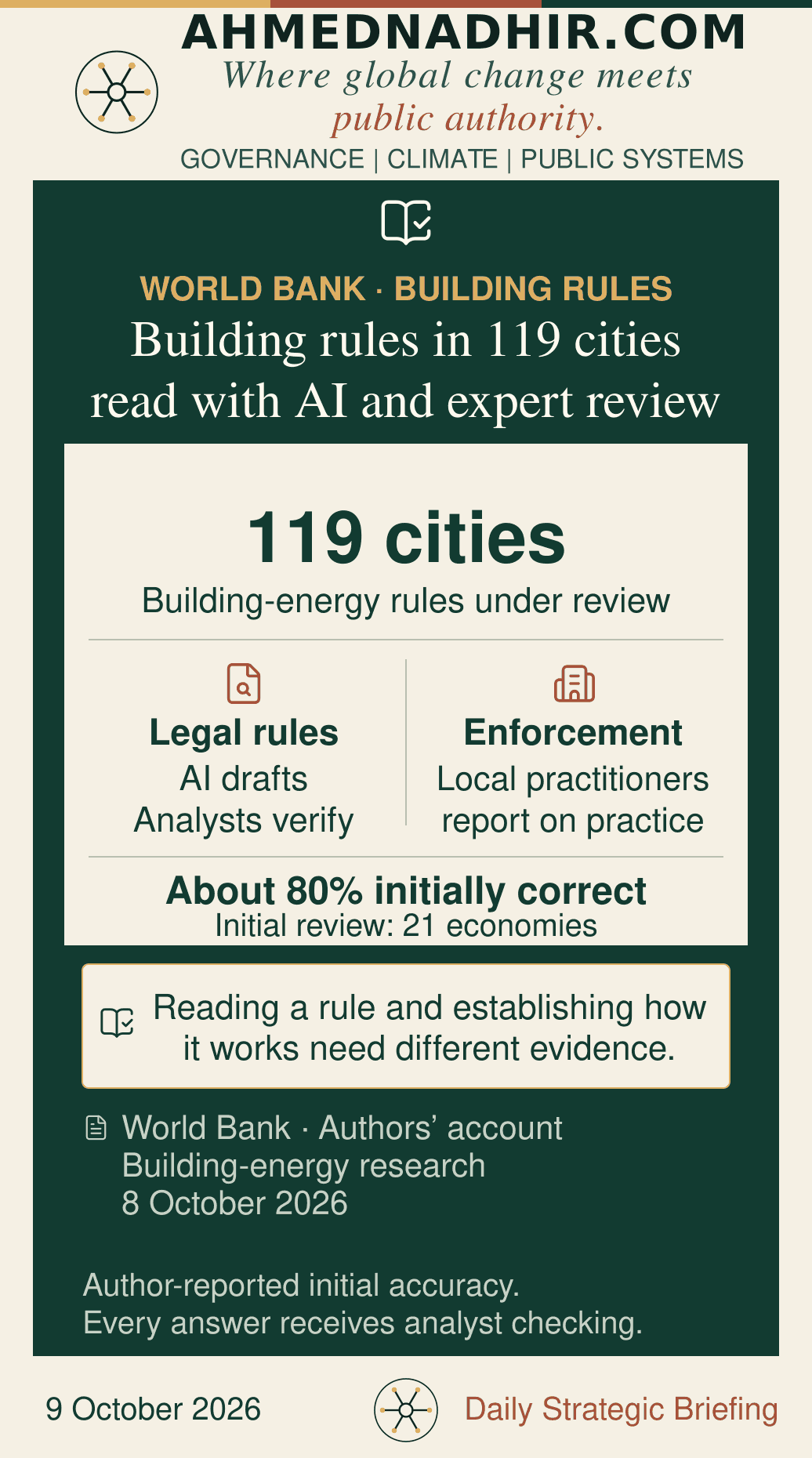
World Bank researchers have used artificial intelligence (AI) to draft answers about building-energy rules across 119 cities. Their 8 October account reports roughly four in five answers correct in an initial review covering 21 economies. Analysts verify every answer before publication.
The reported OpenAI model-usage cost was about US$27 per city. That excludes staff time and is not the full cost of verified research. The accuracy result also belongs to the initial 21-economy review, rather than establishing accuracy across all 119 cities.
The useful distinction is between reading a rule and establishing how it works. Legal texts describe requirements. Local architects, engineers and officials provide separate evidence about enforcement. The researchers use those different sources for different questions, preserving human review of the legal answers.
For public administrations, the experiment offers a way to organise document research more efficiently. Expert time can shift from finding provisions to checking whether the text is current, the citation is correct and the conclusion follows. Evidence about actual inspections and compliance still needs to be collected. Faster reading supports that work without settling it.