
HEALTH SYSTEMS
World · Mental health and social support
Mental health support beyond the hospital gate
Guide and news release: 9 October 2026 · World Mental Health Day: 10 October
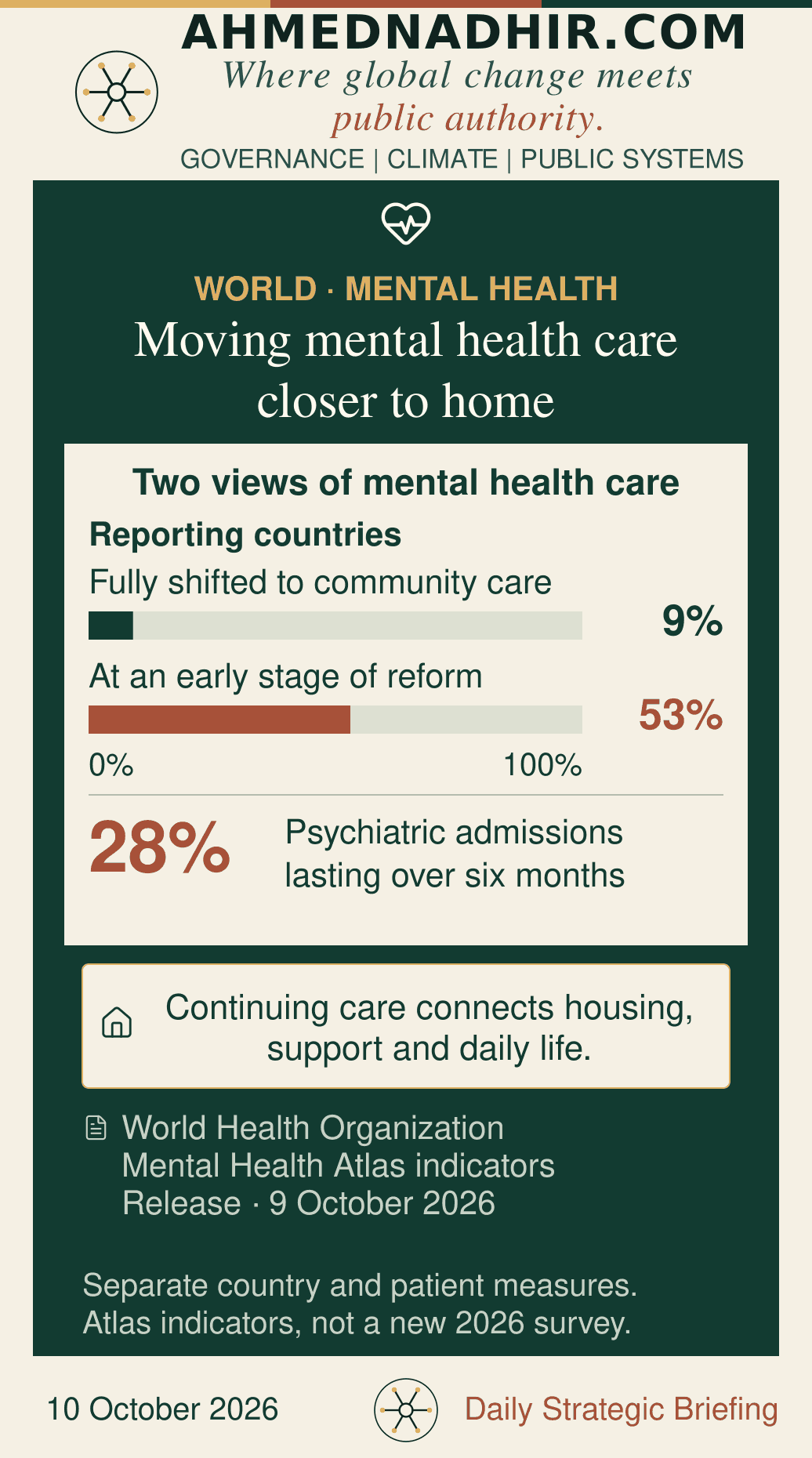
A person leaving a psychiatric hospital needs more than a discharge letter. On 9 October, the World Health Organization (WHO) published a guide to helping adults who have spent long periods in hospital return to community life, with continuing care and support. Released ahead of World Mental Health Day on 10 October, it connects reform to the lives people lead beyond the hospital gate.
The scale of reform is substantial. WHO reports that only 9% of reporting countries had fully moved to community-based mental health care and 53% were at an early stage. A separate hospital indicator finds that 28% of people admitted stayed for more than six months. These are global system indicators drawn from the Mental Health Atlas, not estimates for Kenya or counts of people receiving support at home.
The guide connects hospital reform with housing, health services, social support and opportunities to study or work. People who have experienced institutional care help shape the services. The financial implication is a transition budget: community support needs resources while hospitals continue to care for people who need them. A supported discharge brings those responsibilities together around the person, with help continuing beyond the hospital gate.
DEVELOPMENT EVIDENCE
Africa, Global South and world
Growing trade, slower growth and the income countries retain
Report published and presented: 9 October 2026 · Forecast year: 2026
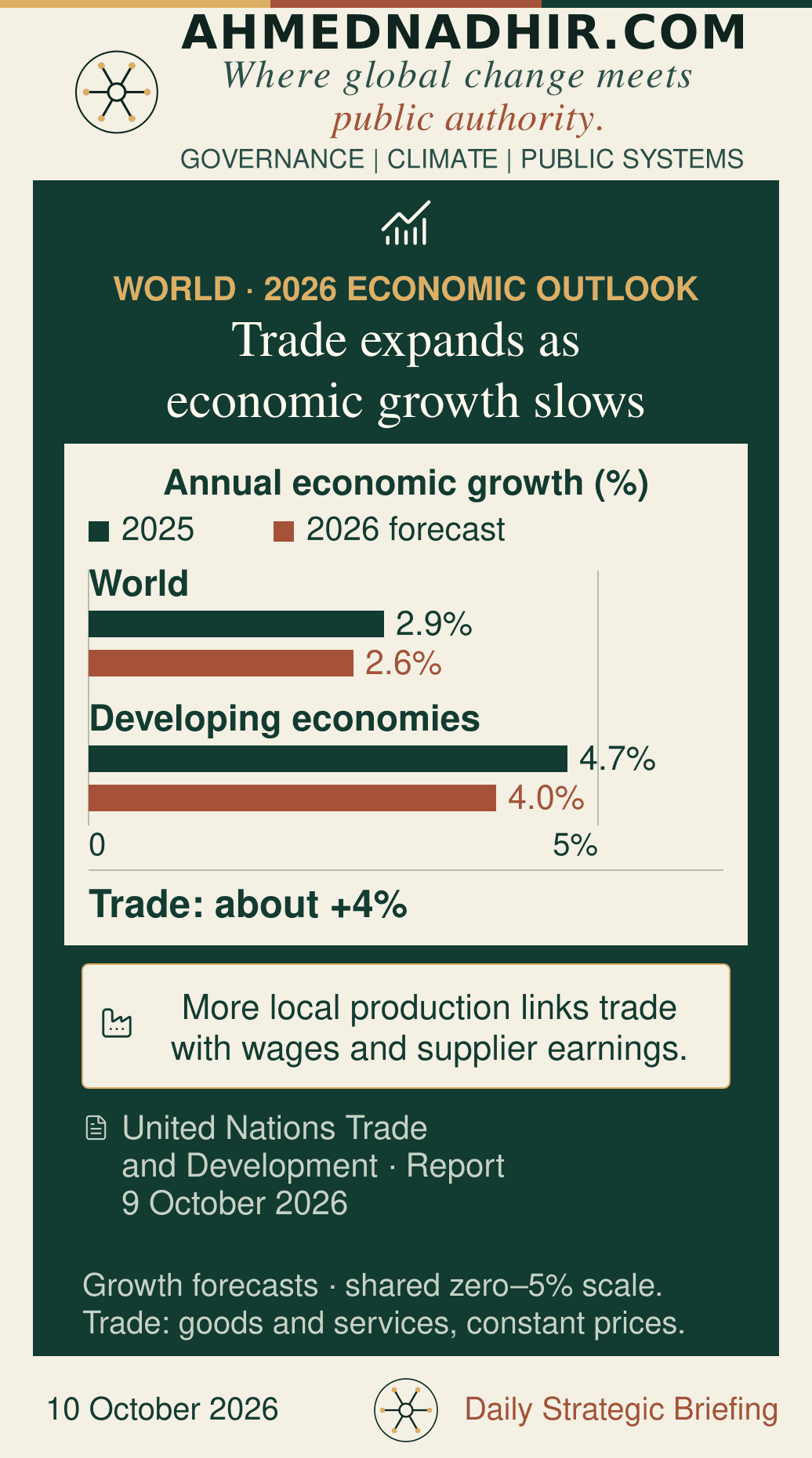
More trade can coexist with slower growth. United Nations Trade and Development projects global economic growth of 2.6% in 2026, compared with 2.9% in 2025, while trade in goods and services expands by about 4% at constant prices. Its Trade and Development Report, published and presented in Geneva on 9 October, puts developing-economy growth at 4%, down from 4.7%.
The report finds that gains in artificial intelligence-related trade are concentrated and calls for stronger links between foreign investment and local suppliers. That makes the composition of an export as important as its sale price. Imported machinery and components absorb part of the revenue; local processing, engineering, transport and design create income for firms and workers at home. More exports and higher local earnings are related, but different, economic results.
For Kenya and other African economies, the opportunity is to build those links around products firms can sell. A food exporter needs reliable cooling and recognised testing; an engineering supplier needs equipment, certification and orders. A shared testing facility or a dependable power connection helps several businesses qualify for customers, spreading the benefit beyond one factory. Public investment has a clear purpose when it removes a specific obstacle to selling and producing.
The forecasts describe the international outlook, rather than growth or job creation in an individual African country. The practical test of industrial progress is closer to the business: repeat orders, a larger share of production carried out locally and skills that suppliers can sell to several customers.
PUBLIC FINANCE
Africa · Launch in Mauritius
A new African assessor enters the credit market
Agency launched: 7 October 2026 · United Nations account: 8 October
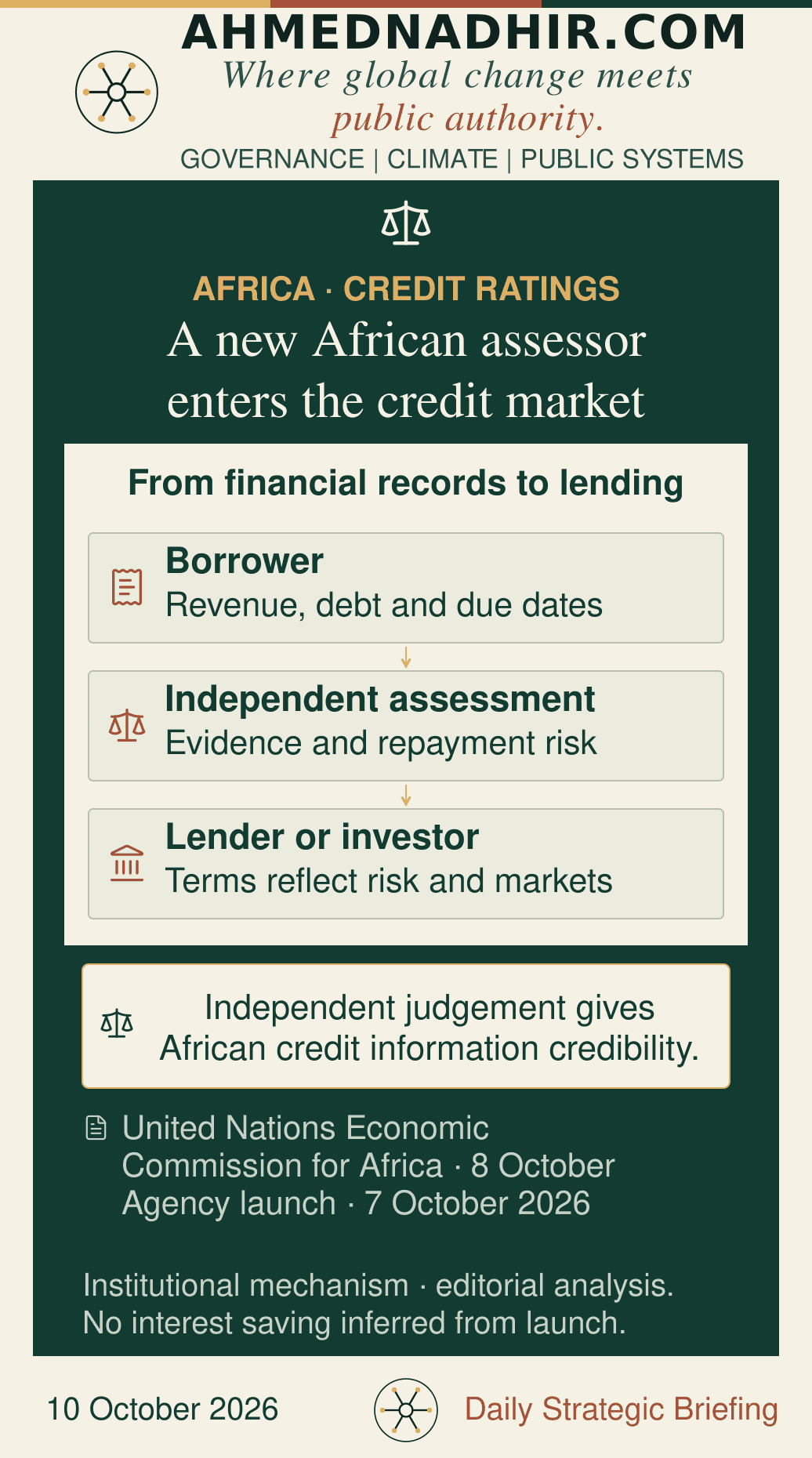
Africa has launched a new institution for assessing creditworthiness. The Africa Credit Rating Agency (AfCRA) was launched in Mauritius on 7 October, according to the United Nations Economic Commission for Africa's account published on 8 October. It is an independent institution driven by the private sector, intended to add African economic knowledge to the information available to lenders and investors.
Its commercial value rests on a judgement that others can examine. AfCRA's published governance framework describes independent rating committees, separation between analysis and commercial interests, conflict management and procedures for factual correction. Those arrangements matter because the government or company seeking finance has an interest in the outcome of its assessment.
The agency’s announced remit includes governments, subnational entities and companies; its website says coverage will be introduced as methodologies, regulatory approvals and operational readiness allow. The economic opportunity is a clearer comparison of borrowers with different revenues, obligations and risks. The same information helps citizens understand what public borrowing commits future budgets to pay.
A rating helps an investor assess repayment; it does not set the bond’s interest rate. That price also reflects market conditions, the borrower’s finances and confidence in the assessment. The launch creates an additional African source of credit information. Its influence on financing costs will emerge through the quality of its work and how investors use it.
CLIMATE AND RESILIENCE
Western Indian Ocean · Ten treaty parties
A regional pollution plan connects coastal protection across borders
Conference: 6–9 October 2026, Dar es Salaam · Outcomes reported: 9 October
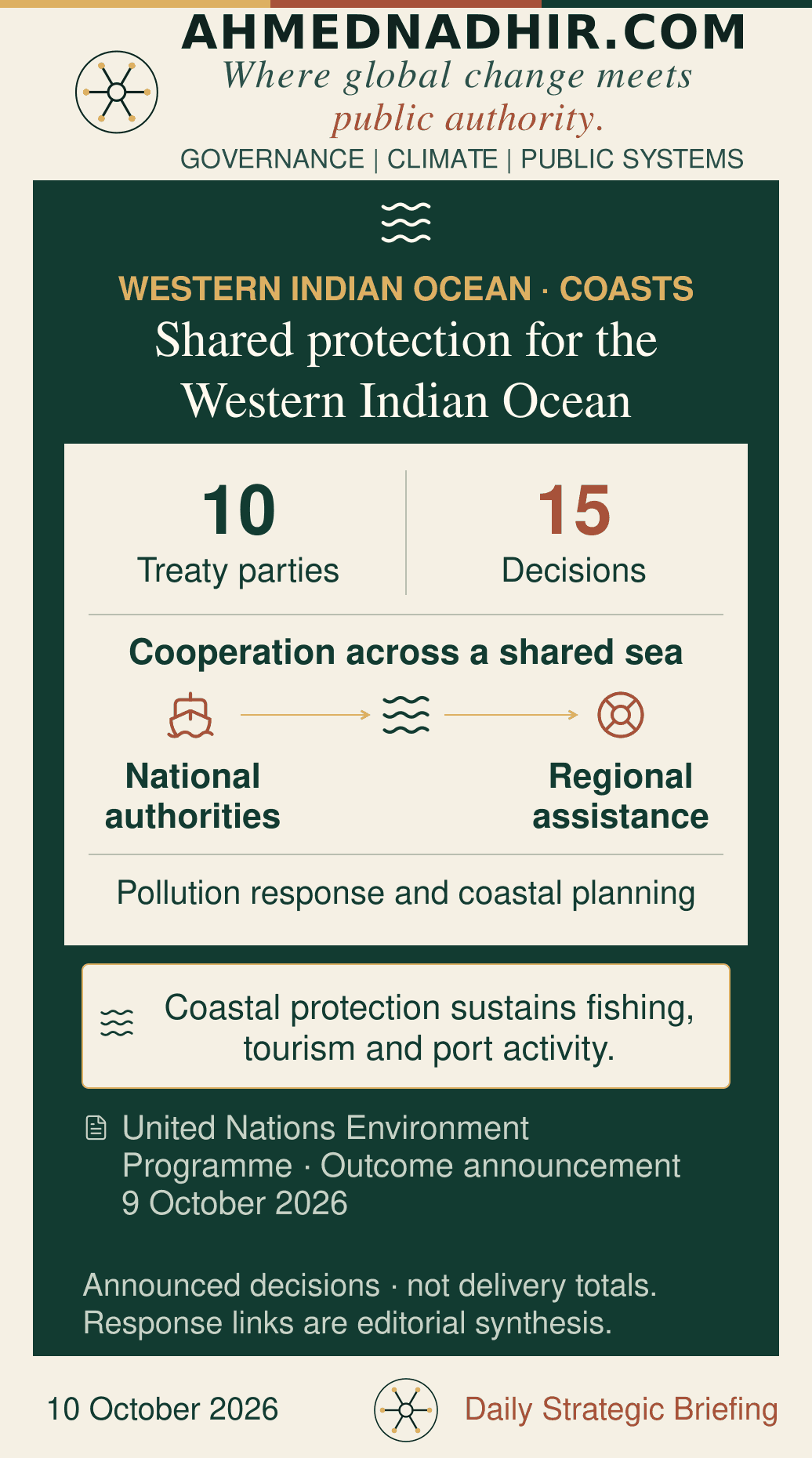
Ten parties to the Nairobi Convention have endorsed a regional plan for responding to major marine pollution. Their twelfth Conference of the Parties concluded in Dar es Salaam on 9 October with 15 decisions, the United Nations Environment Programme (UNEP) reported that day. The parties include Kenya, Tanzania, Mozambique, South Africa and Indian Ocean island states.
The decisions include a regional plan for major marine pollution incidents, a strategy on plastic pollution, stronger marine spatial planning and work on ocean accounting and finance. Their connection is practical: pollution can travel beyond the country where it begins, while fishing, shipping, tourism and habitat protection share coastal space.
A regional response joins national responsibilities around a shared sea. An alert raised in one port needs to reach the right authorities elsewhere; assistance needs people, equipment and arrangements for moving it. This is the practical logic of cooperation. The meeting’s public document collection contains a preparatory draft of the contingency plan, while UNEP’s final announcement confirms its endorsement.
The opportunity for Kenya and its neighbours extends from emergency response to everyday coastal livelihoods. Pollution prevention helps protect fishing grounds, beaches and ports. Spatial planning brings competing uses of the coast into one decision, and habitat monitoring gives investment a clearer environmental basis. These are routes to public benefit; the 15 decisions are a record of agreement, rather than a count of completed works or ecological gains.