
WATER
Philippines · lessons for island and coastal services
Philippines finances water and sanitation on underserved islands
Financing announcement published 9 October 2026 · World Bank project approval: 31 July 2026
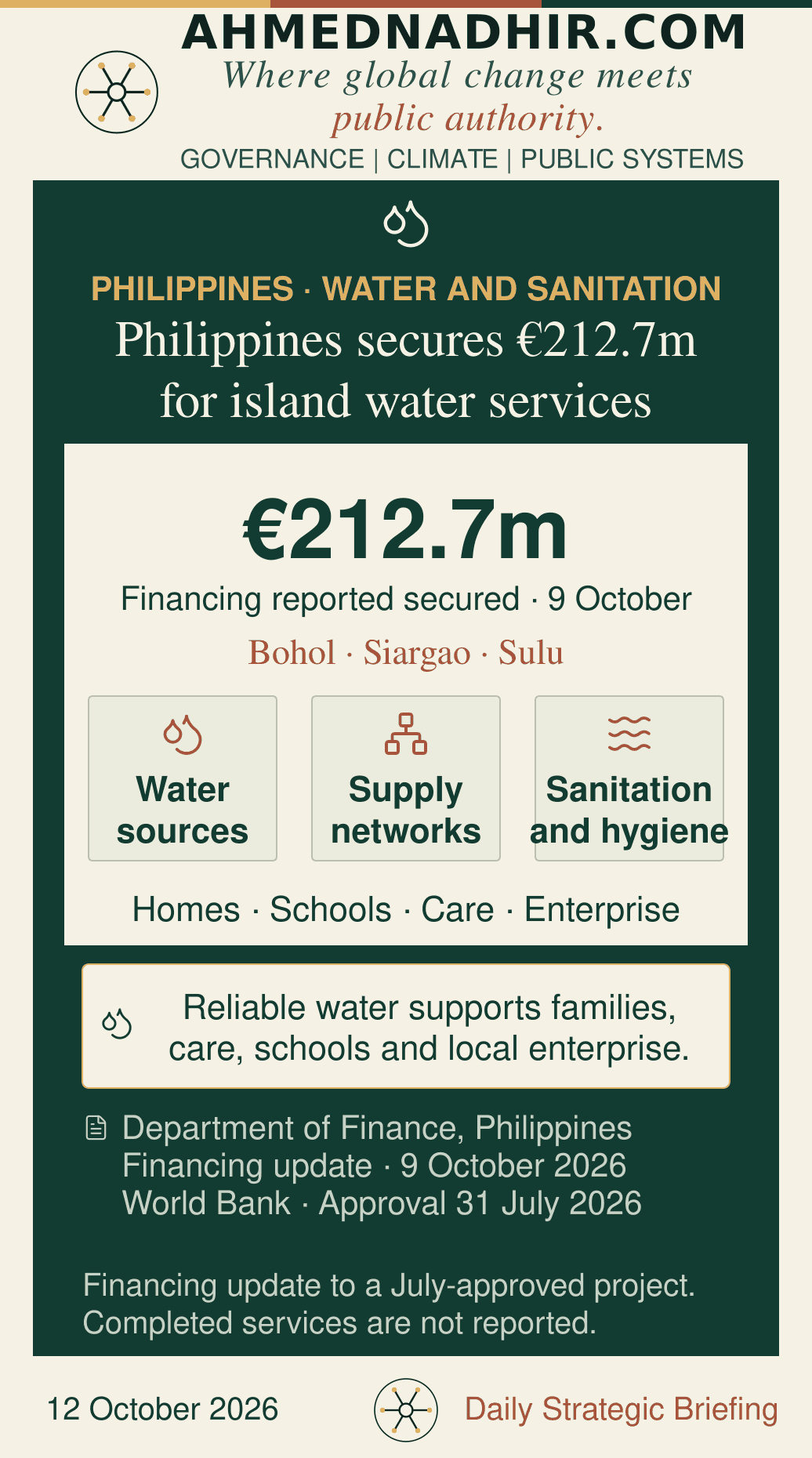
The Philippines’ Department of Finance reported on 9 October that it had secured €212.7 million, about 14.98 billion Philippine pesos, from the World Bank’s International Bank for Reconstruction and Development. The financing supports water supply and sanitation in underserved island communities. The financing update builds on a project approved on 31 July.
The Accelerated Water and Sanitation Project in Selected Areas brings together bulk supply, storage, distribution and sanitation. The finance ministry identifies Bohol, Siargao and Sulu; the World Bank’s approval account specifies Bohol, Siargao and Jolo, within Sulu. The public works and interior departments will implement it, combining infrastructure investment with improvements in local service-provider performance.
For a household, resilience means dependable water through a dry spell and sanitation that withstands flooding. For a school or clinic, it means fewer interruptions to essential routines. For a small business, reliable supply supports trading and employment. Connecting these uses makes water investment an economic programme as well as a public-health measure.
The World Bank projects 8,700 jobs within five years of completion, arising from construction and wider economic activity. This is a forecast, not recorded employment. The October announcement does not establish disbursement or completed services. The lesson for other island and coastal systems is the joined approach: water sources, functioning networks, sanitation and capable operators belong in the same investment plan.
CLIMATE
Bangkok · evidence for cities, buildings and workplaces
Heat protection gets a guide to what works, where and at what cost
Tools announced 6 October 2026 · Global Heat Forum: Bangkok, 6–9 October 2026
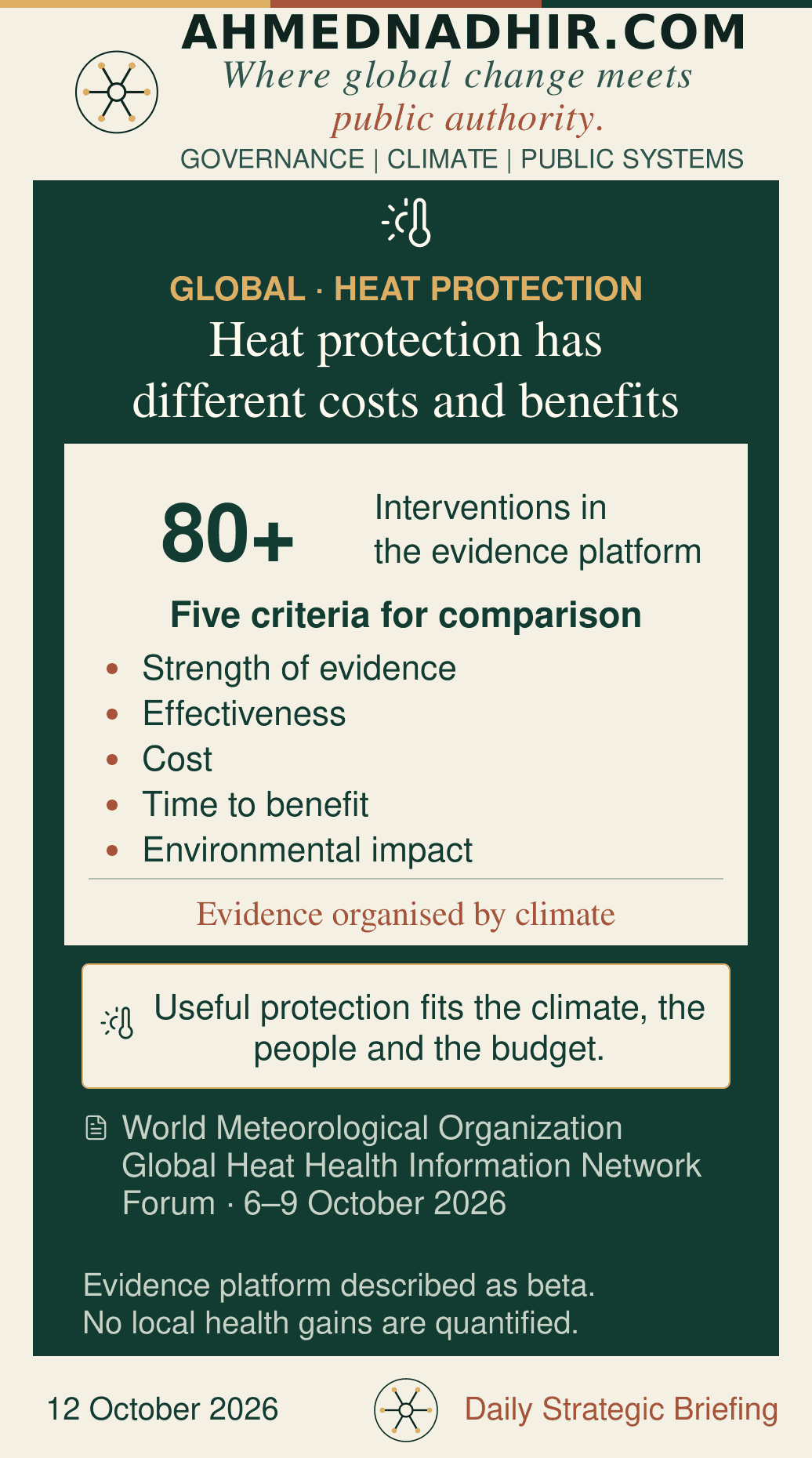
Tree cover, cool roofs and changes to building design address different parts of the heat problem. Choosing among them requires evidence about the setting, the people exposed and the time available. A new resource announced at the Global Heat Forum in Bangkok brings those comparisons into one place.
The World Meteorological Organization’s 6 October account describes What Works Against Heat, developed by the University of Sydney’s Heat and Health Research Centre with the Global Heat Health Information Network and Wellcome support. The forum’s programme describes a beta platform covering more than 80 interventions across landscapes, buildings and personal protection. Its five ratings address evidence strength, effectiveness, cost, time to benefit and environmental impact, with results organised by climate.
This matters because a long list of recommended measures does not tell a city which combination fits its buildings, budget and climate. The platform offers a basis for comparing alternatives and identifying gaps in the research. Evidence from one climate or population still needs interpretation before it informs a different community’s investment.
For public institutions, the opportunity is to connect heat protection with ordinary spending on housing, streets, workplaces and health facilities. Immediate protection and longer-term changes serve different purposes: an emergency response cannot substitute for buildings and neighbourhoods that reduce exposure every day. The launch is evidence of a new decision resource, not a measured reduction in illness or deaths.
HEALTH SYSTEMS
Africa · country-led primary care
Africa’s primary-care coordination starts with national priorities
Statement published 8 October 2026 · Consultation: Addis Ababa, 4–5 June 2026; endorsed 5 June
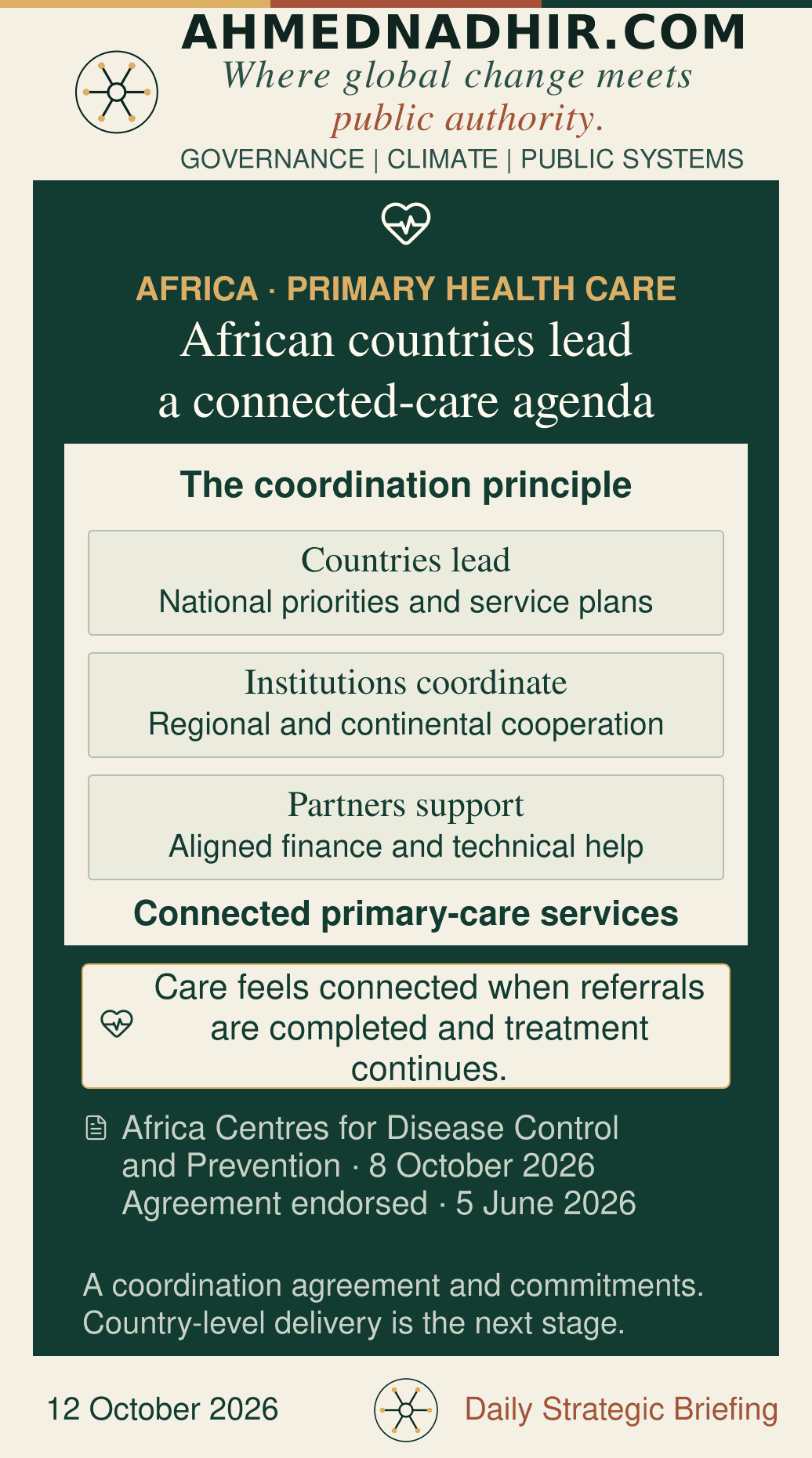
A family’s care crosses services that institutions often organise separately: immunisation, maternal care, nutrition, community support and disease prevention. The Africa Centres for Disease Control and Prevention (Africa CDC), in its newly published primary-care statement, places their coordination around national priorities, with regional and continental bodies supporting that work.
The Primary Health Care Continental Coordination Mechanism was endorsed at a consultation in Addis Ababa on 5 June. The statement, published on 8 October, records that agreement and its commitments. Its central principle assigns leadership to countries, coordination to regional and continental institutions, and support to partners.
The statement proposes a leadership forum and thematic coordination, alongside aligned financing, secure digital systems and progress reviews. The distinction matters for service delivery. Several partners can support a national plan while still leaving gaps between programmes. Coordinating investments around the same workforce, facilities and referral arrangements gives national authorities a clearer way to identify those gaps.
For people seeking care, the practical benefit to pursue is continuity: services that connect across visits and facilities. The statement sets out an institutional route towards that goal. It does not report a newly financed continental programme or demonstrate improvements in patient outcomes.
ARTIFICIAL INTELLIGENCE
Armenia · policy, literacy and participation
Armenia links artificial intelligence policy with skills and participation
Memorandum signed and UNDP announcement published 9 October 2026 · AI Days scheduled for November 2026
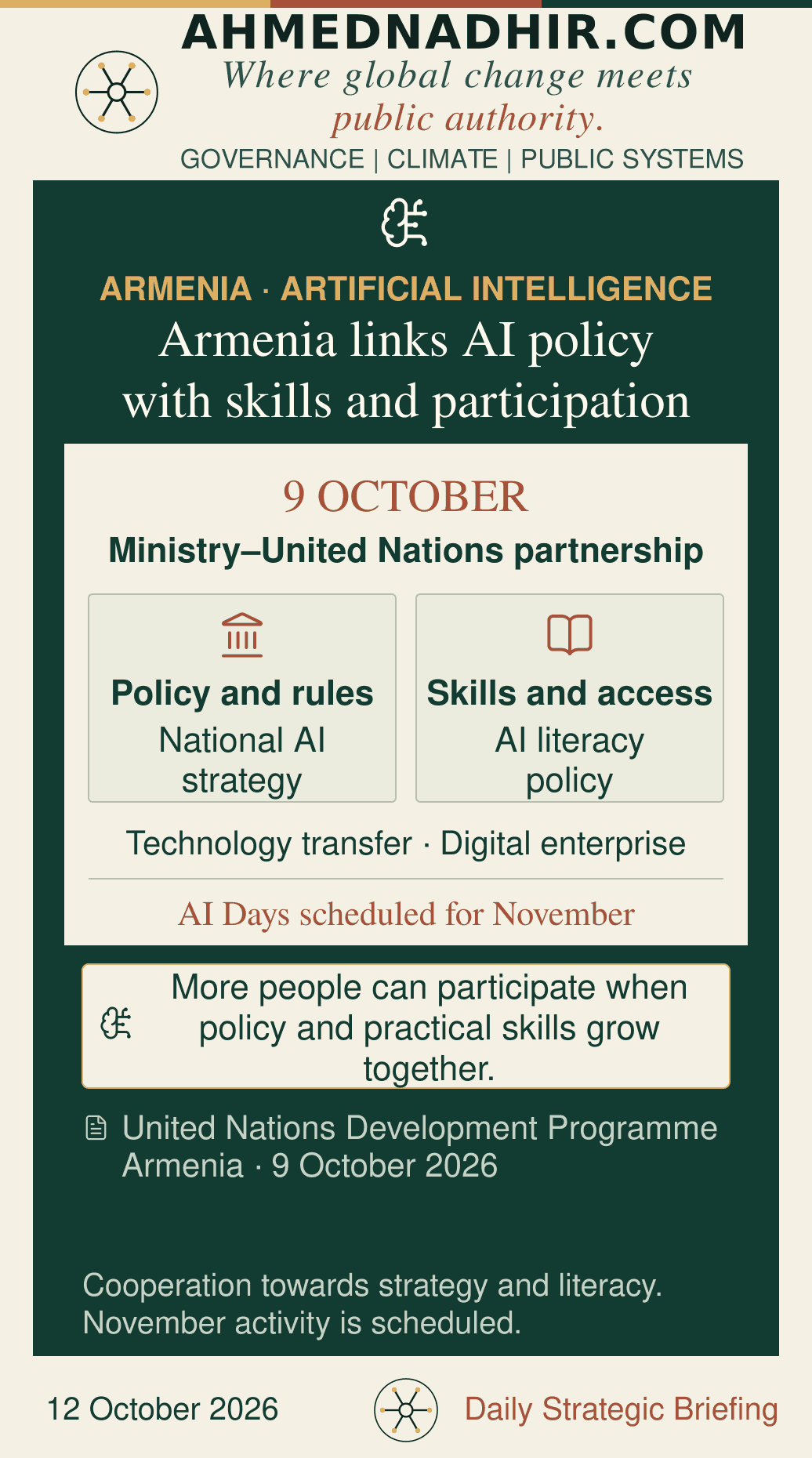
Armenia’s Ministry of High-Tech Industry and Artificial Intelligence and the United Nations Development Programme (UNDP) signed a cooperation agreement on 9 October. Their partnership connects artificial intelligence (AI) policy with literacy and participation.
The memorandum envisages work on a national AI strategy and an AI literacy policy, alongside technology transfer and digital entrepreneurship. It also provides for public authorities’ involvement in policy development. UNDP identifies AI Days, scheduled for November, as an early step. The announcement describes cooperation on developing and potentially implementing these policies; it does not establish that a strategy has been adopted or that implementation funding has been allocated.
The approach offers a useful question for other governments: who gains the skills to participate as the rules take shape? A public employee evaluating a tool, a small business considering its use and a citizen affected by an automated decision need different kinds of understanding. Linking policy with literacy makes participation a practical part of the AI agenda.
The next evidence will come from the strategy, the programmes and the institutions responsible for them. A signed partnership establishes an agenda; published responsibilities, resources and results will show how widely that agenda reaches.