
DEVELOPMENT
108 countries · Africa and the wider developing world
The poverty count rises, but the routes to hardship differ
Global Multidimensional Poverty Index update and release: 12 October 2026 · Surveys: 2014–2024/25; population estimates: 2024
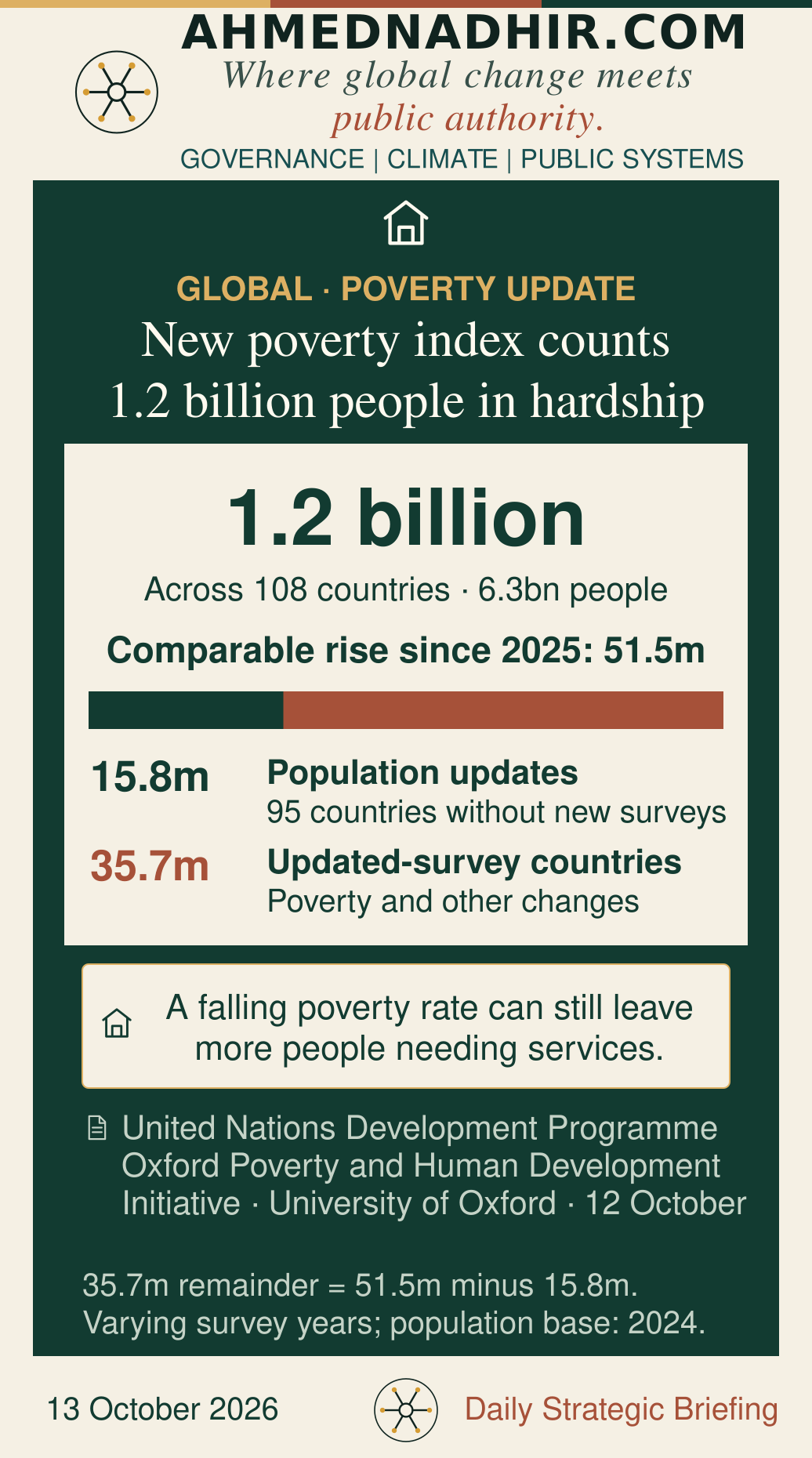
The United Nations Development Programme (UNDP) and the Oxford Poverty and Human Development Initiative at the University of Oxford published their 2026 Multidimensional Poverty Index (MPI) update on 12 October. It identifies 1.2 billion people in acute multidimensional poverty across 108 countries, representing 18.9% of the 6.3 billion people covered. Its measure brings health, education and living conditions together to show the disadvantages a household faces. People count as poor when their household is deprived across at least one-third of the index’s weighted indicators.
The comparable count is 51.5 million higher than in the previous update, the first recorded rise since the index began in 2010. The report separates population growth from changes captured by new surveys. In 95 countries with no new survey, population updates alone added 15.8 million people while poverty rates were held constant. The remainder combines poverty-rate changes, demographics and differences in indicator coverage across 13 countries with new surveys.
That distinction changes the policy reading. Angola and Zambia reduced the proportion of people in poverty, yet population growth increased the number requiring support. A service programme therefore needs to track both the share of residents facing deprivation and the number it must reach. The release is a new statistical update, drawing on surveys from different years; it is not a census of hardship arising in 2026.
The African burden is substantial: the report identifies 616 million people in Sub-Saharan Africa. Globally, 617 million of those identified are children. These groups overlap. The report also records progress: 33 of the 89 countries with trend data halved their MPI value in fewer than 15 years, including six in Sub-Saharan Africa. That describes a reduction in the index, which combines poverty’s incidence and intensity.
For public institutions, the useful question is which deprivations occur together in each place. Health, education, water and energy budgets can then address the household’s needs with a shared service plan, informed by current local evidence.
HEALTH
World · Strategy launched in Berlin
World Health Organization aims for 24-hour detection of new threats by 2030
Strategy published: 10 October 2026 · Launch: 11 October, Berlin · News announcement: 12 October
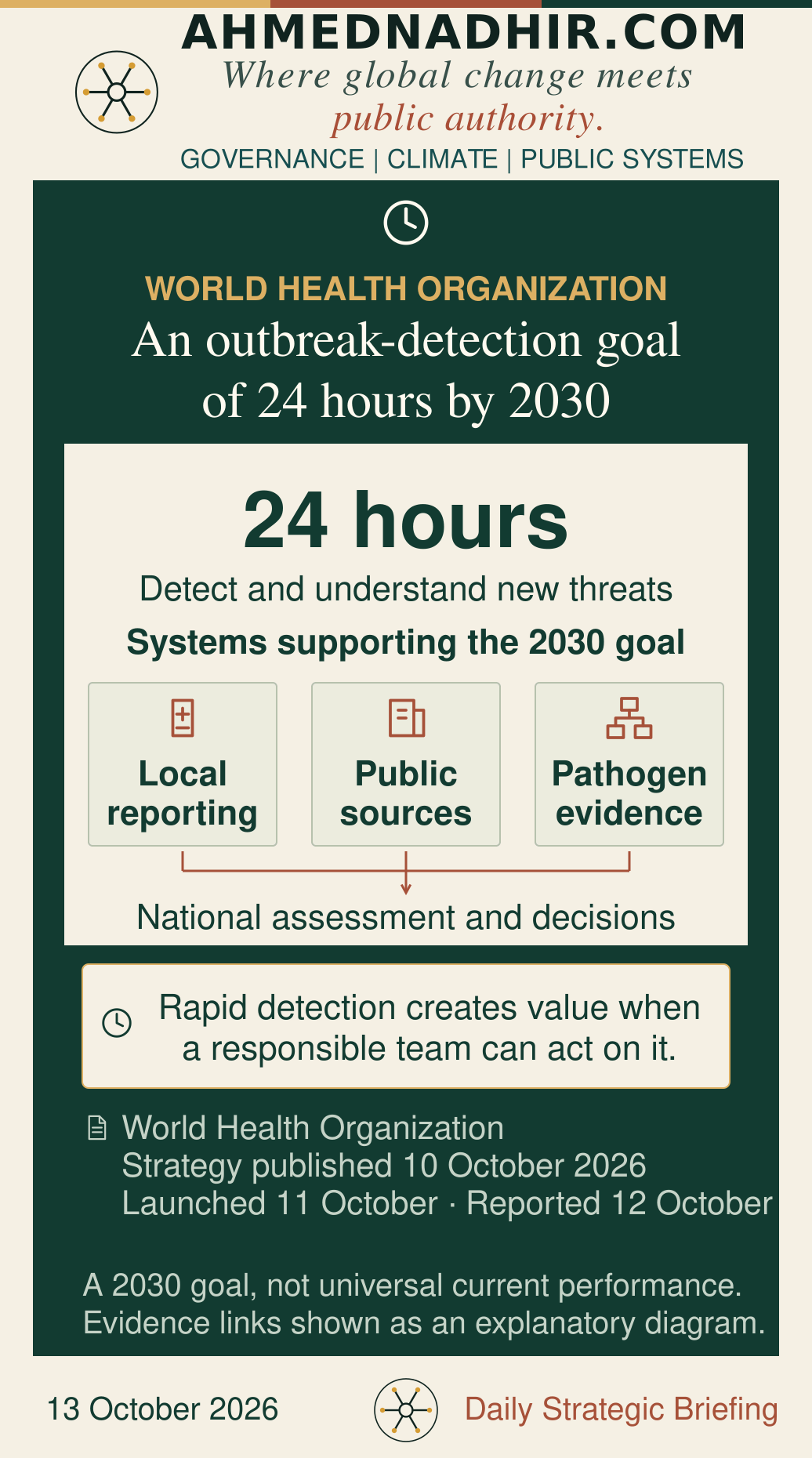
In an announcement published on 12 October, the World Health Organization (WHO) set out its new strategy for the Hub for Pandemic and Epidemic Intelligence. It aims for every country to detect and understand emerging health threats within 24 hours by 2030. The strategy document was published on 10 October and launched at the World Health Summit in Berlin on 11 October. The goal concerns detection and understanding; the next task is a response that can begin quickly.
The strategy connects national surveillance with public-source intelligence, pathogen sequencing, analytical expertise and secure digital systems. WHO reports that its open-source epidemic-intelligence system is already used by more than 125 Member States. Artificial intelligence helps scan public information for signals, while health professionals and laboratories establish what those signals mean.
For a health service, speed is a chain of practical decisions. An unusual report must reach someone able to assess it; information must be checked; and a responsible team must receive the result. Finding a signal faster creates an opportunity for action. Staff availability, laboratory access and the authority to respond determine how that opportunity reaches the community.
The new digital initiative puts secure data sharing and responsible artificial intelligence within the same programme. This connects technology spending with the people who use the evidence. The announcement establishes a strategic goal and the programmes behind it; it does not demonstrate that every country currently meets a 24-hour standard.
CLIMATE
Nepal · Budhi Gandaki river corridor
Warnings and rescue follow Nepal’s Budhi Gandaki flash flood
Flood and preliminary advisory: 11 October 2026 · World Meteorological Organization account: 12 October
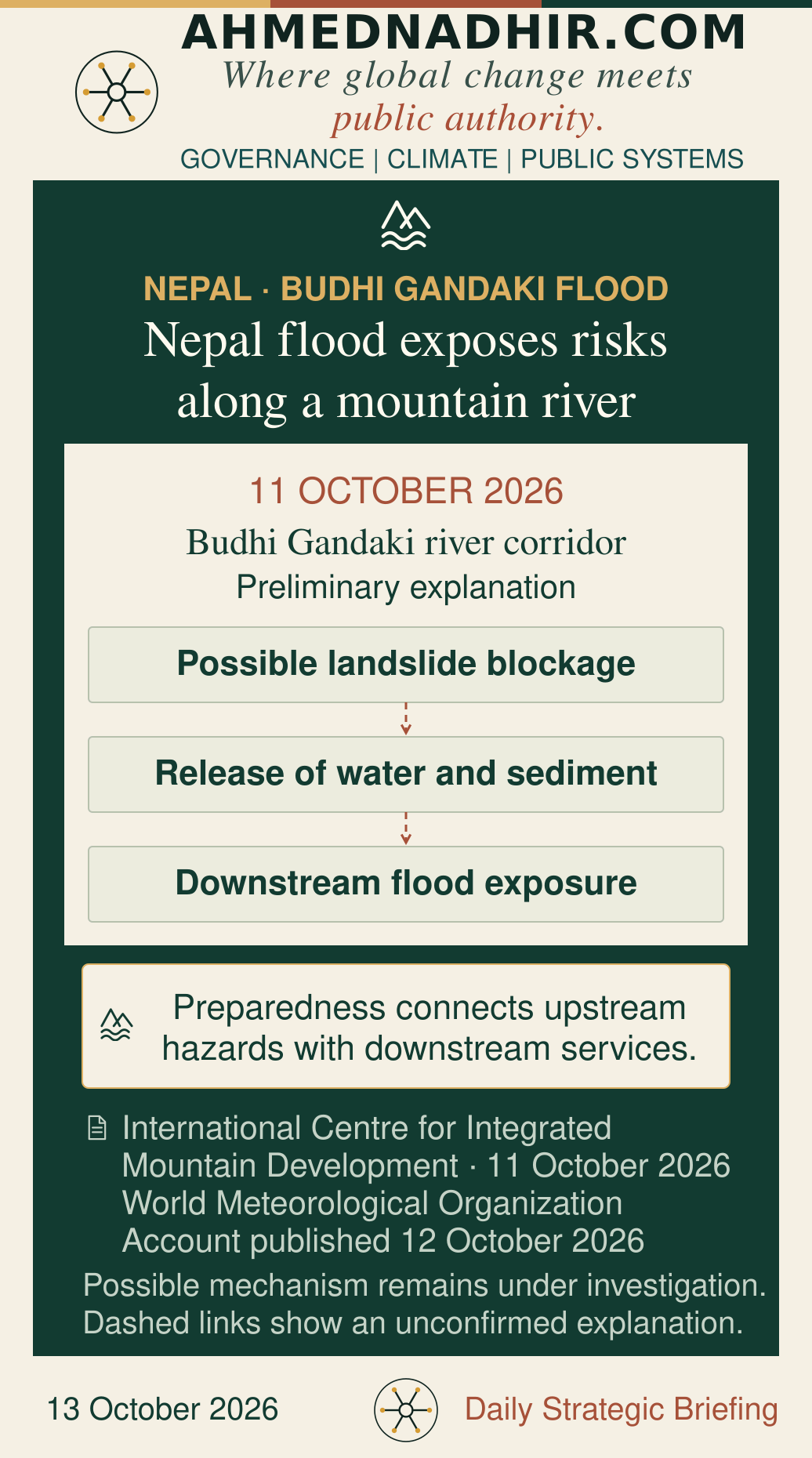
A destructive flash flood swept through Nepal’s Budhi Gandaki river system on 11 October. The International Centre for Integrated Mountain Development (ICIMOD), reviewing preliminary accounts from Nepal’s authorities, identified a possible failure of a temporary landslide blockage near Chumchet in Gorkha district. The explanation remains under investigation.
Authorities issued warnings along the Budhi Gandaki, Trishuli and Narayani river systems. The United Nations’ 11 October statement reports damage to bridges, roads and hydropower facilities, affecting hundreds of households and their livelihoods. It describes support for government-led assessments and relief, including satellite imagery and transport for food and supplies. The World Meteorological Organization’s 12 October account places the event within the wider challenge of cascading mountain hazards.
The important connection is between an upstream disturbance and the services exposed downstream. A blocked channel and a sudden release of water and sediment involve risks that rainfall totals alone cannot describe. Roads, electricity infrastructure and settlements share the river corridor, so a single event can interrupt several services at once.
For other mountain and steep-catchment regions, the transferable lesson is coordinated monitoring and preparedness. Slope conditions, river flow and downstream exposure belong in the same assessment, with warnings connected to evacuation routes and service-continuity plans. The preliminary mechanism is a hypothesis; the need to account for several connected hazards is the broader planning finding.
AFRICAN ECONOMIES
Kenya · Foreign-currency trade credit
US$10 million trade-credit agreement targets Kenyan businesses
Signing and Family Bank announcement: 5 October 2026 · African Development Bank news listing: 12 October
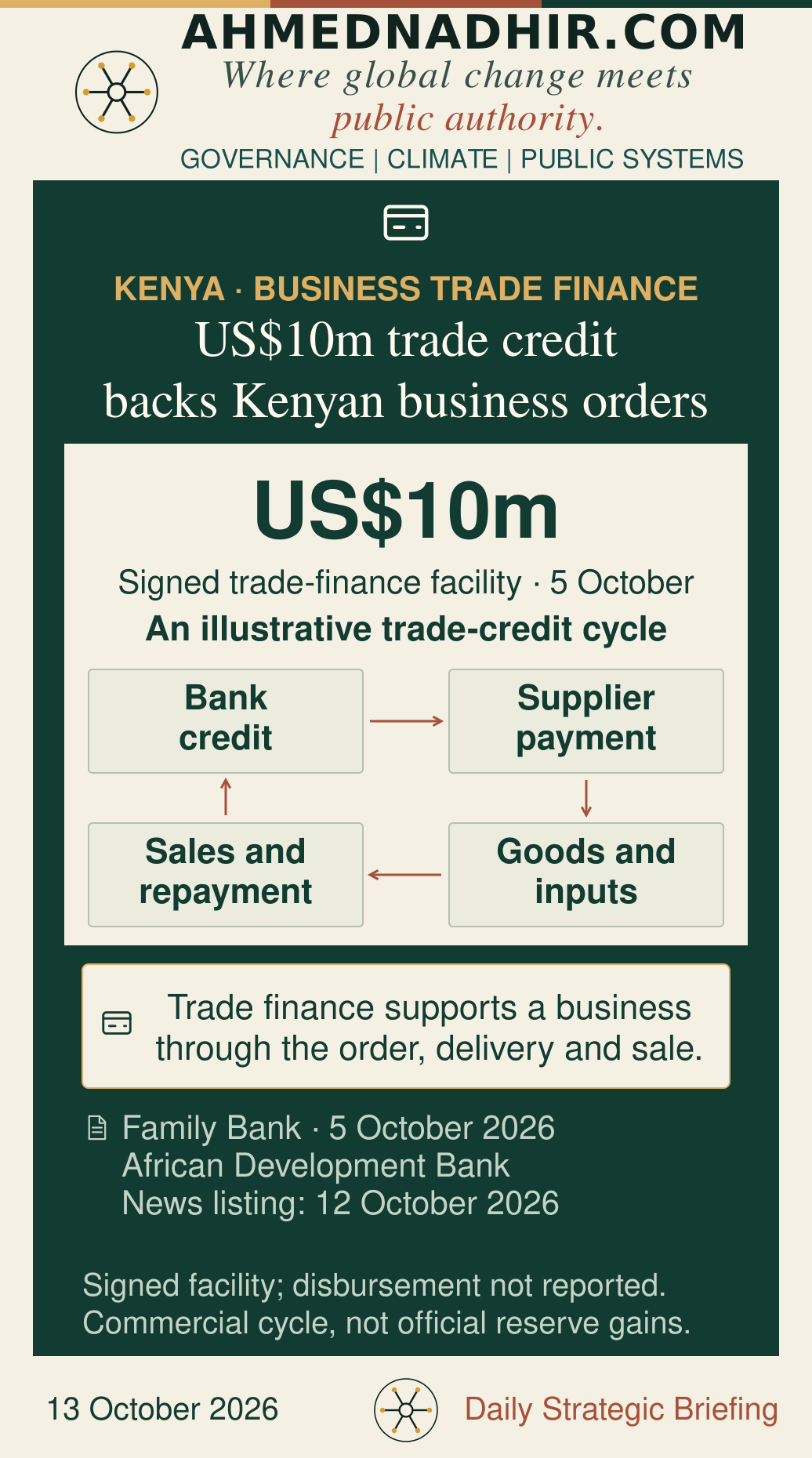
The African Development Bank and Family Bank signed a US$10 million trade-finance line of credit in Nairobi on 5 October. Family Bank announced the agreement that day; the development bank’s regional news listing features it under 12 October. The facility is intended to expand foreign-currency financing for businesses’ trade requirements.
The announcement identifies small and medium-sized firms and local companies, including manufacturing, agriculture, health, renewable energy and women-owned businesses. For a firm importing equipment or inputs, the commercial need is often a payment due before the goods can generate sales. Trade credit helps bridge that interval.
The benefit develops through the order being financed. Inputs support production, stock supports distribution, and a completed sale replenishes working capital. It is therefore useful to assess the facility through businesses served, goods financed and repayment performance, rather than treating the agreement’s headline value as income already earned.
The line is bank trade finance. Its contribution to foreign-currency access for firms should be assessed separately from changes in official reserves. The announcement supplies no borrower interest rate, confirmed disbursement or measured employment gain. The commercial opportunity is clearer financing for real orders, with terms suited to the business’s payment cycle.