
GLOBAL ECONOMY
World · Uneven growth and import costs
Growth holds up, but importers face higher food and energy costs
World Economic Outlook released in Bangkok: 13 October 2026 · Forecast years: 2026 and 2027
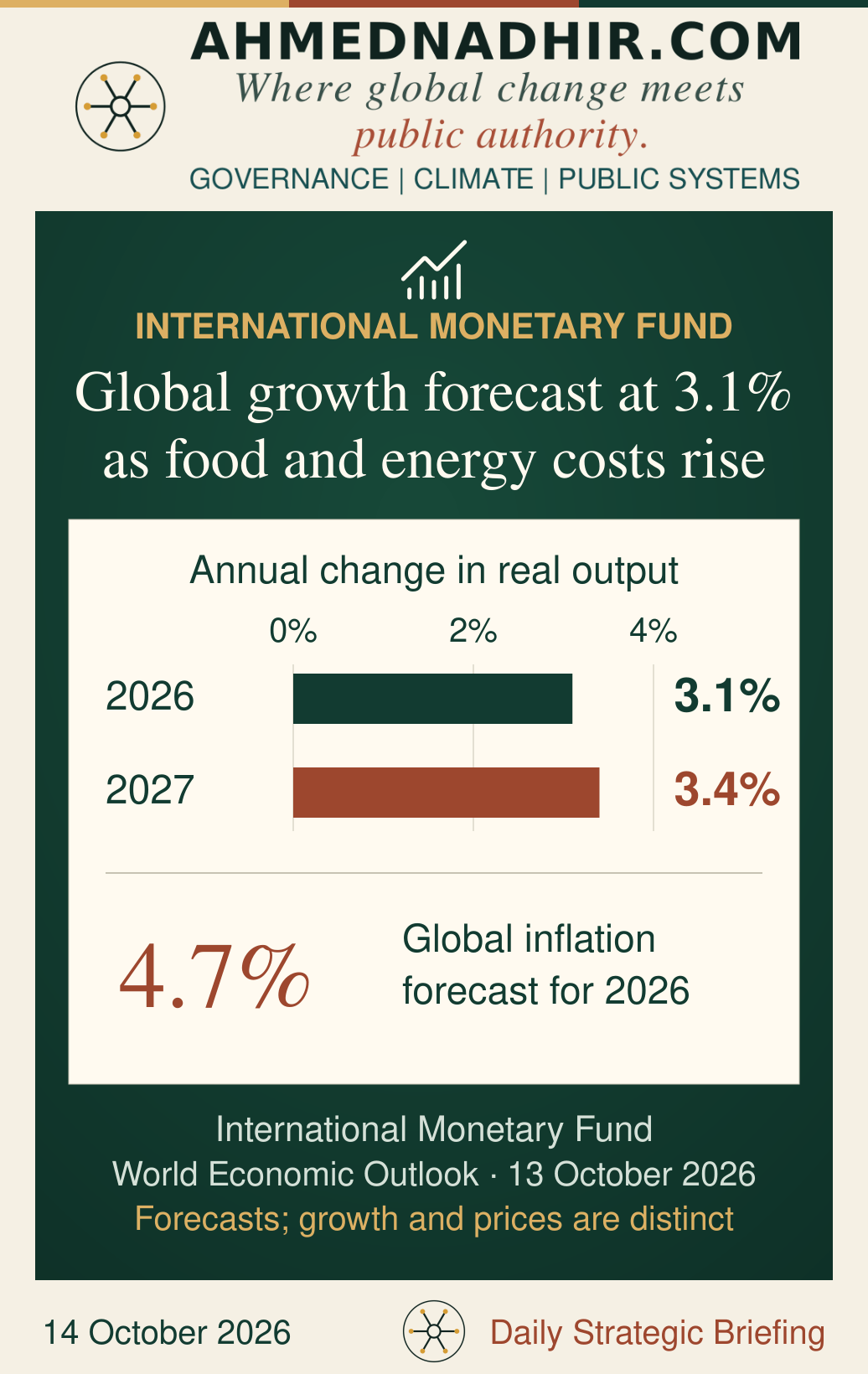
The International Monetary Fund (IMF) released its latest World Economic Outlook on 13 October, projecting global growth of 3.1% in 2026 and 3.4% in 2027. Its release account puts global inflation at 4.7% this year, reflecting higher energy and food prices. These are forecasts; the global average does not describe the conditions facing every country.
The IMF identifies an increasingly uneven expansion. Economies benefiting from artificial intelligence (AI) investment or favourable trade prices are doing relatively well, while energy importers and lower-income countries face greater pressure. Reuters corroborates the growth outlook and reports risks from an AI investment correction and rising debt costs. The technology boom brings opportunities, alongside greater exposure to the performance of a concentrated investment cycle.
For a public institution, these conditions meet in the budget. More expensive fuel raises the cost of transport and operating equipment. Higher food costs affect households and programmes that provide meals. Stronger aggregate growth can therefore coexist with harder choices over what a given allocation will buy. The effect depends on each economy’s imports, exchange rate, revenues and financing terms.
The practical distinction is between output growth and purchasing power. Finance teams need both when assessing the affordability of a service or investment. The 2027 projection offers a prospect of stronger growth, while the range of risks supports plans that can adapt if costs or revenues depart from the central forecast.
CLIMATE
World · Housing, disaster losses and preparedness
United Nations links housing to 43% of reported disaster losses
United Nations housing-risk analysis and release: 13 October 2026 · International Day for Disaster Risk Reduction
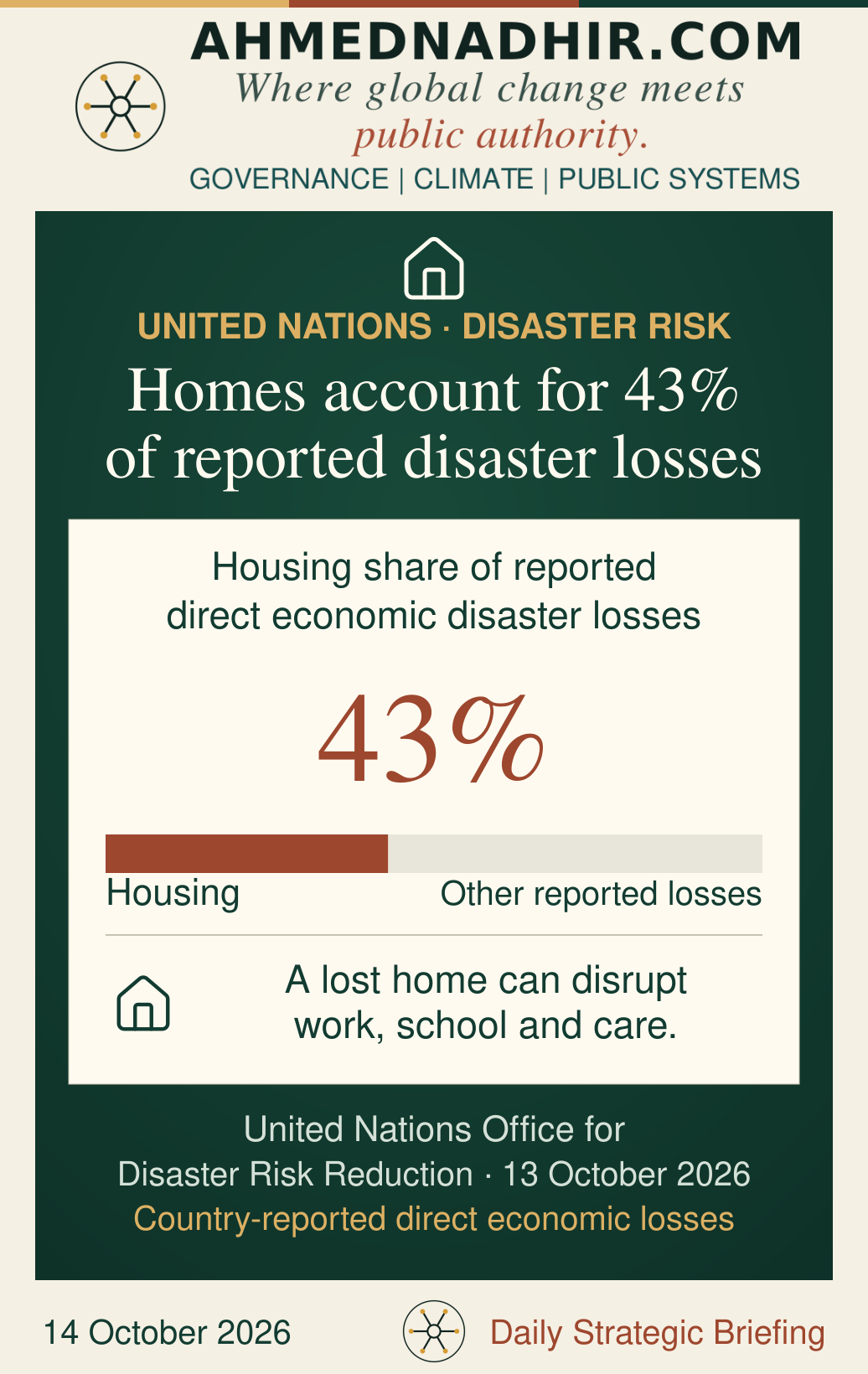
Homes account for 43% of direct economic disaster losses reported by countries through the Sendai Framework Monitor, the United Nations Office for Disaster Risk Reduction (UNDRR) said on 13 October. Its message brings the place where families live into the centre of investment in disaster resilience.
A separate model illustrates the expected scale of building losses. The Coalition for Disaster Resilient Infrastructure’s current-climate model estimates roughly US$228 billion in average annual residential-building losses from cyclones, floods, tsunamis and earthquakes. That represents about 53% of estimated building losses from those four hazards. The reported and modelled figures cover different sets of losses. The dollar estimate describes annual risk; it is not a bill for damage recorded in 2026.
Losing a home can also mean losing access to work, schooling, care and the support of a neighbourhood. Reconstruction spending therefore reaches beyond the replacement of walls and roofs. Safe locations, sound construction and improvements to existing homes can reduce disruption before a disaster occurs, while recovery arrangements influence how quickly families regain stability.
The affordability question deserves equal attention. A household may understand a risk and still lack the money, secure tenure or practical means to act. Public housing and resilience programmes can bring risk information together with finance, accessible design and local participation. The opportunity is to make safety part of ordinary housing decisions, including where new homes are built and how existing ones are maintained.
HEALTH
World · Tuberculosis, pregnancy and breastfeeding
New tuberculosis research guide includes pregnancy and breastfeeding
World Health Organization toolkit launch account: 13 October 2026 · Earlier consensus and call to action: 19 August 2025
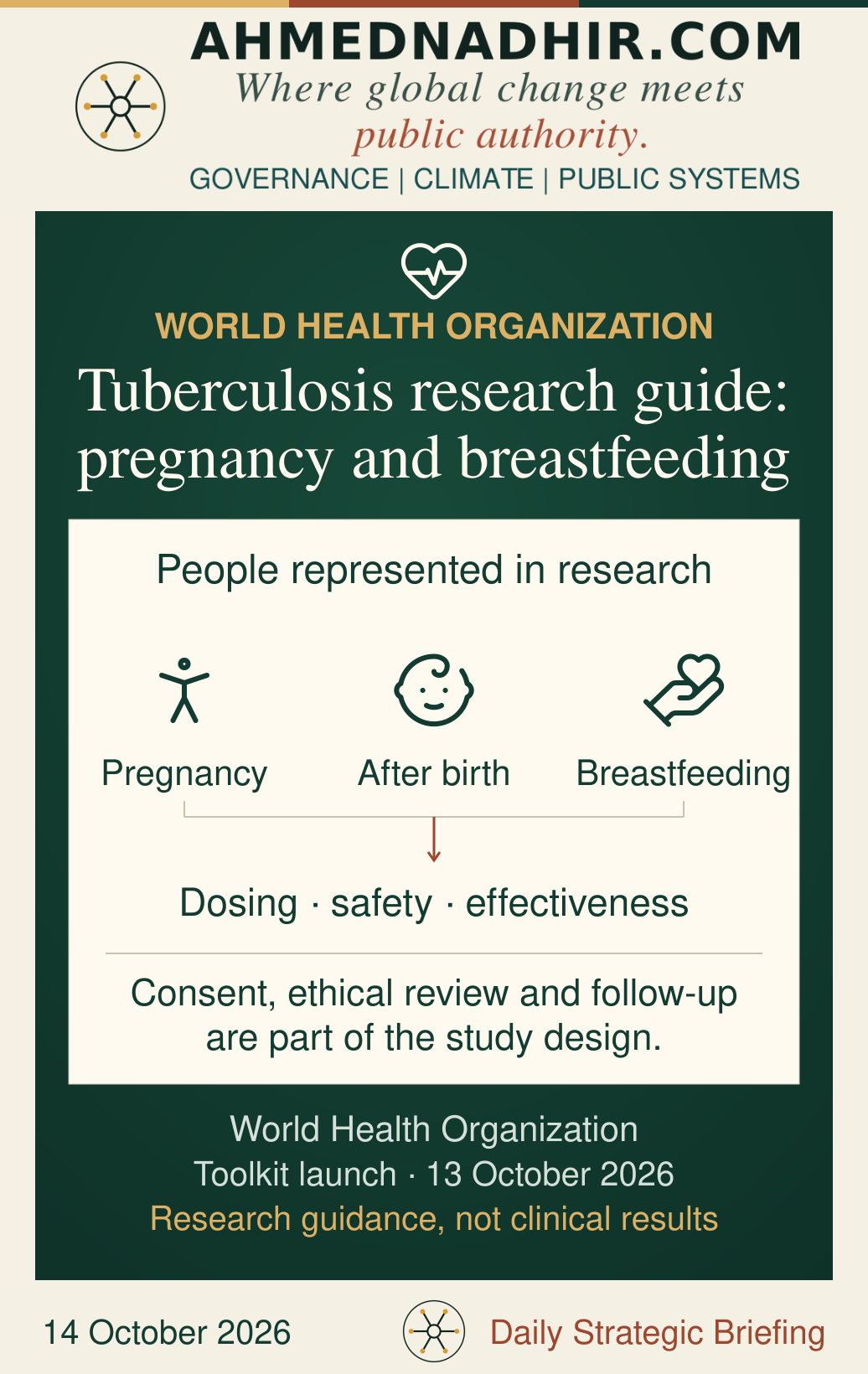
The World Health Organization (WHO) launched a tuberculosis research toolkit on 13 October to support earlier inclusion of pregnant and breastfeeding women in drug and vaccine studies. It gives researchers, trial sponsors, ethics committees and regulators practical guidance for generating evidence about groups historically underrepresented in these trials.
The gap has consequences for care. Pregnancy changes the way medicines move through the body, and breastfeeding raises questions about exposure through breastmilk. WHO’s toolkit explains that limited evidence about dosing, safety and effectiveness leaves clinicians with harder choices for women and infants. Research designed around these circumstances can help answer questions that studies in other adults leave unresolved.
The guidance covers ethical review, community engagement, study design, drug exposure, recruitment, regulation and surveillance. It follows the 2025 consensus process and brings practical resources into one tuberculosis-specific guide. Inclusion requires carefully designed studies and safeguards that reflect the needs of participants and their infants.
For national and local health authorities and service teams, the opportunity is to connect tuberculosis and maternal-health programmes with responsible research. Women’s experience of attending care, travelling to study visits and continuing after delivery belongs alongside the scientific design. The launch supplies a research resource; evidence from the studies it supports will determine its contribution to treatment policy and care.
AFRICAN GOVERNANCE
Cameroon · Yaoundé’s seven district municipalities
Yaoundé equips seven district municipalities to maintain drains and roads
Equipment handover: 8 October 2026 · African Development Bank account: 13 October 2026
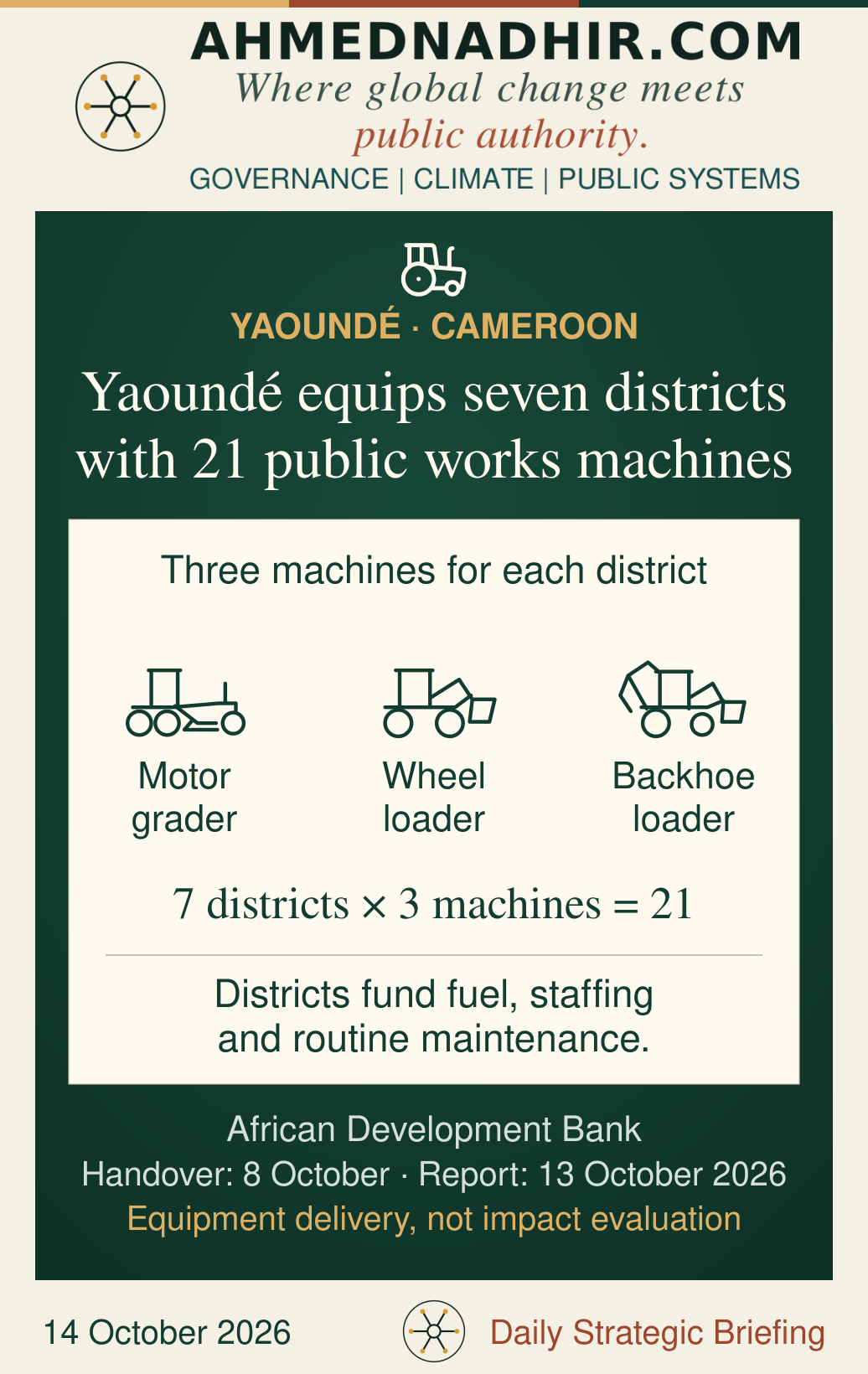
The Yaoundé Urban Community handed 21 pieces of public works and sanitation equipment to its seven district municipalities on 8 October. The African Development Bank’s account, published on 13 October, identifies one motor grader, one wheel loader and one backhoe loader for each district, financed through the city’s drainage and sanitation project.
The machinery is intended for maintaining drains and roads and removing household waste. The handover also assigns operating responsibilities: the districts will cover registration, insurance, fuel, staff and routine maintenance. Drivers undertook training in June. This connects a capital purchase with the local institutions expected to keep the service working.
The benefit will be visible in places residents use every day. A functioning drain helps water leave a neighbourhood; a passable road supports access to work and care; reliable waste removal reduces blockages and improves surroundings. Delivering a machine makes that work possible. Its availability, deployment and upkeep determine how regularly it happens.
The equipment programme is still in progress. Seven tipper lorries were delivered on 19 September 2025; the latest 21 machines bring the reported total delivered to 28. A further seven compactors remain in production. The source reports delivery and responsibilities, rather than a measured flood reduction attributable to this new fleet. The wider lesson is to judge public assets through the service they sustain.