
HEALTH · EBOLA AND REGIONAL PREPAREDNESS
Democratic Republic of the Congo · Regional health partners
New Ebola financing supports the response and the care that must continue
World Bank announcement: 13 October 2026 · Independent report: 14 October
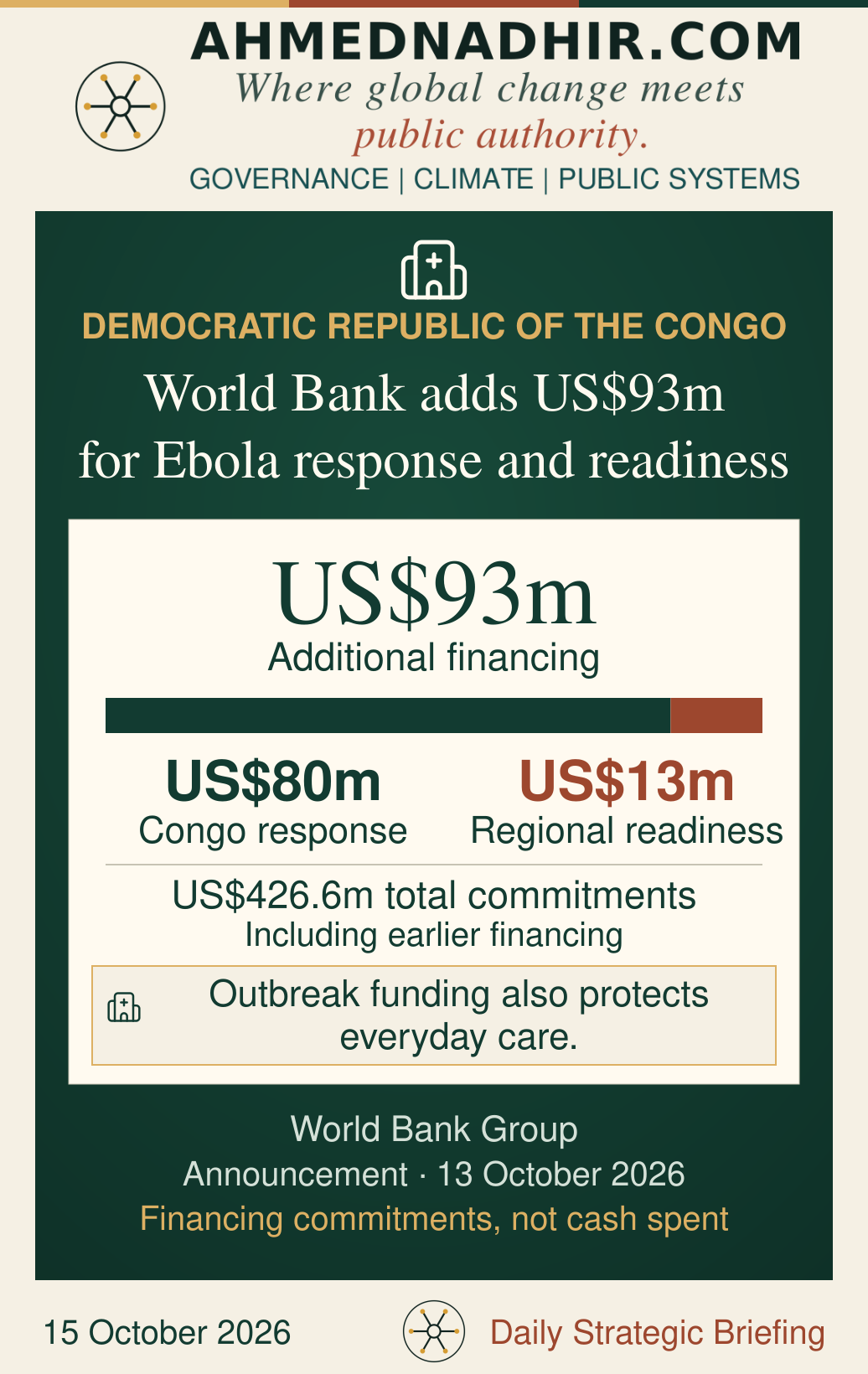
On 13 October, the World Bank Group announced US$80 million in additional financing for the Democratic Republic of the Congo (DRC) and US$13 million for regional preparedness. Their combined value is US$93 million. Overall Ebola-response commitments stand at US$426.6 million, including earlier financing. These amounts describe financing commitments, rather than a record of cash spent or services completed.
In the DRC, the national allocation supports surveillance, laboratories, care and infection prevention. The regional allocation supports preparedness in 11 countries through an existing health-emergency programme. The bank identifies the East, Central and Southern Africa Health Community and the Intergovernmental Authority on Development among the institutions strengthening cross-country coordination. It also places continued maternal and child health services in Ituri within the response.
That last connection is important. A family needing maternity care or a child’s treatment cannot put ordinary illness on hold while an outbreak is controlled. Emergency services and routine care draw on some of the same staff, supplies and transport. Protecting their continuity helps prevent a second burden of illness arising from interrupted care, while supporting confidence in the health service.
The national and regional allocations address different needs. Treatment and laboratory capacity close to an affected community cannot be supplied by border measures alone. Equally, a national response needs partners able to share information and coordinate when people travel. The practical benefit depends on those services working together, with supplies reaching facilities and information reaching teams able to act. The announcement establishes additional financing; it does not establish each country’s allocation or the results of this new spending.
AFRICAN ECONOMIES · BIODIVERSITY AND TRADE
Africa and the wider developing world · Kenyan processing example
Africa accounts for 3% of global biodiversity-based exports
United Nations announcement: 14 October 2026 · Export data: 2024
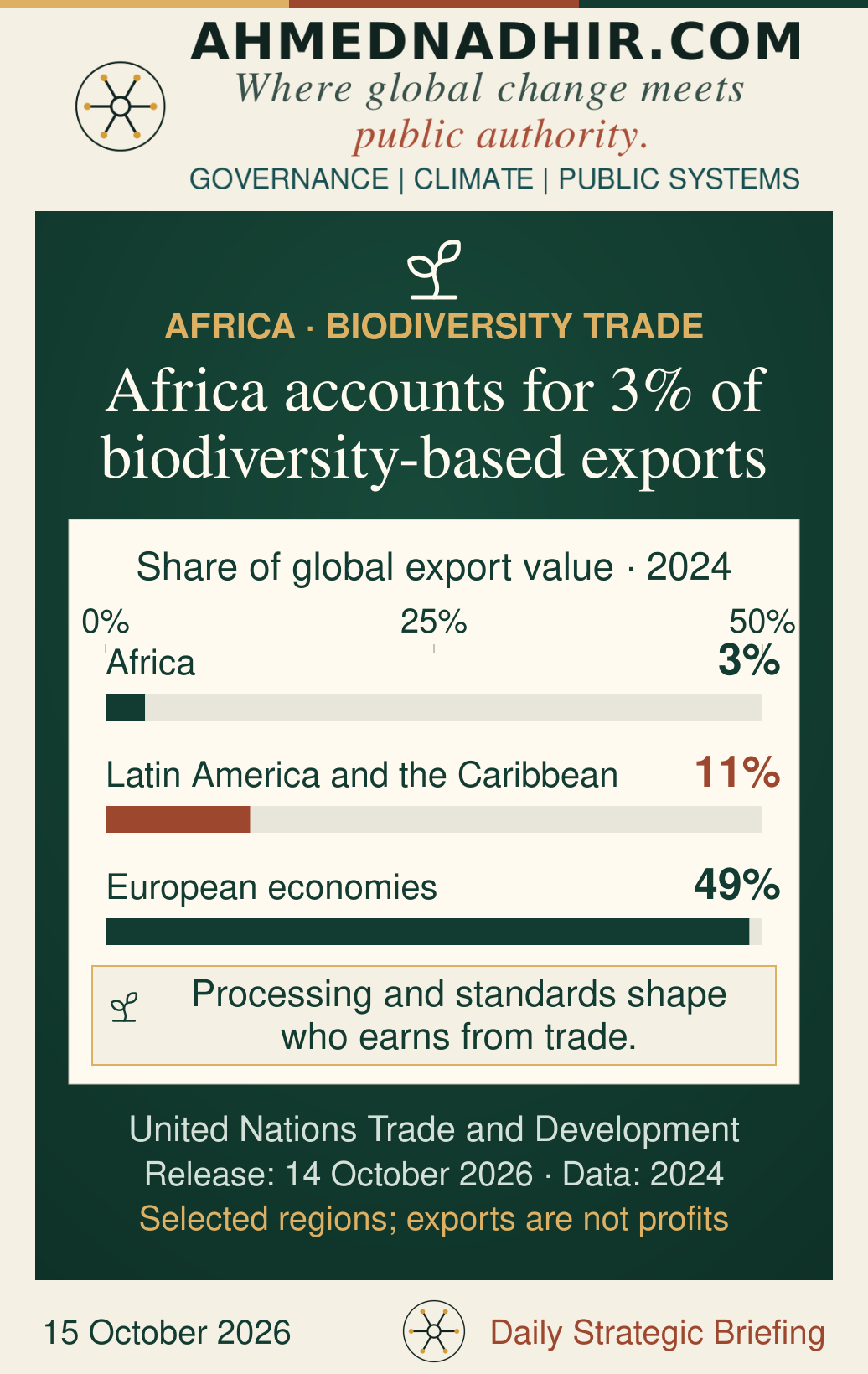
United Nations Trade and Development (UNCTAD), in a release dated 14 October, puts global exports of biodiversity-based products at nearly US$3.8 trillion in 2024. Africa accounted for 3%, Latin America and the Caribbean for 11%, and European economies for 49%. This broad product category includes goods of biological origin and their processed forms, such as food, cotton clothing and wooden furniture. The shares measure export value, not countries’ shares of biodiversity or the profit retained by their producers.
The finding draws attention to the work between a natural resource and a finished product. Harvesting, processing, manufacturing and product development have different costs and earning opportunities. A country can supply the biological input while businesses elsewhere undertake the activities that bring the finished product to market. Increasing the volume harvested therefore does not, by itself, establish that producers will receive more income.
UNCTAD illustrates another route with a Kenyan project that converted more than 3,300 tonnes of pineapple leaves into over 100 tonnes of textile-grade fibre and around 800 tonnes of compost. This is a case cited in the update, not a new investment announced this week. Its commercial significance depends on collection and processing costs, consistent quality and buyers for the output. The quantities establish neither profit nor an export contract.
Public institutions influence that commercial route through testing services, affordable finance, market-access rules and the sharing of certification costs. Conservation and community rights belong in the same account: additional production is not a development gain if it damages the resource or excludes the people depending on it. The opportunity is more productive and better-paid participation in trade, with economic returns assessed alongside sustainable use.
ARTIFICIAL INTELLIGENCE · AFRICAN INVESTMENT
Africa · Country-led projects and proposed financing
Africa’s artificial-intelligence initiative sets out country investment plans
Follow-up account: 14 October 2026 · Initiative introduced at the Nairobi forum in February 2026
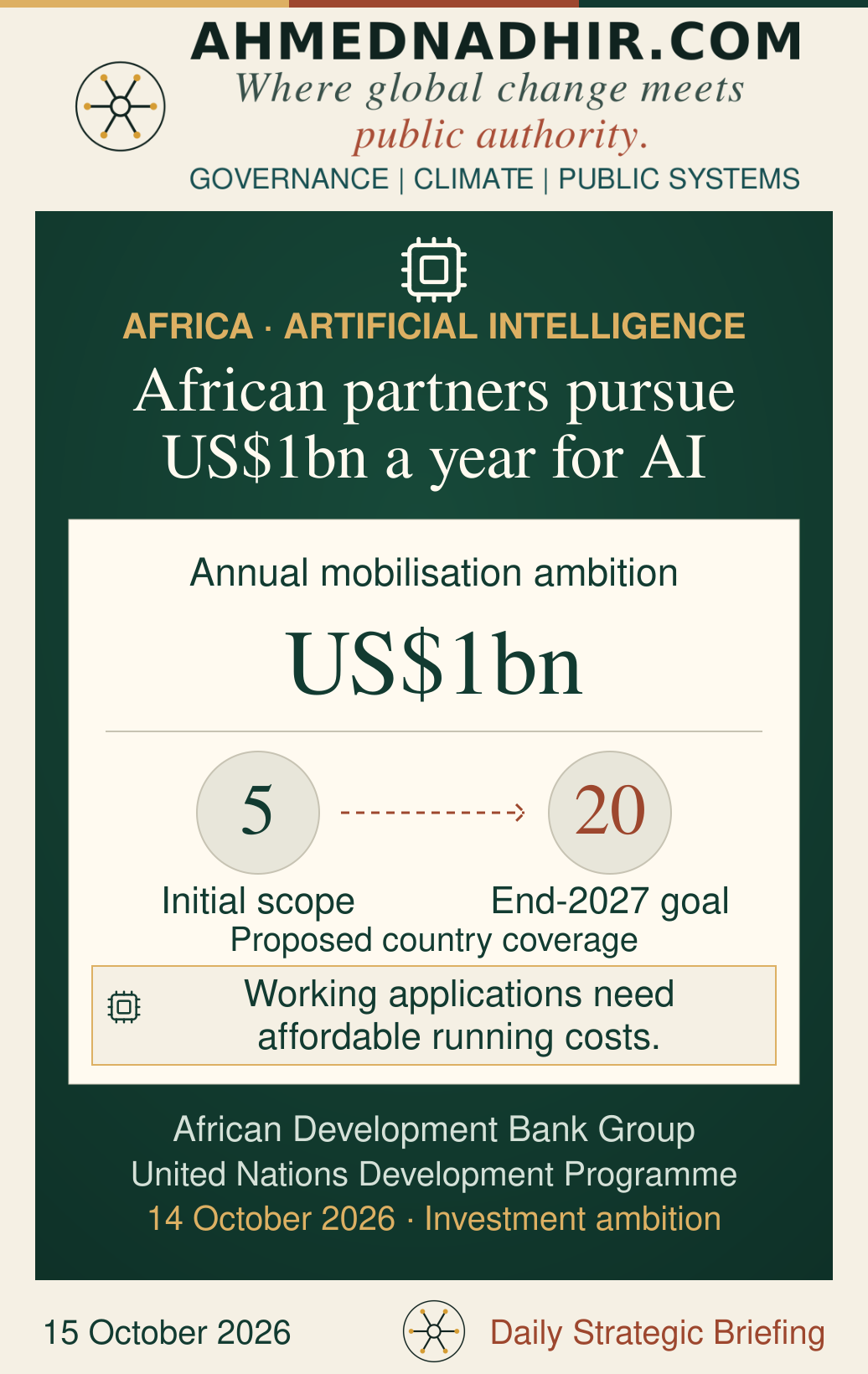
The African Development Bank Group reported on 14 October that it is advancing an artificial-intelligence (AI) investment initiative with the United Nations Development Programme and private partners. The AI 10 Billion Initiative was introduced at the Nairobi forum in February. The latest account describes an ambition to coordinate US$1 billion a year over a decade, beginning with five countries and extending to 20 by the end of 2027. These are mobilisation and coverage plans, not evidence that the financing has been secured or that 20 programmes are operating.
The proposed country approach starts with an assessment of productivity opportunities, followed by project preparation and an investment platform involving public and private partners. This makes the selection of an application important. For example, a business application intended to reduce stock losses would need evidence that it improves the firm’s decisions at an affordable cost. That is an illustration of the investment test, not a result reported for this initiative.
Running costs can change the economic case after an application is purchased. Computing, connectivity, electricity, staff and support must remain affordable; foreign-currency charges can add exposure for a local firm or public service. Useful local data and reliable performance also matter. Paying for a system that staff cannot operate, correct or maintain can absorb resources without delivering the expected improvement.
The early measure of progress is consequently the work completed: projects ready for finance, investment agreed and applications performing in their setting. Employment ambitions differ across the partners’ official releases, without an explanation of the difference. They do not establish jobs created. A credible country programme can connect its spending with changes in business performance and service quality, while accounting for how workers’ tasks and opportunities change.
CLIMATE · SOUTH ASIAN SEASONAL OUTLOOK
South Asia · October to December 2026 rainfall
South Asia’s seasonal outlook separates drier mainland areas from wetter islands
Consensus finalised: 1 October 2026 · World Meteorological Organization report: 14 October · Outlook period: October to December
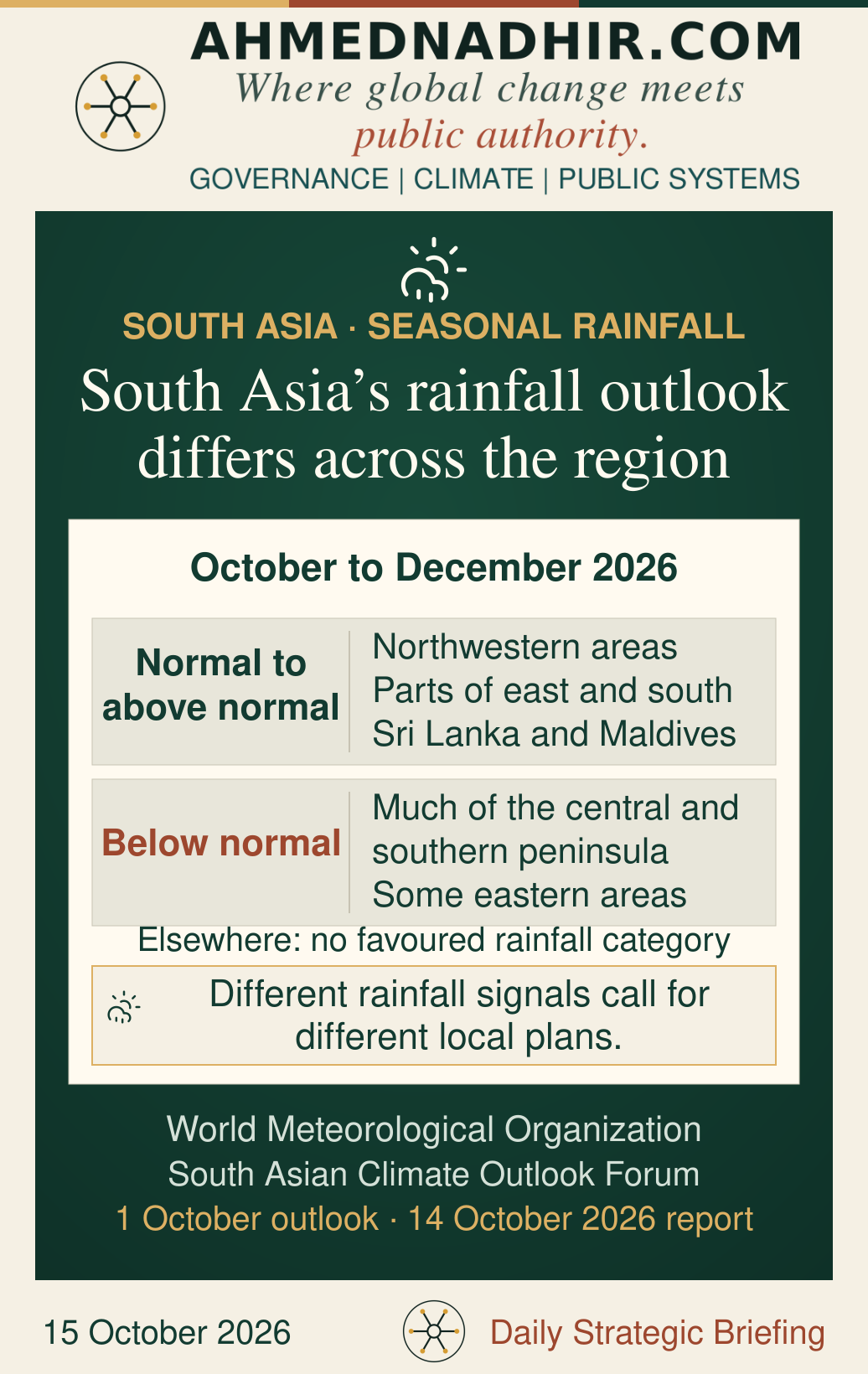
The World Meteorological Organization reported on 14 October an uneven rainfall outlook for South Asia’s October-to-December season. Normal to above-normal rain is favoured in northwestern areas and parts of the east and south, including Sri Lanka and the Maldives. Below-normal rain is favoured across much of the central and southern peninsula and some eastern areas. The remaining areas have no favoured rainfall category. The underlying regional consensus was finalised on 1 October; this is a newly reported account of that outlook, not a forecast issued afresh on 14 October.
The distinction between the peninsula and the islands prevents a misleading regional generalisation. These months are important for southern India, Sri Lanka and the Maldives, where seasonal rains support agriculture. A common large-scale influence, including a strong El Niño, can accompany different local rainfall signals. The seasonal categories compare each place with its own usual rainfall; they do not mean that every wetter area receives the same volume of water.
For farming and water services, the practical question is how the outlook meets existing conditions. A relatively dry season places different pressure on stored water and irrigation from a wetter outlook. A wetter seasonal total can still include dry spells or damaging short bursts of rain. Planting, reservoir operations and drainage preparation therefore need updated national information alongside the regional picture.
The regional statement describes probabilities for a season, rather than the timing of a storm or a flood warning. This changes how institutions can use it: it can inform preparation and spending choices, while shorter-range forecasts guide more immediate decisions. The wider lesson is geographical precision. An El Niño label alone cannot supply the rainfall expectation, agricultural calendar or local service need.