
HEALTH · LEAD EXPOSURE AND PREVENTION
World · Laboratory support includes six African countries
A global lead-prevention plan puts products and pollution alongside testing
World Health Organization announcement: 15 October 2026 · Plan and guidance expected: 2027 · Paint-controls comparison: January 2024
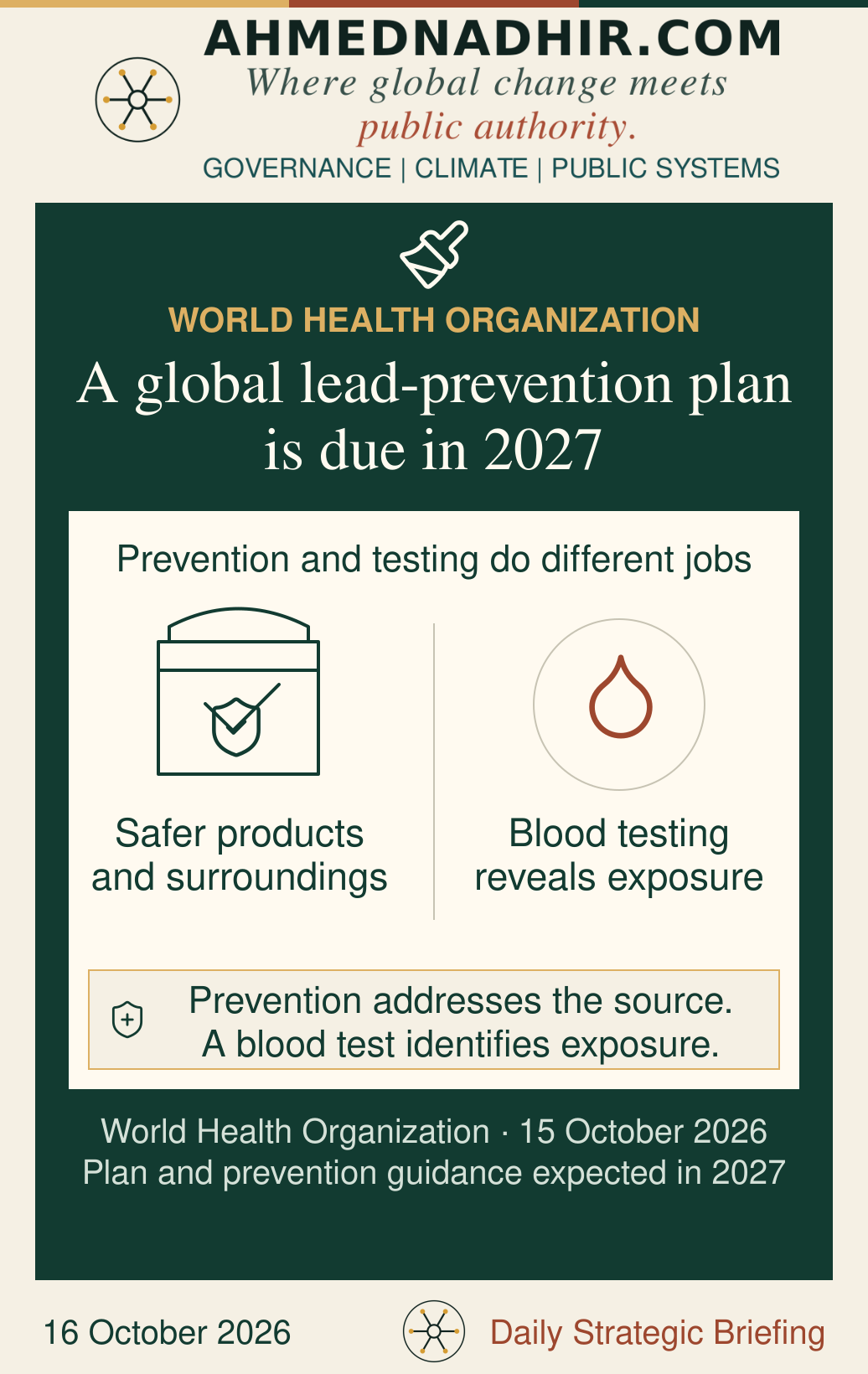
The World Health Organization (WHO) said on 15 October that a Global Action Plan on Lead Mitigation will be presented to the World Health Assembly in 2027. A separate prevention package is also planned for next year. The announcement points towards action on sources of exposure, alongside testing. It identifies six African countries for laboratory capacity building and technical support: Ethiopia, Ghana, Malawi, Rwanda, South Africa and Tanzania. These are programme locations, not evidence that all the laboratory improvements have been completed.
Lead can reach people through contaminated products, workplaces and surroundings. WHO’s June fact sheet describes permanent harm to children’s development and states that no level of exposure is known to be harmless. Testing blood identifies exposure; it does not remove the source. Health services therefore share the prevention task with product regulators, environmental agencies, employers and the businesses supplying everyday goods.
The legal baseline needs its date kept visible. WHO’s published indicator says that, as of 16 January 2024, 48% of countries had confirmed legally binding controls on lead paint. This is not a 2026 count. Nor does the remaining share establish that every other country lacks a law: the indicator also allows missing data. Even a confirmed legal control says little on its own about inspection, compliance or exposure.
For a school, clinic or housing programme buying paint, protection depends on what is supplied, not simply on a safety clause in a tender. Recognised testing, traceable purchases and action when a product fails can connect the rule with the building people use. Safer recycling also needs arrangements that workers and firms can follow. The practical opportunity is prevention that reaches the market and workplace, while laboratory evidence helps identify where further action is needed.
RESILIENCE · EARTHQUAKE-RISK FINANCE
Nepal · Public budgets and capital-market insurance
Nepal explores an earthquake bond before agreeing the cover or cost
Mandate signed in Bangkok and announced: 15 October 2026 · Transaction remains under assessment
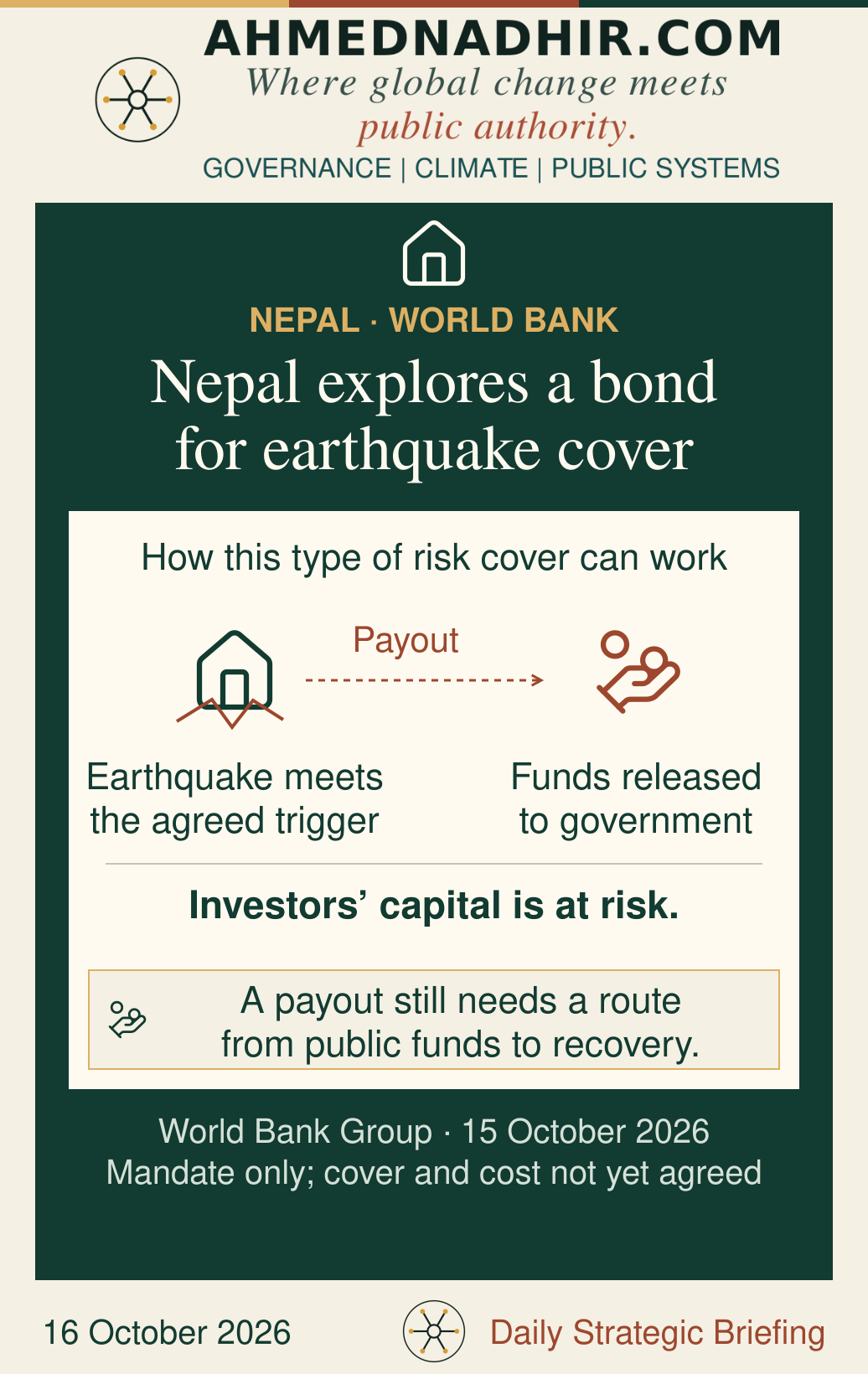
Nepal and the World Bank signed a mandate agreement on 15 October to explore a catastrophe bond for major earthquakes. The bank’s Treasury will work with the government and market participants on feasibility and structure. Reuters corroborates the announcement. No bond size, premium, payout trigger or issuance date is specified. The agreement begins preparation; it does not establish insurance cover already in force.
A catastrophe bond transfers an agreed disaster risk to investors. In the World Bank’s insurance model, a government pays for protection and receives funds if the contract’s conditions are met. Investors can lose capital when a covered event triggers a payment. This differs from arranging a new reconstruction loan after damage has occurred. Nepal’s eventual terms, if a transaction proceeds, would determine what protection it actually buys.
The value for a finance ministry lies partly in avoiding a scramble for money when services are disrupted. But the payout rule is as important as the headline amount. Where payment depends on an index or physical measurement, the result can differ from the loss communities experience. This mismatch, known as basis risk, belongs in the assessment alongside the premium and other financing options. A bond designed for rare, severe events cannot replace all routine emergency funding or investment in safer buildings.
Recovery also has a distribution problem. Money available nationally must reach the agencies restoring water, roads and care, and the households needing support. Eligibility, spending authority and delivery arrangements influence that passage. Earthquake risk is not a climate forecast, and the proposed bond is not cover for Nepal’s recent flood. The transferable lesson is to match each financing instrument to a defined hazard, a funding need and a practical route to recovery.
AFRICAN ECONOMIES · TRADE-PAYMENT GUARANTEES
African trade · Agreement with Habib Bank AG Zurich Kenya
A new bank agreement backs the payment promise behind African trade
Agreement signed: 2 October 2026 · African Development Bank account: 14 October
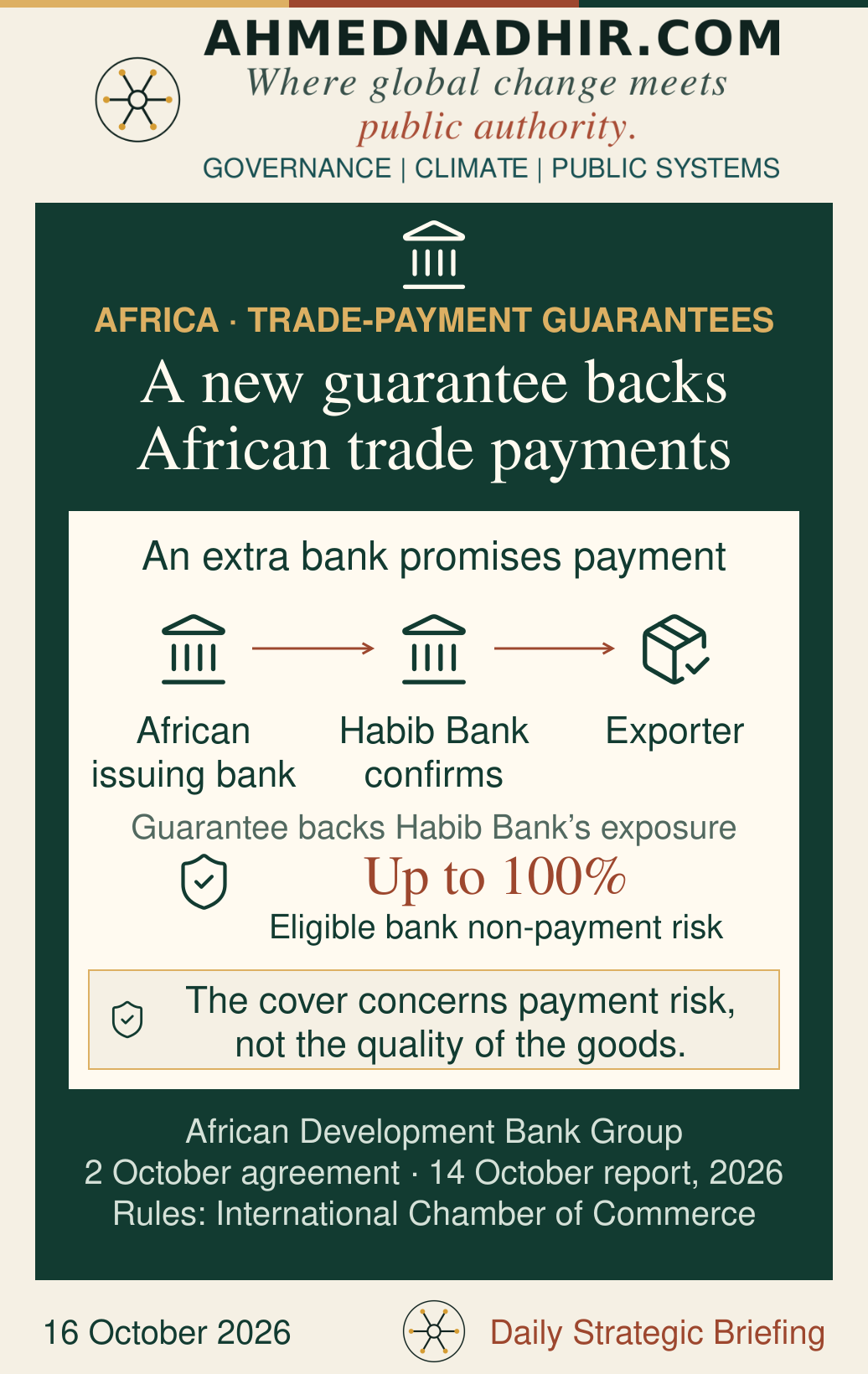
The African Development Bank reported on 14 October a confirming-bank agreement signed with Habib Bank AG Zurich Kenya on 2 October. Under its transaction-guarantee programme, the development bank can cover up to 100% of eligible non-payment risk assumed by Habib Bank on approved African banks’ trade transactions. The percentage describes possible risk coverage on an eligible transaction, not a grant to an importer or a promise to finance every order.
The commercial problem is specific. An exporter may have a buyer and a payment undertaking from that buyer’s bank, yet want another bank to stand behind it. Confirmation adds that second bank’s commitment to pay when the required documents comply with the credit’s terms. The International Chamber of Commerce’s rules distinguish this commitment from merely passing a credit’s details to the exporter.
The guarantee addresses the confirming bank’s exposure. It can make a transaction more workable where risk limits constrain acceptance of an African issuing bank. It does not remove the buyer’s obligations, guarantee the quality of the goods or eliminate documentation costs. For a manufacturer ordering inputs, the opportunity is a payment arrangement a supplier will accept. The full price and timing of that arrangement still affect whether the order is worthwhile.
A lending line supplies funding; this guarantee supports a bank’s capacity to accept payment risk. The distinction matters when assessing what businesses gain. More acceptable transactions can help firms secure supplies and complete sales, but the release gives no measured increase in trade or reduction in fees. Approved transactions, businesses reached and costs are more informative than treating the guarantee percentage as new income.
AFRICAN FOOD SYSTEMS · WOMEN-LED ENTERPRISE
Africa · New cohort launched at the World Food Forum, Rome
Fifty African women entrepreneurs join a nine-month agribusiness programme
Cohort launch and announcement: 15 October 2026 · Programme established: 2022
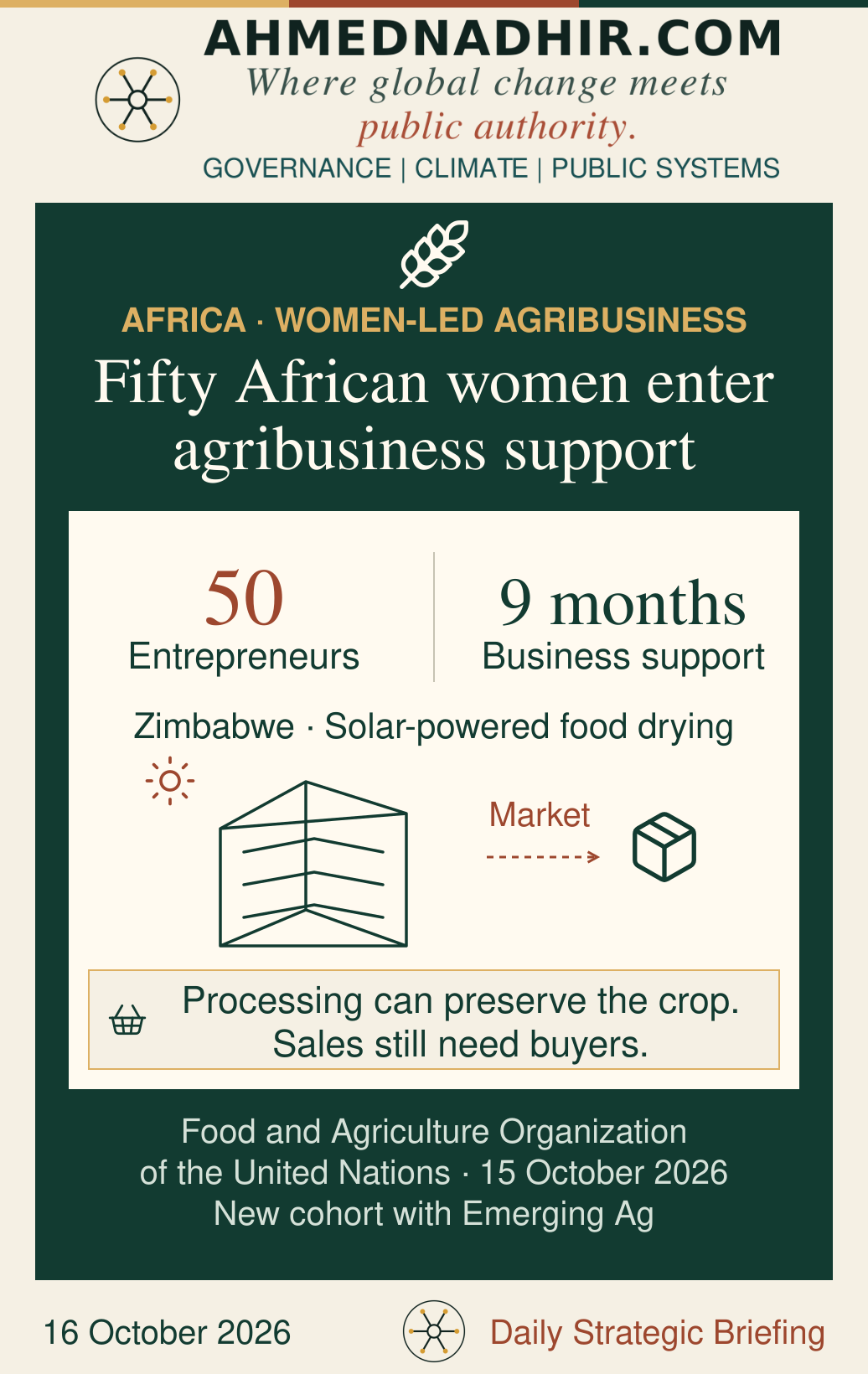
The Food and Agriculture Organization of the United Nations (FAO) and Emerging Ag launched a new accelerator cohort in Rome on 15 October. Fifty women entrepreneurs from across Africa will receive nine months of mentorship, networking and business-development support. The programme, established in 2022, connects business owners with experienced mentors and professional networks.
Among the participants is Perseverance Muzeya of Zimbabwe’s Alzanael Private Limited, which uses solar-powered food drying. Keeping a crop saleable for longer can widen the opportunity to sell it. The return still depends on collection, processing, packaging, demand and the price a customer will pay. Neither a drying machine nor access to a mentor establishes that a business will make a profit.
Different constraints require different forms of support. A processor with orders may need working capital to buy the crop before customers pay. Another may need recognised testing, dependable equipment or a route into distribution. Mentorship can help an entrepreneur identify and negotiate those needs, while lenders, technical services and buyers supply different parts of the answer. Treating every business as a training problem can leave its main commercial obstacle untouched.
Participation and business growth are different results. Firms selected for support may already be expanding, and an improvement during the programme cannot automatically be attributed to mentorship. A starting record of orders, costs and payment delays makes follow-up more useful. For public enterprise programmes, the stronger test is whether support helps firms fulfil orders and sustain earnings, and which part of that support made a practical difference.