
AFRICAN ECONOMIES · MINING AND LOCAL EARNINGS
Egypt, Malawi, Mauritania and Zambia · Eight-country initiative
Four African governments put local earnings alongside mineral extraction
Plans launched in Bangkok: 16 October 2026 · Malawi compact: October 2026 · Procurement targets: 2030 and 2040
Egypt, Malawi, Mauritania and Zambia are among eight governments that announced minerals partnerships and compacts on 16 October. Argentina, Bolivia, India and Kazakhstan complete the group. These are country-led plans covering investment, regulation, infrastructure and local benefits. The World Bank Group says it plans to increase sector support to US$19 billion across fiscal years 2026–2030, combining its financing with private capital mobilised. That is a wider programme ambition, not money already paid to these four governments.
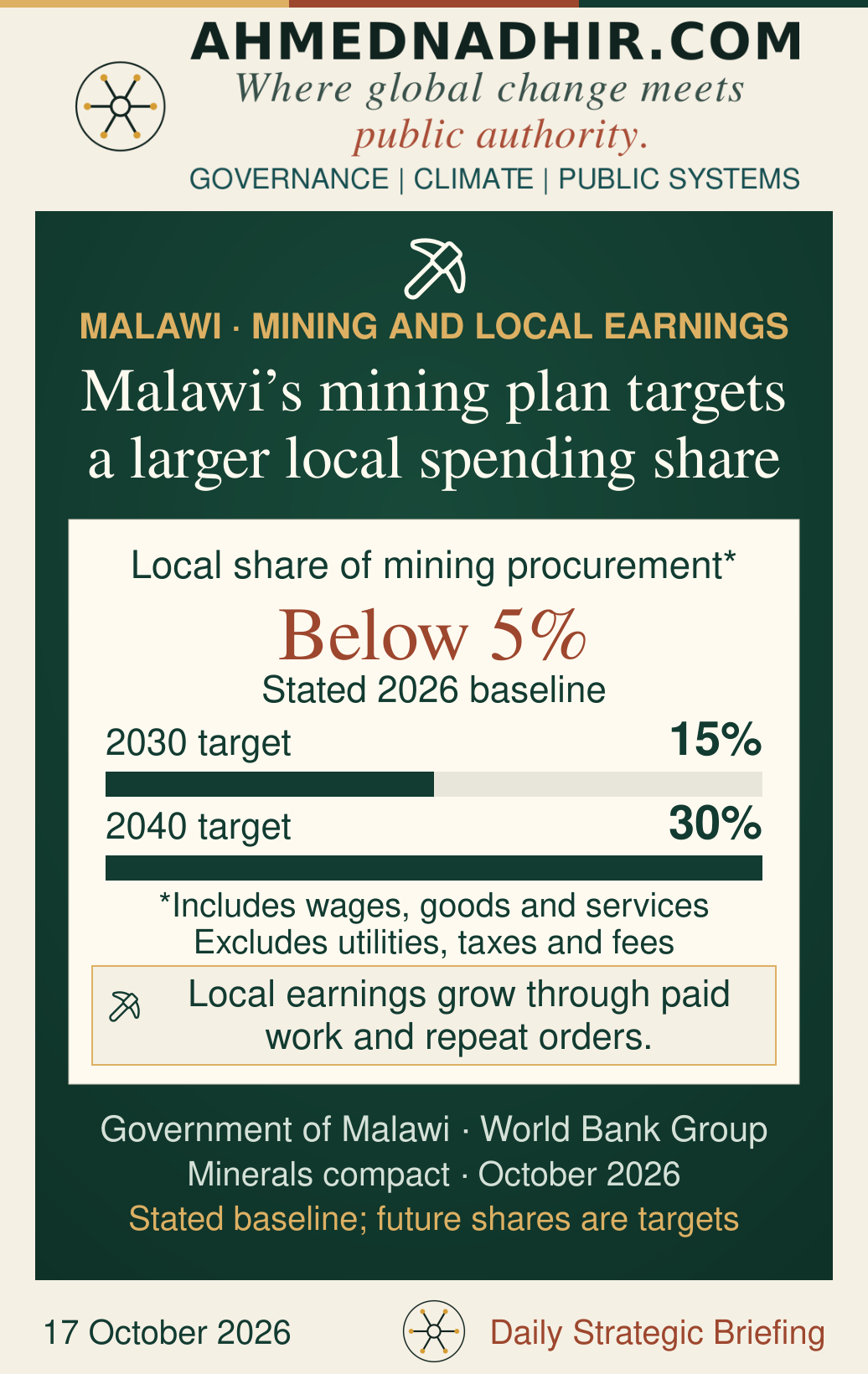
Malawi’s compact sets targets for local participation. Its monitoring table states a 2026 baseline below 5% for the local share of mining procurement, with targets of 15% by 2030 and 30% by 2040. The definition includes wages, goods and services, while excluding utilities, taxes and fees. These figures therefore describe a particular spending account. They are neither the share of minerals owned locally nor a measured increase in household income.
For a workshop supplying a mine, the opportunity might be a regular repair contract. Its earnings depend on the specification, tools, skilled staff, delivery costs and when the customer pays. That illustrates why a local-content target needs more than a preference for domestic suppliers. Malawi proposes a supplier-development fund by 2028, with initial capitalisation by 2029. Until finance and orders are available, firms still face the cost of preparing to qualify.
The public return also extends beyond procurement. Electricity and transport investments can support wider production if other users can access them on workable terms. Conversely, dedicated infrastructure, guarantees and environmental obligations can create public costs. Local wages and purchases, taxes collected and commitments made by the state show different parts of the return. Higher mineral exports can enlarge that opportunity; they do not establish how much additional income the country retains.
ARTIFICIAL INTELLIGENCE · CITIES AND LOCAL KNOWLEDGE
Namibian mapping example · United Nations discussions in Geneva
Namibia’s mapping example brings local knowledge into the debate on AI planning
United Nations account: 16 October 2026 · Committee session: 14–16 October · Background paper published in September
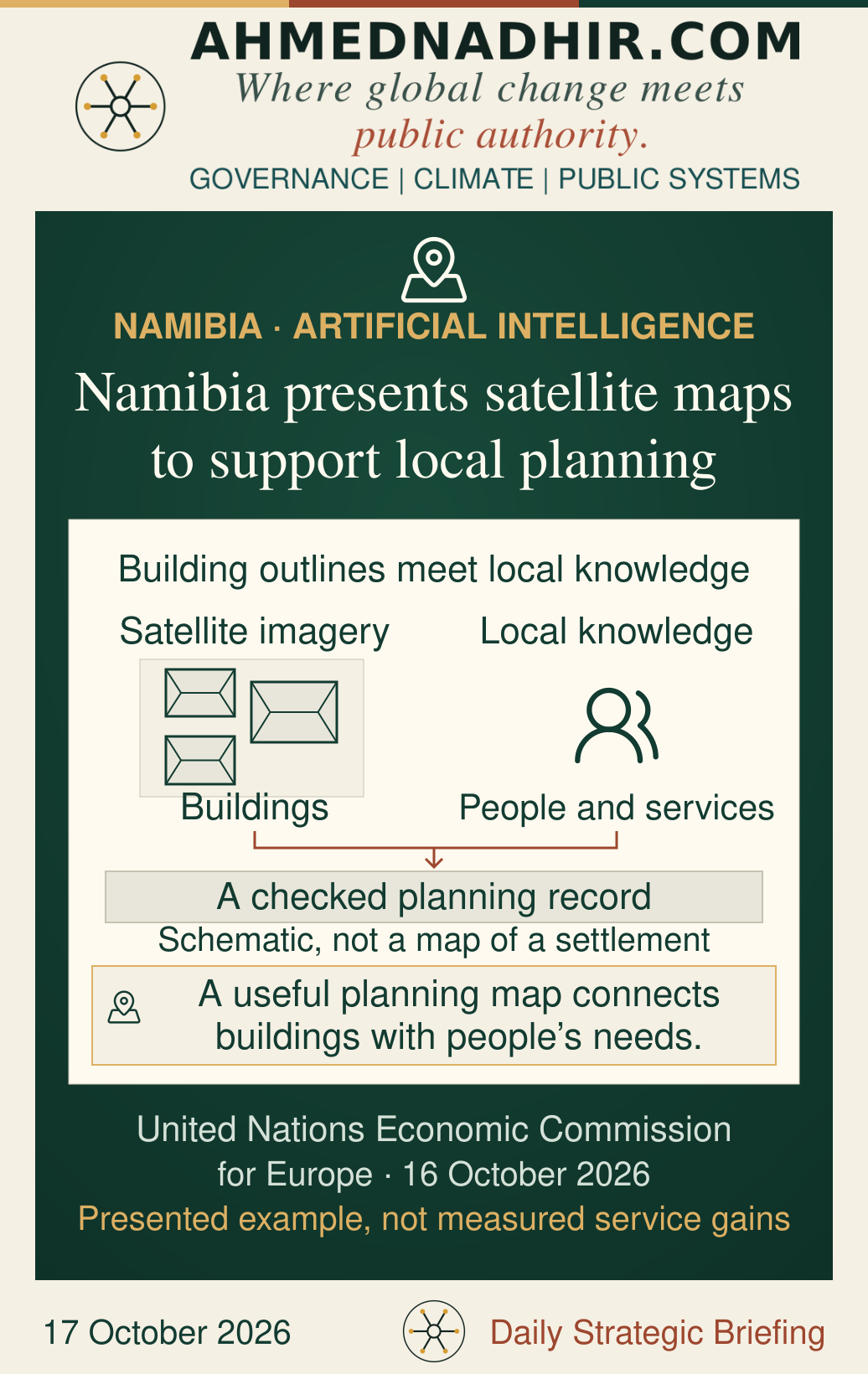
Satellite images can show where buildings have appeared. Understanding who lives there and which services they need requires another kind of knowledge. A Namibian example presented during United Nations urban-planning discussions illustrates that distinction. The United Nations Economic Commission for Europe’s account, published on 16 October, describes artificial intelligence (AI) and Earth observation being used to examine urban growth and land-use change. It emphasises local validation and municipal ownership of the work.
The United Nations Innovation Technology Accelerator for Cities describes a related mapping tool that identifies likely rooftops in aerial or satellite images. Building outlines can make a growing settlement more visible to a planning department. They do not, by themselves, establish occupancy, household size, tenure or a family’s access to water. Field records and residents’ accounts supply the household information that makes the map useful for service planning.
Norway’s examples in the same discussions concerned consultation comments and planning archives. Grouping similar submissions can help a team handle a large response. A less common concern, however, may still be consequential: a small group losing access to a path should not disappear into a summary of what most respondents said. The original submissions and the ability to inspect how they were grouped remain important to an accountable decision.
The background paper was published in September; this week’s discussions and account provide the new occasion for examining it. They do not establish a measured improvement in planning accuracy, service access or cost. For municipalities considering such tools, the practical question is which task becomes easier, which records remain available and who can correct an error before it affects a resident.
HEALTH · CLINICAL RESEARCH
Singapore · African nominees from seven countries
Singapore workshop connects African researchers with practical trial design
Workshop: 31 August–2 September 2026 · World Health Organization account published: 16 October 2026
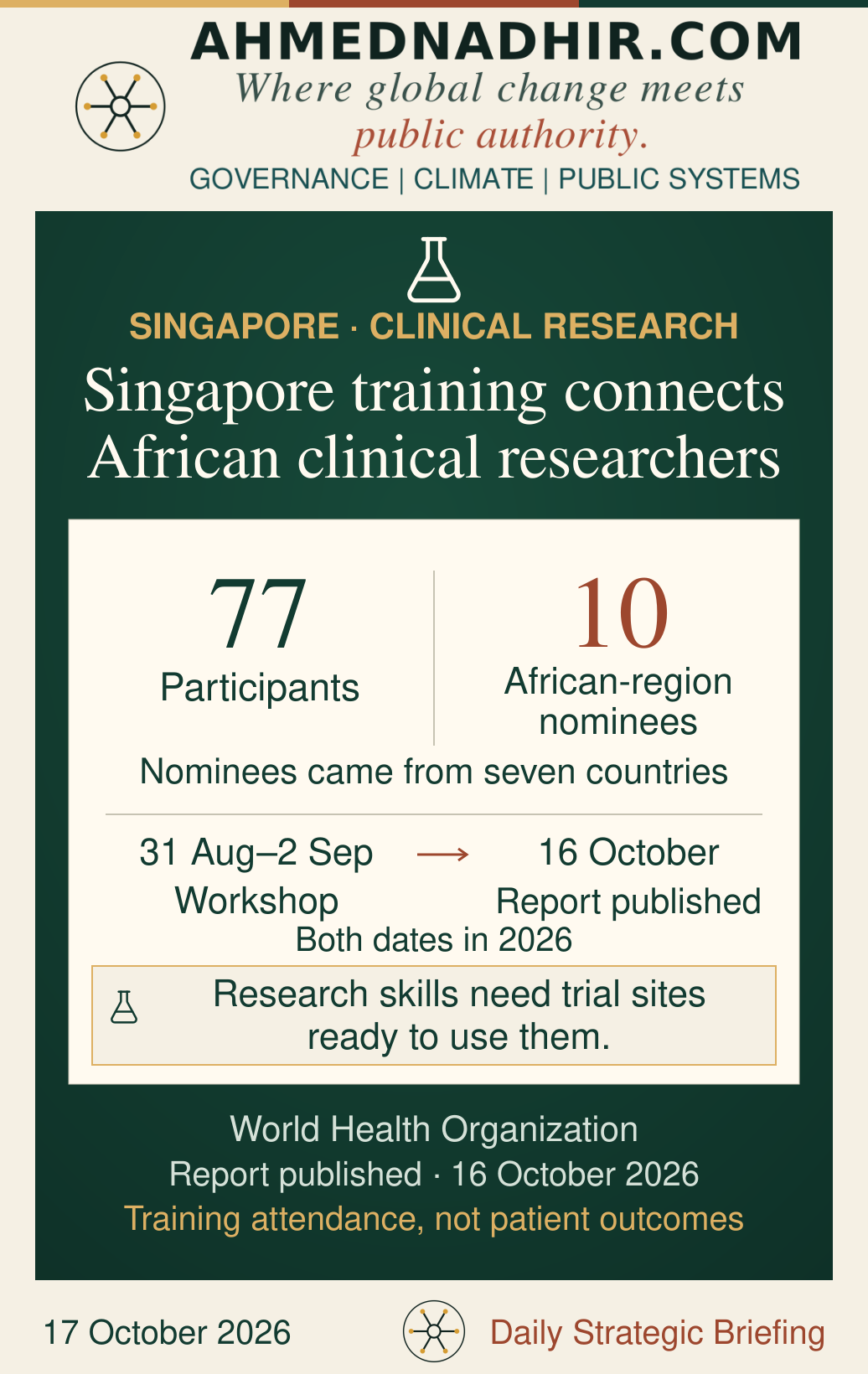
The World Health Organization (WHO) published an account on 16 October of a Singapore clinical-trial workshop held from 31 August to 2 September. Co-organised with the Advancing Clinical Evidence in Infectious Diseases network, it brought together 77 participants. Ten were nominated through WHO’s Regional Office for Africa, from institutions in Cameroon, Gabon, Ghana, Kenya, Senegal, Uganda and Zambia. The publication is new; the workshop took place earlier.
Participants worked on research questions, study design, feasibility and proposals, with input from statisticians and public-engagement specialists. The organisers’ programme corroborates the dates and proposal sessions. WHO’s standing guidance places such skills within a broader aim: research arrangements that remain active for everyday health problems and can respond when an emergency arrives. A short course is one contribution to that continuing work.
A researcher returning to a hospital may know how to ask a better question yet still lack protected time, diagnostic support or staff to follow participants. Those constraints affect whether a proposal can become a sound study. Consent, independent review and a way to address participants’ concerns are equally part of the work. Training is more likely to be useful when the institution can support the research it hopes to host.
Neither the attendance count nor a proposal presentation establishes that a trial has begun or that patients have benefited. For national and local health institutions, follow-up can examine whether supported teams develop feasible studies, recruit appropriately and return results to services and communities. That would connect professional learning with the evidence clinicians need, while keeping participation, research quality and health outcomes distinct.
PUBLIC FINANCE · MUNICIPAL SERVICES
Europe and the Caucasus · Municipal finance
Cities offered grants to test new ways of financing services
Call announced in Istanbul: 16 October 2026 · Applications close: 13 November · Programme: January–November 2027
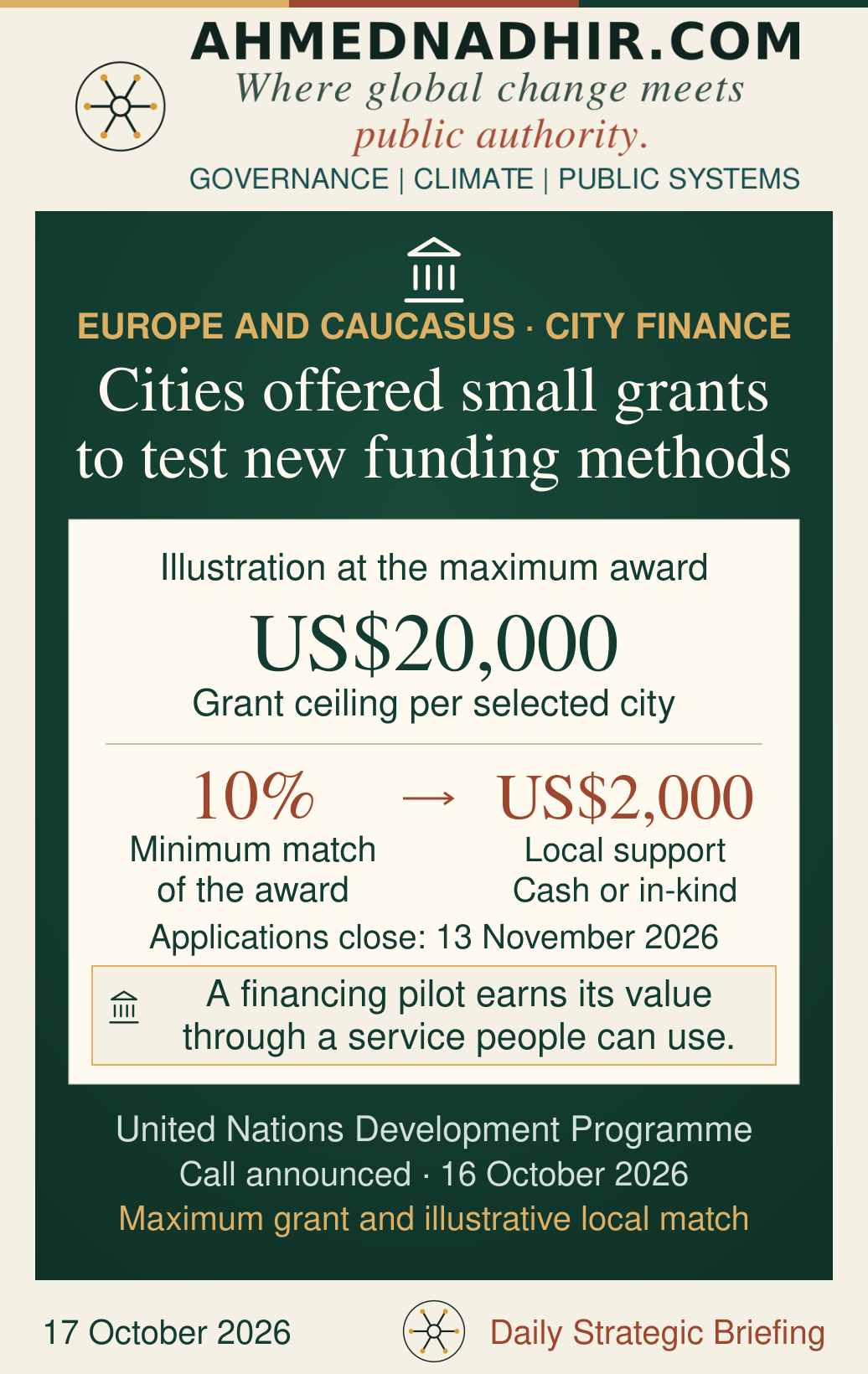
The United Nations Development Programme announced a city-finance challenge on 16 October. Selected municipalities can receive advice and up to US$20,000 to design and implement financing methods. The dated release names Armenia, Moldova, North Macedonia and Ukraine; the programme’s broader listing also includes Georgia. Applications close on 13 November, with participation from January to November 2027.
The offer requires a local contribution of at least 10% of the award, in cash or in-kind. At the maximum grant, that would mean at least US$2,000 in matching support. This is an illustration of the rule, not an award already made. Nor is the small grant a construction budget for a water network or road.
The programme is intended to help cities resolve specific obstacles to investment. A city may have an asset it cannot put to useful work, or a viable service improvement without an affordable funding route. A fund that lends money and reuses repayments, for example, needs rules for missed payments. Other financing methods have different costs. A useful pilot establishes who contributes, who repays and which losses the public might carry, before the city expands the arrangement.