
HEALTH SYSTEMS · VACCINES AND PUBLIC FINANCE
Southeast Asia · Health-financing cohort includes five African countries
Vaccine investment links routine purchases with readiness for the next outbreak
Partnership announced in Bangkok: 16 October 2026 · Financing remains a mobilisation ambition
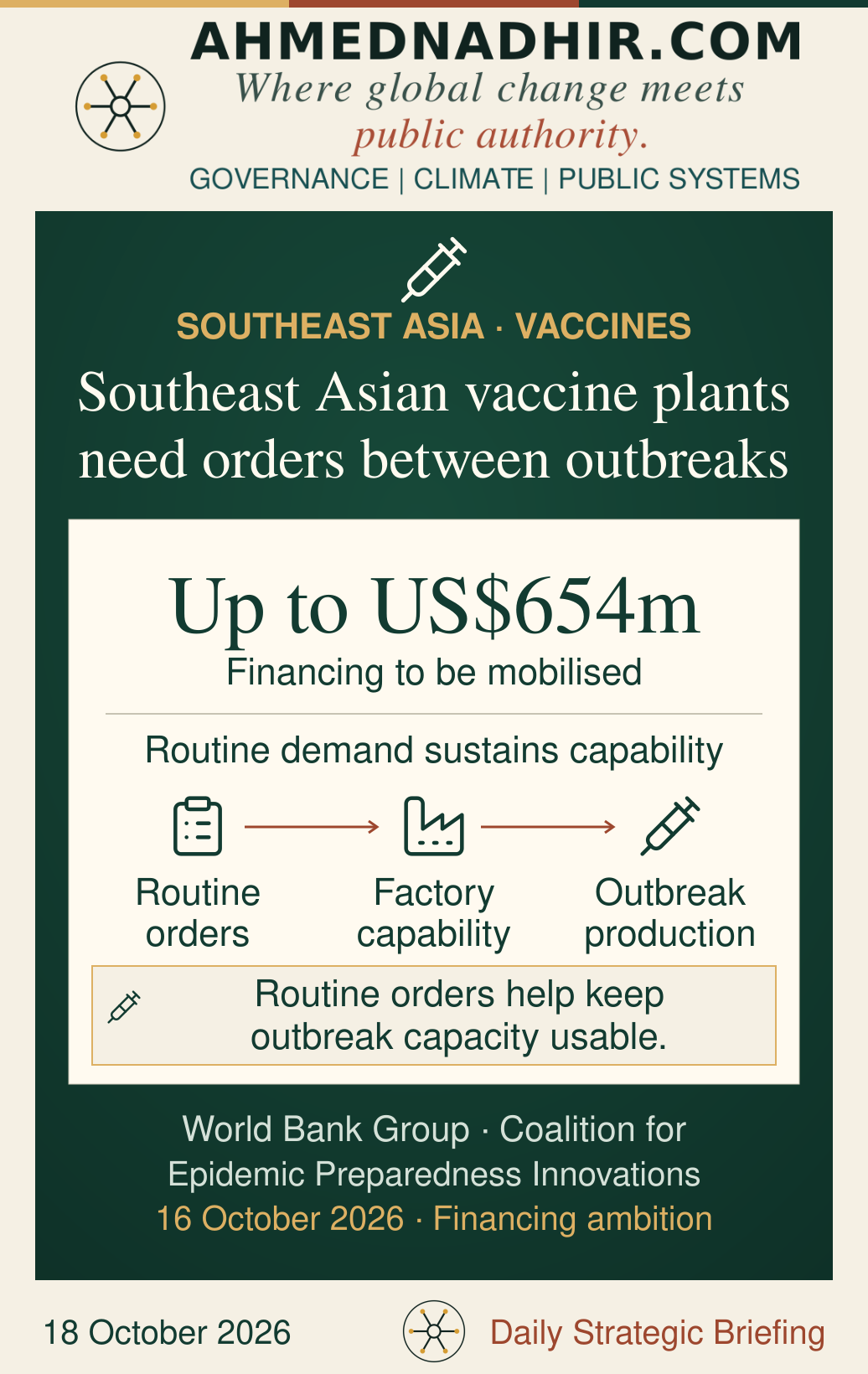
The World Bank Group and partners announced an ambition on 16 October to mobilise US$654 million for vaccine production in Southeast Asia. The Coalition for Epidemic Preparedness Innovations describes the amount as up to US$654 million. Both accounts describe financing to be mobilised, rather than money already disbursed. The partnership connects production for routine immunisation with the capacity to switch when an outbreak creates a different need.
That connection has a commercial purpose. A factory kept idle between emergencies still has staff, equipment and quality systems to maintain. Routine orders can sustain that capability. Buyers, meanwhile, need an approved vaccine, dependable delivery and a price they can afford. The opportunity therefore depends on purchasing arrangements and regulatory work alongside investment in the plant. The announcements do not establish agreed product prices, completed factories or quantities already secured.
A separate part of the World Bank announcement concerns public budgets. Seven countries will enter the next Universal Health Coverage Knowledge Hub cohort: Bangladesh, Côte d’Ivoire, Laos, Senegal, Sierra Leone, South Africa and Tanzania. Five are African. The programme brings health and finance policymakers together to work on financing reforms; membership is not a country funding allocation.
The two initiatives address different constraints. A manufacturer needs viable demand; a health service needs a budget that pays for treatment, staff and supplies throughout the year. A country can expand domestic production while patients still struggle to obtain care. For the African participants, the practical value of the financing work will lie in changes to how resources are raised, released and spent, and what households must pay themselves. Those results remain to be demonstrated.
CLIMATE AND RESILIENCE · FARM WEATHER SERVICES
India · Odisha and Maharashtra
Indian farm examples show why a rainfall forecast needs a crop decision
World Meteorological Organization account: 16 October 2026 · Odisha advisory: 8 May 2026 · Nashik study: 2023
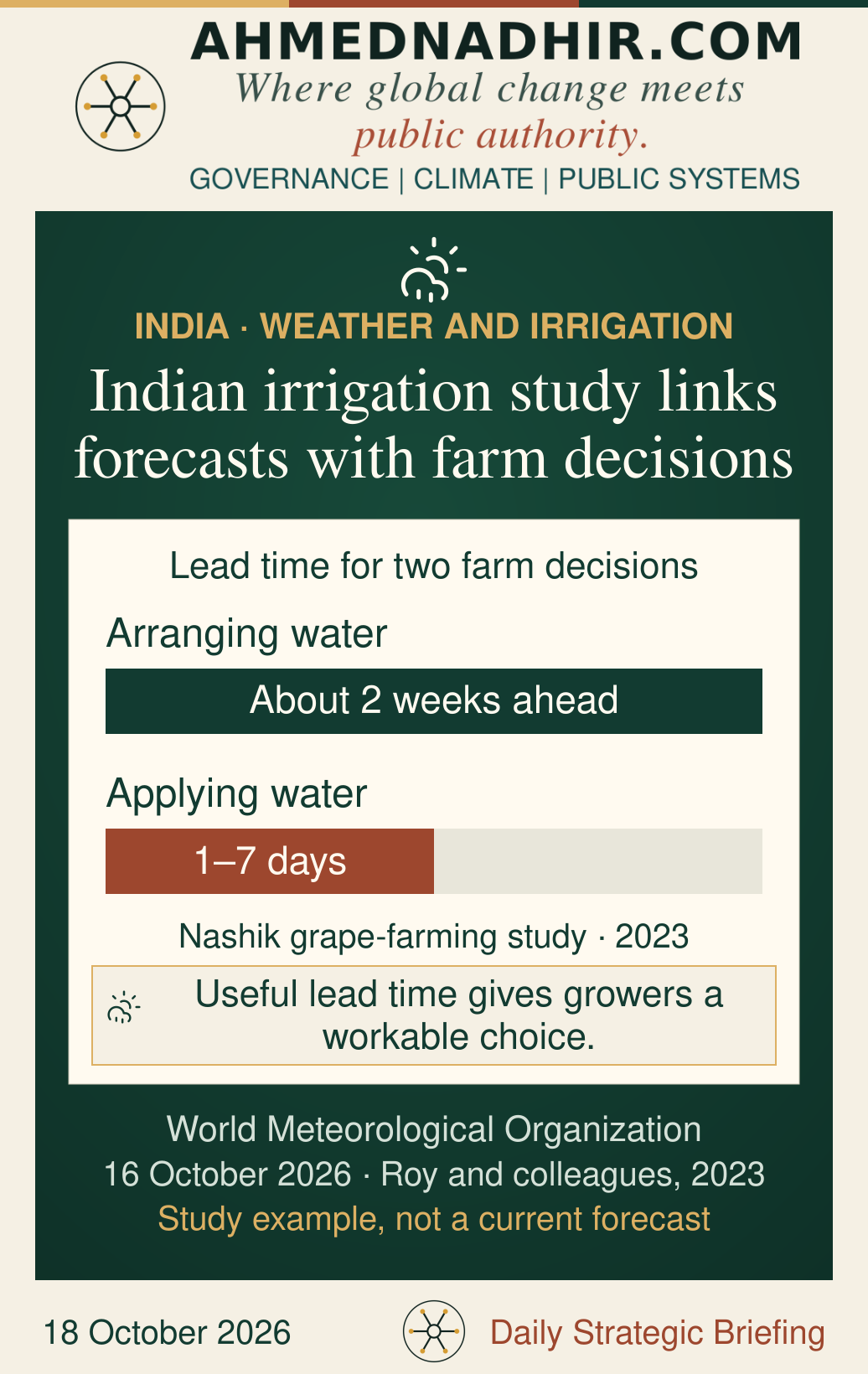
The World Meteorological Organization published an account on 16 October of India’s use of forecasts in farming. In Odisha’s Bargarh district, a warning issued on 8 May covered possible adverse weather during the following two weeks. The advice concerned mature crops: harvest early where appropriate, move produce to safety and protect livestock. The new publication describes an earlier advisory, not weather expected this week.
Irrigation requires a different decision. A 2023 study of grape farming around Nashik combined rainfall forecasts, soil-moisture information and a model of water movement through soil and plants. It supported arranging water about two weeks ahead and deciding when to apply it over the following one to seven days. Its authors reported achievable water-saving ranges of 20–45% in the monsoon crop season and 17–35% in the dry-season crop, without yield loss. The publisher’s description identifies two farm locations. These are study-specific results, not savings established for all Indian farmers or transferable percentages for African farms.
The useful connection is between a weather signal and a decision a grower can make. Harvesting sooner may require labour, transport and dry storage. Changing irrigation requires control over when water arrives. A farmer sharing a fixed delivery schedule may have little freedom to follow otherwise sound advice. The service becomes more valuable when agronomists and forecasters understand those practical limits.
For agricultural and water institutions elsewhere, the Indian examples support testing a defined service with growers. They do not establish its local accuracy or financial return. The relevant comparison is what changes in water use, crop losses, labour costs and earnings when usable advice arrives in time. A message delivered to a phone is only one part of that account.
GOVERNANCE · ACCESS TO JUSTICE
Comparative evidence · Participating countries
Justice report finds that information often stops short of personal help
Report published: 16 October 2026 · Legal-needs survey observations: 2017–2024, varying by country
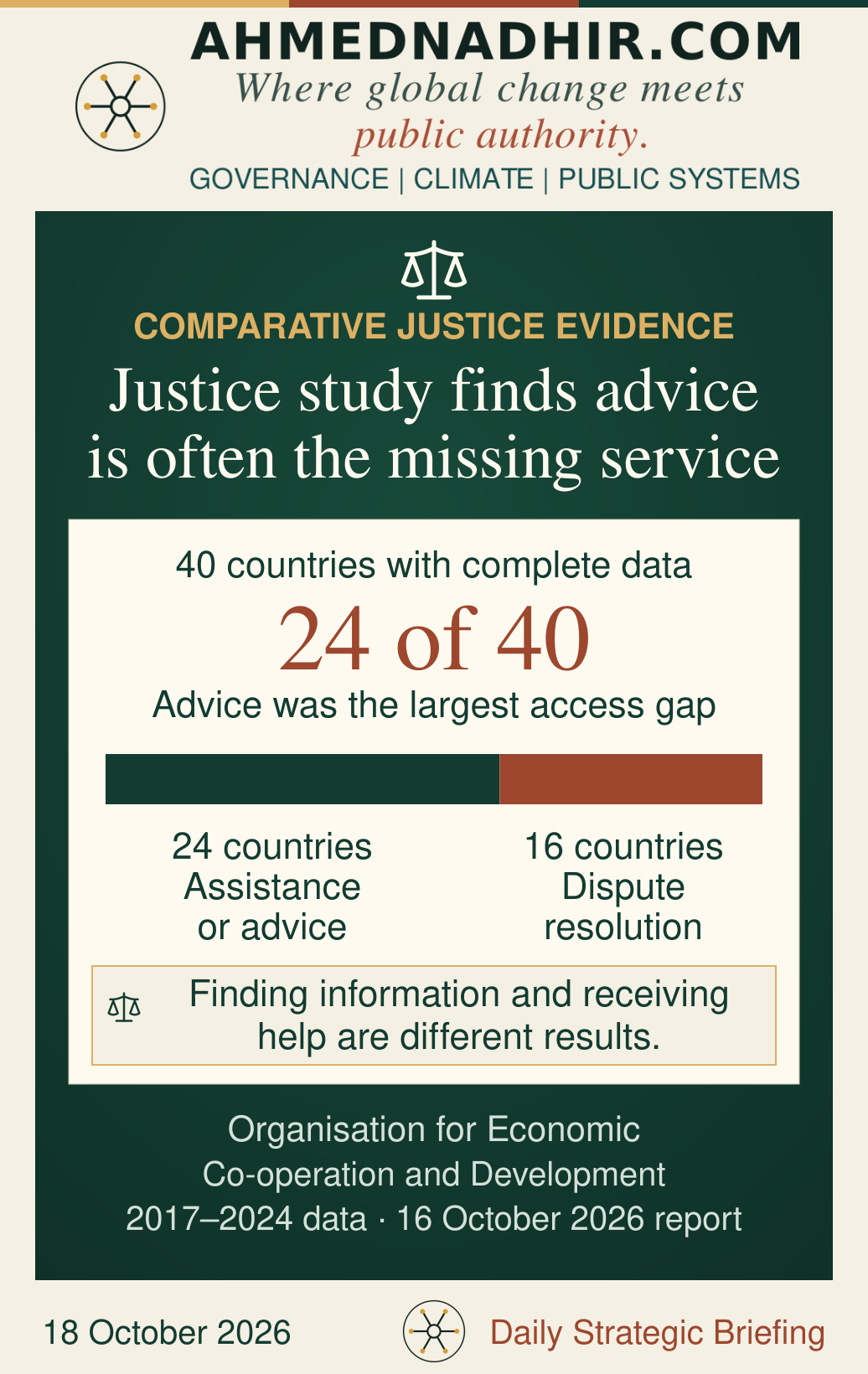
A new Organisation for Economic Co-operation and Development report examines justice as a public service. Among 40 countries with complete data across its access indicators, obtaining suitable assistance or advice was the largest gap in 24. Access to a dispute-resolution mechanism was the largest gap in the other 16. The underlying legal-needs observations date from 2017 to 2024, varying by country; publication in 2026 does not make them a current global count.
The distinction is familiar in an everyday dispute. A person challenging an unpaid bill or a housing decision may find the correct form yet need help understanding evidence, costs or the available remedy. Publishing instructions can solve an information problem. It cannot, by itself, provide individual assistance. That distinction matters when a department treats an improved website as evidence that access has improved.
Administrative records also begin late in the story. A completed case shows activity within an institution; it says little about people who could not start, approached the wrong office or abandoned the effort. These are questions for local investigation, rather than conclusions about any one country from the comparative figures. A useful service account follows what happened after the first request for help, including referrals and whether the person obtained a workable resolution. Faster processing is valuable, but it answers only part of that question.
AFRICAN ECONOMIES · SOCIAL INVESTMENT
African Development Bank · Euro-denominated funding
African Development Bank prices a €1bn social bond for eligible projects
Bond priced: 14 October 2026 · Bank announcement: 15 October · Settlement scheduled: 21 October
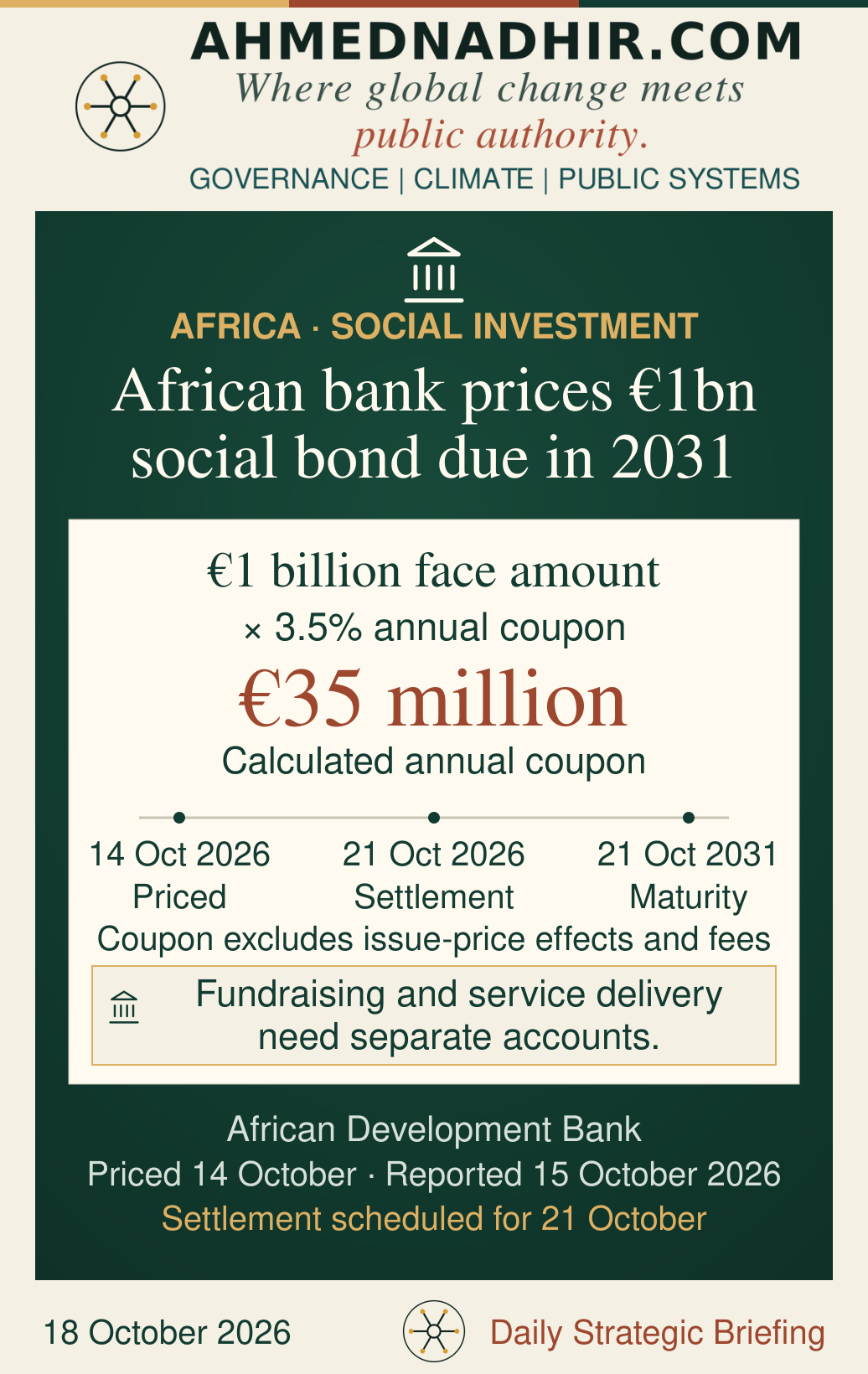
The African Development Bank reported on 15 October that it had priced a five-year social bond with a face amount of €1 billion. Settlement is scheduled for 21 October 2026, with repayment due on 21 October 2031. The annual coupon is 3.5%. The bank says the transaction will support eligible social projects under its Sustainable Bond Framework. It does not identify a new €1 billion allocation to a particular country.
The bond is borrowing by the development bank. On the stated face amount, the coupon implies €35 million a year, calculated as €1 billion multiplied by 3.5%. That is not the rate a government or project would necessarily pay. Nor is it the bank’s complete borrowing cost: issue price and other expenses are outside that simple calculation. Pricing precedes settlement, when the transaction is due to complete.
The social label provides a stated use for an amount equivalent to the net proceeds; the financed services need their own appraisal. A water project, for example, may bring construction costs, maintenance needs and choices about user charges or public subsidy. Those choices affect who can use it after construction. The bank’s programme provides for reporting on allocation and benefits. For the public, that is the next evidence to examine, alongside what the services actually deliver. Investor demand and successful financing do not themselves establish affordable access or completed projects.