
AFRICAN ECONOMIES · ELECTRONICS AND WASTE
Horn of Africa and Southern Africa · A 16-country global programme
Nine African countries join a programme covering the whole life of electronics
Launched in Manila on 7 October 2026 · Reported by the lead agency on 14 October and the African Development Bank on 16 October.
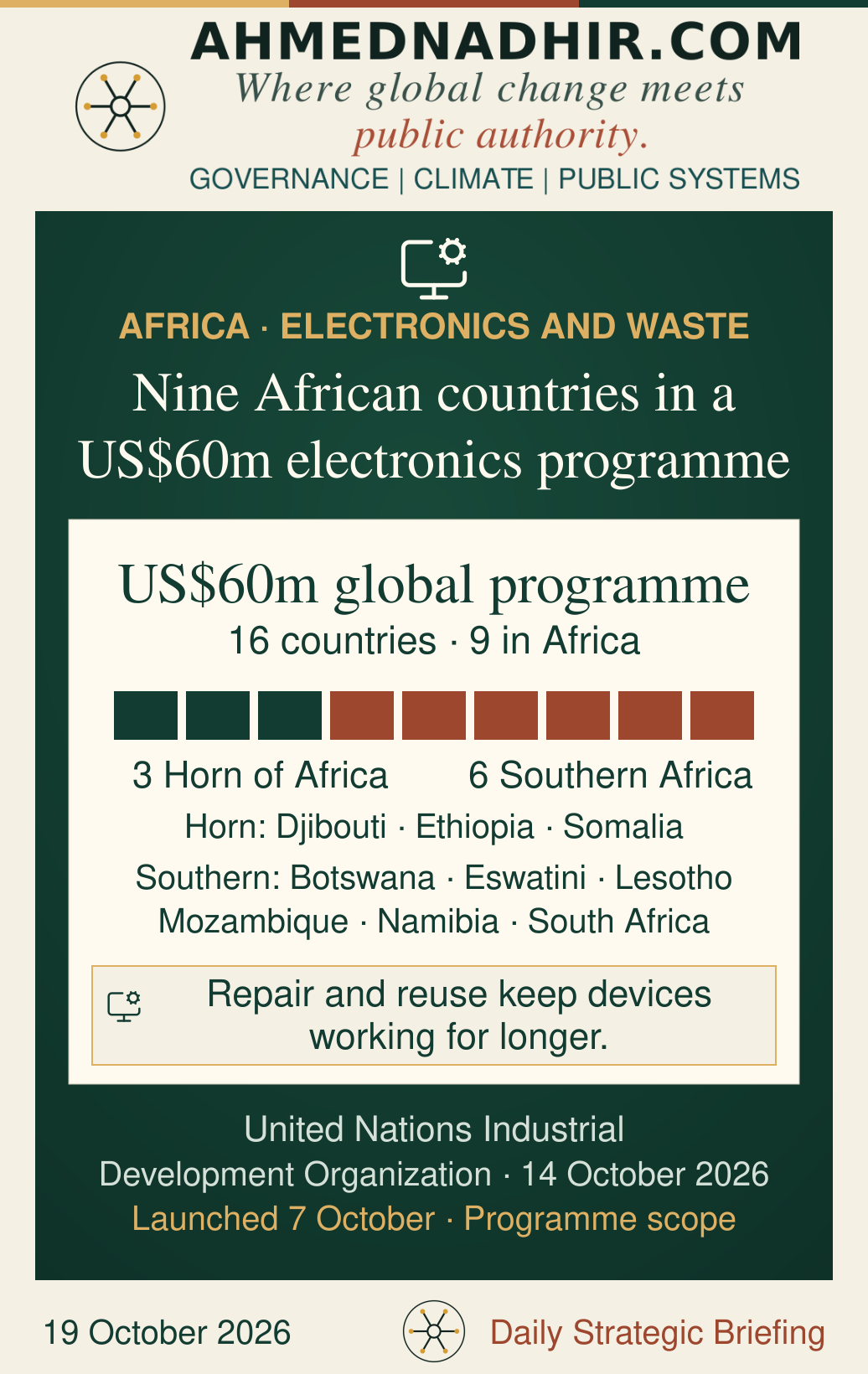
The United Nations Industrial Development Organization and its partners have launched the US$60 million Global Electronics Management programme, funded by the Global Environment Facility. Nine of its 16 participating countries are African: Djibouti, Ethiopia and Somalia in the Horn, alongside Botswana, Eswatini, Lesotho, Mozambique, Namibia and South Africa.
The programme covers what happens before an electronic device becomes waste: cleaner production, longer use, repair and resale, followed by material recovery and safer recycling. That creates distinct business opportunities. A repairer earns by restoring a usable device; a recycler needs enough discarded material, reliable collection and buyers for the recovered output. Collection alone does not establish that hazardous components have been handled safely.
Public purchasing can influence both markets. A school computer that can be repaired locally has a different lifetime cost from one that must be replaced when a minor part fails. Contracts for equipment, maintenance and disposal therefore belong in the same financial account, even when different firms provide them.
The launch establishes the programme’s scope, not money already received by each country or jobs already created. Its commercial promise will become clearer through national arrangements for spare parts, repair, collection and licensed treatment. For the Horn’s three participants, regional cooperation could help aggregate material and expertise where an individual market is small.
HEALTH SYSTEMS · PRODUCT SAFETY
Worldwide · Health protection and law enforcement
World Health Organization and INTERPOL link health protection with criminal investigation
Cooperation agreement announced in a joint release on 16 October 2026.
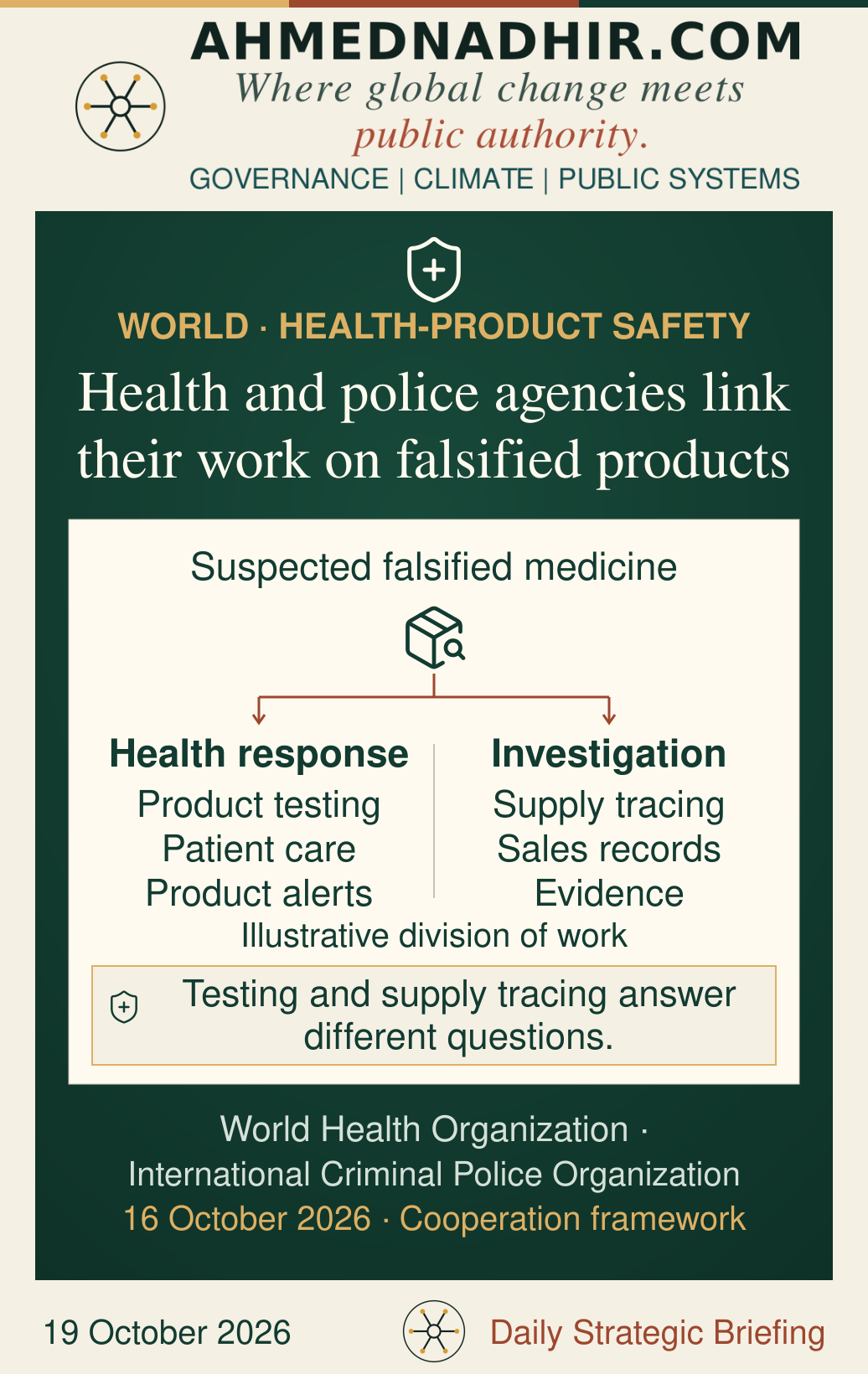
The World Health Organization and the International Criminal Police Organization, known as INTERPOL, have announced a cooperation framework addressing threats that require both health expertise and law enforcement. It covers falsified medicines, vaccines and devices, unsafe food and drink, organ trafficking and exceptional biological, chemical or radioactive incidents.
A suspect medicine illustrates the division of work. Health authorities need to establish what the product contains, where it has been used and whether patients require protection. Investigators need evidence about its manufacture, movement and sale. A laboratory result and a supplier’s transaction records answer different questions; linking them can connect a health alert with the source of the product.
The framework creates a basis for cooperation, rather than reporting a completed operation or a measured fall in harmful products. Its value for national authorities will depend on the arrangements used when a pharmacist, clinician, inspector or customs officer first encounters a concern. Speed matters, but so do lawful information sharing and clear responsibility for action.
PUBLIC FINANCE · LIVELIHOODS
Rwanda and Indonesia · Government programmes supported by philanthropy
Rwanda and Indonesia pair public livelihood programmes with delivery support
New partner account published on 15 October 2026 · Earlier research reviewed in October 2023.
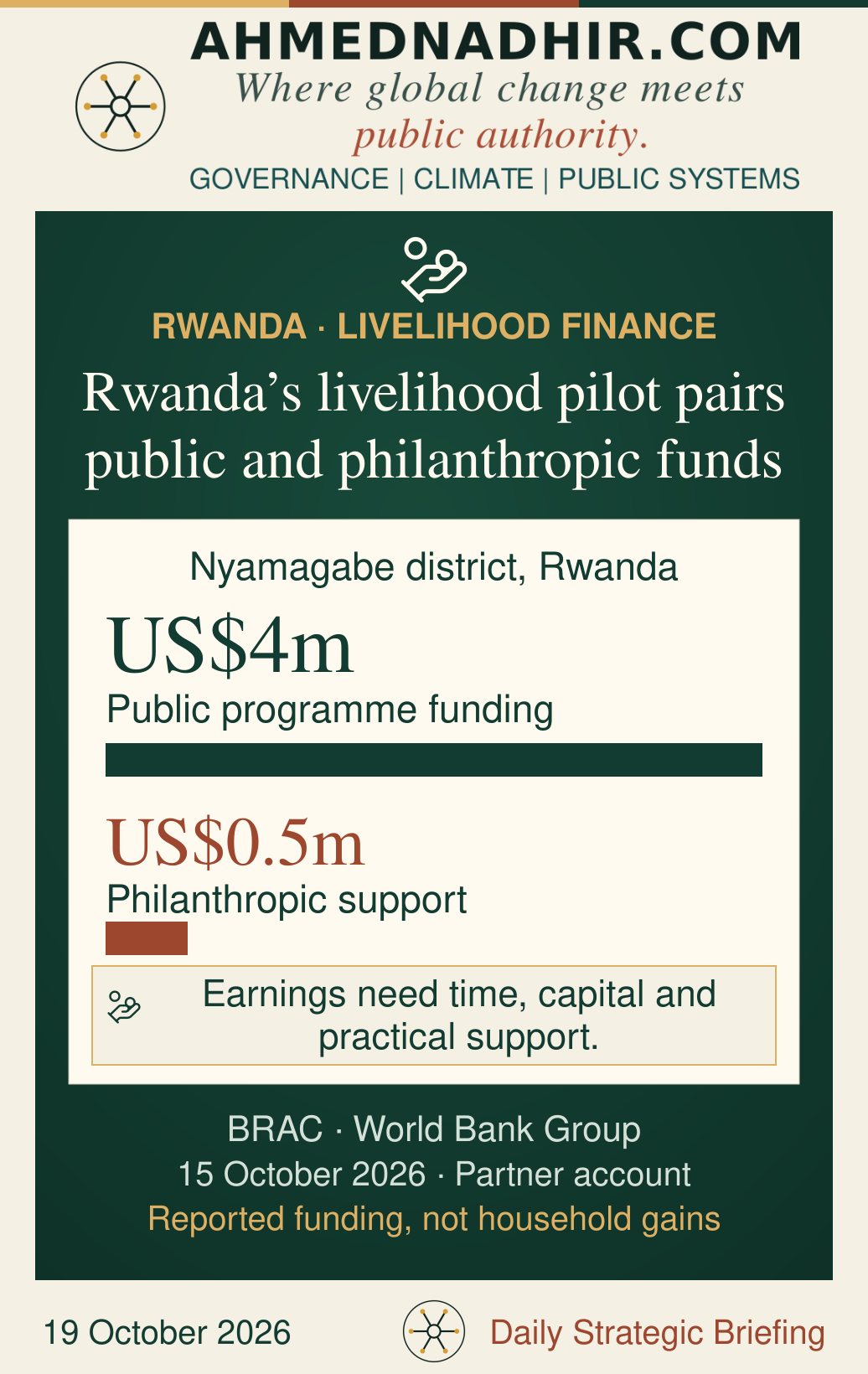
A BRAC account published by the World Bank on 15 October describes philanthropic funding being used to improve government poverty programmes. In Rwanda’s Nyamagabe district, BRAC reports US$500,000 in philanthropic support alongside US$4 million in public funding for the first district pilot. In Indonesia, it reports a government commitment of US$50–55 million to support 165,000 households through the 2026 Socio-Economic Empowerment Programme.
The approach combines help to earn a living with support while that income develops. Productive assets or working capital, skills, coaching, savings and basic household needs address different constraints. A family may receive livestock or stock for a small business and still struggle if illness, food costs or a lack of advice forces it to sell the asset before earnings become dependable.
There is research behind this combination. An October 2023 review by the Abdul Latif Jameel Poverty Action Lab examined twenty randomised evaluations and found that multifaceted livelihood support often produced lasting gains. Results varied with the setting and programme design; removing individual components sometimes reduced the benefit.
The new financing account is written by a BRAC representative, not an independent evaluation of the current Rwandan or Indonesian programmes. The amounts describe reported commitments, not household income gains. For governments, the substantive proposition is that the quality of delivery deserves funding alongside transfers. Whether that pays off locally requires following households after the initial support ends.
RESILIENCE · WATER AND PUBLIC SERVICES
Moldova · Nistru River pollution in spring 2026
Moldova counts €2.33m in losses from a water crisis without physical damage
Assessment findings presented and published on 16 October 2026 · The pollution incident occurred in spring 2026.
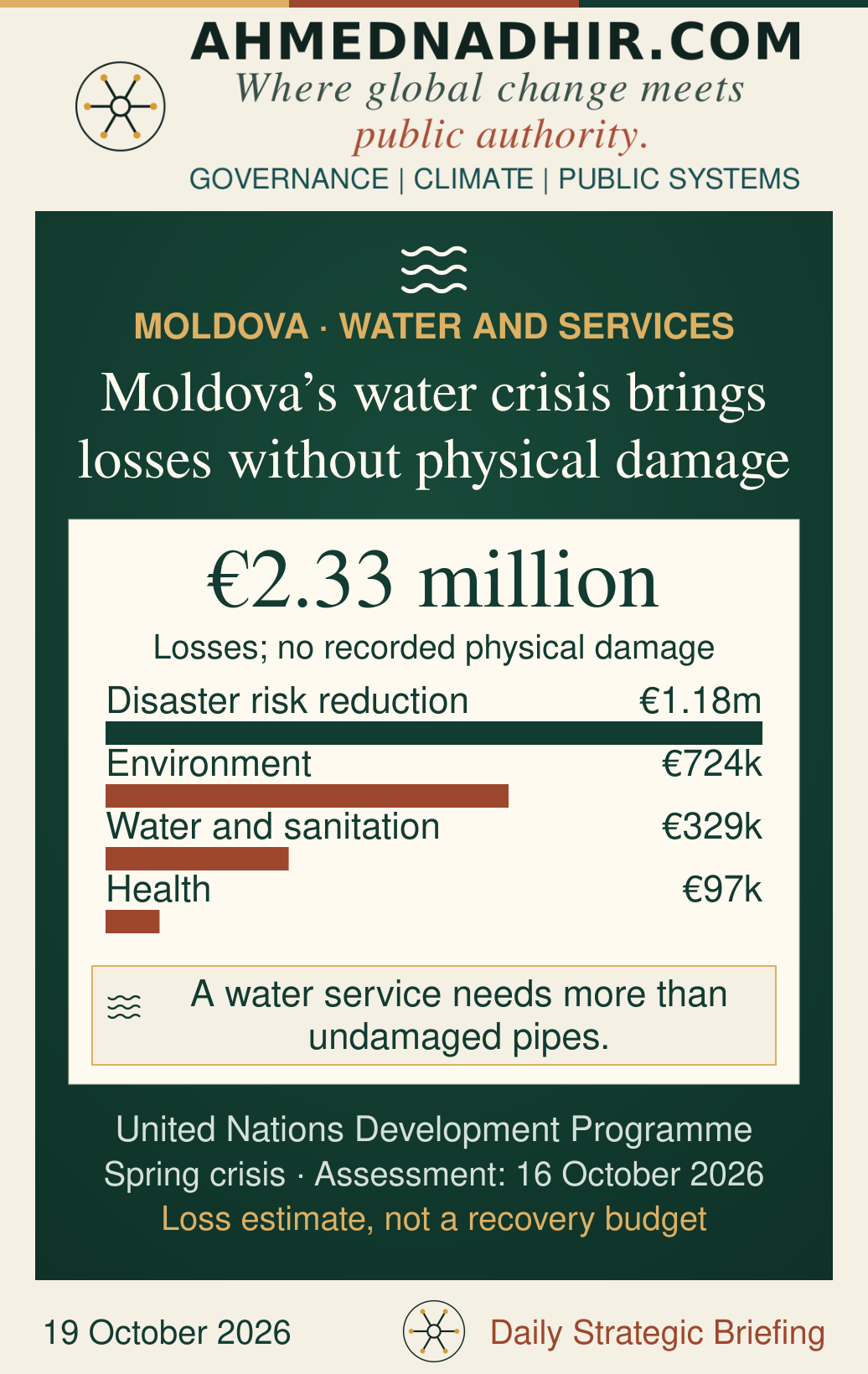
An assessment presented on 16 October puts losses from petroleum pollution in Moldova’s Nistru River in spring 2026 at €2.33 million, although no damage to infrastructure, buildings or equipment was recorded. Precautionary suspension of river-water abstraction temporarily cut centralised supply to about 100,000 people. Some non-urgent medical services were postponed and schools in Bălți moved temporarily online.
The published findings attribute €1.18 million to disaster risk reduction, €724,000 to the environment, €329,000 to water and sanitation, and €97,000 to health. These are assessed losses, not the price of replacing broken assets or a bill for the proposed recovery programme. The assessment remained subject to finalisation after the presentation.
The case broadens the meaning of resilience. An intact water network can lose its source. A hospital then needs an alternative supply, a school must decide whether it can remain open, and households face the cost of obtaining water elsewhere. Infrastructure condition and service availability therefore require separate attention.