
CLIMATE · HEALTH AND PUBLIC FINANCE
World · National climate commitments
Health commitments are widespread; estimates of their resource needs are not
World Health Organization review published: 19 October 2026 · Third-generation national climate plans
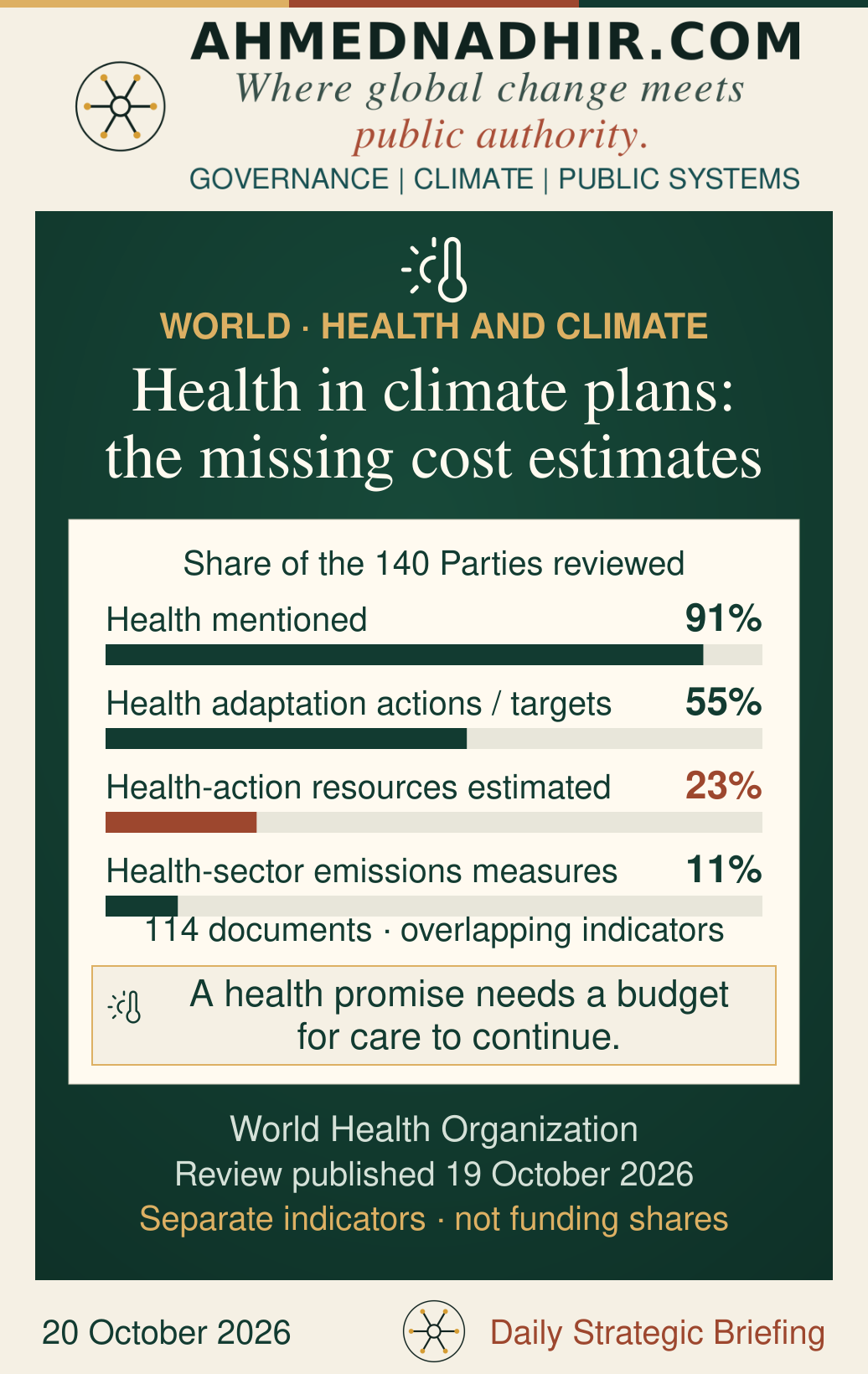
The World Health Organization (WHO) published a review on 19 October of 114 national climate-plan documents representing 140 Parties to the Paris Agreement. Health appears in the commitments of 91% of those Parties, but only 23% estimate the resources required for health-related climate action. These are findings about the plans reviewed, rather than the share of the world’s health spending devoted to climate protection.
There is more substance than a passing mention in many plans: 55% include health-specific adaptation actions or targets. Much less common are health-sector emissions measures or targets, included by 11%. The indicators measure different features of a plan. They are not successive stages through which each country has passed.
For a clinic facing heat or unreliable water, a commitment has practical costs: suitable buildings, dependable supplies and people able to maintain them. A cost estimate gives health and finance officials something to compare with available budgets and prospective support. It does not itself secure funding. Conversely, the absence of an estimate in a climate submission does not establish that no relevant spending exists elsewhere.
WHO’s standing guidance connects climate resilience with infrastructure, staff, monitoring and finance. Read in that light, the new review exposes a planning weakness: recognition of health risks is more common than a stated account of the resources needed to address them. The next useful evidence is which priorities enter funded programmes and whether they protect care when conditions deteriorate.
ARTIFICIAL INTELLIGENCE · OUTBREAK PREPAREDNESS
Democratic Republic of the Congo · Regional health intelligence
World Health Organization deploys outbreak-intelligence platform in the Congo
World Health Organization announcement: 19 October 2026 · Separate installation date not stated
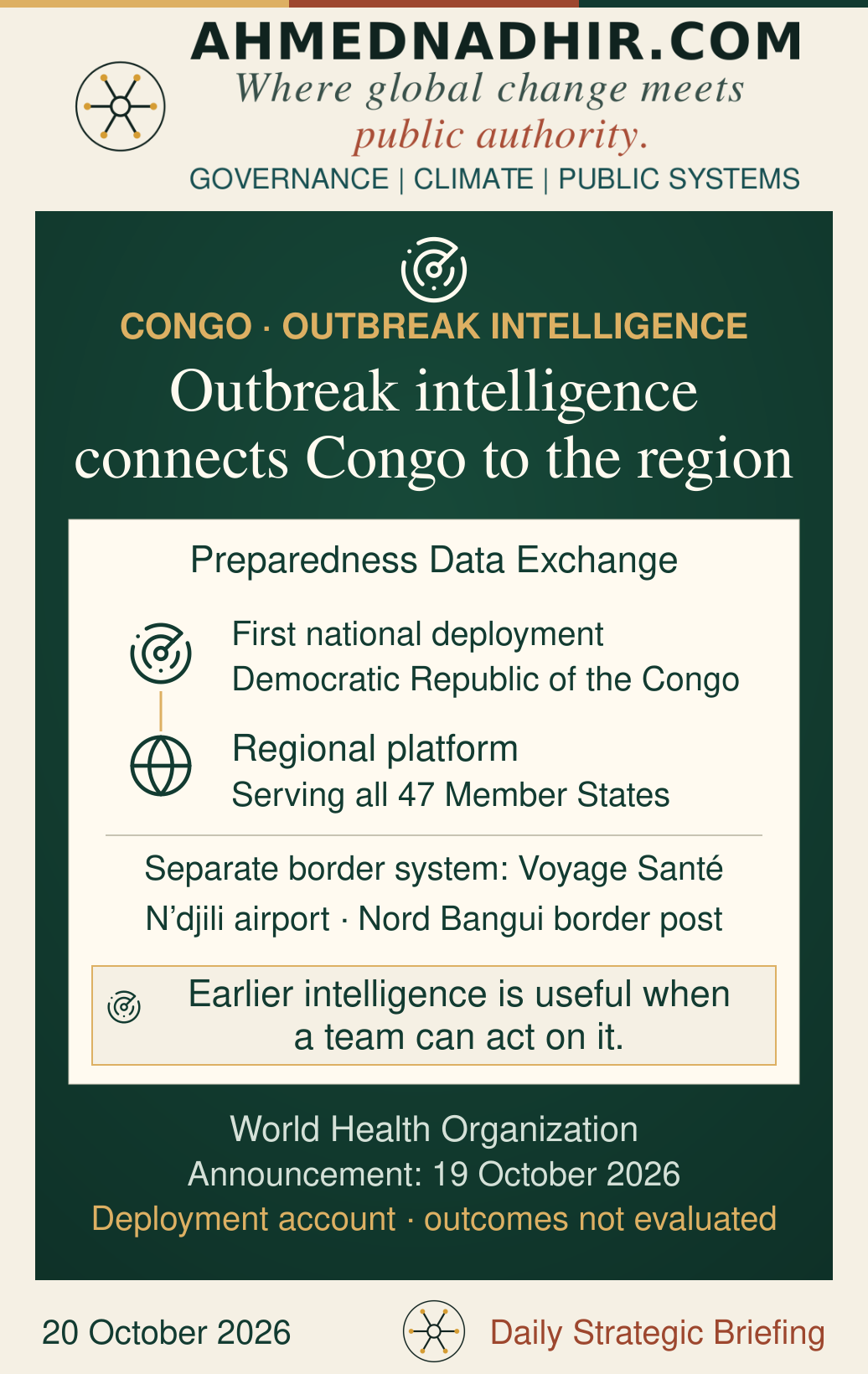
WHO announced on 19 October that its Preparedness Data Exchange (PDX) is in use in the Democratic Republic of the Congo, the first country deployment. The artificial intelligence platform brings health and risk information together and connects the country to a regional system serving all 47 Member States in WHO’s African Region. Regional coverage does not mean the platform has been installed nationally in all 47.
The same account reports a separate system, Voyage Santé, installed with Dure Technologies at points of entry including N’djili International Airport and the Nord Bangui border post. That system supports screening at crossing points; PDX supports the wider view of emerging risks. WHO presents their connection as an opportunity to improve preparedness during the Congo’s Ebola response.
The institutional task begins when a signal needs checking. An alert may justify contacting a facility, investigating an unusual event or arranging a laboratory test. Those are professional decisions requiring staff, access to records and a response team. A clearer regional picture can support that work, while local verification establishes what is actually happening.
The announcement provides no evaluation of alert accuracy, investigation times or infections prevented. Its significance is therefore a new connection between national and regional intelligence. Whether that connection improves the response will depend on how reliably signals are checked and how quickly verified concerns reach people able to act.
GOVERNANCE · PUBLIC PROCUREMENT
Europe · Municipal services and institutional learning
New procurement diagnostic asks whether public buyers can support useful innovation
Tool tested at Geneva session: 12–13 October 2026 · UNECE account: 19 October
The United Nations Economic Commission for Europe (UNECE) described a pilot procurement diagnostic on 19 October, following testing at its Geneva specialists’ session on 12–13 October. The tool helps public buyers examine the skills, incentives and internal arrangements that enable innovation. It remains under refinement; it is not a new procurement law or a certification of participating institutions.
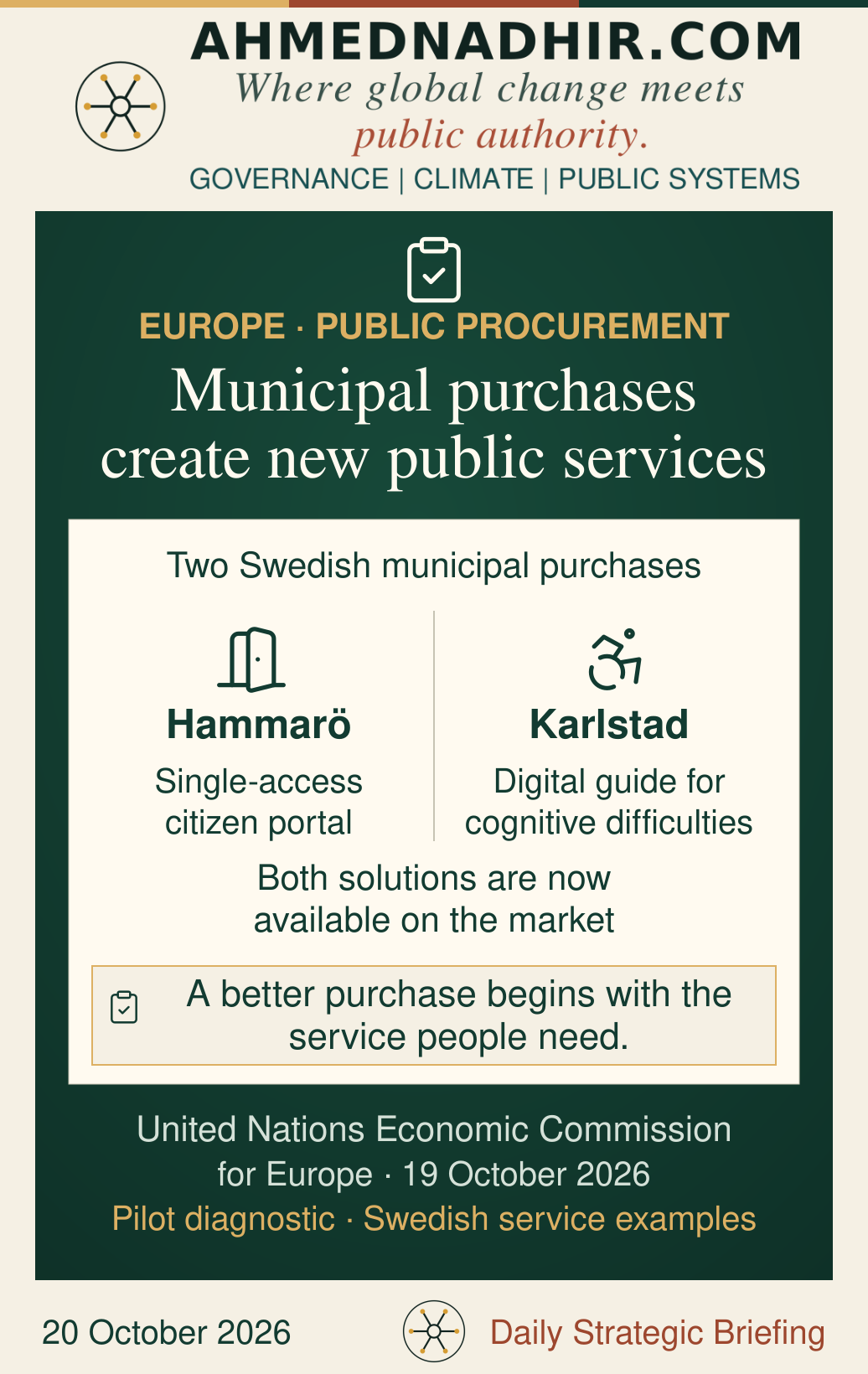
Two Swedish examples make the idea concrete. Hammarö commissioned a single-access citizen-services portal; Karlstad used procurement to develop a digital guide for people with cognitive difficulties. UNECE says both solutions are now available on the market. Its account supplies no quantified estimate of savings or improvement in residents’ experience.
A service need can give a supplier a reason to develop something that does not yet exist in a suitable form. The public buyer, however, must be able to explain the problem, hear from users and assess the result. For a digital guide, a successful technical demonstration may leave unanswered whether intended users can navigate it independently or obtain help when they need it.
That is where institutional capability affects a purchase. Staff need time and authority to work across service delivery, procurement and technical functions. A pilot can expose those needs before a larger contract makes them expensive to change. The European examples offer a way to examine purchasing practice elsewhere, within local law, rather than a ready-made procedure to copy.
AFRICAN ECONOMIES · RAIL AND TRADE
Algeria · Algiers–Tamanrasset corridor
Algeria’s railway discussions turn towards the production and markets along the route
Joint mission: 21 September–1 October 2026 · African Development Bank account: 19 October · Earlier financing approval: 13 July
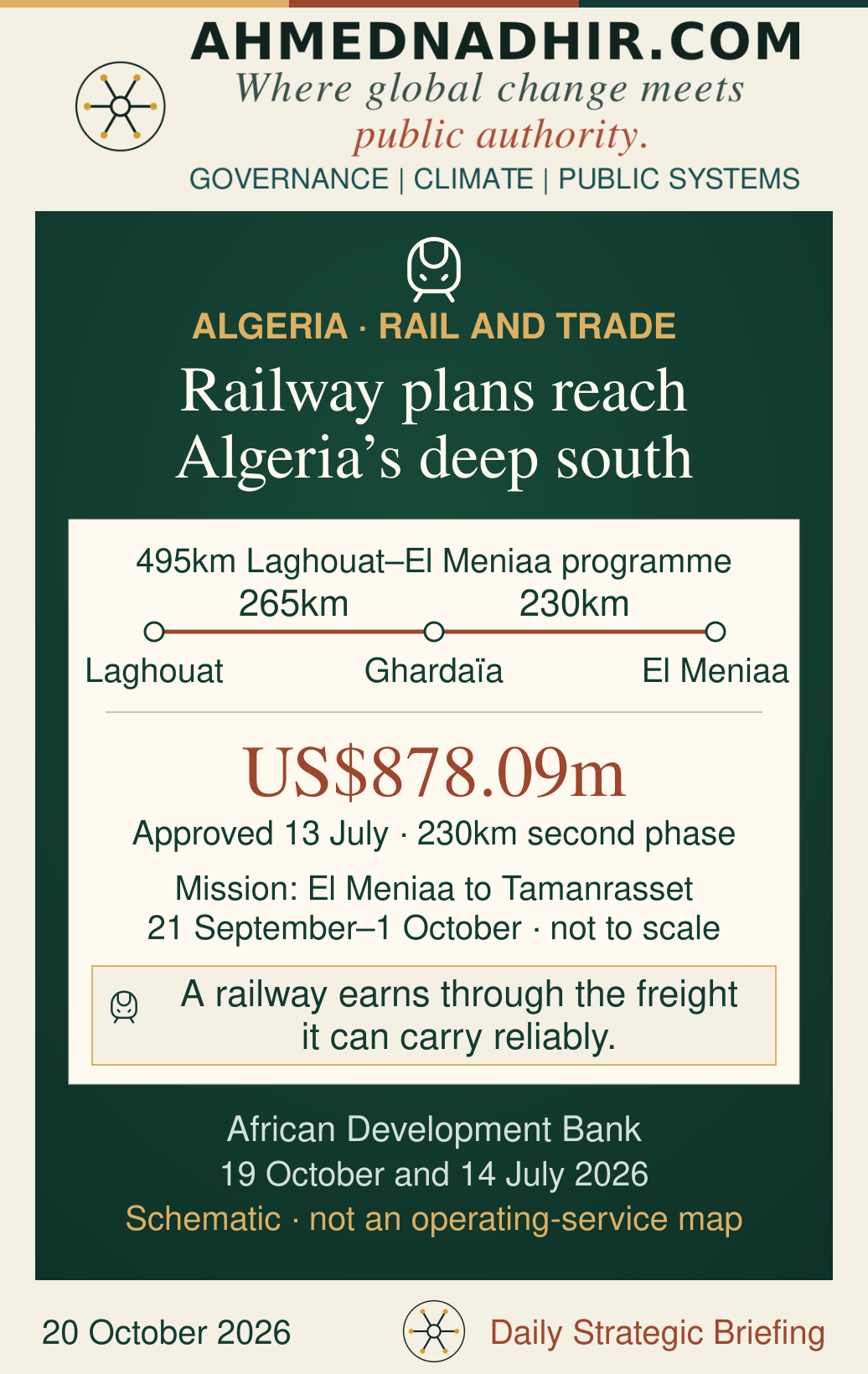
An African Development Bank account published on 19 October describes a joint mission with the Islamic Development Bank along Algeria’s proposed north–south railway corridor. The visit took place from 21 September to 1 October, examining the El Meniaa–In Salah–Tamanrasset sections and their economic role. The railway ambition reaches towards Niger and West African markets; the release does not establish an operating cross-border rail service.
There is an earlier, distinct financing decision. On 13 July, the African Development Bank approved US$878.09 million for a second phase centred on the 230-kilometre Ghardaïa–El Meniaa section. It forms part of the 495-kilometre Laghouat–Ghardaïa–El Meniaa programme. That approval is not new October money, nor evidence that the line has opened.
The commercial question is what freight can use the route at a viable delivered cost. Agricultural produce needs collection and timely onward handling; minerals need loading arrangements and regular capacity. Those examples explain the choices around a railway, rather than confirmed cargo contracts. Connecting production areas to the track requires roads, terminals and services as well as the railway itself.
The latest mission brings that wider economic work into view. For firms along the route, the eventual opportunity rests on dependable transport and access to buyers. Construction expenditure and lending approval are meaningful steps, while freight volumes, delivery times and customer costs will show what the corridor earns.