
HEALTH SYSTEMS · DATA GOVERNANCE
Africa · Continental validation in Addis Ababa
African states validate safeguards for sharing health data
Validation workshop: 21–22 October 2026. Joint announcement: 22 October. Further African Union consideration anticipated: 2027.
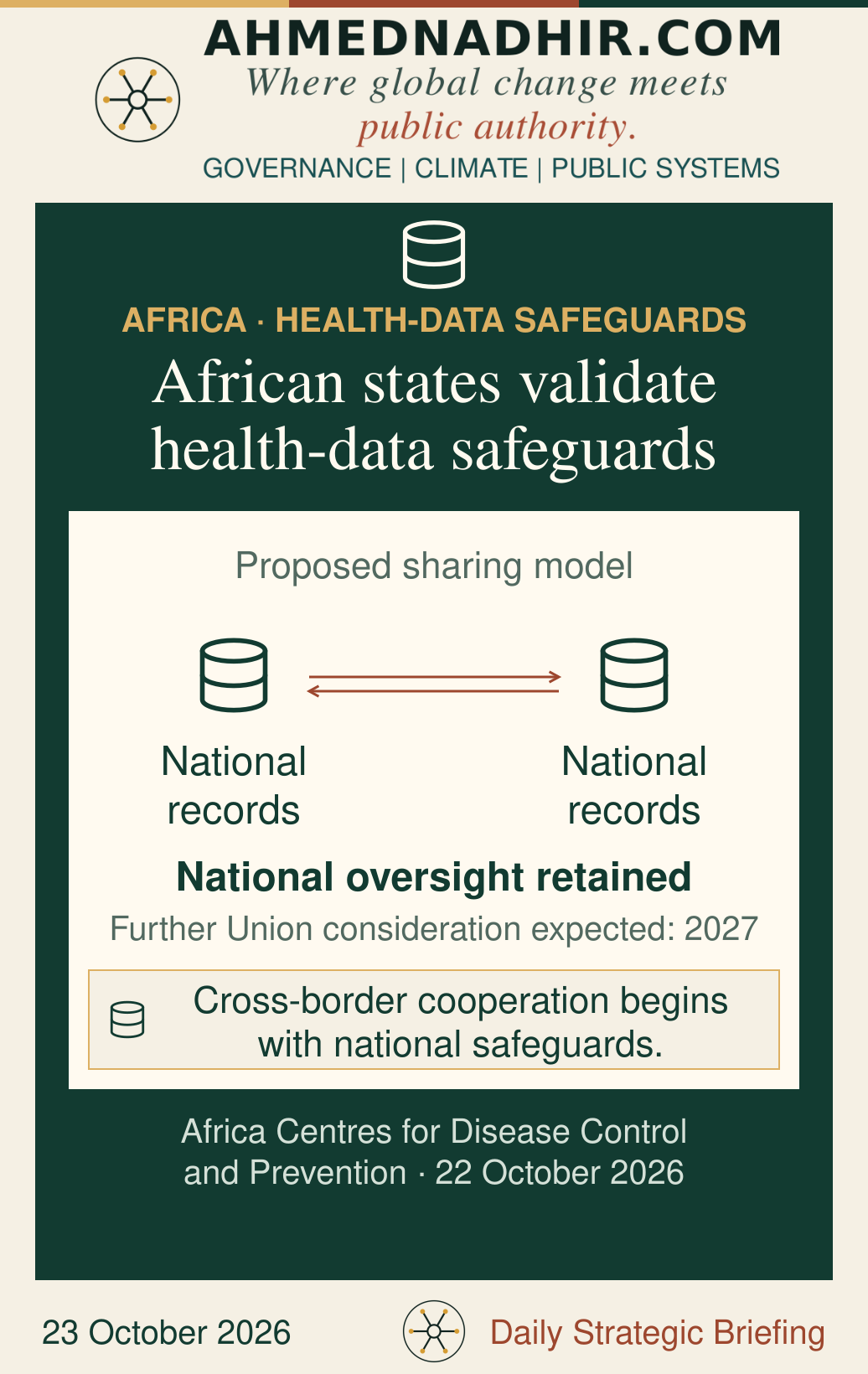
The Africa Centres for Disease Control and Prevention announced on 22 October that African Union Member States had validated the African Continental Health Data Governance Framework. The proposed approach connects secure information sharing with countries’ continued oversight of their national health-data systems.
That distinction matters when a disease threat crosses a border. Useful information needs to reach another health authority, but access also needs a legitimate purpose, safeguards and someone accountable for its use. A common approach could make these exchanges more dependable while protecting patients and public trust.
The framework is intended to guide national legislation, policies and governance arrangements. Its proposed federated approach allows cooperation across national systems without requiring countries to relinquish oversight. The announcement also connects privacy and cybersecurity safeguards with the risks of misuse and bias as health services adopt artificial intelligence.
Validation is not the final policy step. The agency will incorporate agreed amendments and advance the text through African Union processes, with consideration anticipated in 2027. Implementation would then be led by Member States. The announcement establishes agreement on a direction; it does not establish that all countries now operate compatible systems or that a new continental law is in force.
AFRICAN ECONOMIES · CLIMATE RESILIENCE
Morocco · Public enterprises, investment, water and electricity
Morocco’s US$487m approval links public-sector reform with water and power
Approval: 21 October 2026, according to Morocco’s official account. Announcement and corroborating reporting: 22 October.
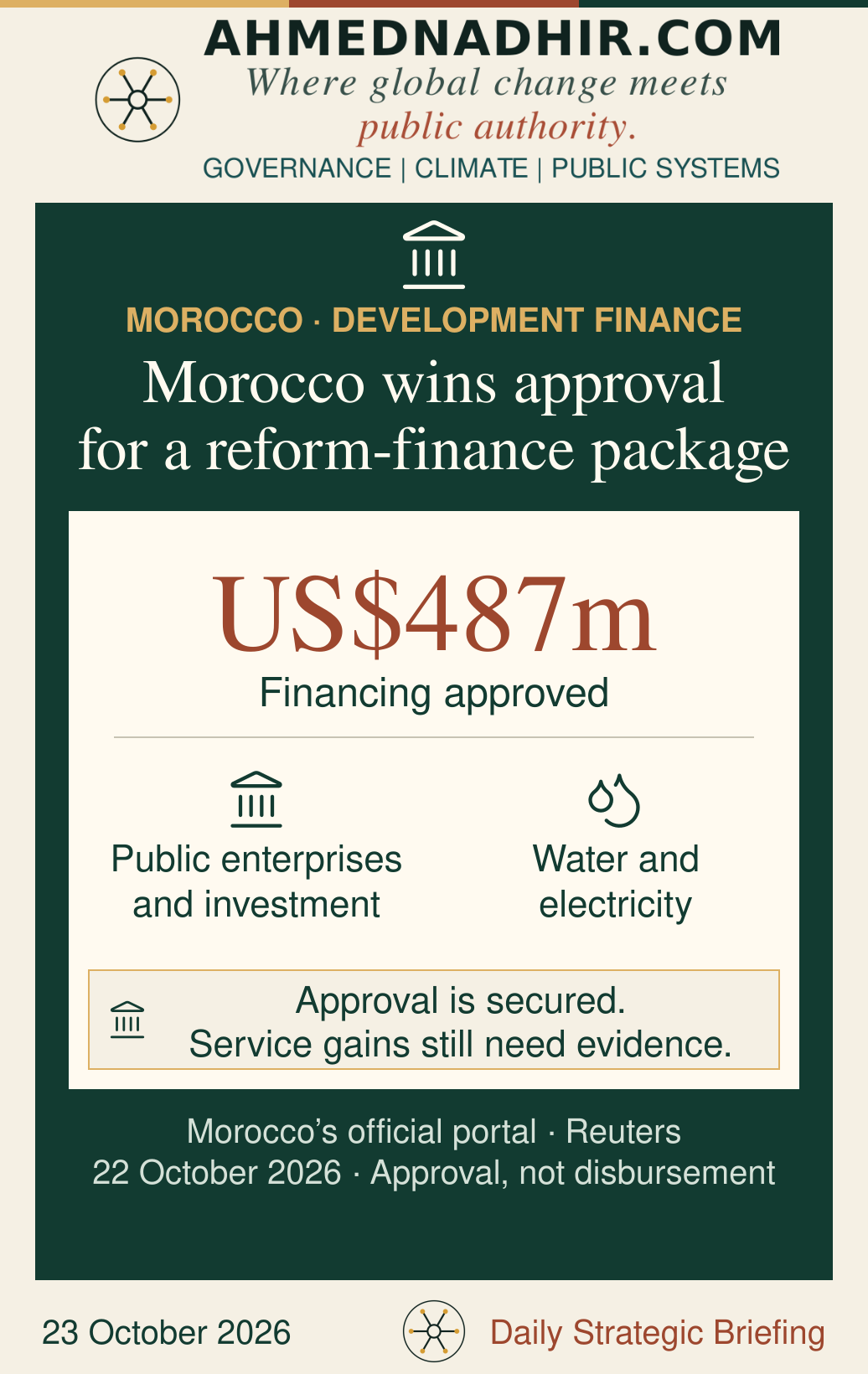
The African Development Bank Group has approved US$487 million in financing for Morocco’s economic and climate-resilience reforms. Morocco’s official portal dates the approval to 21 October in Abidjan; its account and Reuters reporting were published on 22 October.
The programme’s third phase has two connected purposes. One concerns public action: restructuring the public-enterprise portfolio, improving the framework for public-private partnerships and creating better conditions for private investment. The other concerns the governance of water and electricity, with climate risks brought more fully into public policy.
This makes the operation different from a loan for a single dam or power station. Its intended contribution runs through the institutions that manage assets, structure investment and maintain essential services. Changes in those arrangements can influence how efficiently public resources are used and whether further investment becomes viable.
The approval establishes financial backing for a programme, rather than evidence that funds have been disbursed or reforms completed. The published accounts do not divide the US$487 million between the two purposes or report resulting improvements in water, electricity or employment. Those outcomes will require evidence of implementation and service performance.
CLIMATE · TRANSPORT AND INDUSTRY
Africa, Asia and Latin America · Electric vehicles and battery management
Electric transport needs affordable credit and a safe route for used batteries
United Nations technical account: 22 October 2026. Finance series launch: 22 July. Battery report launch: 29 September, Stellenbosch.
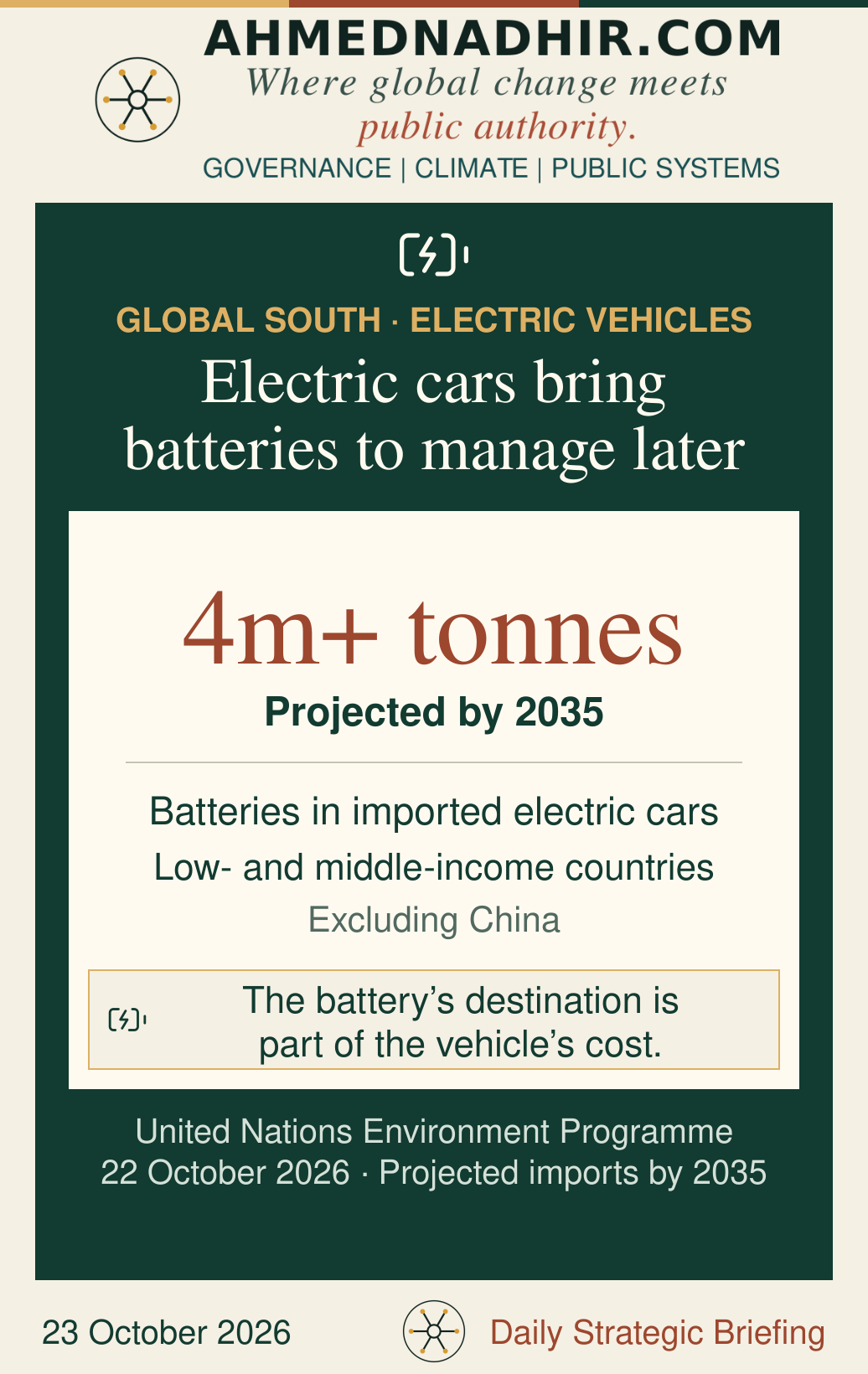
A United Nations Environment Programme account published on 22 October brings two problems in electric transport together: buying the vehicle and managing its battery later. It draws on a financing series launched in July and a battery-management report launched in September, rather than announcing a new funding programme.
The finance series estimates that meeting projected electric two- and three-wheeler volumes would require roughly US$110 billion of capital during 2026–2035. This is an estimated investment requirement, not committed finance. Lower running costs can improve a driver’s business, but the purchase price and repayment terms determine whether that saving becomes usable income.
The battery analysis projects more than four million tonnes of used lithium-ion batteries arriving in low- and middle-income countries, excluding China, inside imported electric cars by 2035. This is a forecast of batteries entering with vehicles, not a measurement of waste already collected. Their eventual handling can create material-recovery businesses or expose workers and communities to hazardous substances.
The two issues meet in the vehicle’s full commercial life. Guarantees, cash-flow-based lending and reliable product standards can improve access to finance. Producer responsibility, battery tracking and safe collection can give a retired battery a documented destination. Neither the financing estimate nor the battery projection establishes that these arrangements are already available everywhere.
ARTIFICIAL INTELLIGENCE · PUBLIC PROTECTION
Asia and the Pacific · Cambodia case with wider relevance
Online scams test the connections between banks, platforms and public agencies
Report released: 22 October 2026. General evidence cut-off: 30 September. Cambodia example and original training commitments: 2024.
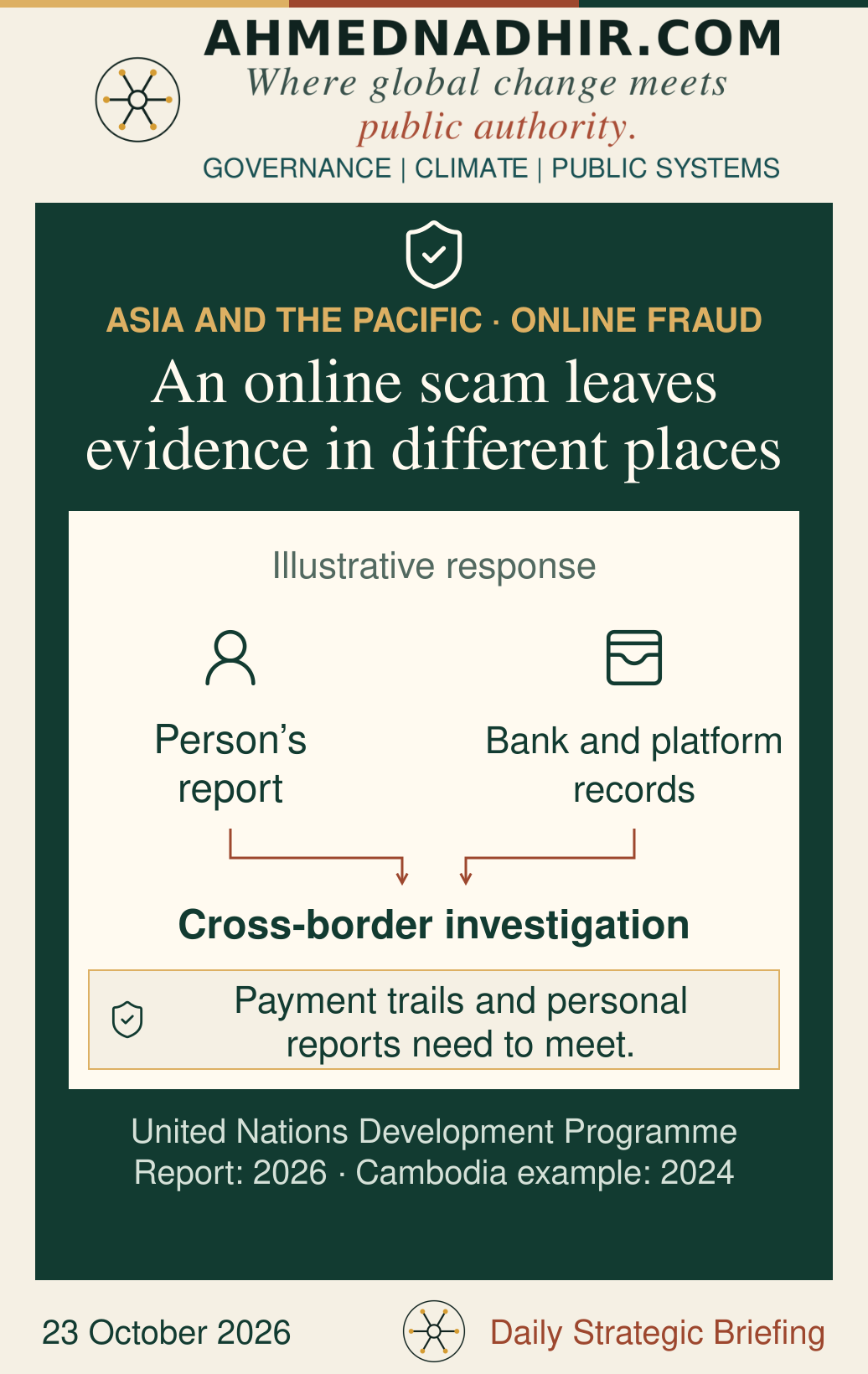
A United Nations Development Programme report released on 22 October treats online scams as a threat to livelihoods and confidence in digital services. Its Asia-Pacific analysis connects fraud prevention with financial institutions, technology platforms, regulators and justice agencies. Artificial intelligence (AI) can assist scammers, but the report does not attribute all online fraud to AI.
The Cambodia example gives the argument practical form. The report recalls a workshop bringing together more than 40 experts from 20 organisations, alongside a commitment by the International Criminal Police Organization to train officers in exchanging cross-border intelligence on fraudulent payments. The original account dates these activities and commitments to 2024.
The mechanism is coordination across responsibilities. A victim’s report, a payment trail and information held by a platform may sit in different organisations and jurisdictions. Their usefulness depends on a lawful, timely route between them. A public-awareness campaign can help people recognise a scam, but cannot provide that route on its own.
The new report is a synthesis, with a general evidence cut-off of 30 September 2026. It does not make the Cambodia workshop a new event or establish how much money that initiative recovered. For public institutions, its value lies in examining the response as a connected service, with clear responsibilities for receiving reports, tracing payments, investigation and support.