
HEALTH · IMMUNISATION
Angola · National campaign and border communities
Angola’s vaccination campaign aims to reach more than 10 million children
Campaign: 23–27 October 2026. Launch in Luanda and WHO report: 23 October.
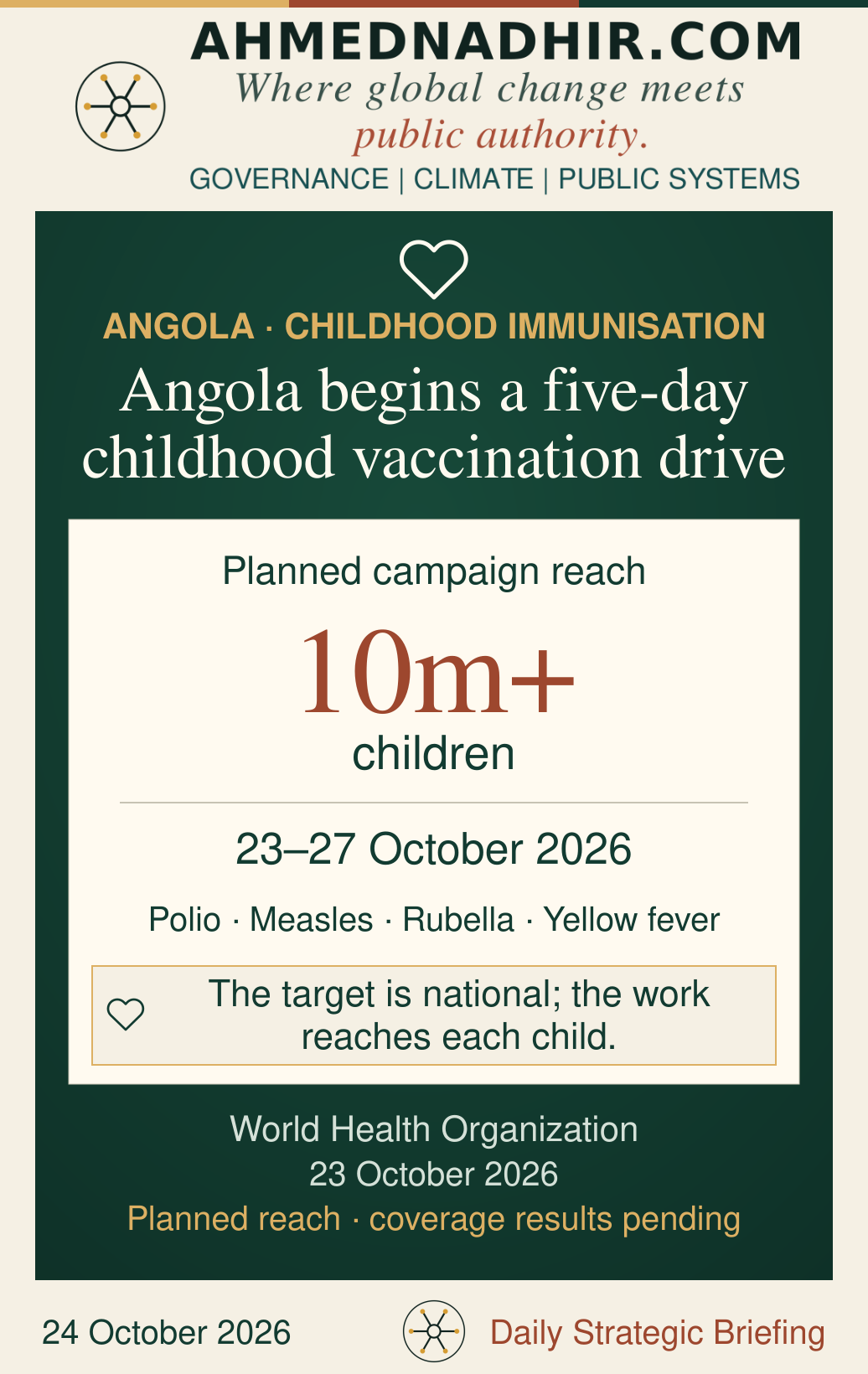
Angola began a national vaccination campaign on 23 October, aiming to reach more than 10 million children with protection against polio, measles, rubella and yellow fever. The Ministry of Health is leading the operation, which runs until 27 October.
The World Health Organization (WHO) reports that teams will work across all provinces, including remote communities. The ministry’s earlier public notice confirms the dates and says vaccination is free. WHO also describes coordination with neighbouring countries for injectable polio vaccination in areas bordering the Democratic Republic of the Congo and Namibia.
Delivering several forms of protection through one campaign can reduce the journeys families make to obtain care. It also places considerable demands on local planning: supplies, transport, community information and the records that allow teams to distinguish children already reached from those still missing.
The launch establishes that the campaign has begun. Its intended reach is a target, not a count of children already vaccinated. Evidence of equitable coverage will depend on the results reported after the operation, including places where teams need to return.
CLIMATE · PUBLIC INFRASTRUCTURE
Nigeria · Investment in weather, water and climate services
Lagos weather talks prioritise funding to keep services running
Alliance meeting: 13–15 October 2026. World Meteorological Organization account: 23 October.
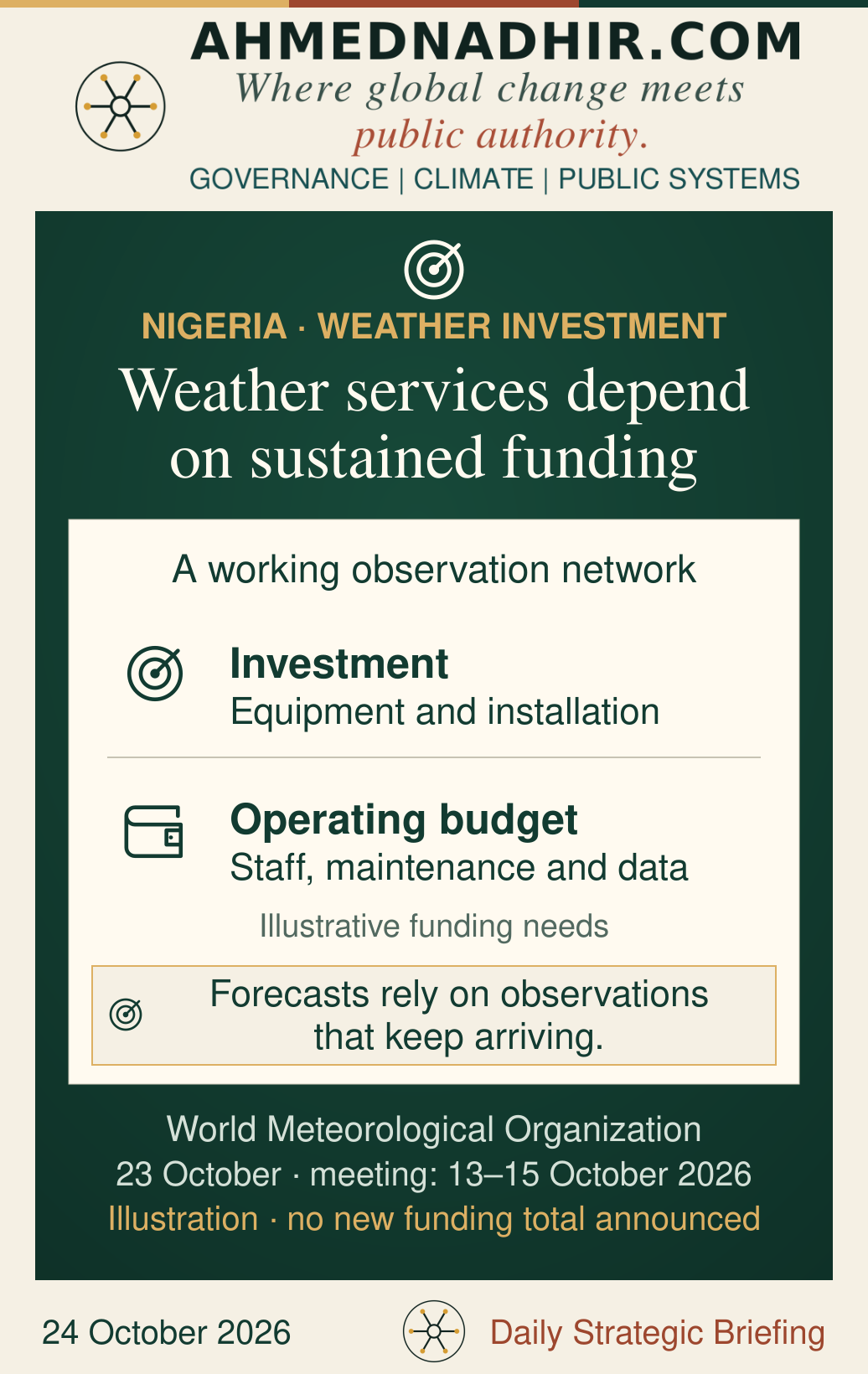
Weather investment has to pay for a service that keeps working. That is the practical issue in the World Meteorological Organization’s (WMO) 23 October account of the Alliance for Hydromet Development meeting in Lagos, held on 13–15 October.
The account identifies priorities for 2027–2028: coordinating finance around national needs, strengthening institutions and predictable domestic funding, and developing partnerships. The Nigerian Meteorological Agency’s meeting programme explicitly includes maintenance, operating finance, staff capacity and the full cost of owning infrastructure.
A weather station contributes little when equipment fails, communications stop or skilled staff cannot maintain it. For finance ministries and service managers, the investment decision therefore extends from installation to the years of observations that follow. Donor support and domestic budgets need to meet along that timetable.
This is a statement of investment priorities following the meeting, rather than an announcement of a new funding total. The published account does not establish that all proposed projects are financed or that national observation gaps have closed.
ECONOMIES · BUSINESS PRODUCTIVITY
International · World Bank Enterprise Surveys, 2023–2026
Firms in lower-income economies report less product and process innovation
Analysis published: 23 October 2026. Survey cycle: 2023–2026; innovation questions cover the preceding three years.
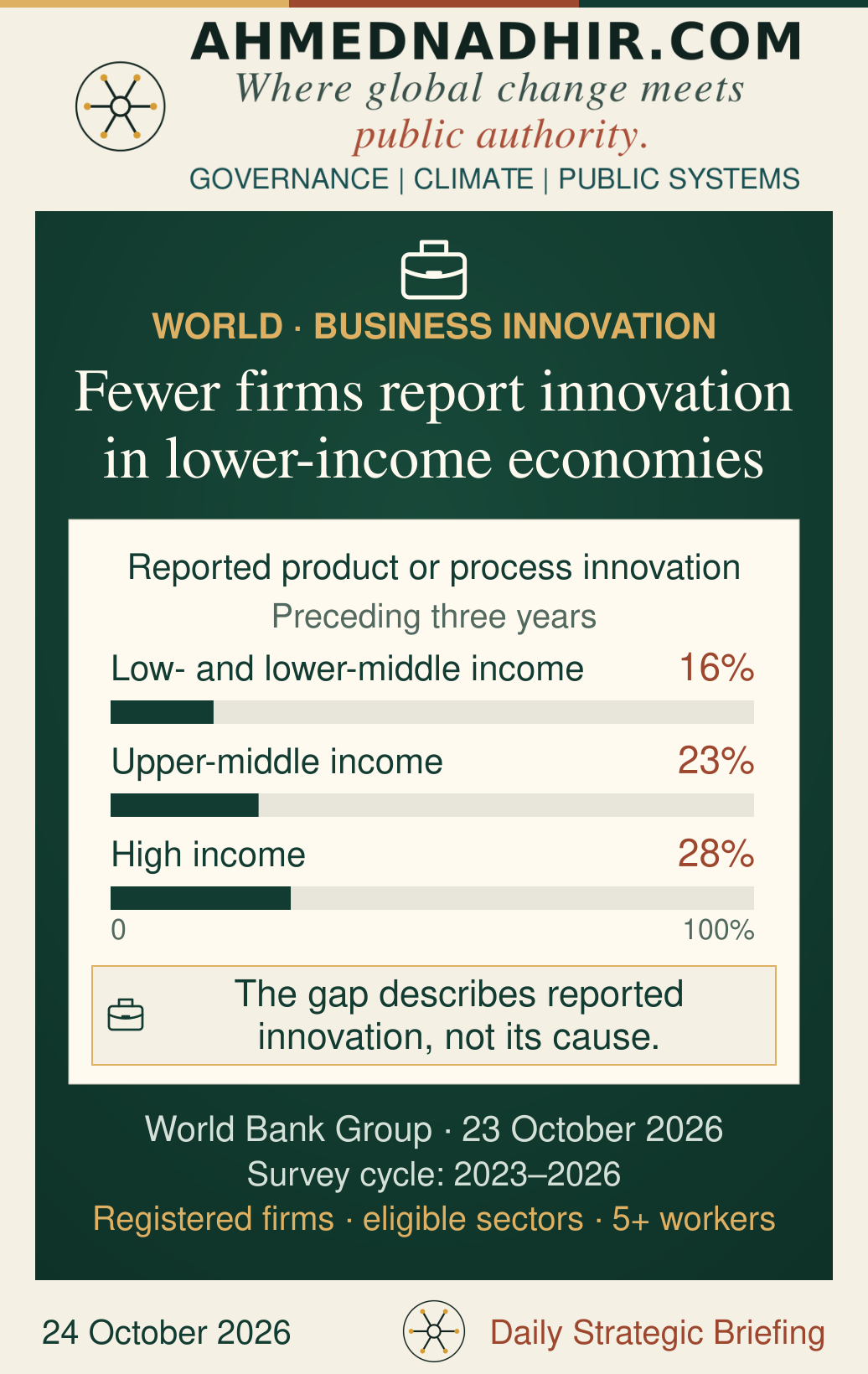
A World Bank analysis published on 23 October brings together findings from a survey cycle covering 164 economies. It reports new products or processes at 16% of firms in low- and lower-middle-income economies, compared with 23% in upper-middle-income economies and 28% in high-income economies.
The comparison concerns innovation reported over the preceding three years. It is not a measure of artificial intelligence adoption or the share of firms doing research. The standard formal-sector surveys cover registered businesses with at least five workers in specified manufacturing and service sectors; separate surveys address informal and smaller enterprises.
The analysis also associates stronger management with a greater likelihood of innovation. That relationship does not establish that a management intervention would produce the same gain, or identify which reform would work in a particular country.
For public institutions supporting enterprise, the useful question is what prevents an existing firm from improving a product or production process. Country and sector evidence can help distinguish financing difficulties, unreliable infrastructure and gaps in business capability before a programme is designed.
ARTIFICIAL INTELLIGENCE · PUBLIC SAFEGUARDS
Council of Europe · Guidance with wider relevance for public services
Council of Europe adds participation and project responsibilities to AI assessment guidance
Adoption reported from the Strasbourg plenary held on 21–23 October 2026.
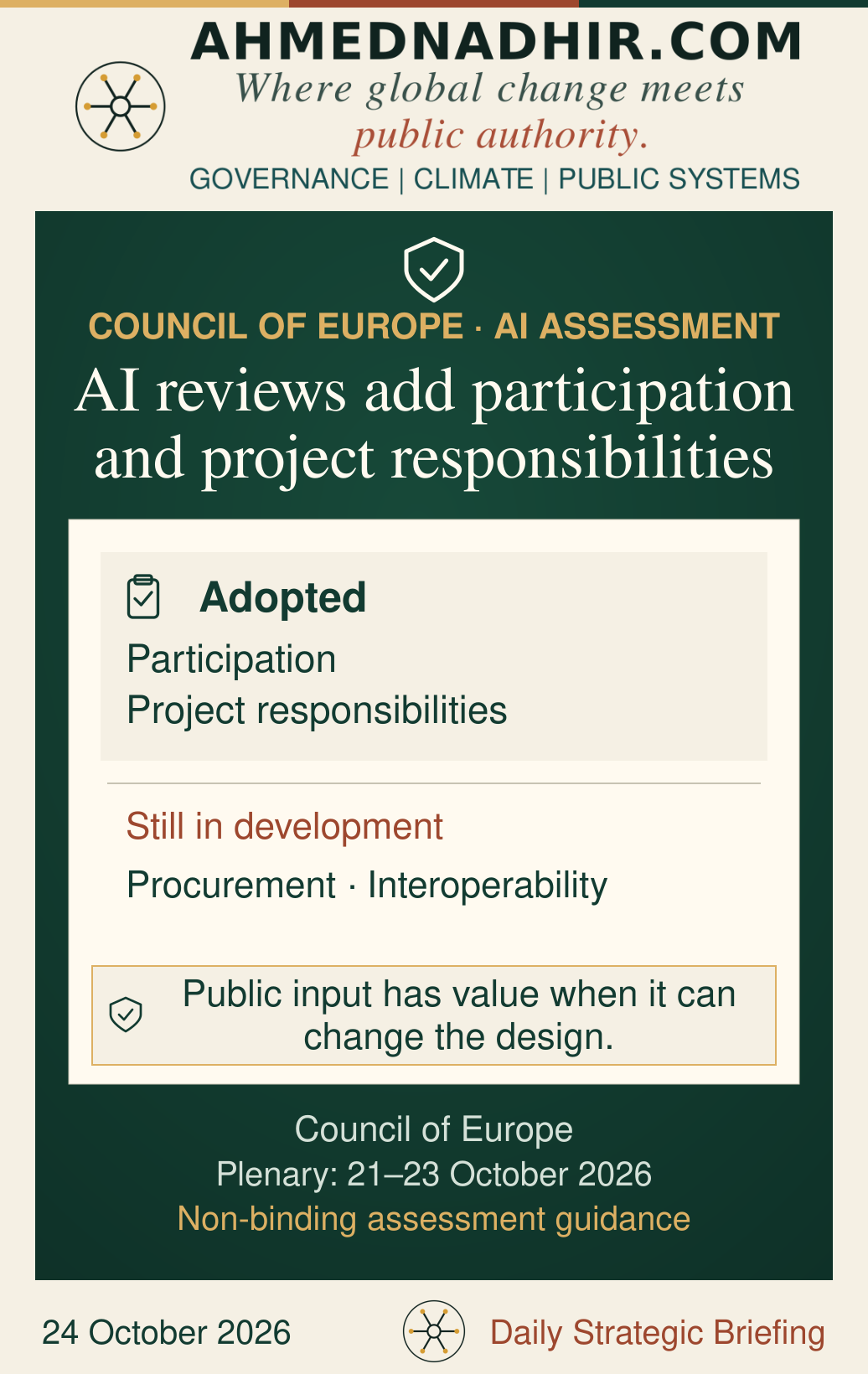
The Council of Europe’s Steering Committee for New and Emerging Digital Technologies has adopted two additions to its artificial intelligence (AI) assessment model: one on stakeholder engagement and one on responsibilities across a project’s lifecycle. The decision came at its 21–23 October plenary.
The additions form part of the Council’s guidance for assessing AI’s effects on human rights, democracy and the rule of law. This is non-binding guidance. The meeting account says procurement guidance and work on interoperability clauses remain in development.
The existing methodology includes the perspectives of potentially affected people in risk assessment. In a public service, that could mean learning how an automated application process affects someone unable to use the preferred digital channel. A technically accurate system can still create difficulties through the way access and support are organised.
The adoption advances the supporting guidance available to institutions. It does not show that participation has occurred in any particular project, that a service has become safer, or that procurement rules have changed. Those claims require evidence from implementation.