
Public finance · Climate-resilient investment
Zambia
Zambia’s financing gap reaches beyond the annual budget
African Development Bank account: 23 October 2026. Estimates concern annual structural-transformation needs through 2030; the launch-event date is not specified.
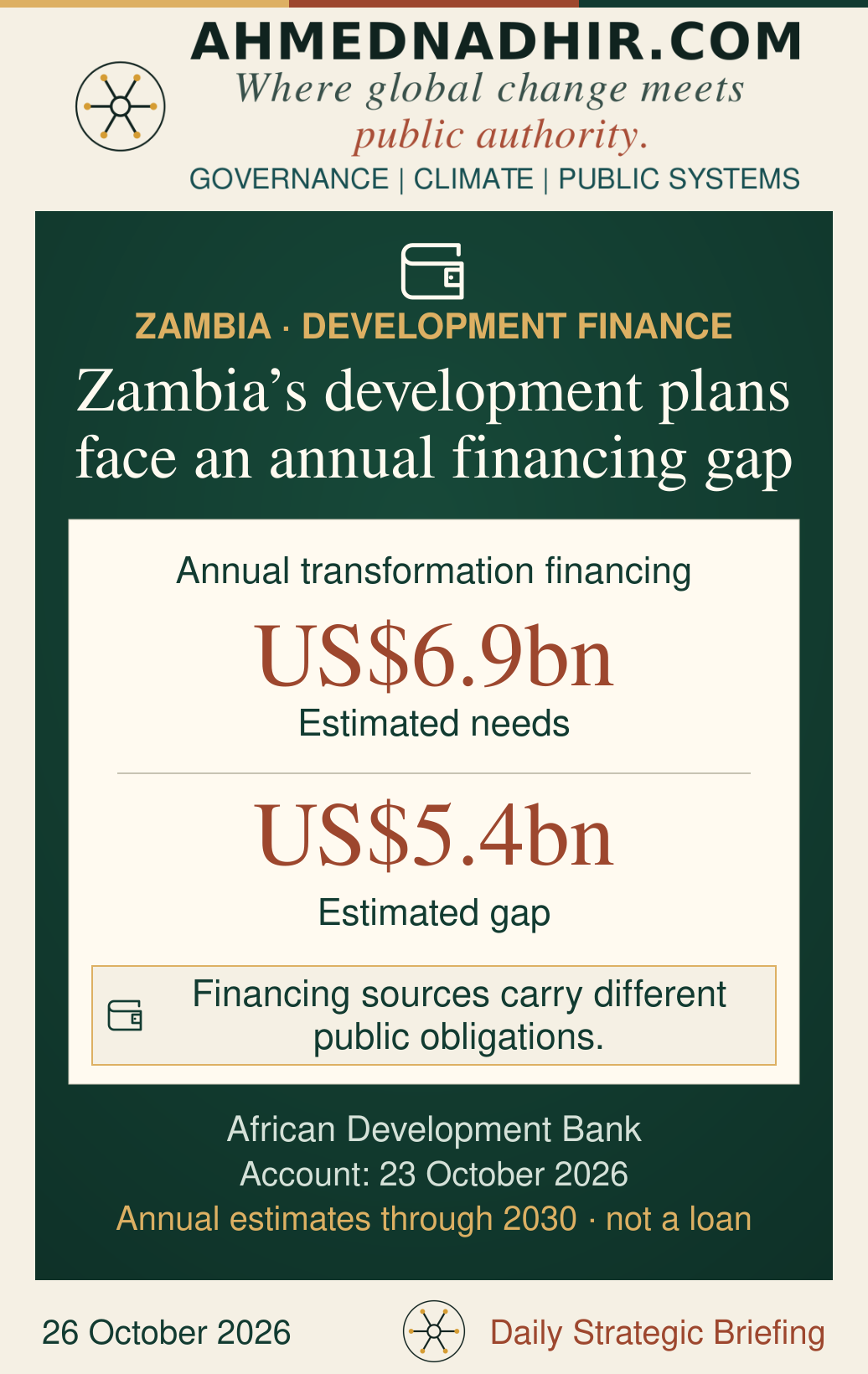
The African Development Bank’s 23 October account of its 2026 Zambia Country Focus Report estimates annual financing needs for structural transformation at US$6.9 billion through 2030, with a gap of about US$5.4 billion. These are development-financing estimates, not a newly announced loan or the shortfall in a single annual government budget.
The account identifies domestic revenue, capital markets and private investment as potential sources. Its priorities include climate-resilient infrastructure, agricultural processing and economic diversification. The financing instruments discussed are possible routes to capital; the announcement does not establish that the estimated gap has been closed.
Health · Continuity of essential care
Lita, Ituri province · Democratic Republic of the Congo
Lita’s maternity services recover as the Ebola response supports ordinary care
World Health Organization account: 22 October 2026. Delivery counts: June and September 2026; usual monthly average reported as about 80.
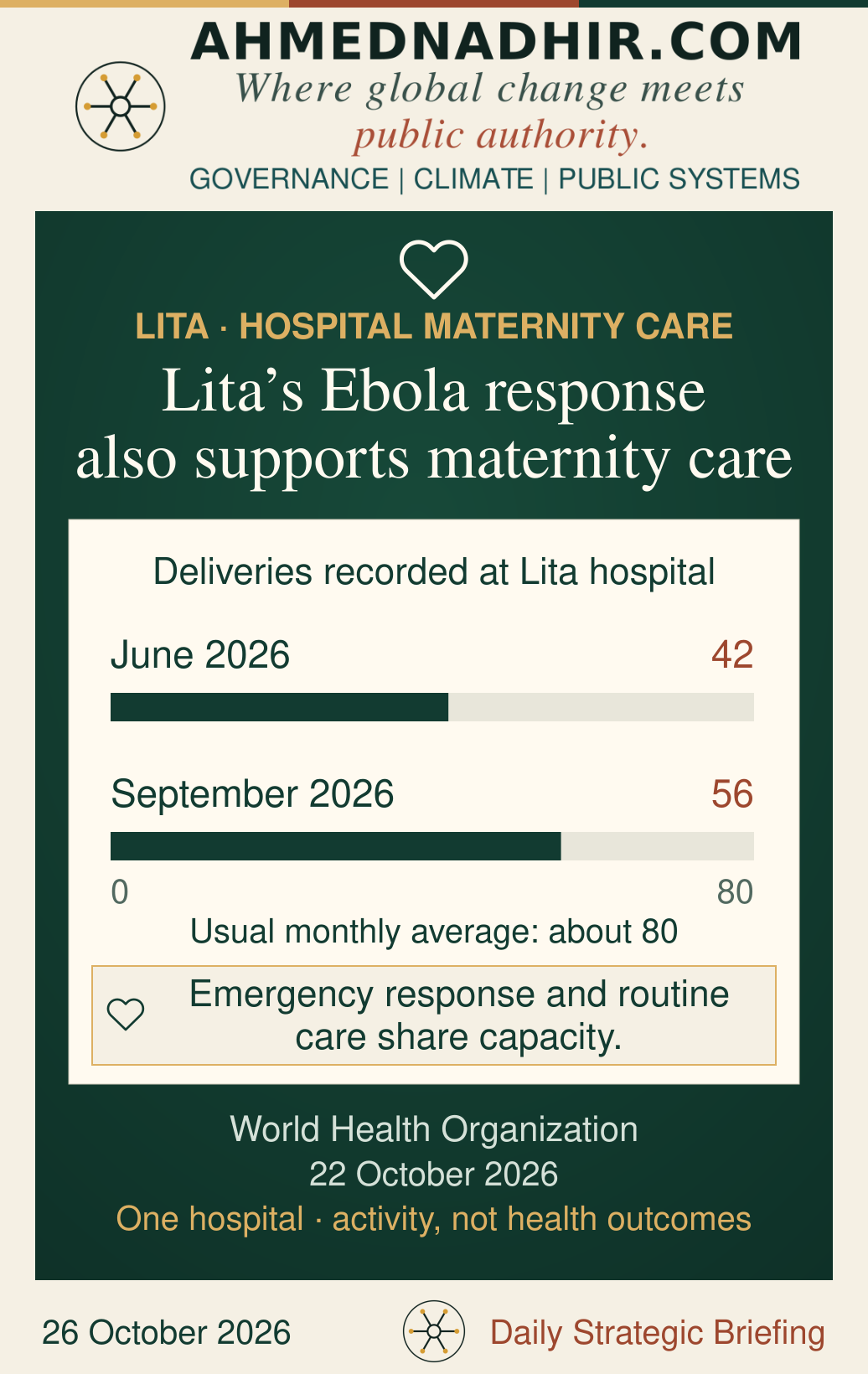
At Lita General Reference Hospital in Ituri province, the Ebola response disrupted care beyond the outbreak itself. The World Health Organization reports that maternity deliveries fell from a usual monthly average of about 80 to 42 in June. By September, the hospital recorded 56 deliveries, a recovery that still left activity below the reported usual level.
Its 22 October account describes additional beds, water supply, staff training and triage arrangements intended to separate suspected cases while maintaining general care. The monthly counts describe one hospital’s activity. They do not establish changes in population-wide access, maternal outcomes or the contribution of each intervention.
Artificial intelligence · Public administration
Kenya
Kenya launches a second government AI course targeting 9,000 public servants
Second cohort launched: 21 October 2026. First-cohort graduation: 8 October. Programme account published: 23 October.
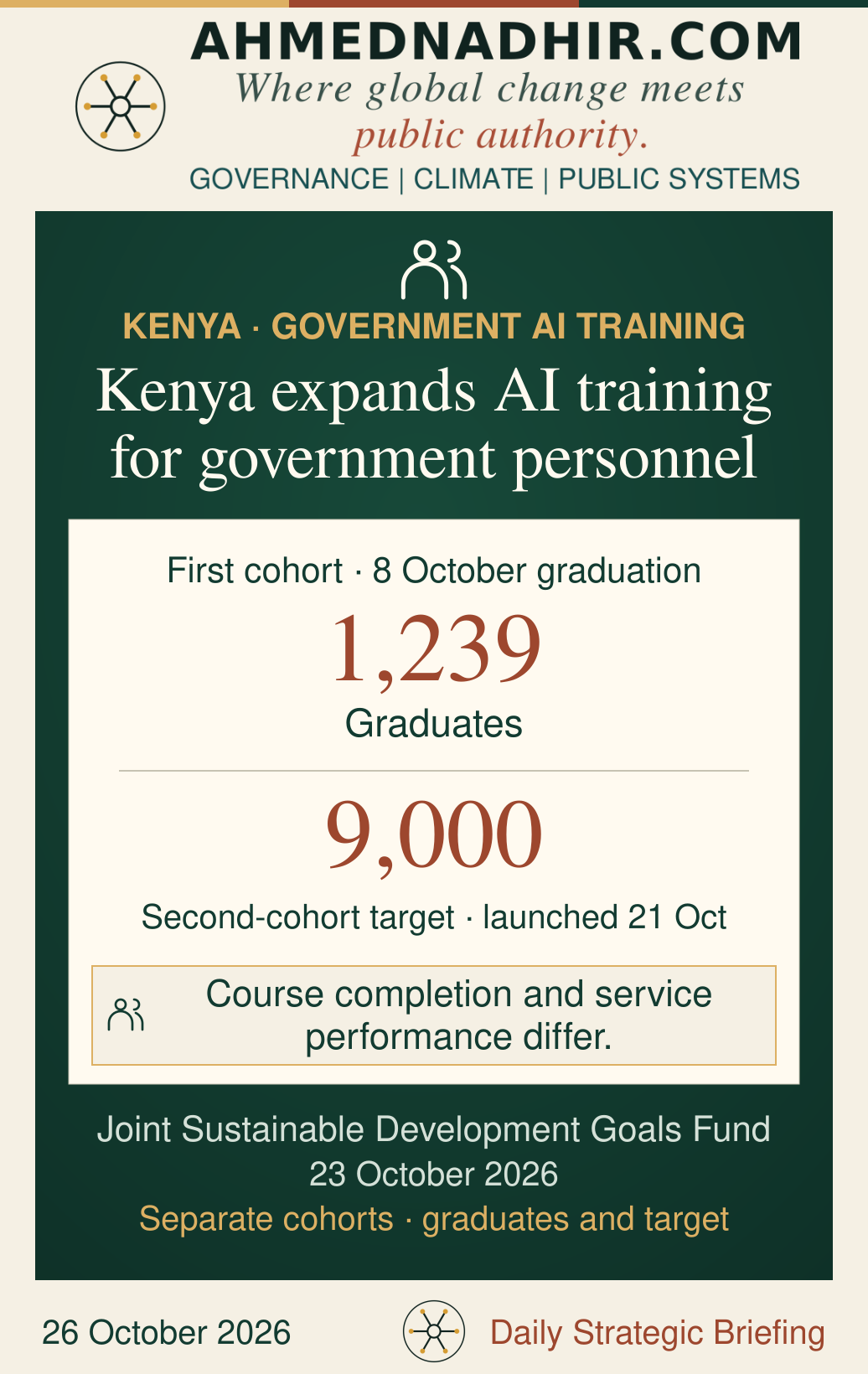
Kenya has launched a second cohort of a course on artificial intelligence (AI) and digital transformation in government, targeting an additional 9,000 public servants. The Joint Sustainable Development Goals Fund’s 23 October account dates the new launch to 21 October and reports 1,239 graduates from the first cohort at an 8 October ceremony.
The course was developed by the United Nations Educational, Scientific and Cultural Organization and the University of Oxford, working with the Kenya School of Government. It covers ethics, data governance and digital transformation. The graduate count records completed learning; the new cohort figure is a target. Neither establishes an improvement in service quality or the performance of a deployed AI system.
Governance · Artificial intelligence and work
Latin America and the Caribbean
Inter-American rights office focuses on the decisions automated systems make over workers
Statement published: 23 October 2026. The earlier technical workshop took place in August; this is a policy statement, not a newly enacted law.
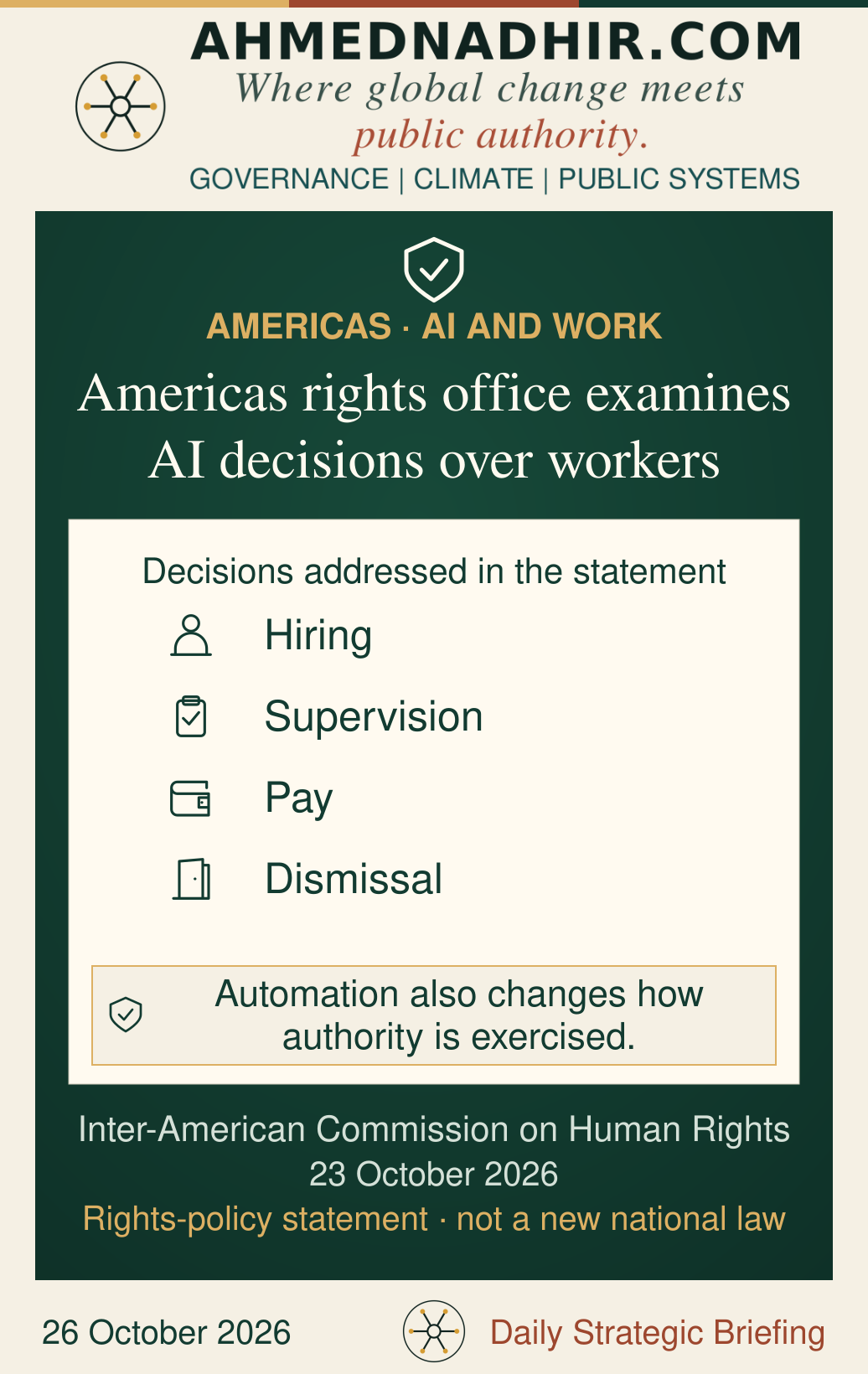
The economic, social, cultural and environmental rights office of the Inter-American Commission on Human Rights has called attention to AI and algorithmic management across hiring, task allocation, supervision, pay and dismissal. Its 23 October statement covers both public and private employment and highlights the position of workers in Latin America and the Caribbean.
Its central concern is the imbalance in information and power between organisations using these systems and the people affected. Understandable records, human intervention and routes to challenge decisions feature in the statement. This is an official rights-policy position; it does not itself enact a new national rule or establish compliance by an employer.