
Artificial intelligence · Investment and development
Doha, Qatar · Developing economies
United Nations investment forum turns attention from AI data centres to their use
UN Trade and Development account: 26 October 2026. Investment data: 2020–2025. World Investment Forum: 25–27 October in Doha.
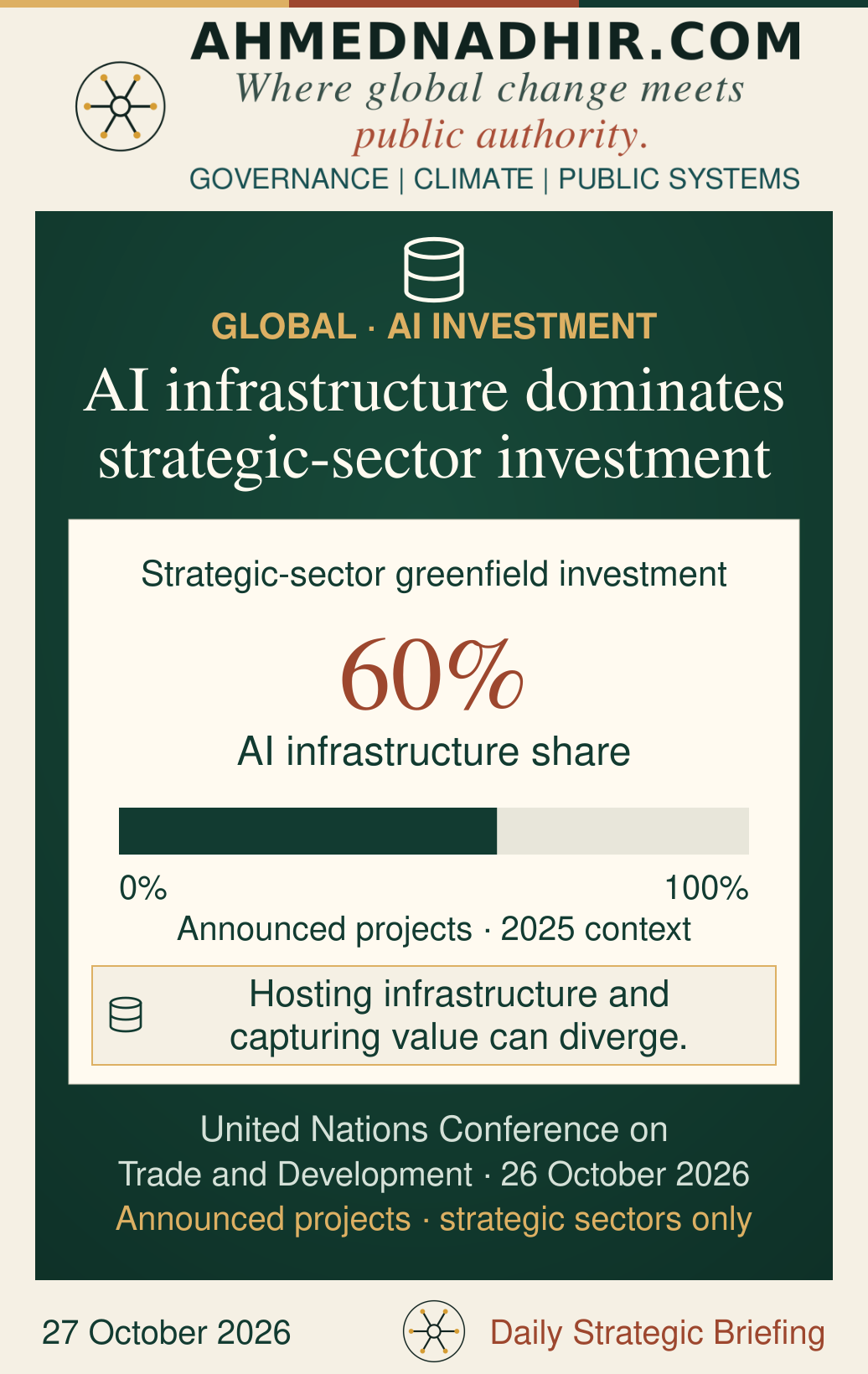
The United Nations Conference on Trade and Development says announced greenfield investment in artificial intelligence (AI) infrastructure grew by an average of 47 per cent a year between 2020 and 2025. AI infrastructure accounts for three fifths of greenfield investment in strategic sectors, according to its 26 October account of the World Investment Forum in Doha. This denominator is strategic-sector investment, not all global investment.
The account argues that developing economies capture value through use as well as production. Reliable electricity, affordable connectivity, research, skills, data and access to finance affect whether businesses and public services can adopt the technology. The figures describe announced projects; they do not establish completed facilities, local productivity gains or better services.
Health systems · Hand hygiene
Addis Ababa, Ethiopia · Households, schools, workplaces and public institutions
Ethiopia’s hand hygiene review identifies gaps in finance and oversight
World Health Organization account: 26 October 2026. The account does not specify the workshop’s calendar date.
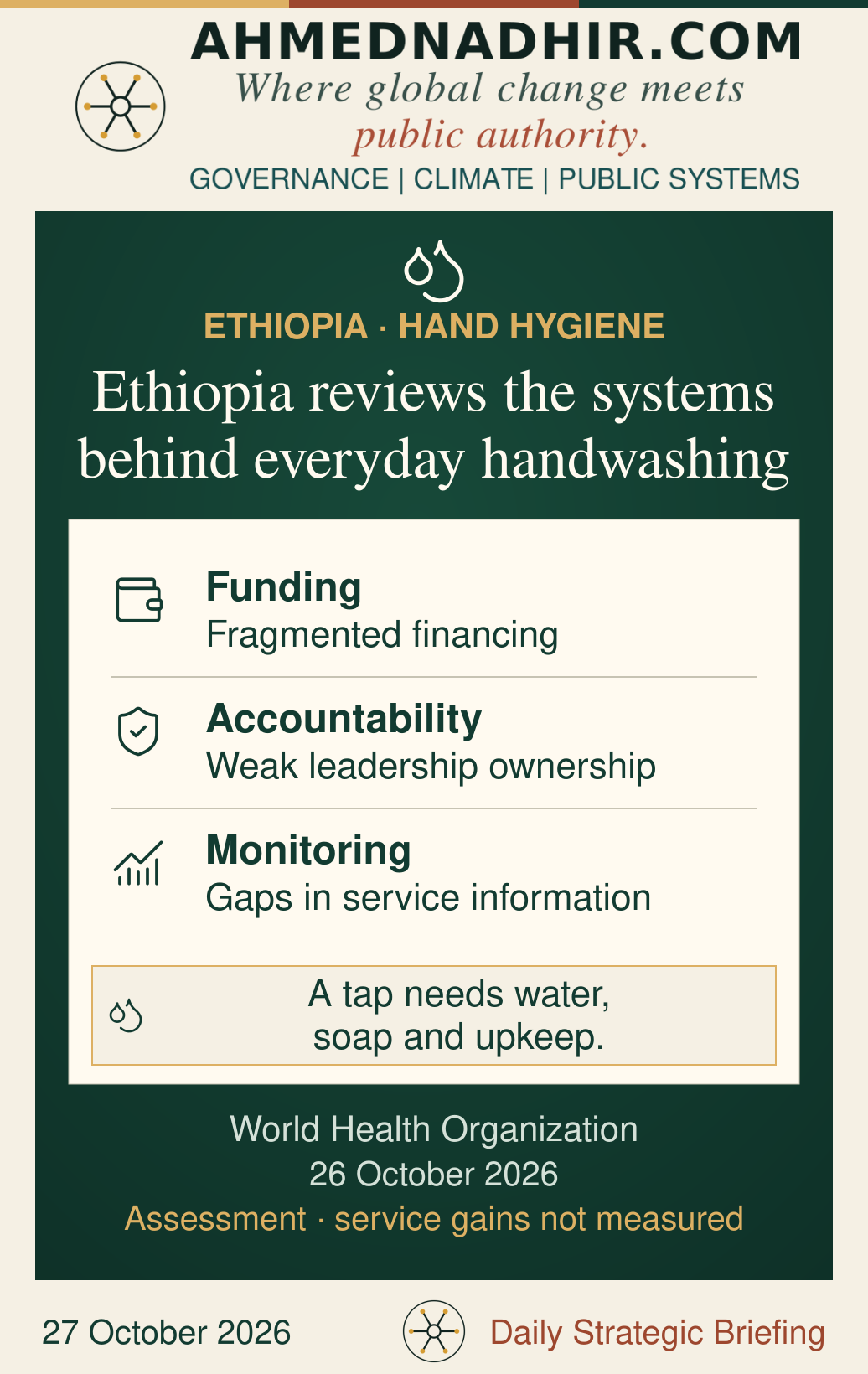
Ethiopian ministries and partners have reviewed the financing and oversight behind everyday handwashing. In an account published on 26 October, the World Health Organization describes a workshop in Addis Ababa examining the country’s Hand Hygiene for All assessment. Participants identified fragmented funding, weak accountability, limited capacity and gaps in service information.
Their recommendations connect hand hygiene with routine sector budgets, spending records and standards suited to households, schools, workplaces and public institutions. The account describes assessment findings and proposals for ministries. It announces no new funding allocation or measured improvement in access, and does not give the workshop’s calendar date.
Climate and resilience · Nature finance
Yerevan, Armenia · Global financial flows
United Nations environment chief presses for finance rules that change flows to nature
Speech at the biodiversity conference’s Finance and Biodiversity Day: 26 October 2026. Financial-flow estimates refer to 2023, not 2026.
Speaking in Yerevan on 26 October, United Nations Environment Programme Executive Director Inger Andersen argued that disclosure tools alone have not redirected enough money towards nature. She linked biodiversity finance to corporate reporting, subsidy policy and a more consistent way to count private funding.
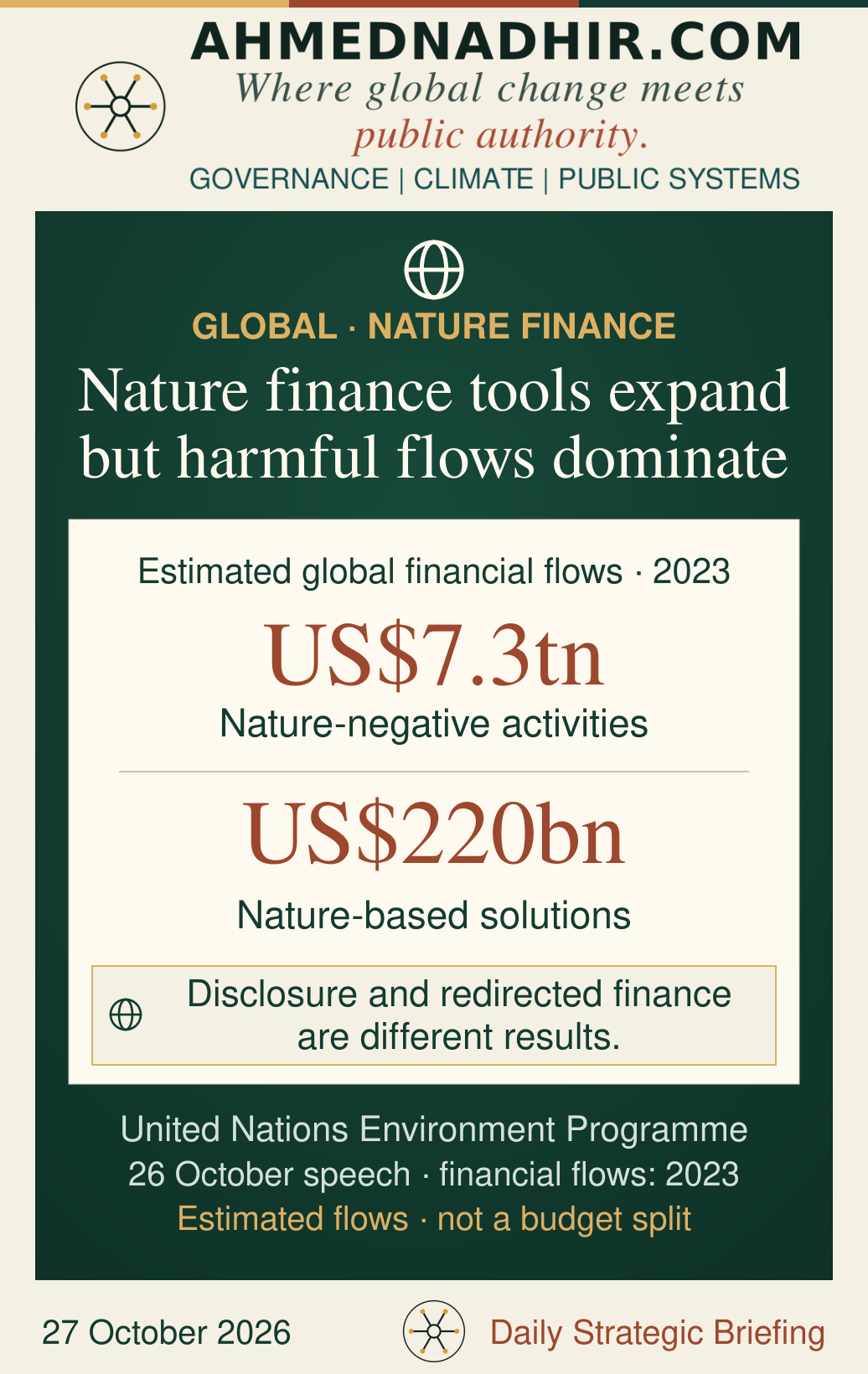
The programme’s State of Finance for Nature 2026 estimates that US$7.3 trillion flowed into nature-negative activities in 2023, compared with US$220 billion for nature-based solutions. These are broad estimated global flows with different scopes, not two parts of a government budget. The speech is a policy intervention at the conference, not evidence that a new binding disclosure requirement or subsidy reform has been adopted.
African economies · Development finance
Conakry, Guinea · African regional member countries
African Development Bank and UK Export Finance establish their first co-financing framework
Agreement signed: 21 October 2026 in Conakry. African Development Bank announcement: 23 October. Subsequent reporting appeared on 25–26 October.
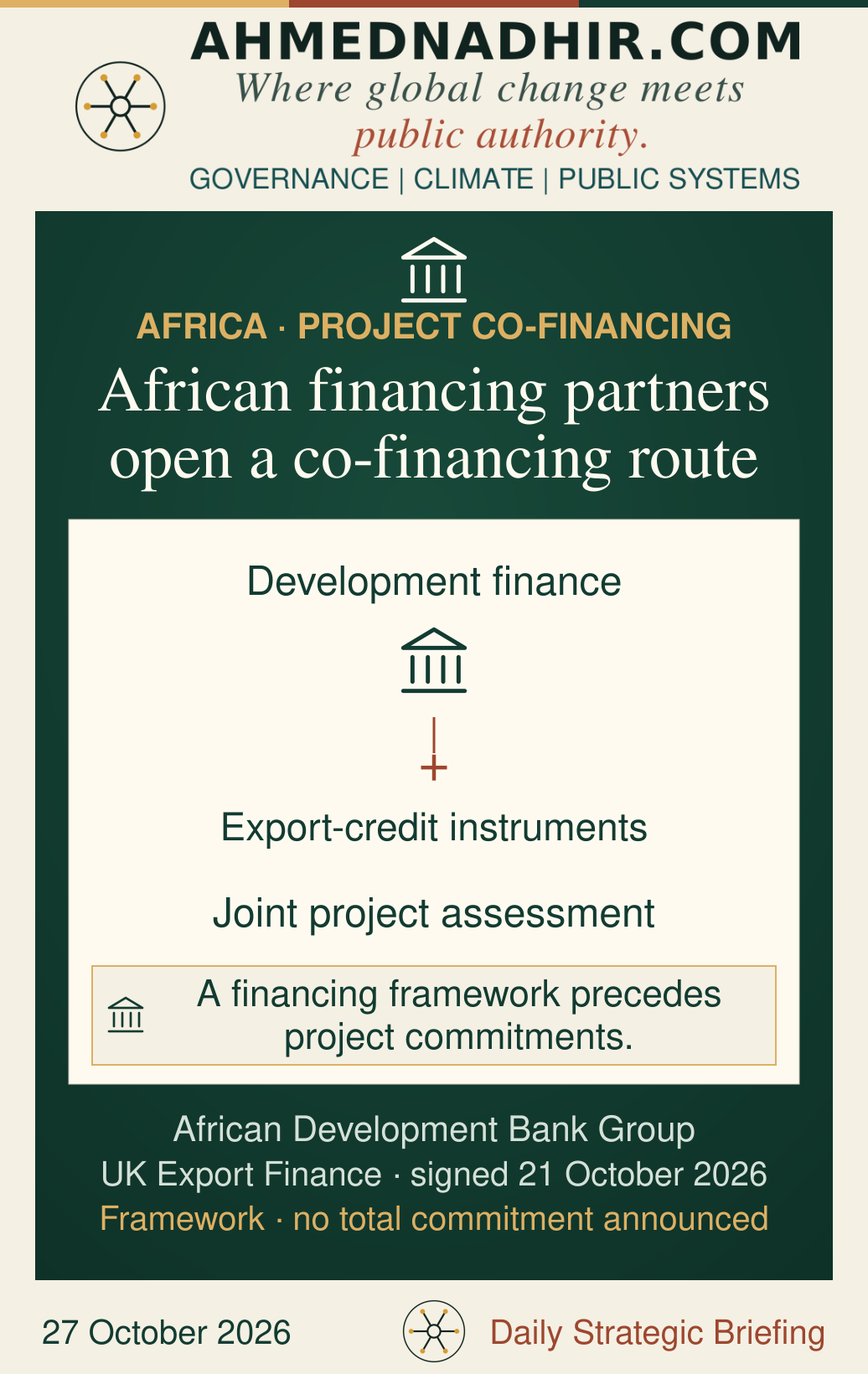
The African Development Bank Group and UK Export Finance signed their first cooperation framework on 21 October in Conakry, Guinea. Announced by the Bank on 23 October, the memorandum establishes a route to identify, assess and develop co-financing opportunities for sovereign and non-sovereign operations across the Bank’s African regional member countries.
Priority areas include energy, water and sanitation, health, digital infrastructure, agriculture and trade finance. The agreement brings development finance together with export-credit instruments. The announcement specifies no aggregate funding commitment, approved project list or disbursement total; it establishes a framework for subsequent transactions.