
Climate and resilience
Global observations · Implications for long-lived public infrastructure
Global carbon dioxide concentration reaches 426.8 parts per million
Bulletin and announcement: 27 October 2026. Observation year: 2025. Pre-industrial comparison: before 1750.
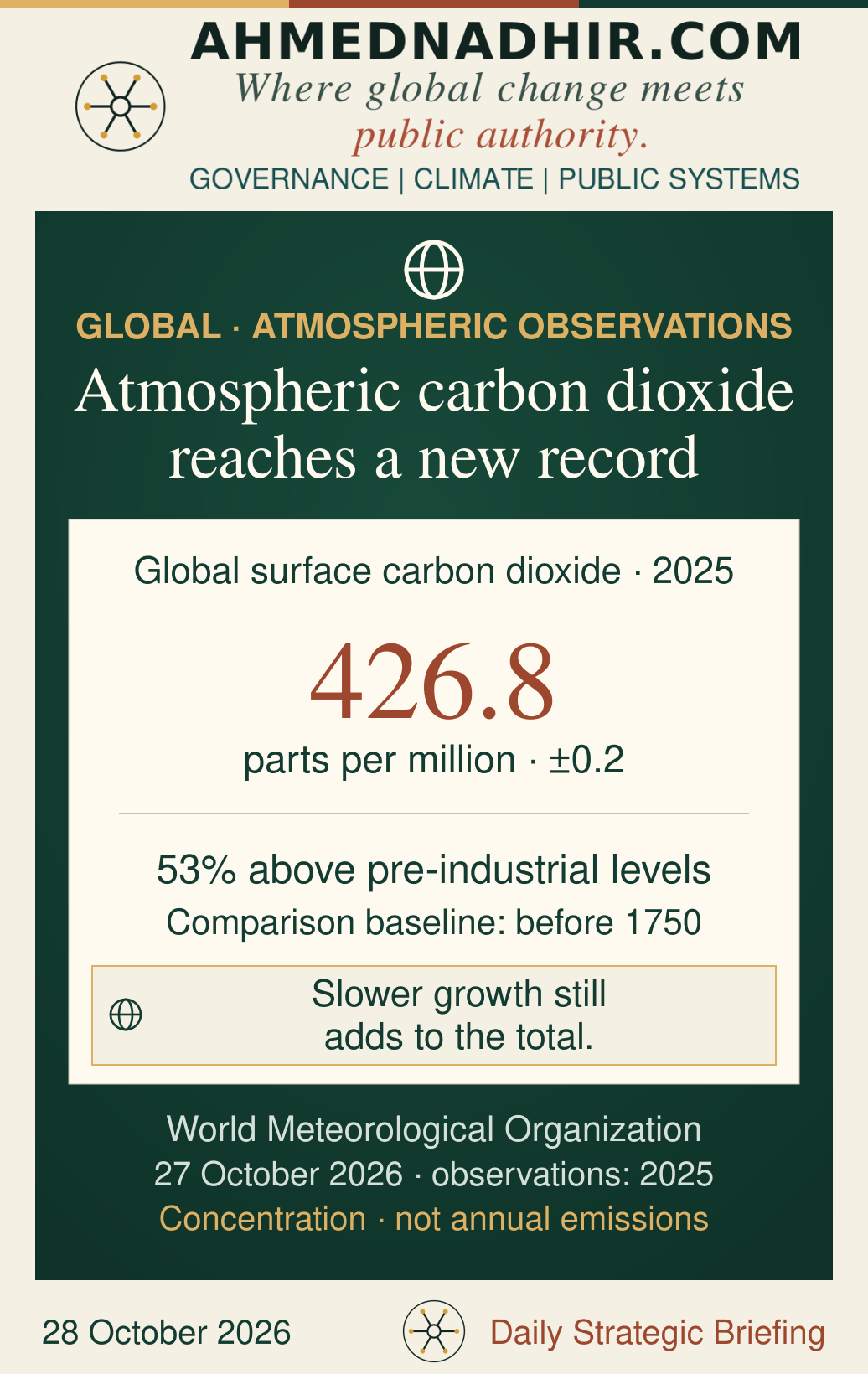
The World Meteorological Organization’s latest Greenhouse Gas Bulletin reports a globally averaged surface carbon dioxide concentration of 426.8 parts per million in 2025, with an uncertainty of ±0.2 parts per million. That is 53 per cent above the pre-industrial level. Methane and nitrous oxide also reached record concentrations.
Published on 27 October, the bulletin measures gases accumulated in the atmosphere. It does not measure annual emissions. Carbon dioxide rose by 2.8 parts per million between 2024 and 2025: a smaller increase than in the preceding year, while the total concentration continued upwards. The agency links carbon dioxide’s long persistence to warming over decades and centuries.
Health systems · Public finance
Gaborone, Botswana
Botswana brings finance and health ministries together around a 100-day reform plan
United Nations Economic Commission for Africa announcement: 27 October 2026. The account does not give separate dates for the meetings.
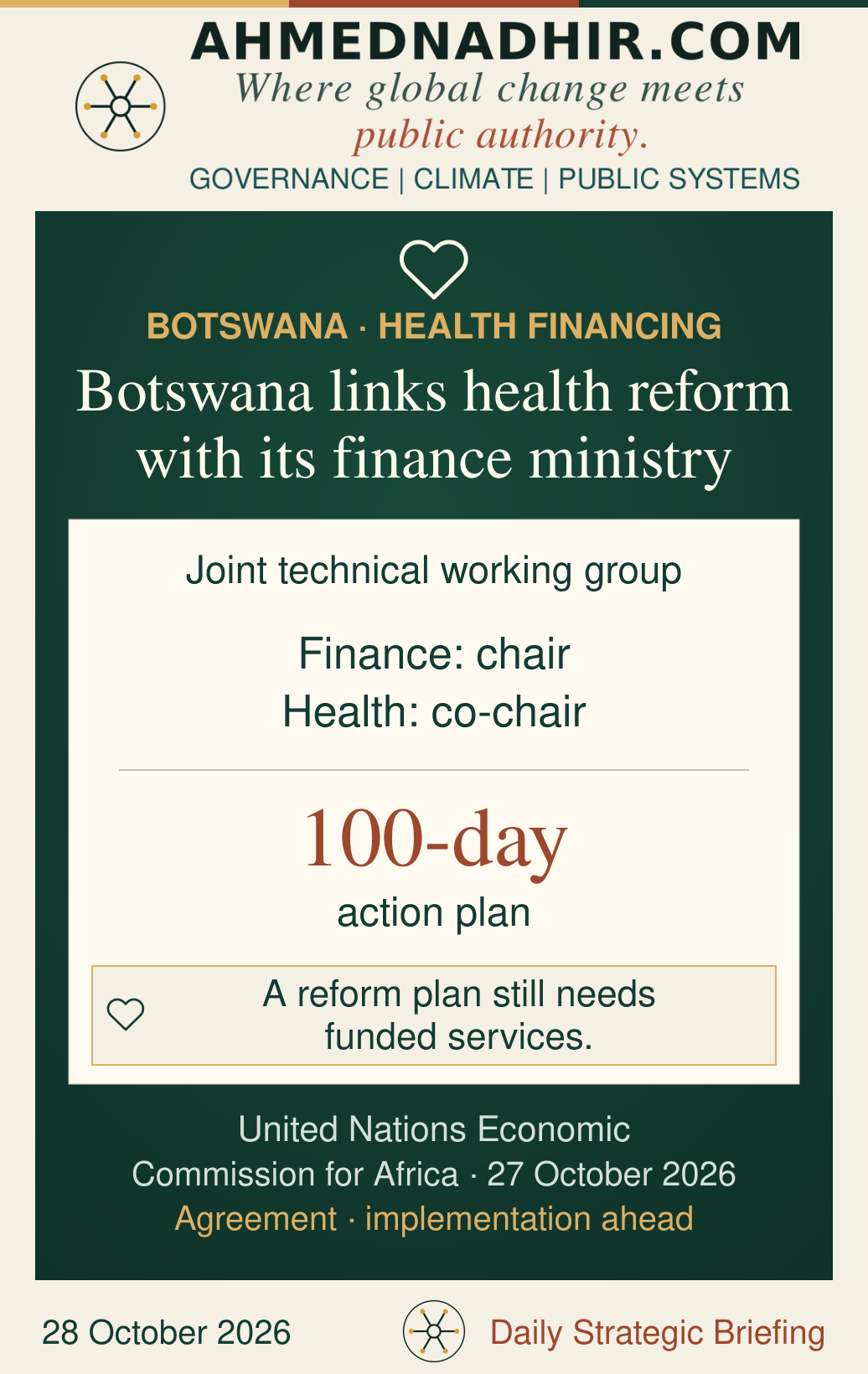
Botswana and the United Nations Economic Commission for Africa have agreed to establish a joint technical working group on health financing. The Ministry of Finance will chair it, with the Ministry of Health as co-chair and the Commission providing technical support. A 100-day action plan will guide priority measures, according to the 27 October account of engagements in Gaborone.
Discussions covered primary care, national health insurance, procurement and expenditure monitoring. This is an institutional agreement and reform agenda. The announcement specifies no new funding envelope, commencement date for the 100 days or measured improvement in services.
Artificial intelligence · Education and skills
International higher education · Report announced in Singapore
New AI report warns that completed group work can conceal less student discussion
Report announcement: 27 October 2026. The public resource page describes more than 80 global case studies; their individual observation periods are not specified there.
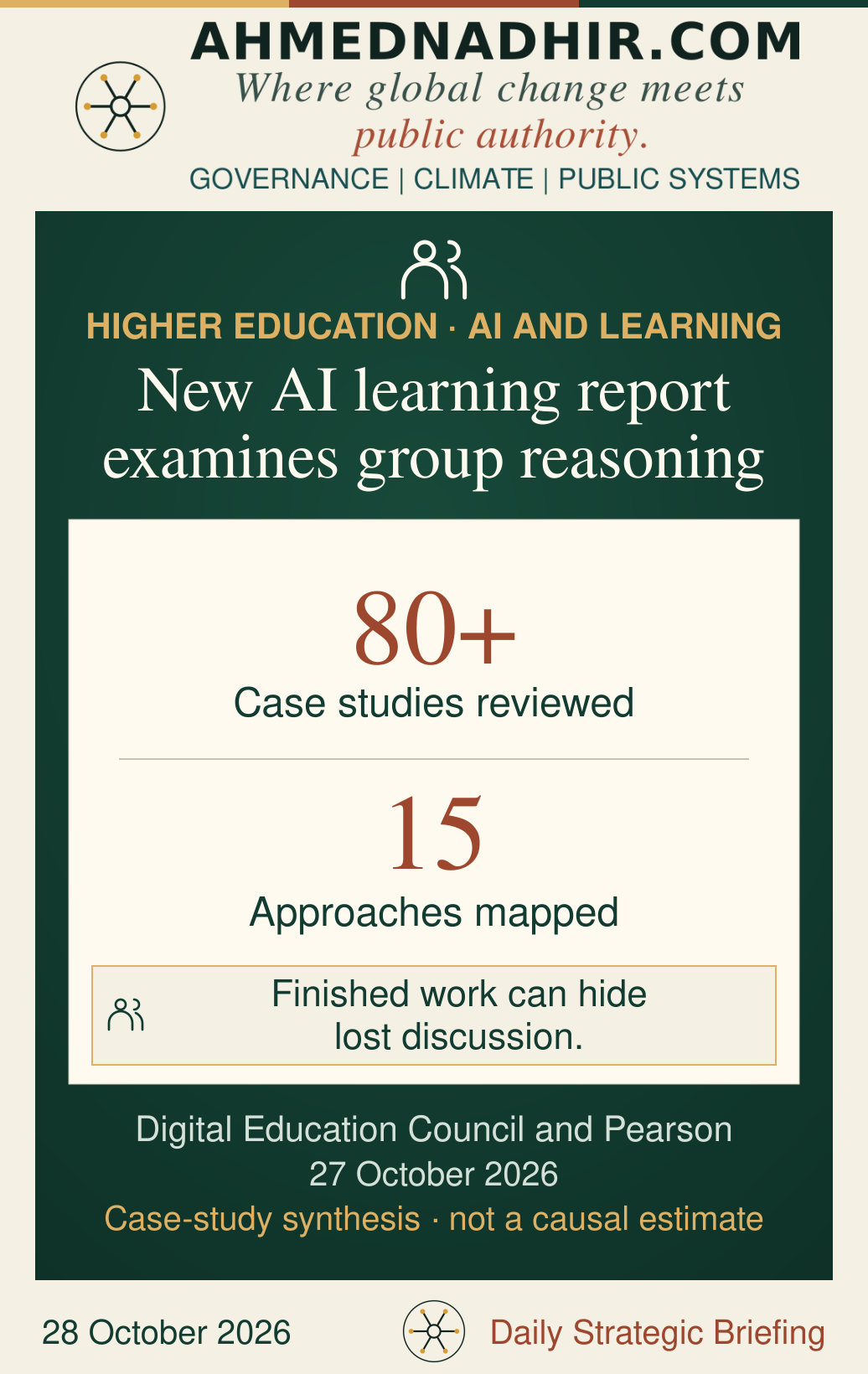
The Digital Education Council and Pearson announced Designing AI for Collaborative Learning on 27 October. Its public resource page describes an analysis of more than 80 global case studies and maps 15 approaches to using artificial intelligence (AI) in collaborative learning.
The announcement describes students arriving with similar AI-assisted ideas and asking AI to settle disagreements. It also reports students’ preference for tools that organise or explain rather than lead the group’s thinking. These are the publishers’ reported findings. The public material does not establish how prevalent these behaviours are across universities or provide a population-wide causal estimate of lost learning.