International research on public decisions and resources
Who can act on the evidence?
A regulator must be able to check an AI recommendation. A tax investigator must be able to trace company ownership. A public service must be reachable by the people it is meant to serve. Five new publications show what those duties require of government.
In this week’s edition
The five sources were published from 2 to 4 November 2026. They include regulatory principles, a legal peer review, a comparison of integration arrangements and two reports on regional development. Each is read within its own evidential limits.
The edition’s central argument
When the official cannot check the record
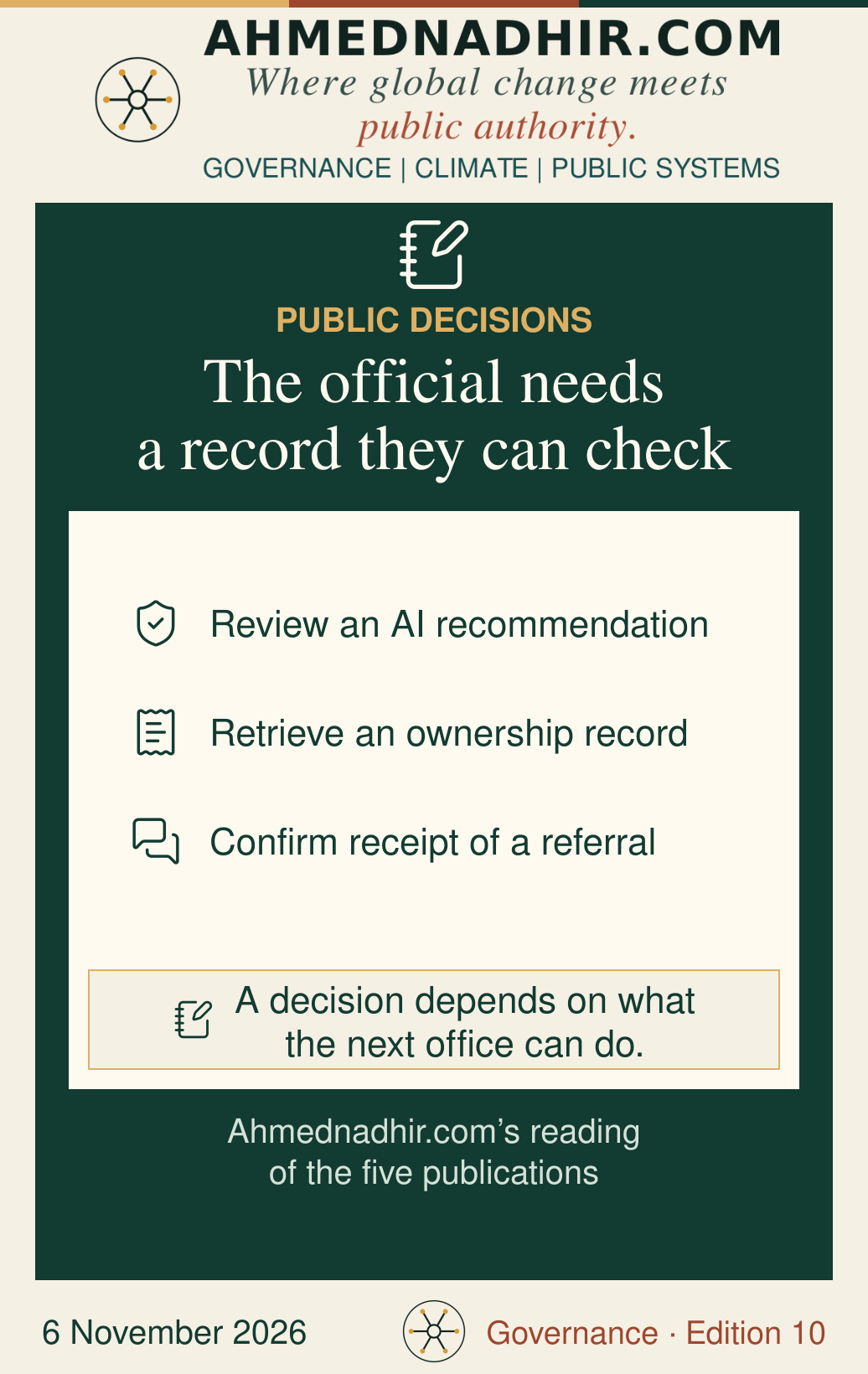
Imagine a medicines regulator reviewing a safety alert flagged by an AI tool. The official can see the recommendation, but only the supplier knows which version of the model produced it. Now consider a tax investigator who can lawfully request a company’s ownership records but cannot establish who controlled it on the date in question. Both officials have work to do that the rules alone cannot make possible. They need records they can retrieve, powers they can exercise and another office that will answer when something goes wrong.
The five readings connect a practical problem across institutions: a request, a recommendation or a referral has value only if an office can follow it through.
Editorial comparison of oversight and service handovers.
AI in regulatory decisions
The regulator must be able to intervene
Published by Center for Regulatory Science, Pharmaceuticals and Medical Devices Agency, Japan ·
Japan’s medicines and medical devices agency sets out principles for AI used in activities involving regulatory judgement. It calls for validation in the intended setting, records of data sources and changes, continuing monitoring and arrangements that allow people to intervene. Responsibility for the judgement remains with people.
The governance reading
Kenya
When a national regulator procures a tool to screen safety reports, the contract could require access to the model version and input record. A county reporting a suspected adverse event should have a route to correct the underlying record and receive a response.
Global South
Smaller regulators could share technical assessments across borders while retaining access to their own files and authority to suspend a use that performs poorly in their setting.
Wider significance
An official cannot take meaningful responsibility for a decision if a supplier alone can reconstruct how the recommendation was produced.
Japan’s principles require records of data sources and changes, validation in the setting of use and an arrangement for human intervention.
The official needs enough information to check and intervene.
Cross-border tax information
A tax request needs a retrievable record
Published by Global Forum on Transparency and Exchange of Information for Tax Purposes, OECD ·
The peer review of the Republic of the Congo identifies gaps in the availability of legal and beneficial ownership information, powers to obtain records, the network for exchanging information on request, and safeguards for incoming information. These are separate links in the handling of a tax request.
The governance reading
Kenya
A practical exercise between the tax authority and the registry would test whether an authorised request can recover the ownership position on a specified date, including changes since the original filing.
Global South
A small revenue authority can learn more from testing a few complete requests, including secure return and closure, than from counting signed agreements alone.
Wider significance
Cross-border transparency depends on both access and confidentiality. An authority must be able to establish who obtained the record, for which purpose and under what safeguards.
The Congo peer review distinguishes availability of ownership records, authority to retrieve them and confidentiality during exchange.
An exchange agreement cannot supply a record that was never kept.
This volume of Making Integration Work compares institutional arrangements for the integration of immigrants and their children in OECD countries. Its practical value lies in examining how integration policy is organised across the institutions that make rules and deliver support, drawing on country examples.
The governance reading
Kenya
Where documentation and service delivery meet, national offices and county providers can agree who handles an unresolved referral, how the person is informed and where a failed handover is escalated.
Global South
In places where municipalities, humanitarian agencies and ministries all provide support, an explicit handover can prevent a case from disappearing when a project closes or funding moves.
Wider significance
A measure of completed referrals, checked with the receiving office, offers a better view of co-ordination than a count of referrals sent.
Illustrative handover: the referring office sends the case, the receiving office confirms receipt, and the responsible office tells the person what happened.
A referral is complete when the next office acts and the person hears back.
Regional measures of opportunity
Where people go for a service can matter more than where they live
The OECD compares outcomes and access across regions, cities and functional labour markets. Its innovation measures show concentration: the largest functional urban area led in patent share in 27 of 31 countries studied for 2019–2024. In a separate measure, one small region attracted more than half of national venture capital in 32 of 39 OECD and accession countries with data for 2020–2024.
The governance reading
Kenya
County boundaries are useful for budgets. For access to a specialised service or training centre, planners could also examine the catchment that people actually travel across and account for who funds the trips or referrals.
Global South
Public investment appraisals can test whether a proposed hub reaches businesses beyond the capital by looking at travel times and repeat use rather than drawing a circle around the site.
Wider significance
Territorial comparisons work best when their unit matches the policy question. Labour markets, service catchments and political jurisdictions answer different questions.
A single small region received over half of national venture capital in 32 of 39 countries with data for 2020–2024.
National totals can conceal where finance is available.
Digital capacity and production
A digital investment needs people who can use it
Published by OECD, ECLAC, CAF Development Bank of Latin America and the Caribbean, and European Commission ·
The outlook argues that digital investment can serve productive development if connectivity and computing are matched with skills and institutions able to support firms. It describes digital and industrial programmes that have developed in separate ministries. Drawing on underlying sources cited in Figure 1.11, it reports basic digital skills for 45% of the region’s population, intermediate skills for 22% and advanced skills for 14%.
The governance reading
Kenya
For a regional AI procurement or a county digitisation project, an appraisal could specify the workflow and staff needed to use the service, the cost of support and a workable exit route before committing to capacity.
Global South
Neighbouring countries considering shared computing can negotiate access, data handling and price review together. Domestic agencies still need staff who can verify what the service delivers.
Wider significance
International financing for digital infrastructure should be judged against actual use and the distribution of capability, alongside the assets financed.
The Latin American Economic Outlook reports basic digital skills for 45%, intermediate for 22% and advanced for 14%. The shares are not additive.
Access to technology and the skills to use it are separate questions.
The governing question
What each office must be able to do
Japan’s regulator asks whether an official can intervene when a tool goes wrong. The Congo review asks whether an authority can obtain and protect the information it is entitled to request. The OECD’s integration report brings the problem to the service counter: one office may take the details, but another must carry the case to a decision. The territorial reports ask where people can actually reach services and where firms have the skills to use new technology. These are separate tests of government. Each can change a practical choice: what to require in a contract, how to hand over a case or where to put an investment.
Reflections for policy work
Three questions to carry into the institution
Who can reconstruct a decision?
Before adopting AI in a consequential workflow, can the designated official retrieve the evidence, model version and review record, and intervene without waiting for the supplier?
Who follows a case to the next office?
For a tax request or service referral, which office verifies receipt and completion, who can recover a missing record and where does an unresolved case go?
Where can people actually reach the service?
Would the proposed funding or service location change if officials examined travel patterns, skill shortages and actual use rather than relying on an administrative average?
Original publications
Sources and publication dates
The research accounts report the publications’ claims. The governance readings, interpretive diagrams and synthesis are Ahmednadhir.com’s analysis. The sources differ in method and reach; their findings do not establish a common measured effect on public services.