
Who can reconstruct a decision?
Before adopting AI in a consequential workflow, can the designated official retrieve the evidence, model version and review record, and intervene without waiting for the supplier?
A regulator must be able to check an AI recommendation. A tax investigator must be able to trace company ownership. A public service must be reachable by the people it is meant to serve. Five new publications show what those duties require of government.
The five sources were published from 2 to 4 November 2026. They include regulatory principles, a legal peer review, a comparison of integration arrangements and two reports on regional development. Each is read within its own evidential limits.
Japan’s medicines regulator calls for records and human intervention when artificial intelligence supports a regulatory decision.
Read the finding and its implications →A peer review of the Republic of the Congo identifies gaps in ownership records, access powers and confidentiality safeguards.
Read the finding and its implications →The Organisation for Economic Co-operation and Development compares how countries assign responsibility for helping migrants settle.
Read the finding and its implications →In 32 of 39 countries with data, one small region received more than half of national venture capital in 2020–2024.
Read the finding and its implications →The Latin American Economic Outlook reports that 45% of the region’s population has basic digital skills.
Read the finding and its implications →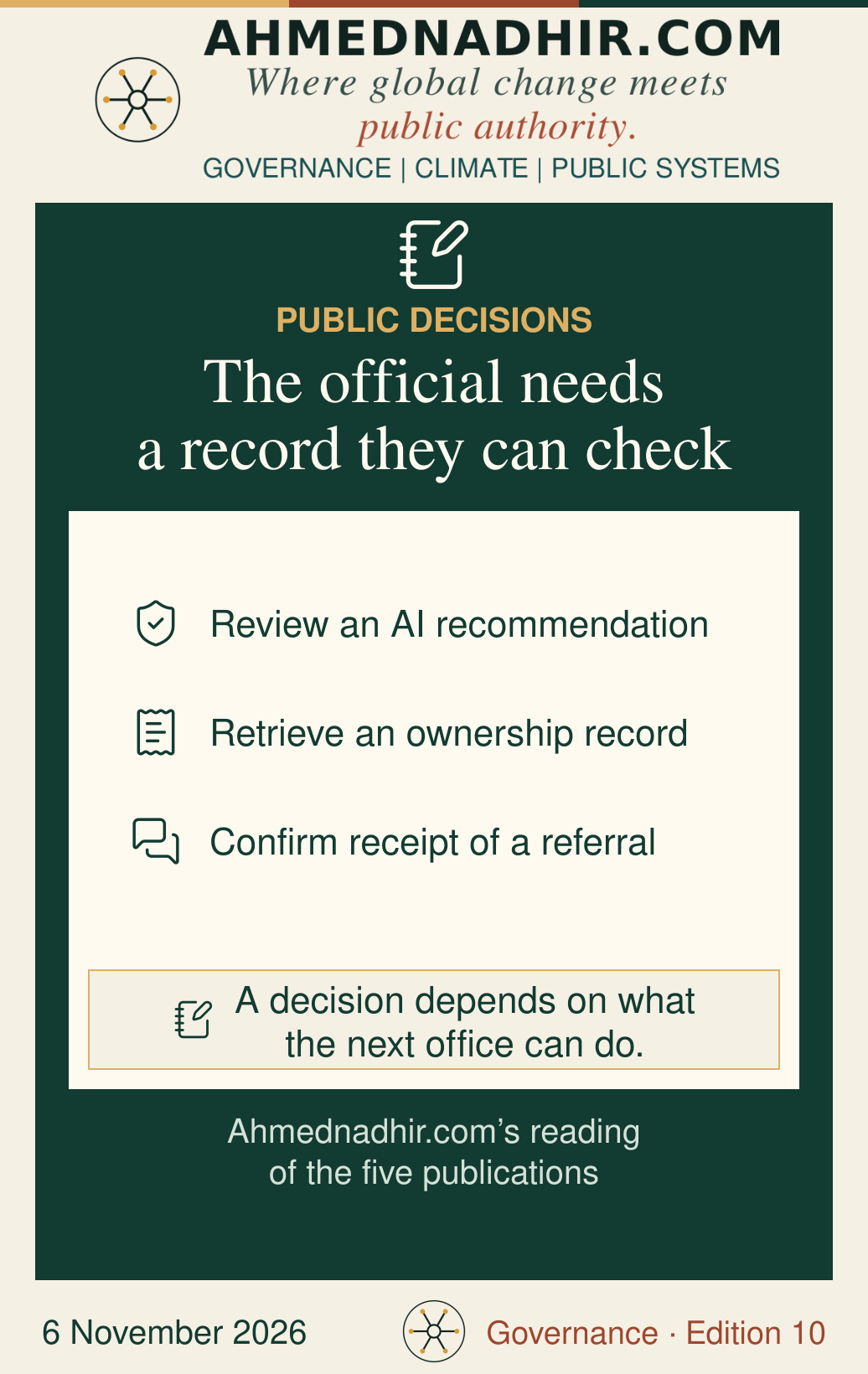
The governing question
Japan’s regulator asks whether an official can intervene when a tool goes wrong. The Congo review asks whether an authority can obtain and protect the information it is entitled to request. The OECD’s integration report brings the problem to the service counter: one office may take the details, but another must carry the case to a decision. The territorial reports ask where people can actually reach services and where firms have the skills to use new technology. These are separate tests of government. Each can change a practical choice: what to require in a contract, how to hand over a case or where to put an investment.
Japan’s guidance states principles. The Congo review examines the legal framework. The regional figures describe where venture finance and digital skills are found.
For policy work
Before adopting AI in a consequential workflow, can the designated official retrieve the evidence, model version and review record, and intervene without waiting for the supplier?
For a tax request or service referral, which office verifies receipt and completion, who can recover a missing record and where does an unresolved case go?
Would the proposed funding or service location change if officials examined travel patterns, skill shortages and actual use rather than relying on an administrative average?