
How long would it take to switch?
Before a public body renews a critical digital service, what has it actually tested about exporting records, replacing the supplier and continuing to serve people during the change?
A ministry signs a cloud contract. An assembly receives a fiscal risk report. A resident follows advice from a government chatbot. In each case, the first decision matters. So does what happens when the price rises, the risk materialises or the advice is wrong.
The five publications appeared between 9 and 12 November 2026. They include analysis of UK technology contracts, a public consultation report with provisional findings, two surveys of government practice and a Canadian study that estimates the costs of justice problems.
The Institute for Public Policy Research proposes pooling technology capabilities with other countries to reduce Britain’s reliance on overseas suppliers.
Read the finding and its implications →In the Internet Governance Forum network’s 13 selected cases, four drew on independent outcome measurement and one on direct accounts from affected people.
Read the finding and its implications →Most legislatures surveyed by the Organisation for Economic Co-operation and Development receive fiscal risk information; a minority debate it.
Read the finding and its implications →In a 2025 survey by the Organisation for Economic Co-operation and Development, 46% of responding institutions were exploring artificial intelligence for government communication.
Read the finding and its implications →A Canadian study by the Organisation for Economic Co-operation and Development estimates CAD 57.5 billion in social costs across 12 categories of justice problems.
Read the finding and its implications →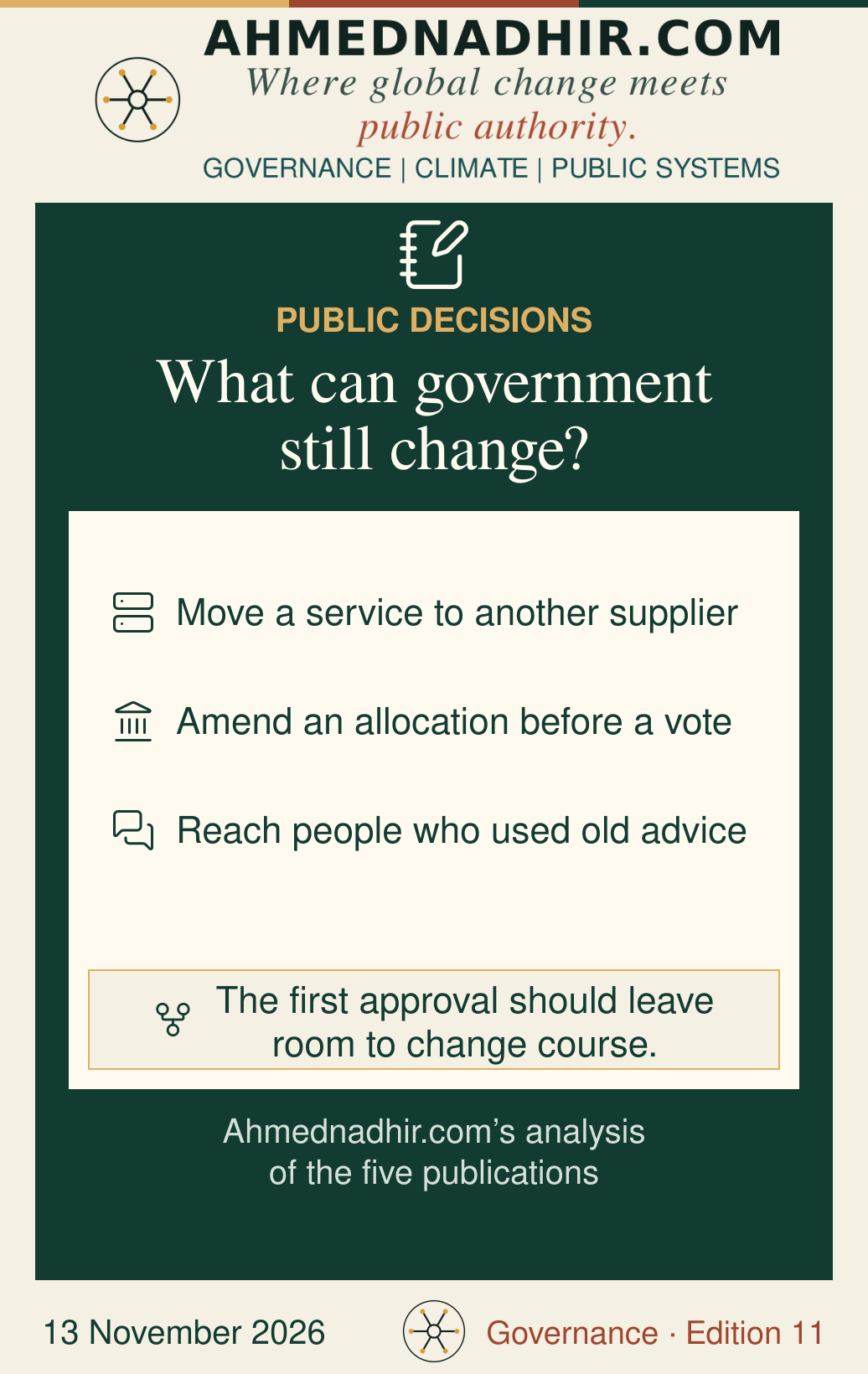
The governing question
The first two readings suggest that a public body has to buy itself room to act. A replacement supplier cannot help if the service cannot move, and an oversight body cannot learn whether a rule worked if it only receives evidence that a procedure was followed. The communication report takes that problem into the life of a resident: a corrected government page may still leave earlier advice circulating through search or a chatbot.
Legislative scrutiny raises a question of timing. A risk report that reaches members after they can change allocations may document the problem without changing the budget. Canada’s justice study then asks whose costs count. A saving at the counter can leave households paying through lost work or delayed help. These sources use different methods. What they make possible together is a sharper question at the point of approval: if the arrangement fails, who will have the authority, time and evidence to change it, and who will pay while they do?
For policy work
Before a public body renews a critical digital service, what has it actually tested about exporting records, replacing the supplier and continuing to serve people during the change?
Will members see the risks while they can still amend the allocation? If the service gives wrong advice, who can correct it and contact people who acted on it?
If the public body spends less, what happens to household travel, missed work, waiting time and unresolved cases? Which of those costs will appear in the appraisal?