International research on public decisions and resources
What government must be able to change
A ministry signs a cloud contract. An assembly receives a fiscal risk report. A resident follows advice from a government chatbot. In each case, the first decision matters. So does what happens when the price rises, the risk materialises or the advice is wrong.
In this week’s edition
The five publications appeared between 9 and 12 November 2026. They include analysis of UK technology contracts, a public consultation report with provisional findings, two surveys of government practice and a Canadian study that estimates the costs of justice problems.
The edition’s central argument
When an office needs to change course
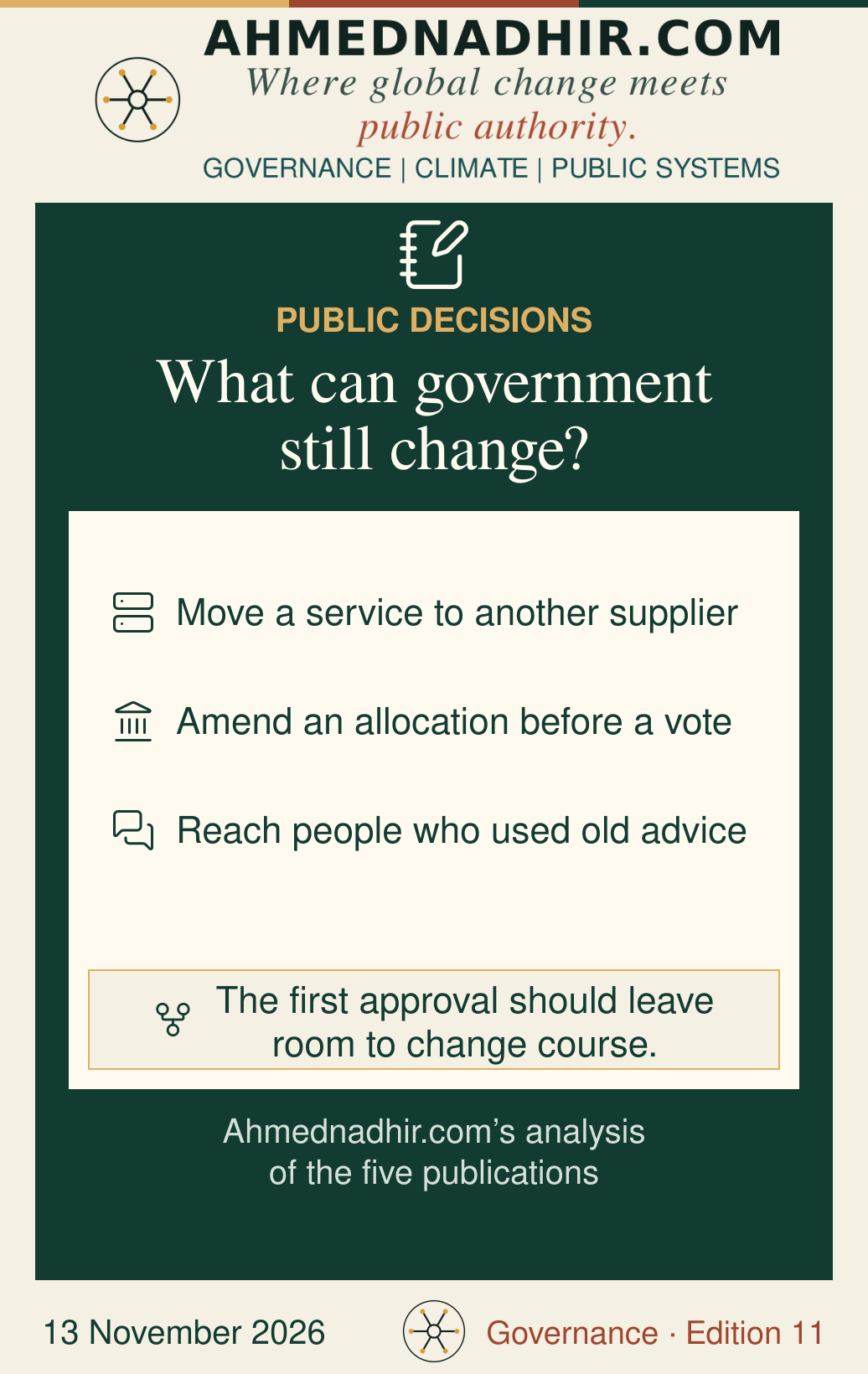
Consider a licensing office that discovers its supplier will retire the model on which its helpline depends. The contract may promise access until the end of the term, but that promise leaves the office with a different problem: how to move its records and keep answering people while a replacement is tested. The same distinction runs through this week’s readings. The moment when an institution first gives its approval can be less consequential than the moment when it needs to revise it.
Three tests of what a public institution can change after approval.
Technology procurement
The test of a cloud contract comes when it has to end
Published by Roa Powell, Nayana Prakash and Carsten Jung, Institute for Public Policy Research ·
The authors use UK public technology contracts to examine dependence on overseas suppliers. They argue that Britain is unlikely to control a critical part of the frontier AI supply chain on its own. Their preferred response is to spread dependence through partnerships with other middle powers that can contribute meaningful capabilities of their own.
The governance reading
Kenya
A county buying a service on a national framework can ask who can export the records, who will pay for migration and which office will run the service if the supplier withdraws. A rehearsal with a representative export would expose problems before the authority commits to a renewal.
Global South
Smaller markets may be able to negotiate better terms together for switching and interoperability. The practical division of labour matters: a regional buyer can bargain over terms, while a domestic service owner still needs people who can test a replacement.
Wider significance
A supplier can be registered locally while its models, updates and infrastructure remain beyond the buyer’s control. Governments can assess dependence by asking how long a service would take to restore under a different supplier.
The contract test is whether the service can continue when the supplier leaves.
A service can be available today and still prove difficult to move.
AI oversight
A rule in operation can still leave its effects unknown
Published by Policy Network on Artificial Intelligence, Internet Governance Forum ·
In a public consultation report, the network reviews 13 cases, comprising 12 from 11 countries and one international standard. Four draw on independent measurement of outcomes and just one includes direct accounts from those most affected. The network finds that evidence is stronger on whether instruments were put into operation than on whether they improved outcomes.
The governance reading
Kenya
A county pilot can log the applicant’s outcome when an official overrides the tool or a resident contests its advice. A national oversight body could then inspect a sample across councils without treating the number of completed compliance forms as proof of improvement.
Global South
A regulator with limited staff could ask an independent university, auditor or civil society partner to examine a sample of contested cases. The institution would have to pay for that scrutiny and protect the people who take part.
Wider significance
International comparisons could distinguish an adopted rule, an operating control and an independently checked outcome. Those are different stages, and publishing them separately would make claims of progress more useful.
These are two measures of evidence from the same selected cases.
Putting a rule into operation is easier to establish than its effect on people.
Legislative scrutiny
Fiscal scrutiny has to arrive while choices are open
Published by Organisation for Economic Co-operation and Development ·
Drawing on its 2025 survey of parliamentary budget oversight, the OECD finds that most legislatures receive fiscal risk and sustainability information but only a minority debate it. Only a minority vote on aggregate budget totals before considering detailed allocations. Legislative access to information therefore coexists with uneven opportunities to use it when setting the budget.
The governance reading
Kenya
When a county assembly scrutinises a proposed system, members need to see recurrent licence costs, replacement obligations and the source of funding in time to amend the allocation. National and county committees can apply that same question within their respective budget powers.
Global South
Where debt service narrows the room for manoeuvre, an independent budget office can make trade-offs visible before committees settle individual lines. Its analysis needs access to the assumptions behind contingent liabilities and recurrent costs.
Wider significance
The timing of a hearing can determine what it achieves. Publishing the date when a risk was debated alongside the action taken would reveal more than a register of reports received.
The survey measures separate practices, with no percentages shown.
A risk can be documented without changing an allocation.
Government communication
An official correction has to reach the person misled
Published by Organisation for Economic Co-operation and Development ·
The OECD examines how platform algorithms and generative AI are changing the way people find official information. Its 2025 survey places 46% of responding institutions at an exploratory stage of AI use. The report describes drafting, translation and adapting content among early applications and argues for testing, human oversight and clearer disclosure.
The governance reading
Kenya
A county that changes the documents required for a permit could publish the effective date in a durable official notice, then test the answer in the languages used by residents. Staff who receive callers or visitors need the same notice and a way to report old advice.
Global South
Where access runs through messaging services or community radio, a ministry can plan for corrections in those channels as well as on its website. It should assess whether people can verify the advice without owning a recent smartphone or paying for more data.
Wider significance
As search services supply answers directly, the authority publishing the rule may lose control of the route through which people hear it. A dated official record, a clear correction and an accessible channel for redress help preserve public responsibility.
The survey measured stages of AI adoption, not the frequency of wrong answers.
An official page can change while earlier advice continues to circulate.
The cost of unresolved problems
A saving at the counter can leave a cost at home
Published by Organisation for Economic Co-operation and Development ·
The OECD estimates CAD 57.5 billion in social costs across 12 categories of justice problem, equivalent to about 2.4% of Canada’s 2021 GDP. The largest share falls on individuals and households, including through lost income, ill health and suffering. The study combines surveys, administrative records and other evidence, counting effects of underlying problems as well as the resources used to address them.
The governance reading
Kenya
When a county service changes where people lodge a complaint, its own handling costs tell only part of the story. An appraisal could also record extra travel, days away from work and unresolved cases, while keeping the national justice system’s responsibilities distinct.
Global South
Where informal work makes lost income hard to observe, interviews about time and missed earnings can improve appraisal without pretending the costs can be estimated precisely. The first comparison can be between two realistic ways of getting help.
Wider significance
A reform judged on agency costs alone may look efficient while increasing the time and expense people incur. Appraisal should identify separately what the institution saves and what households are left to bear.
Canada’s 2021 GDP provides a benchmark for the modelled burden.
An agency’s accounts can miss costs borne by households.
The governing question
What a public body can still change
The first two readings suggest that a public body has to buy itself room to act. A replacement supplier cannot help if the service cannot move, and an oversight body cannot learn whether a rule worked if it only receives evidence that a procedure was followed. The communication report takes that problem into the life of a resident: a corrected government page may still leave earlier advice circulating through search or a chatbot.
Legislative scrutiny raises a question of timing. A risk report that reaches members after they can change allocations may document the problem without changing the budget. Canada’s justice study then asks whose costs count. A saving at the counter can leave households paying through lost work or delayed help. These sources use different methods. What they make possible together is a sharper question at the point of approval: if the arrangement fails, who will have the authority, time and evidence to change it, and who will pay while they do?
Reflections for policy work
Three questions to carry into the institution
How long would it take to switch?
Before a public body renews a critical digital service, what has it actually tested about exporting records, replacing the supplier and continuing to serve people during the change?
When can scrutiny still change the decision?
Will members see the risks while they can still amend the allocation? If the service gives wrong advice, who can correct it and contact people who acted on it?
Who pays when the arrangement fails?
If the public body spends less, what happens to household travel, missed work, waiting time and unresolved cases? Which of those costs will appear in the appraisal?
Original publications
Sources and publication dates
The research accounts report the publications’ claims. The governance readings, interpretive diagrams and synthesis are Ahmednadhir.com’s analysis. The sources differ in method and reach; their findings do not establish a common measured effect on public services.